What are you preparing for?We show the practice and previous year questions of your exam.
Start from zero: when Delhi weakened
In the Sultanate chapter, we followed the imperial style of Delhi. From the late 14th century, the Delhi Sultanate began to break up. Governors in distant provinces declared independence and set up their own kingdoms, from Bengal in the east to Gujarat in the west and the Deccan in the south.
Map of the provincial styles
New capitals, new styles. Each new ruler wanted a capital as grand as Delhi. They hired local masons, used local stone or brick and adapted to local weather. The result was a set of provincial styles, each with its own personality.
Three groups. Some provinces stayed close to the Delhi style, such as Jaunpur and Malwa. Others, such as Gujarat, Bengal and Kashmir, let local Indian traditions dominate. The Deccan developed a style of its own, with strong Persian and Turkish links.
Why this matters. Provincial styles show that Indo-Islamic architecture was not one uniform style. It was a family of regional languages, shaped by climate, materials and local craft. This idea of "unity in diversity" is a strong theme for Mains answers.
Bengal: brick, terracotta and the curved roof
Shaped by climate. Bengal is a land of heavy rain and few stone quarries. So builders used brick, along with bamboo, timber and some stone. Arches were pointed and rested on short, heavy stone pillars, and lotus motifs were common.
From bamboo hut to brick roof
The curved cornice. The most original Bengal feature is the curved cornice, copied from the roofs of village bamboo huts. Such curved roofs throw off heavy rain. Walls were often decorated with terracotta, a local craft also used in Bengal temples.
Key buildings. The capitals Gaur and Pandua have the main monuments. The Adina Mosque at Pandua (1364) is huge and oblong, with a vaulted central hall and wings covered by many small domes. The Eklakhi tomb at Pandua is a single-domed square building, a type copied widely.
Other examples. Multi-domed oblong mosques include the Chhoti Sona Masjid and the Tantipara mosque at Gaur. The Qadam Rasul at Gaur has a single dome with corridors on three sides. Bengal shows how Islamic building could fully take on a local look.
Jaunpur: the Sharqi propylon
The Sharqi kingdom.Jaunpur, in present-day Uttar Pradesh, was founded under Firoz Shah Tughluq. In 1394, its governor Malik Sarwar founded the independent Sharqi dynasty. Under the Sharqis, Jaunpur became a centre of learning and building.
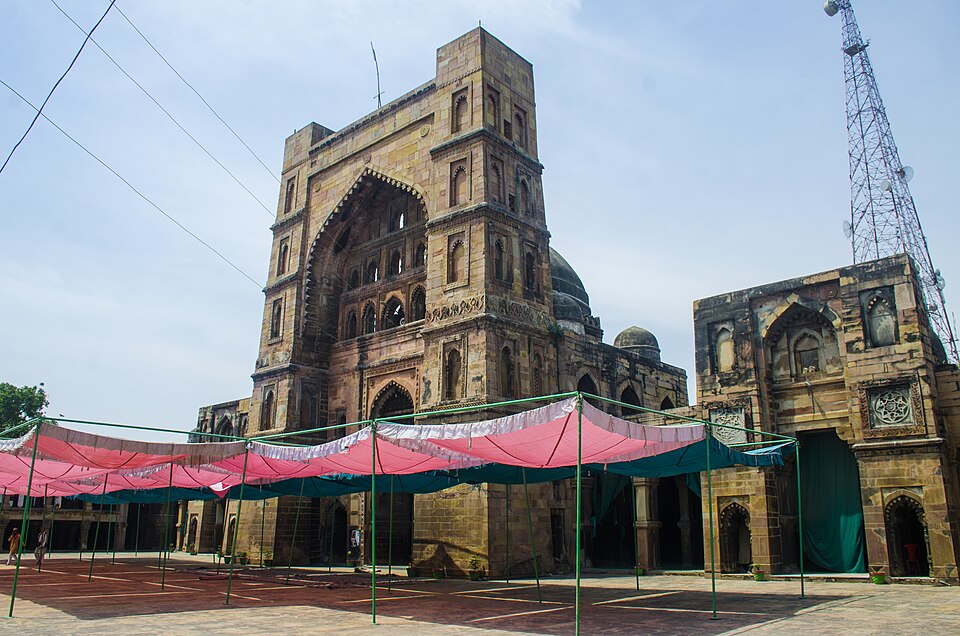
Close to Delhi. Jaunpur architecture keeps many Tughluq traits, such as sloping walls and square pillars. But it added one dramatic new feature: the propylon. This is a huge, recessed arched screen in front of the prayer hall, framed by tall, tapering towers.
Key mosques. The Atala Masjid (1408) is the finest example; its name comes from the Atala Devi temple, whose pillars were reused. The Jhanjhiri Masjid is like a smaller copy, and the Jami Masjid is the largest. The Lal Darwaza mosque is another Sharqi building.
Why it matters. The massive propylon gave Jaunpur mosques a bold, fortress-like face. It shows how a provincial court could take a Delhi idea and turn it into something new. This is a common one-liner in prelims.
Gujarat: the most Indian style
A rich craft tradition. Gujarat had one of India's richest traditions of temple building and stone carving. When its sultans built mosques, they used these local craftsmen. The result is often called the most indigenous and finest of the provincial styles, an almost perfect synthesis.
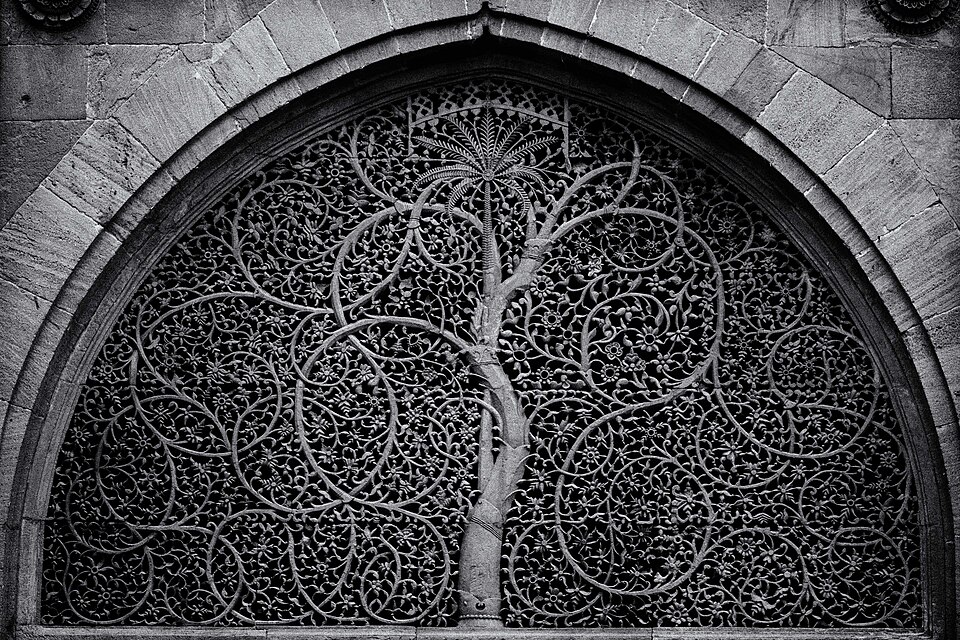
Temple forms in mosques. Gujarat builders fitted temple forms into the mosque. Prayer halls have forests of finely carved pillars, balconies and brackets, and the central part is raised to let in light. Carving of a very high quality, including stone jali (lattice) screens, covers the buildings.
Ahmedabad.Ahmad Shah I founded Ahmedabad and built its Jami Masjid (1423). Other famous buildings are the Tin Darwaza (triple gateway), the tombs of Ahmad Shah and his queens (Rani ka Hujra), and the mosque and tomb complex of Sarkhej for the saint Shaikh Ahmad Khattu. The Sidi Sayyid mosque is world-famous for its finely carved stone jali windows.
Champaner. At Champaner, the sultans built another grand Jami Masjid. Other notable Gujarat buildings include the Rani Sipri mosque and the Darya Khan tomb. Later Mughal architecture borrowed ideas such as fine jali work from Gujarat.
Malwa and Kashmir
Malwa: Mandu. The Malwa sultans ruled from Dhar, then Mandu and Chanderi in central India. Their style keeps many Delhi features: sloping walls, the arch-and-beam, fringed arches, high plinths reached by stairways and colourful encaustic tiles. Early mosques such as the Kamal Maula at Dhar reused older material.
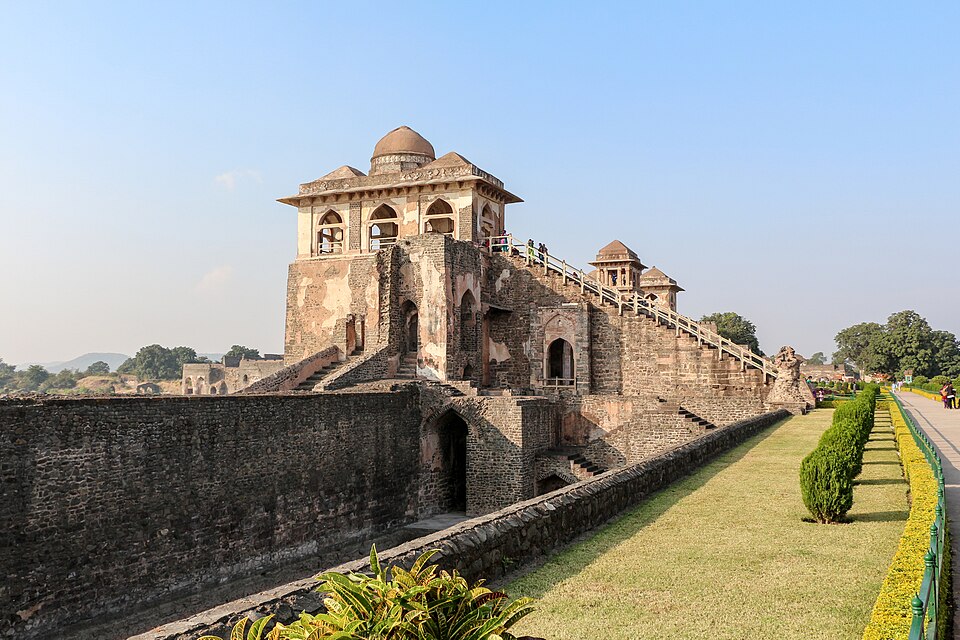
The buildings of Mandu. Mandu has the great Jami Masjid and the marble tomb of Hoshang Shah. The Hindola Mahal ("swinging palace") is another famous hall. The Jahaz Mahal ("ship palace"), standing between two lakes, looks like a ship, and Rupmati's pavilion looks over the plains.
Kashmir: a wooden style. Kashmir took a completely different path. Its mosques and shrines were built almost entirely of wood, a material the forested valley had in plenty. They blend local Hindu forms with Islamic needs, a Hindu-Muslim fusion seen nowhere else.
Key Kashmir buildings. Examples include the Jami Masjid of Srinagar, built under Sikandar Shah (1390–1419), and the Shah Hamdan mosque (Khanqah) on the river. The tomb of Madin Sahib is another example. Kashmir shows how a mountain region produced a style found nowhere else.
The Deccan I: Bahmani Gulbarga and Bidar, and Vijayanagara
The Bahmani kingdom. In 1347 the Bahmani kingdom broke away from Delhi in the Deccan. Its first capital was Gulbarga (1347–1425) and then Bidar (1425 onwards). Later, it split into smaller sultanates, including Bijapur and Golconda.
Gulbarga's covered mosque. The Jami Masjid of Gulbarga (1367) is unique in India because it is fully covered, with no open courtyard. Light enters through arches in the side walls. This bold design was a striking departure from the usual mosque plan.
Bidar. At Bidar, buildings used colourful Persian tiles and domes on tall drums, which were forerunners of the later bulbous dome. The great madrasa of Mahmud Gawan, a Bahmani minister, was a centre of learning. Bidar also has the Rangin Mahal and the tombs of the Bahmani and Barid Shahi rulers.
Vijayanagara's borrowing. The Hindu empire of Vijayanagara (1336–1565), the Bahmanis' great rival, also borrowed Indo-Islamic forms. Its Lotus Mahal and elephant stables at Hampi use arches and domes alongside Hindu features. This shows that architectural ideas crossed political and religious borders, as the Vijayanagara temple chapter also shows.
The Deccan II: Bijapur and Golconda
Bijapur of the Adil Shahis.Bijapur, capital of the Adil Shahi sultans, became a city of great domes. The Ibrahim Rauza, the tomb of Ibrahim Adil Shah II with its mosque, is famous for its elegant proportions and carving. You met Ibrahim Adil Shah II as a painter-sultan in the Deccani painting chapter.
The Gol Gumbaz. The Gol Gumbaz is the tomb of Muhammad Adil Shah. It is a huge square hall covered by a single enormous dome, one of the largest domes in the world, with a tower at each corner. Its scale shows the confidence and engineering skill of the Deccan builders.
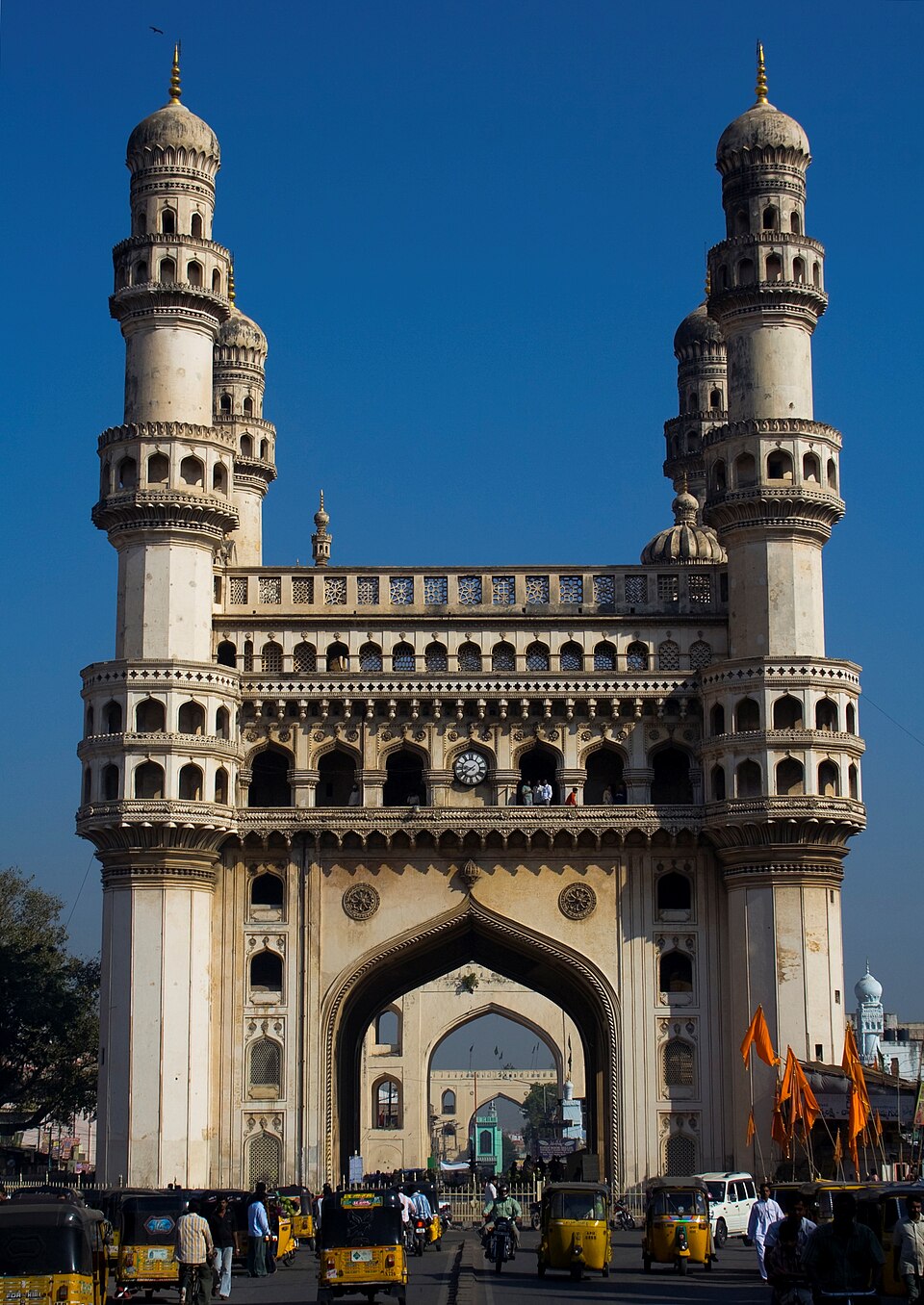
Golconda and Hyderabad. The Qutb Shahi sultans ruled from the fort of Golconda and later founded Hyderabad. Muhammad Quli Qutb Shah built the Charminar (1591), a grand arched structure with four minarets at the heart of the new city. The Mecca Masjid and the domed Qutb Shahi tombs near Golconda are other landmarks.
The Deccan legacy. Deccan architecture mixed Persian, Turkish and local elements in its own way. Its bulbous domes, tall drums and rich surface work influenced later buildings. In the 18th century, Hyderabad under the Asaf Jahis continued this tradition.
Region
Dynasty and capital
Signature feature
Key buildings
Bengal
Bengal sultans; Gaur, Pandua
Brick, terracotta, curved cornice
Adina Mosque, Eklakhi tomb, Chhoti Sona Masjid
Jaunpur
Sharqi
Propylon
Atala, Jhanjhiri, Jami Masjid
Gujarat
Ahmad Shahi; Ahmedabad, Champaner
Temple-like pillars, jali
Jami Masjid 1423, Sidi Sayyid, Sarkhej
Malwa
Malwa sultans; Mandu
Sloping walls, tiles, palaces by lakes
Jahaz Mahal, Hindola Mahal, Hoshang Shah's tomb
Kashmir
Kashmir sultans; Srinagar
Wood
Jami Masjid, Shah Hamdan
Deccan
Bahmani, Adil Shahi, Qutb Shahi
Covered mosque, huge domes, minarets
Gulbarga mosque, Gol Gumbaz, Charminar
Mains lens: practice questions
Regional diversity. Provincial styles are the best proof that Indo-Islamic architecture adapted to place. Bengal's curved roofs came from rain and bamboo huts, Kashmir's wooden mosques from forests and earthquakes, and Gujarat's carving from a living temple craft. Climate, material and local skill decided the look.
Political meaning. A grand new mosque or capital announced that a provincial ruler was now independent. Architecture was thus a tool of legitimacy as well as faith. Linking style to politics makes answers stronger.
These are practice questions written by us, not past papers. Past questions from your exam appear in the PYQ panel.
Angle
Question
Key points to cover
Diversity
Regional styles of Indo-Islamic architecture reflect local climate and materials. Illustrate.
Bengal brick and curved cornice; Kashmir wood; Gujarat carving; Gulbarga covered mosque; Mandu palaces by lakes.
Synthesis
Gujarat produced the most indigenous Indo-Islamic style. Examine.
Temple craftsmen; pillared halls; jali; Ahmedabad Jami Masjid; Sidi Sayyid; influence on Mughals.
Deccan
Discuss the distinctive features of Deccani architecture.
Gulbarga covered mosque; Bidar tiles and drums; Gol Gumbaz; Ibrahim Rauza; Charminar; Persian links.
Exchange
Architectural ideas crossed religious lines in medieval India. Discuss.
Temple forms in Gujarat mosques; Lotus Mahal at Hampi; reused pillars at Jaunpur; Bengal terracotta.
Answer plan for the diversity question. Begin by explaining why provincial styles arose after Delhi weakened. Then take four regions, each with its material or climate factor and one named building. Conclude that this diversity enriched the later Mughal synthesis.
Quick revision
Why: Delhi weakened → independent provinces; local climate, material, craft.
Kashmir: wood; Srinagar Jami Masjid (Sikandar Shah), Shah Hamdan.
Bahmani: Gulbarga Jami Masjid 1367 = fully covered; Bidar tiles, tall drums; Mahmud Gawan's madrasa.
Bijapur: Ibrahim Rauza; Gol Gumbaz (Muhammad Adil Shah; one of the largest domes). Golconda-Hyderabad: Charminar 1591 (Muhammad Quli Qutb Shah), Mecca Masjid, Qutb Shahi tombs.