

Module 8 · 14 min read · Free chapter
Green Revolution, food output and irrigation
After the droughts of the mid-1960s and dependence on US food aid, India adopted a new farm strategy from 1966: high-yielding seeds, fertilisers and assured irrigation. Wheat output soared, mainly in Punjab, Haryana and western Uttar Pradesh. The gains were uneven and came with costs to soil, water and crop diversity. Foodgrain output reached a record 376.56 million tonnes in 2025-26.
Start from zero: the day the seed changed
In the years after independence, feeding a fast-growing population was one of India's biggest worries. A failed monsoon could mean hunger in many villages.
Imagine a farmer in Punjab at that time. Then a new kind of wheat seed arrives. The plant is shorter, so it doesn't fall over under a heavy ear of grain. With enough water and fertiliser, it yields far more grain from the same field.
This package of new seeds, water, fertiliser and support is called the Green Revolution. India adopted it from 1966 onwards, and the core of the strategy was high-yielding variety (HYV) seeds.
This chapter explains what the Green Revolution achieved, where it fell short, how much food India grows today, and why water is now the biggest challenge.
What the Green Revolution did
The package. HYV seeds need three things to give high yields: assured water, chemical fertilisers, and protection from pests. So the Green Revolution was not just a seed. It was a package of irrigation, fertiliser, credit, and price support.
The results. The production of wheat increased sharply. Growth in rice, oilseeds and coarse grains was slower.
Where it worked. The Green Revolution was successful mainly in Punjab, Haryana and western Uttar Pradesh. These areas had irrigation, flat land and farmers who could afford the package.
The limits. The majority of farmers and areas in the country did not benefit from it. Rain-fed regions, poorer farmers, and crops like pulses were largely left out. This created gaps between regions and between rich and poor farmers.
How much food India grows today
The Agriculture Ministry's Third Advance Estimates for 2025-26, released on 27 May 2026:
| Crop | 2024-25 (million tonnes) | 2025-26 (million tonnes) |
|---|---|---|
| Total foodgrains | 357.73 | 376.56 |
| Rice | 150.18 | 154.02 |
| Wheat | 117.95 | 120.66 |
| Maize | 43.41 | 55.09 |
| Gram | 11.11 | 12.51 |
Records. Foodgrain output of 376.56 million tonnes is the highest ever, up 5.3% from the year before. Maize also hit a record. Oilseed output was 43.06 million tonnes.
The long view. Official data show foodgrain output rising from 265.0 million tonnes in 2013-14 to 376.56 million tonnes in 2025-26.
Why this matters: India now grows enough grain to feed its people and run large food schemes (see MSP, procurement, PDS and food security). The challenge has shifted from "enough food" to better nutrition, more pulses and oilseeds, and higher farm incomes.
Water: the next frontier
Why water matters. HYV seeds and fertilisers work only with assured water. Many Indian farms still depend on the monsoon, so a weak monsoon can hurt output and incomes.
PMKSY. The Pradhan Mantri Krishi Sinchayee Yojana (PMKSY) was launched on 1 July 2015. It has four components:
- AIBP (Accelerated Irrigation Benefit Programme): completing major and medium irrigation projects.
- Har Khet Ko Pani: water to every field, through minor irrigation and repair of water bodies.
- Watershed Development: conserving rainwater in rain-fed areas.
- Per Drop More Crop: saving water through micro irrigation, such as drip and sprinklers.
Per Drop More Crop. Official figures show that 110.92 lakh hectares have come under micro irrigation since the start, about 7.98% of net sown area. Small and marginal farmers get a 55% subsidy and others 45%. From 2022-23, this component runs under PM-RKVY.
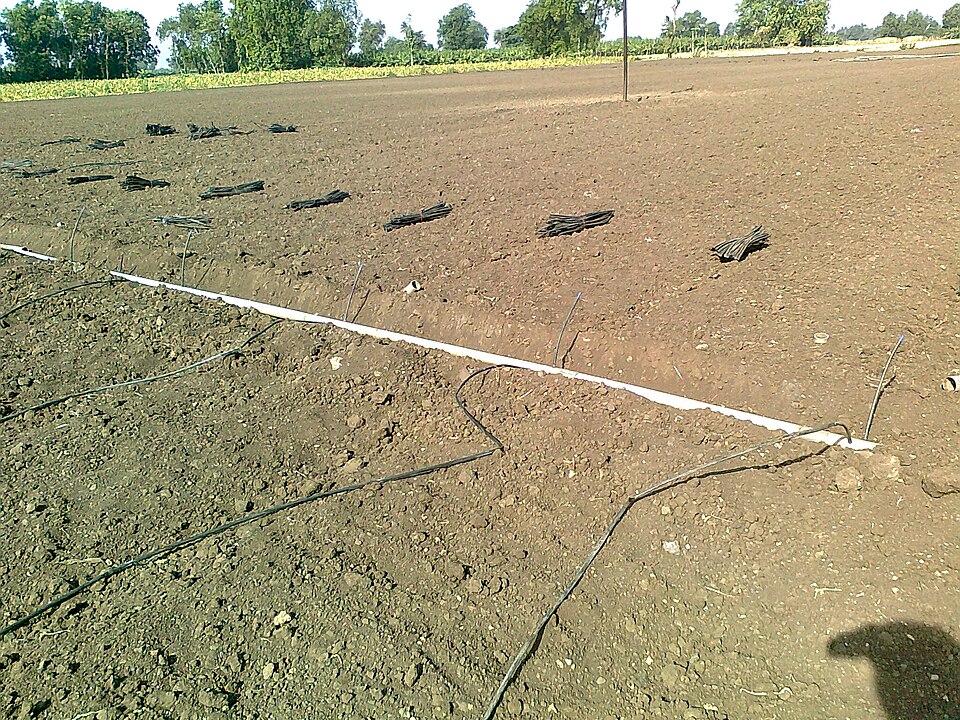
Why this matters: drip irrigation delivers water at the roots and wastes much less than flooding a field. With water under pressure in many farming regions, using each drop better is essential.
After the Green Revolution: farming with fewer chemicals
Start with a farmer's bill. A farmer who grows rice and wheat the Green Revolution way buys seeds, fertiliser and pesticides every season, often on credit. When prices of these inputs rise, the farmer's profit shrinks even if the harvest is good. Some farmers began to ask whether they could cut these bills by using what is already on the farm.
What natural farming means. Natural farming tries to grow crops without chemical fertilisers and pesticides, using local inputs such as cow dung, cow urine, crop waste and mixed cropping. The idea is to feed the soil's own life, so that it can supply nutrients and resist pests. It costs less in cash, though it can take time for yields to stabilise.
The national mission. India first promoted this through the Bhartiya Prakritik Krishi Paddhati, started in 2019-20 in 8 states. On 25 November 2024, the Union Cabinet scaled this up into the National Mission on Natural Farming, a standalone centrally sponsored scheme with an outlay of ₹2,481 crore. Its target is to bring 1 crore farmers into natural farming over 7.5 lakh hectares.
Why now? The Green Revolution raised output but made farming depend heavily on purchased inputs. Rising input costs, concern about soil health and demand for chemical-free food all pushed the search for alternatives. Natural farming is also seen as a way to make small farms more resilient to price and weather shocks.
The debate. Supporters say natural farming cuts costs and restores soil. Sceptics worry that yields may fall if it spreads too fast, which could hurt food security in a country that must feed a large population. Most experts favour careful scaling, with research on yields and support for farmers during the switch.
Why it matters. India's food security came from the Green Revolution, but its future depends on keeping soil and water healthy. A good Mains answer presents natural farming as one tool among several, alongside micro irrigation, better seeds and crop diversification, rather than a complete replacement.
1965-67: the crisis and the people behind the seed
Start with ships at the port. In the mid-1960s, India's daily bread often arrived by ship. Imports of food reached nearly one-sixth of what the country grew, much of it American wheat under the PL-480 programme, and people called it a "ship-to-mouth" existence. Then came the droughts of 1965-66 and 1966-67, near-famine in parts of Bihar, and pressure from donors on economic policy.
Why the old strategy had run out. In the first three Plans, India relied on land reforms and on bringing more land under the plough. By the mid-1960s, little new land was left and land reforms had moved slowly, so output could grow only by raising yield per hectare. At that time only about 17% of cultivated land was irrigated, mostly in a few states.
The people and the seed. The American scientist Norman Borlaug had bred short, fertiliser-hungry wheat in Mexico, and his varieties Sonora 64 and Lerma Rojo did best in Indian trials. Agriculture Minister C. Subramaniam pushed the new strategy, and M.S. Swaminathan led the work to adapt the grain to Indian tastes, producing varieties such as Kalyan Sona and Sonalika.

Seed at scale. In 1966, India imported 18,000 tonnes of high-yielding wheat seed, and rice varieties such as IR 8 and Jaya followed in 1968.
The institutions around it. In 1965 the government created the Agricultural Prices Commission (now the CACP) to recommend support prices and the Food Corporation of India to buy and store grain. Banks and extension services were told to supply credit, fertiliser and advice. Wheat output jumped to about 17 million tonnes in 1967-68, against an earlier best of about 12 million, and in 1968 USAID's William Gaud called it a "Green Revolution".

The Mains angle. The Green Revolution was a response to a food and foreign-exchange crisis, not just a scientific event. It deliberately chose growth over equity, betting on irrigated areas and on larger farmers who could afford the full package. This choice explains both its success and many of its problems.
The hidden bill: soil, water, pests and fairness
Start with a field that needs more each year. A Punjab farmer finds that he must add more fertiliser each year just to keep the same yield. The tube-well must go deeper, and a weed he never saw before is spreading through his wheat. These are the hidden costs of the Green Revolution.
Soil and water. Heavy use of nitrogen without enough potash, zinc and organic manure has mined the soil in north-west India, and deficiencies of potassium and zinc are now common. Free or cheap power and assured procurement of paddy encouraged pumping, so groundwater tables have fallen sharply in Punjab, Haryana and western Uttar Pradesh. In some canal areas the opposite happened: seepage caused waterlogging and salinity.
Pests and diversity. Large areas of a few uniform varieties replaced the many local varieties farmers once grew. This monoculture made crops more open to pests, and weeds such as Phalaris minor in wheat have become resistant to herbicides. Yields became less stable after the early gains, so scientists had to keep breeding for resistance.
Crop and regional bias. The revolution was mainly about wheat and rice in irrigated areas, while pulses, oilseeds and coarse grains were pushed to poorer land. Net availability of pulses fell from about 56 grams per person per day in 1968 to about 32 grams by 2000, and India came to import much of its edible oil. Rainfed eastern and central states gained only later, widening regional inequality.
Slowing returns. Economists measure total factor productivity (TFP), the growth in output that is not explained by more inputs. In the Indo-Gangetic plains, the share of cropped area with healthy TFP growth fell sharply between the 1980s and 1990s. The message for Mains is that the old formula of more water and more fertiliser has reached its limits, which is why balanced nutrients, water saving, diversification and rainfed research matter now.
Why the Green Revolution happened, and why irrigation is the next frontier
Why new seeds (from 1966)? India needed more food from the same land. The answer, adopted from 1966 onwards, was high-yielding variety (HYV) seeds, which give far more grain when they get water and fertiliser. Wheat output rose sharply, mainly in Punjab, Haryana and western Uttar Pradesh.
Why it was uneven. HYV seeds need assured water, so they worked best where irrigation already existed. As a result, the majority of farmers and areas did not benefit. This gap between regions is one of the Green Revolution's lasting legacies.
Why irrigation now (2015). A farm without assured irrigation depends on rain, so a weak monsoon can hit its output and income. PMKSY (1 July 2015) aims at "Har Khet Ko Pani", and Per Drop More Crop promotes drip and sprinkler systems with subsidies of 55% for small and marginal farmers.
Implications. The results show in record foodgrain output of 376.56 million tonnes in 2025-26. The next task is to grow more with less water and spread the gains beyond the old Green Revolution belt.
Mains lens: do we need a second Green Revolution?
1. What the first one left behind. It focused on wheat and rice in irrigated areas. Rain-fed regions, pulses, oilseeds and small farmers gained less.
2. New problems. Heavy use of water and chemicals in some regions raises concerns about falling groundwater and soil health. Growing water-hungry crops in water-scarce areas is hard to sustain.
3. What a second revolution could focus on.
- Rain-fed and eastern regions, where yields are still low.
- Pulses, oilseeds and millets, which use less water and improve nutrition.
- Micro irrigation and water-saving methods.
- New seeds that tolerate heat, drought and floods.
A good conclusion: the first Green Revolution made India food-secure. The next one must be more inclusive and more sustainable, raising incomes without exhausting soil and water.
Mains practice: three questions, three angles
These are practice questions written by us, not past papers. Past questions from each exam are in the PYQ panel of this module.
| Angle | Question | Key points to cover |
|---|---|---|
| Evaluate | Critically evaluate the Green Revolution in India. | Credit the HYV seeds adopted from 1966 with the surge in wheat. Then weigh its concentration in a few regions and the fact that most farmers were left out at first. |
| Water | Why is micro-irrigation central to sustainable agriculture? Discuss with reference to PMKSY. | Explain the idea of Per Drop More Crop and the coverage of 110.92 lakh ha. Then mention the 55% and 45% subsidies and the risk of depending on rain. |
| Way forward | Is a second Green Revolution needed? What should it look like? | Use the record output of pulses, oilseeds and maize as a sign of change. Then argue that the focus should be eastern India and water efficiency. |
How to use this table: each answer should explain the what, then the why from the section above, and end with a way forward.
Quick revision
- India adopted the Green Revolution from 1966, and its core was high-yielding variety (HYV) seeds.
- Wheat output rose sharply, mainly in Punjab, Haryana and western UP, but most farmers and regions did not gain much at first.
- In 2025-26 (third advance estimates, May 2026), foodgrain output hit a record 376.56 million tonnes, up 5.3%.
- Within that, rice was 154.02, wheat 120.66 and maize a record 55.09 million tonnes, while oilseeds reached 43.06.
- Foodgrain output has grown from 265.0 million tonnes in 2013-14 to 376.56 in 2025-26.
- PMKSY was launched on 1 July 2015 and brings together AIBP, Har Khet Ko Pani, watershed development and Per Drop More Crop.
- Micro irrigation now covers 110.92 lakh hectares, about 7.98% of net sown area, with a subsidy of 55% for small and marginal farmers and 45% for others.
- Since 2022-23, Per Drop More Crop has run under PM-RKVY.
- The National Mission on Natural Farming (Cabinet, 25 November 2024, ₹2,481 crore) aims to bring 1 crore farmers over 7.5 lakh ha into chemical-free farming, scaling up BPKP (2019-20).
- The Green Revolution answered the 1965-67 food crisis: Borlaug's Mexican wheats, 18,000 t seed imported in 1966, APC (CACP) and FCI in 1965, IR 8 rice in 1968.
- Hidden costs: soil nutrient mining, falling groundwater, waterlogging and salinity, Phalaris minor, falling pulses availability and slowing TFP.
Common confusions and exam traps:
- The Green Revolution's biggest early gain was in wheat, not rice.
- Per Drop More Crop is about micro irrigation; Har Khet Ko Pani is about reaching every field.