

BPSC ASO · Module 51 · standard depth · 19 min
Limits, niches and key species: why each living thing lives where it does
What BPSC ASO asks from this chapter
Syllabus lines this chapter covers:
- Preliminary: General Knowledge (General Studies 50, General Science and Mathematics 50, Mental Ability 50) · General awareness of the environment around the candidate and its application to society, and everyday matters in their scientific aspect
- Mains Paper 2: General Knowledge (General Studies 50, General Science and Mathematics 50, Mental Ability 50) · General awareness of the environment around the candidate and its application to society, and everyday matters in their scientific aspect
BPSC ASO questions from this module are being sorted into our bank.
Cut to standard depth for BPSC ASO. 9 deeper paragraphs are in the full chapter.
Start from zero: why is there no camel in Kerala?
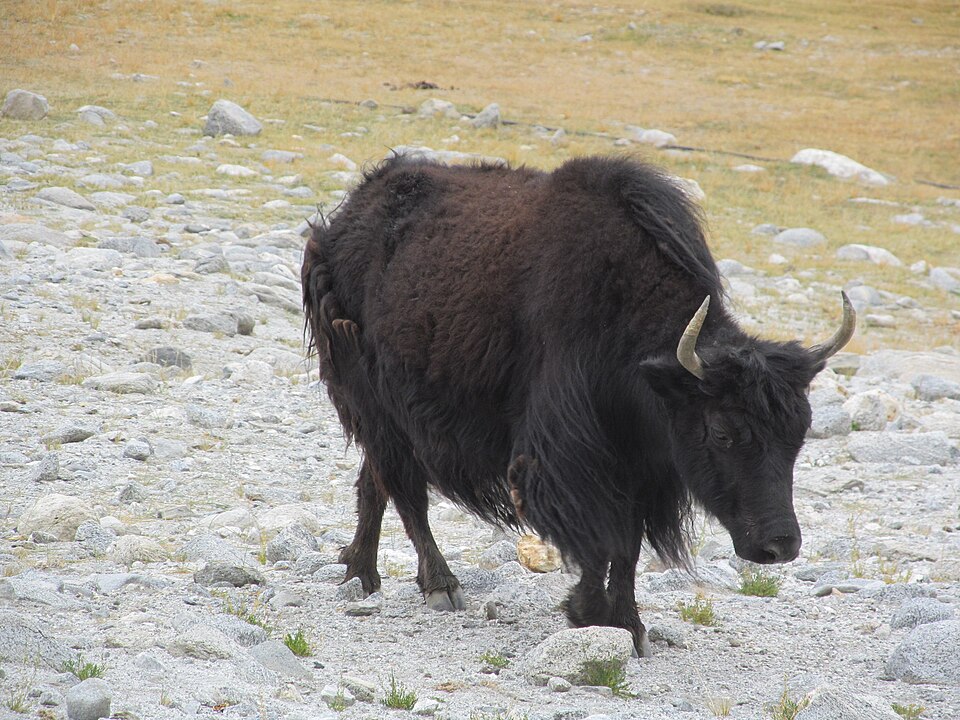
A camel thrives in the Thar but is never seen grazing in the wet forests of Kerala. A yak walks easily across a cold Ladakh pass but suffers in the heat of the plains. Mangroves grow happily in salty coastal mud, where most trees would die within weeks. Every living thing seems to have its own "right place".
What decides that place? Part of the answer is the environment: water, heat, cold, salt, light and nutrients. Every species can cope with only a certain amount of each. Too little or too much of any one of them, and the species cannot live there.
The other part of the answer is the other living things around it. A species must find food that others are not taking, avoid its enemies and fit into a role in the community. Some species, as we shall see, matter far more than their numbers suggest.
This chapter brings these ideas together: the limits that nature sets, the role each species plays, the forces that keep numbers in check and the few species that hold whole communities together. These ideas explain why forests, rivers and coasts look the way they do, and why harming one part can upset the whole.
The law of the minimum: the weakest link decides
Living things are built from about 40 chemical elements, and each has a job to do. In 1840 the German chemist Justus von Liebig studied how crops grow in soil. He found that a plant keeps growing only while every essential element is available in enough quantity. Growth is controlled by the essential element that is present in the lowest amount, however plentiful the others are.
This is the law of the minimum. Think of a barrel made of wooden planks of different heights. Water can fill it only up to the shortest plank, no matter how tall the others are. In the same way, a field rich in nitrogen but poor in phosphorus will give a poor harvest until the phosphorus is supplied.
From elements to all factors. Later ecologists saw that the same logic applies to every condition of life, not just soil nutrients. Photosynthesis, for example, depends on carbon dioxide, water, sunlight, chlorophyll and temperature all at once. If even one of these is short, photosynthesis slows or stops, even when the others are abundant. Any factor that holds back growth in this way is called a limiting factor.
Why this matters. The idea explains why adding more fertiliser to a field short of water achieves nothing, and why soil testing before fertiliser use saves money and prevents pollution. It also explains why a single missing condition, such as winter water in a wetland, can make a whole habitat useless for a species.
The law of tolerance: too little and too much both hurt
Liebig looked only at shortages. But an essential factor can also harm when there is too much of it: too much heat, too much salt, too much water. In 1913 the American ecologist V. E. Shelford widened Liebig's idea to include these upper limits. His law of tolerance says that a value below a critical minimum, or above a critical maximum, keeps a species out of an area.
The tolerance curve. Between the lower and upper limits lies the species' range of tolerance. Within it there is a narrower optimum range, where the species is most abundant and does best. Moving away from the optimum towards either limit, the species is stressed and becomes scarcer, and beyond the limits it cannot survive at all. Plotted on a graph, this gives a bell-shaped curve.
Steno and eury. Ecologists use two prefixes to describe the width of this range. Steno- means narrow and eury- means wide. A stenohaline fish tolerates only a small change in salinity, while a euryhaline fish can handle a wide range. Similarly, stenothermal species need a steady temperature, while eurythermal species cope with large swings.
One species, many ranges. A species can be tolerant of one factor and fussy about another. Some freshwater fish survive wide temperature changes but die quickly in sea water. The Atlantic salmon is a striking exception: it lives in the sea as an adult and moves into rivers to breed, adjusting its body chemistry on the way. These ranges are shaped by the species' genes, natural selection and adaptation.
Why this matters today. Tolerance limits explain who wins and who loses as the climate warms. Stenothermal species, such as many reef-building corals and cold-water fish, have little room to adjust, so even a small rise in temperature pushes them past their limit. Species with narrow tolerance also make good indicators, because their disappearance warns us that conditions have changed.
Habitat and niche: an address and a profession
Two words are often confused, so it helps to fix them early. A species' habitat is the place where it lives: a tropical forest, a pond, a grassland. Its ecological niche is the role it plays there: what it eats, when it is active, where it shelters, which conditions it needs and which enemies prey on it. Ecologists sometimes put it simply: the habitat is the address, and the niche is the profession.
Microhabitat. Inside a habitat, a species often needs a smaller special spot with particular conditions, called its microhabitat. Take a fungus that decomposes dead leaves in a tropical forest. Its habitat is the forest, but it may feed only on one kind of plant litter, at a certain moisture, temperature and light. That narrow set of conditions is its microhabitat, and the local conditions there are its microclimate.
No two species in one niche. If two species tried to use exactly the same food, at the same time, in the same way, they would compete without end. Sooner or later one would push the other out. So no two species can permanently occupy exactly the same niche. This idea is called the principle of competitive exclusion.
How species share. Natural selection therefore pushes species towards niche separation. In one stream, a fish clings to rocks in the fast current and grazes algae, another fish waits by the same rocks to eat smaller animals, a third feeds at the surface and a fourth hides among water plants. Two species can even share the same food by feeding at different times, one by day and one by night. Time, place, food and behaviour all become ways of dividing the resources.
Why this matters. Niche separation is why a rich habitat can hold so many species without endless fighting. A landscape with many kinds of microhabitats offers many niches, and so supports high diversity. When we flatten that variety, by clearing undergrowth, draining marshes or straightening rivers, we remove niches, and the species that depended on them disappear.
What keeps numbers in check?
Describing a population. Before asking what controls a population, we must measure it. Ecologists count its size; where a full count is impossible, they count individuals in a unit area, which gives numerical density, or weigh them, which gives biomass density. They also study fecundity, the number of young produced per year, and innate capacity, the maximum number of offspring a species could produce. A life table records deaths and life expectancy at each age.
Two kinds of control. A population is said to be regulated when its numbers move up and down around an average instead of exploding or vanishing. The forces that do this fall into two groups. Density-dependent factors grow stronger as the population becomes crowded. Density-independent factors act with the same force however many individuals there are.
Density-dependent factors are mostly biotic. Competition for food and space becomes fierce in a dense population. Disease spreads fastest when individuals live close together, and predators find crowded prey easily. Crowding also lowers breeding and pushes individuals to emigrate. All these brakes ease again when numbers fall, so they act like a thermostat.
Density-independent factors are mostly abiotic. A sudden cold wave, a flood or a forest fire can wipe out a large share of a population, whatever its size. When a pond dries up, every tadpole in it dies, whether there were ten or ten thousand. Weather, shelter and available space are of this kind.
How the two work together. The density-independent factors set the ultimate ceiling, the carrying capacity that cannot be exceeded for long. The density-dependent factors then hold the population at or a little below that ceiling. This is why natural populations rarely trace a neat S-shaped curve: they fluctuate around it, sometimes in regular cycles and sometimes irregularly.
Why this matters. These ideas guide wildlife and fisheries management. A crowded deer herd in a small reserve suffers disease and starvation, so managers widen habitats and corridors. A cyclone or drought, on the other hand, can crash even a healthy population, which is why small and isolated populations are at greatest risk. Ecologists call the study of one species and its environment autecology, and the study of whole communities synecology.
Keystone and foundation species: the few that hold up the many
In a stone arch, one wedge-shaped stone at the top, the keystone, locks all the others in place. Pull it out and the arch collapses, even though it is only one stone among many. Ecologists borrowed this picture for species that matter far more than their numbers suggest.
Keystone species. A keystone species has a large effect on the structure of its community compared with its biomass or abundance. When it is removed, diversity falls sharply or the community collapses. Keystone species are often top predators that keep other species in check.
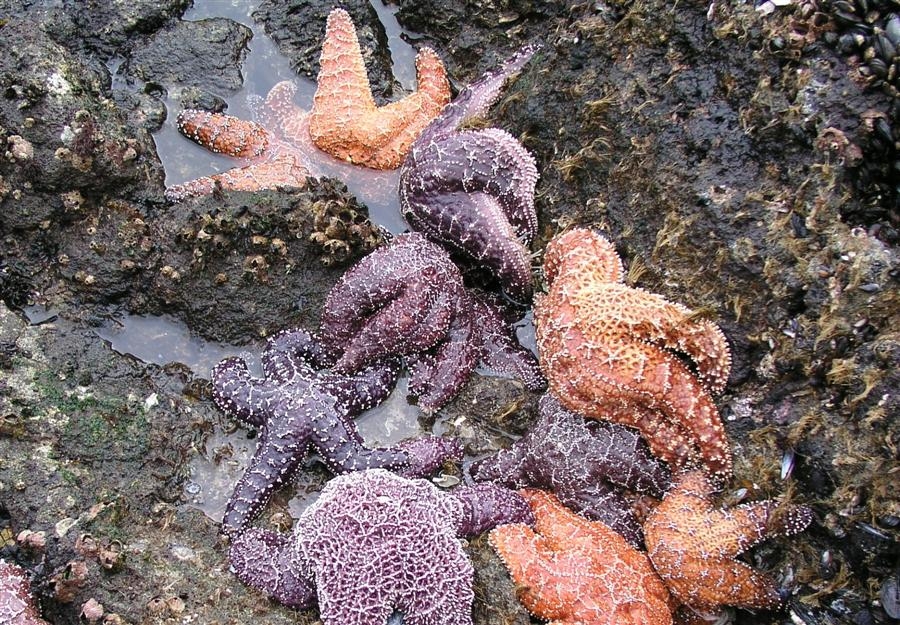
The classic example. On the rocky shores of north-western United States, a sea star feeds on mussels. Where the sea star is present, the lower shore holds many species of barnacles and algae alongside the mussels. When the sea stars were removed, mussels multiplied and covered almost the whole rock, crowding out the other species. One predator, few in number, was keeping the whole shore diverse.
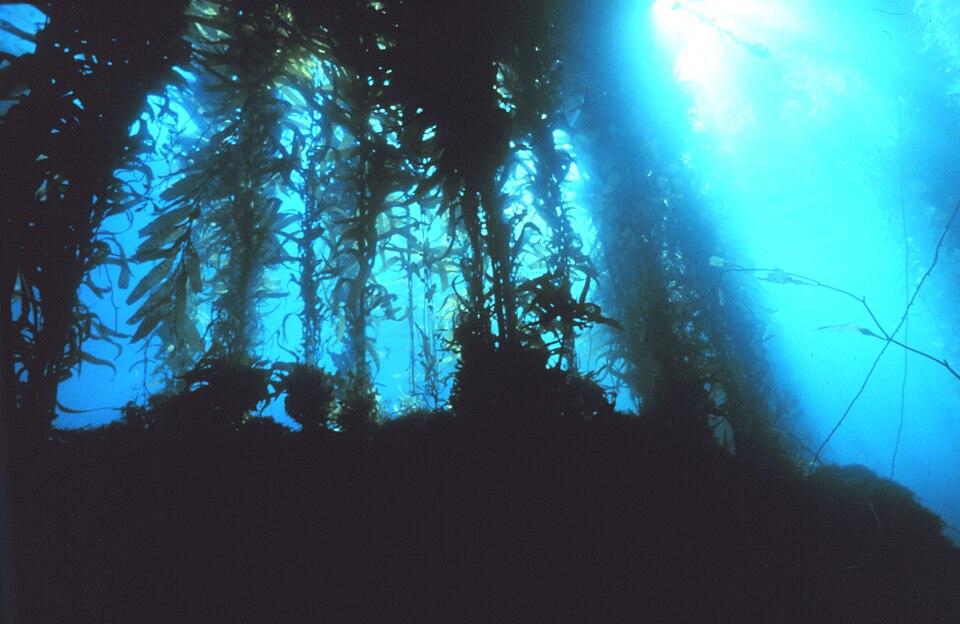
Foundation species. A foundation species plays a different role: it creates the habitat that others live in. Kelp, a large brown seaweed, forms underwater forests off the coast of California that shelter many animals. Reef-building corals are another example, because their living and dead skeletons make up most of the reef and protect other species from waves. Lose the foundation species, and the home itself disappears.
Scavengers and decomposers also hold key roles. Vultures, for instance, feed on dead animals and so fill an important niche. Without such scavengers and decomposers, much of the energy and nutrients locked in dead bodies would not be returned to the ecosystem efficiently, and carcasses would linger.
Why this matters. Conservation cannot treat all species alike. Protecting a keystone predator or a foundation species protects the many species that depend on it. In Mains answers, this idea supports protecting top predators and coral reefs, and explains why the loss of a single species can trigger a chain of losses.
Succession revisited: who drives it, and does it ever end?
Ecological succession is the replacement of one community by another over time, from pioneers through seral stages to a climax. Two further ideas deepen this picture: what drives the change, and whether the climax is really the end.
Autogenic and allogenic succession. When the community itself changes its surroundings and so makes way for the next community, the succession is autogenic, meaning self-generated. Lichens on bare rock release a weak acid and trap dust, building the first soil, and in time this leads to a forest. When outside inputs drive the change, the succession is allogenic. A lake receiving silt and nutrients from incoming streams slowly becomes shallow, turns into a marsh and may end as forest.
Early and late communities differ. Pioneer species are generalists with wide niches, able to bear harsh and changing conditions. Their total biomass is low, but their production is high compared with that biomass, and their food webs are simple. Climax communities are the opposite: they are diverse, hold large biomass, run complex food webs that pass energy efficiently and are full of specialists with narrow niches.
What shapes the path. Water decides much of the pattern, which is why ecologists separate successions that begin in water, in dry places and in moderate conditions. Soil type, the slope and shape of the land, and the flow of nutrients also shape the route. In lakes, extra nutrients feed heavy growth of algae, a process called eutrophication. It happens naturally, but farm runoff and erosion speed it up sharply.
Is the climax ever final? The climax was long seen as a stable end point. Ecologists now doubt this. When a canopy tree dies, a different species may take its place, and differences in soil, slope and disturbance keep reshaping the community. Careful long-term studies have not shown a community reaching a truly steady state, so many ecologists conclude that, in practice, succession never fully stops.
Why this matters. This modern view changes how we manage nature. A forest is not a museum piece that stays fixed once protected. Fire, floods and grazing are part of how many ecosystems renew themselves, so management should protect natural processes, not just a single snapshot.
Quick revision
- Liebig (1840), law of the minimum: the scarcest essential factor limits growth.
- Shelford (1913), law of tolerance: both too little and too much exclude a species; it is most abundant in the optimum range.
- Steno = narrow tolerance, eury = wide tolerance (stenohaline, euryhaline, stenothermal, eurythermal).
- Habitat is the address and niche is the profession; no two species can permanently share exactly the same niche.
- Density-dependent factors are mostly biotic and stabilise numbers, while density-independent factors are mostly abiotic and set the ceiling.
- A keystone species has a big impact relative to its abundance (the sea star), and a foundation species builds the habitat (corals, kelp).
- Autogenic succession is driven by the community itself, and allogenic succession by outside inputs.
- Pioneers are generalists; climax species are specialists, and many ecologists now hold that succession never fully stops.