

BPSC ASO · Module 6 · standard depth · 19 min
Mughal administration: offices, mansabs and land revenue
What BPSC ASO asks from this chapter
Syllabus lines this chapter covers:
- Preliminary: General Knowledge (General Studies 50, General Science and Mathematics 50, Mental Ability 50) · India and neighbouring countries: history of neighbouring countries, history of India, culture
- Mains Paper 2: General Knowledge (General Studies 50, General Science and Mathematics 50, Mental Ability 50) · India and neighbouring countries: history of neighbouring countries, history of India, culture
BPSC ASO questions from this module are being sorted into our bank.
Cut to standard depth for BPSC ASO. 13 deeper paragraphs are in the full chapter.
Start from zero: how do you run an empire this size?
Imagine you rule land from Kabul to Bengal. Your subjects speak dozens of languages, follow different faiths and obey powerful local chiefs. You cannot visit every village, and news travels at the speed of a horse.
The Mughals solved this with a machine of offices, ranks and revenue. Officers were placed at every level, from the court down to the village. Each officer was watched by others, moved around often, and paid from the land's produce.
Two goals drove everything. First, keep control, by drawing chiefs and rulers into imperial service instead of fighting them forever. Second, collect as much of the rural surplus as possible as land revenue, because that money paid the army and the officials.
This chapter takes the machine apart in four pieces: the central and provincial offices, the local and town officers, the mansab and jagir system, and land revenue. As you read, ask yourself: was this a tightly centralised state, or a bargain with local power dressed up as one?
The system at a glance
| Level or part | Key officers or terms | What they did |
|---|---|---|
| Centre | Wakil, diwan-i kul, mir bakhshi, mir saman, sadr-us sudur, qazi | Advice, finance, military ranks, workshops, grants, justice. |
| Suba | Subadar, diwan, bakhshi, waqai navis | Order; revenue; troops; reports to the court. |
| Sarkar | Faujdar, amalguzar | Law and order; revenue. |
| Pargana | Shiqqdar, amil, qanungo | Collection; records. |
| Village | Muqaddam, patwari | Headman; village records. |
| Towns, forts, ports | Kotwal, qiladar, mutasaddi | Police; garrison; customs. |
| Mansab | Zat and sawar | Rank and pay; horsemen to maintain. |
| Jagir | Tankha, watan, khalisa | Revenue in place of salary. |
| Land revenue | Batai, kankut, zabt | Ways of fixing the state's share. |
The same idea repeats at every level: split power so that no single officer controls both force and money.
The centre: the emperor and his ministers
Sher Shah's groundwork. The Afghan ruler Sher Shah had already built a bureaucracy under a strong ruler, which Akbar later gave its final shape. Villages formed parganas, and parganas formed shiqqs, equal to the later Mughal sarkar, of which there were 66. The shiqqdar collected revenue at pargana level, the munsif measured land, the qanungo kept records, and the muqaddam and patwari linked each village to the state; the story of his reforms is in the chapter on Babur, Humayun and Sher Shah.
The emperor at the top. Both Indian tradition and Muslim jurists supported a strong ruler, so the idea of a near-divine monarch found easy acceptance. The emperor appeared daily at the jharokha before the public. Every officer owed his post, promotion and dismissal to the emperor's will.
Taming the wakil. Under the early Mughals and during Bairam Khan's regency, the wakil (or wazir) held vast civil and military powers. In 1564-65 Akbar took away the wakil's financial powers and gave them to the diwan-i kul, the finance minister. The wakil kept the highest place in rank, but real power over money moved elsewhere.
The diwan-i kul. The diwan supervised the treasury, checked all accounts and controlled provincial diwans. His seal was needed on every revenue paper and every appointment. To keep even him in check, he had to report on the state's finances to the emperor every day.
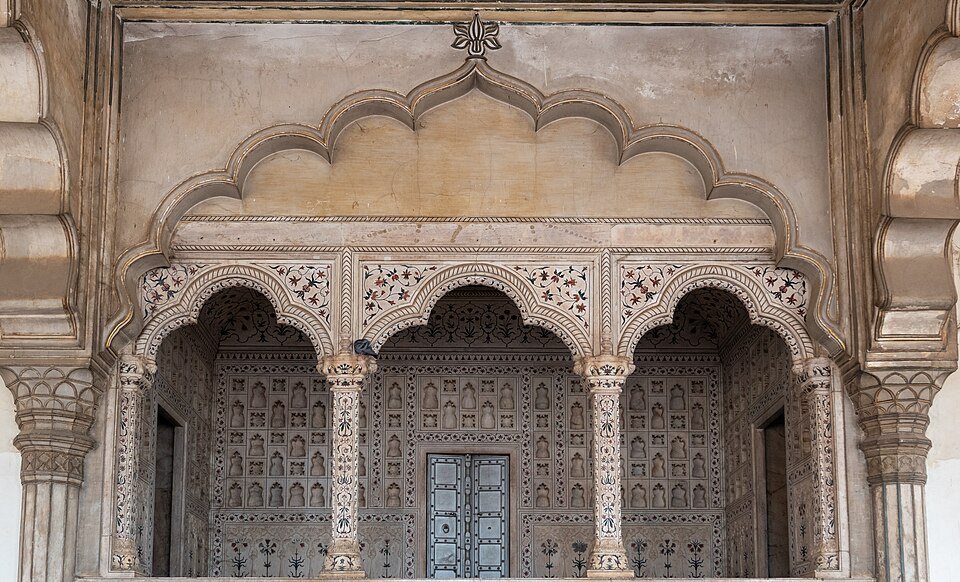
The mir bakhshi. The mir bakhshi handled the military side of the mansab system. He presented new candidates to the emperor, endorsed appointments and supervised the branding of horses (dagh) and the descriptive rolls of soldiers (chehra). Only after his check would the diwan release pay.
The mir saman and the sadr. The mir saman ran the royal karkhanas, the workshops and stores that made everything from weapons to luxury goods. The sadr-us sudur handled charity and revenue-free land grants such as madad-i ma'ash, and checked that they went to the right people.
Justice. The qazi decided civil and criminal cases under the sharia, the mir adl carried out court orders, and the muhtasib policed public morals while also checking weights and fair prices. Under Aurangzeb, the chief qazi's post was separated from the sadr's, which sharply cut the sadr's power.
Provinces, districts, villages and towns
The suba. Around 1580 Akbar divided the empire into twelve subas, which grew as conquests were added. Each suba was split into sarkars, each sarkar into parganas, and each pargana into villages; the list of subas is in the chapter on Akbar.
Governor and diwan. The subadar was appointed by the emperor, usually for about three years. He kept order, encouraged farming and trade, and built sarais, wells and gardens. But revenue was in the hands of a separate provincial diwan, also appointed by the emperor and answerable to the centre, which stopped governors from becoming independent.
Eyes and ears. The provincial bakhshi checked troops and pay bills, and often doubled as a news-writer. Waqai navis, waqai nigar and sawanih nigar sent reports, some of them secret, straight to the emperor. A darogha-i dak at each provincial capital ran a chain of dak chowkis, where runners, horses and boats carried letters to the next post.
Why so many checks. Officers were transferred about every three years, emperors toured the provinces, and independent officers reported on each other. The possibility of revolt never vanished, so the Mughals relied on overlapping reporting. These news reports are now among the richest sources for historians.
The sarkar. In each sarkar the faujdar was the executive head, responsible for law and order, safe roads for traders and keeping rebellious zamindars in check. The amalguzar or amil assessed and collected revenue and sent daily accounts to the provincial diwan. Thanedars commanded posts of soldiers in disturbed areas and around cities.
Pargana and village. In the pargana, the shiqqdar helped the amil, and the qanungo kept land records. The village remained the lowest unit, much as under Sher Shah. The muqaddam was the headman and the patwari kept the village records.
Towns, forts and ports. In towns the kotwal acted much like a modern police chief, kept a register of people coming and going, and checked weights and measures. Each fort was a small township under a qiladar, usually a high-ranking mansabdar. Ports were run separately by a mutasaddi appointed directly by the emperor, whose post was sometimes auctioned to the highest bidder, assisted by a shahbandar who handled the customs house.
The mansab system: ranking the ruling class
What a mansab meant. Mansab means a place or rank. It did three things at once: it fixed the holder's status, his pay, and the number of horsemen he had to keep. Mansabdars held almost every important post, from wazir to faujdar, except in the judiciary.
Decimal roots. Akbar's ranking drew on the decimal army of Chingiz Khan, built in units of ten, a hundred and a thousand. Abul Fazl says there were 66 grades, from commander of 10 to commander of 10,000, though he lists only 33. Under Akbar ranks above 5,000 went mostly to princes; Raja Man Singh was the only noble to reach 7,000 zat in his last years.
Two numbers: zat and sawar. At first one number showed rank, pay and contingent together. From about 1595-96, each rank had two numbers. Zat fixed personal rank and pay, and sawar fixed the horsemen the officer had to maintain and the money he got for them; Athar Ali settled an older debate by showing that this meant one contingent, not two.
Three classes. Mansabdars were grouped by how their sawar compared with their zat: equal, half or more, or less than half. Seniority followed zat, so an officer of 4000/2000 outranked one of 3000/3000, though the second had more horsemen. In difficult postings the state could raise the sawar rank alone, sometimes temporarily (mashrut).
Do-aspa sih-aspa. Under Jahangir a new device let the state double part of a noble's sawar rank as 'two-horse, three-horse' troopers; Mahabat Khan was the first to get it. Why?
Raising sawar normally meant raising zat too, which cost more personal pay and upset the hierarchy. This allowed bigger armies for trusted nobles without touching their zat rank.
Who got mansabs. There was no examination, unlike China's civil service; mansabs were the emperor's gift. The most favoured were khanazads, sons and kinsmen of serving officers, then nobles from Persia, Central Asia and the Deccan, and autonomous chiefs, mainly Rajputs. In 1636 the ruler of Bijapur even asked the emperor not to hire his nobles, so strong was the pull of a Mughal mansab.
Aurangzeb's nobility. Of 575 mansabdars of rank 1,000 and above under Aurangzeb, about 272 were khanazads, and in 1707 the list included 81 zamindars. Turanis, Iranis, Afghans, Indian Muslims, Rajputs, Marathas and Deccanis were all represented, and Aurangzeb recruited the last two on a larger scale for military reasons.
Keeping honest. The mir bakhshi's department inspected contingents through dagh-o-chehra. Under Shah Jahan, a mansabdar posted in the province of his jagir had to muster one-third of his sawar, one posted elsewhere one-fourth, and one in Balkh one-fifth. Ranks were cut for failing to keep the promised troops.
Month-scales and escheat. Pay was reckoned on a jagir's estimated revenue (jama), but actual collection (hasil) was always lower. So pay was scaled by months: a jagir yielding half its jama was 'six-monthly'. On a noble's death the state could seize his property to recover unpaid loans (escheat), and Aurangzeb's farmans of 1666 and 1691 set rules for this.
The jagir system: paying officers with revenue
Revenue, not land. A jagir was an assignment of the revenue of an area in place of a cash salary. The holder did not own the land. The Delhi Sultans had used a similar device called the iqta.
Babur's start. After his conquest, Babur gave assignments called wajh to Afghan chiefs and his own men, and kept the rest as khalisa. Under Akbar the basic framework took shape: all territory was either khalisa, whose revenue went to the imperial treasury, or jagir, assigned to mansabdars by rank.
How much was assigned. The balance kept shifting. Under Jahangir about nine-tenths of the territory was in jagir and only one-tenth in khalisa. Later in Aurangzeb's reign, as the number of mansabdars grew, there was heavy pressure to hand out even khalisa land.
Why transfer jagirdars. Ordinary tankha jagirs were moved every three or four years. This stopped jagirdars from putting down local roots and becoming rival powers. The price was that they had little reason to improve their areas and tried to squeeze out as much as possible quickly.
Four kinds of jagir. Tankha jagirs were given in place of pay. Mashrut jagirs came with conditions, and in'am jagirs had no service duty attached. Watan jagirs were given to chiefs in their own homelands, and were hereditary and non-transferable.
Watan plus tankha. When a chief's rank needed more pay than his homeland yielded, he received a tankha jagir elsewhere as well. Maharaja Jaswant Singh, for example, held his watan in Marwar and a tankha jagir in Hissar. Aurangzeb occasionally took a watan jagir into khalisa, as with Jodhpur in 1679.
Watching the jagirdar. The jagirdar's own agents collected only the authorised revenue. The provincial diwan was supposed to stop oppression, and from Akbar's later years an amin was posted to check that imperial rules were followed. The faujdar helped when zamindars resisted payment.
Land revenue: the money behind it all
Tax, not rent. Early British officers thought the Mughal emperor owned all land, so land revenue was rent. Later research showed it was a tax on the crop. Abul Fazl justified it as the reward of sovereignty, paid for protection and justice.
Crop-sharing. In ghalla-bakhshi or batai, the state took a share of the actual crop, divided at the threshing floor, in the standing field, or in cut heaps. Peasant and state shared the risk of a bad season. But it needed many watchmen; when Aurangzeb used it in the Deccan, the cost of collection doubled.
Kankut. In kankut the field was measured, and the yield per bigha of good, middling and poor land was estimated. The demand was fixed on that estimate. It sat between crop-sharing and full measurement.
Zabt. Zabt was the most important method. It grew from Sher Shah's crop rates; after the karori experiment of the mid-1570s and the ten-year averages of 1580, land was measured with bamboo rods joined by iron rings (tanab) and regions were grouped into dastur circles, each with fixed cash rates for every crop; the steps are told in the chapter on Akbar.
Merits and limits of zabt. Measurements could be rechecked, and fixed rates left little room for local officials to cheat. But it suited only land of even quality, peasants bore the whole risk of a poor harvest, and the measuring parties cost money. Zabt was used mainly in the core provinces: Delhi, Agra, Allahabad, Awadh, Lahore and Multan.
Nasaq and ijara. Nasaq was a shortcut that reused past figures instead of measuring every year. Ijara, or revenue farming, gave villages to bidders for a lump sum. The Mughals disapproved of it, but jagirdars often farmed out their assignments, and it became common in the eighteenth century.
How much the state took. The demand usually ranged from one-third to one-half of the produce, and sometimes more; Aurangzeb said it should not exceed half. Because it was charged per unit of area, it was regressive, weighing most on small holders. The European traveller Pelsaert wrote that so much was taken from peasants that they were left with hardly dry bread.
Cash and timing. Under zabt the revenue was paid in cash, and under other methods it could be converted at market prices; this spread money through the countryside. Collection for the rabi crop was to begin from Holi and for kharif from Dussehra. By the late seventeenth century, officials in some areas stopped peasants from reaping until they paid.
Relief. Areas where crops failed (nabud) were excluded from assessment. Taqavi loans, free of interest, helped peasants buy seed and cattle, given through local chaudhuris and muqaddams. Wells were dug and repaired to extend cultivation.
The revenue staff. The karori, created in the mid-1570s, first handled both assessment and collection. Under Shah Jahan an amin took over assessment in every mahal, leaving the karori mainly to collect. The hereditary qanungo kept pargana records, the chaudhuri stood surety for smaller zamindars, the muqaddam got 2.5 per cent of what he collected, and the patwari kept village records; from 1583-84 Persian became the sole language of accounts.
Quick revision
- Sher Shah: village → pargana → shiqq (= sarkar, 66); shiqqdar, munsif, qanungo, muqaddam, patwari.
- Centre: 1564-65 finance moved from wakil to diwan-i kul (daily report); mir bakhshi (dagh, chehra); mir saman (karkhanas); sadr-us sudur (grants; split from chief qazi under Aurangzeb); mir adl; muhtasib.
- Suba: subadar (~3 years) vs independent diwan; bakhshi; waqai navis, sawanih nigar; darogha-i dak, dak chowkis.
- Local: sarkar faujdar + amalguzar; thanedar; pargana shiqqdar, amil, qanungo; village muqaddam, patwari. Town kotwal; fort qiladar; port mutasaddi (+ shahbandar).
- Centralisation debate: Habib, Athar Ali (centralised); Blake, Richards (patrimonial-bureaucratic); Streusand, Chetan Singh (periphery).
- Mansab: 66 grades (Abul Fazl lists 33), 10 to 10,000; zat/sawar from c. 1595-96; three classes; zat decides seniority; do-aspa sih-aspa under Jahangir (Mahabat Khan first); mashrut.
- Recruitment: no exam; khanazads; foreigners; chiefs. Aurangzeb: 575 of 1,000+, ~272 khanazads, 81 zamindars (1707).
- Dagh-o-chehra; Shah Jahan's muster rule (1/3, 1/4, 1/5); jama vs hasil; month-scales; escheat (1666, 1691).
- Jagir = revenue, not land; Jahangir ~9/10 jagir; tankha (moved every 3-4 years), mashrut, in'am, watan (hereditary).
- Revenue: tax on crop; batai, kankut, zabt (tanab, dastur, cash); zabt in Delhi, Agra, Allahabad, Awadh, Lahore, Multan; nasaq, ijara; demand 1/3 to 1/2; regressive; nabud, taqavi.
- Staff: karori (mid-1570s), amin (Shah Jahan), qanungo, chaudhuri, muqaddam (2.5%), patwari; Persian sole language of accounts 1583-84.