

BPSC Auditor, Panchayati Raj Dept · Module 19 · standard depth · 12 min
Energy resources
What BPSC Auditor, Panchayati Raj Dept asks from this chapter
Syllabus lines this chapter covers:
- Prelims: General Studies · General geography and geography of Bihar
- Mains: General Studies II · Indian economy and geography of India
BPSC Auditor, Panchayati Raj Dept questions from this module are being sorted into our bank.
Cut to standard depth for BPSC Auditor, Panchayati Raj Dept. 11 deeper paragraphs are in the full chapter.
Start from zero: what is an energy resource?
Every light bulb, train, factory and phone charger runs on energy, and that energy comes from somewhere: burning coal, flowing water, splitting atoms, sunshine or wind. An energy resource is any natural source we can turn into useful heat, motion or electricity.
Energy resources are grouped in two ways. By use, they are conventional (coal, oil, natural gas, hydropower, nuclear fuel), which have powered industry for a century, and non-conventional (solar, wind, tidal, geothermal, biomass), which are newer. By availability, they are non-renewable (coal, oil, gas, uranium), which took millions of years to form and will run out, and renewable (sun, wind, water), which nature keeps replacing.
Energy use is closely tied to development. Richer countries use far more energy per person, and India's per-person use is still low compared with the world average, while millions of rural homes still cook with wood and dung.
Why it matters. Where energy is found decides where industries grow, how much India must import and how fast it can cut carbon emissions. Energy is therefore a meeting point of geography, economy and climate policy.
Coal: India's main energy source
Coal forms when buried plant material is pressed and heated over millions of years. As it matures, it loses moisture and gains carbon, giving four grades: peat (lowest carbon, burns smokily), lignite or brown coal, bituminous coal, the most widely used grade, and anthracite, the hardest coal with the highest carbon content.
Coal supplies more than half of India's commercial energy and around three-quarters of its electricity. India has some of the world's largest coal reserves and is now the world's second-largest coal producer after China. Most of India's coal is found in two kinds of rock.
Gondwana coal, about 250 million years old, makes up the vast majority of reserves. It lies in the river valleys of the peninsula: the Damodar valley (Jharia, Raniganj, Bokaro), the Sone, Mahanadi (Talcher, Korba), Godavari–Wardha (Singareni) and Pench–Kanhan valleys. These valleys formed as rift troughs, where swamp forests were buried in sinking basins.
Tertiary coal is much younger and is found in the North-East (Assam, Meghalaya, Arunachal Pradesh, Nagaland) and in Jammu and Kashmir. Lignite is concentrated at Neyveli in Tamil Nadu, with smaller deposits in Rajasthan and Gujarat, and it is used mainly in power stations close to the mines.
India's coal has a weakness: much of it has high ash and little of it is good coking coal, the kind needed to make steel. So the steel industry imports a large share of its coking coal.
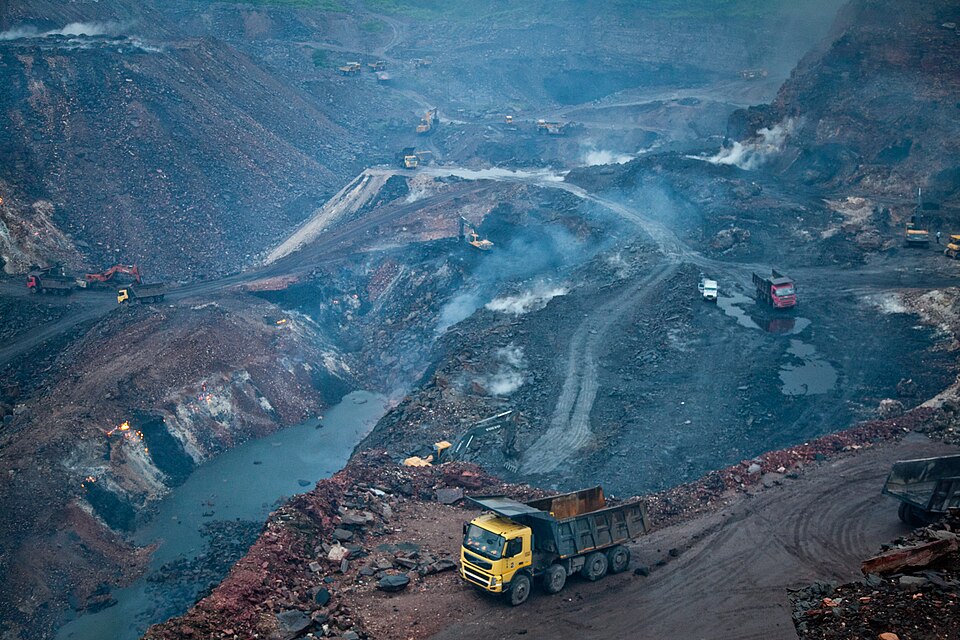
Why it matters. The coal belt of Jharkhand, Odisha, Chhattisgarh and West Bengal explains the location of steel plants and thermal power stations. It also shows the clash between energy security, forests, tribal displacement and air pollution.
Oil and natural gas: where they are trapped
Petroleum formed from tiny marine organisms, such as plankton, buried in sea-floor mud millions of years ago. Heat and pressure turned them into liquid and gaseous hydrocarbons, which then moved up through porous rock until they were trapped under impermeable layers in anticlines (upward folds) and fault traps. That is why oil is found in sedimentary basins of the Tertiary period, not in the old hard rocks of the peninsula.
India's main oil and gas basins are Mumbai High offshore, the largest producing field; the Gujarat onshore fields of Khambhat and Ankleshwar; Upper Assam, where Digboi is one of the oldest oil fields in Asia; the Krishna–Godavari and Cauvery basins on the east coast; and Barmer in Rajasthan. Natural gas is often found with oil, and Mumbai High and the Krishna–Godavari basin are major sources.
Natural gas is cleaner than coal or oil, and it is used for power, fertilisers, city gas and petrochemicals. A national network of gas pipelines and import terminals for liquefied natural gas (LNG) is spreading its use.
Yet India's domestic production is far below its needs. India imports most of the crude oil it refines, which makes it one of the world's largest oil importers and exposes it to price shocks and supply disruptions. Refineries, both near oil fields and on the coasts near ports, process this crude.
Why it matters. Oil imports are a major item in India's import bill and a key strategic vulnerability. This explains strategic petroleum reserves, overseas oil investments and the push for electric vehicles and biofuels.
Hydropower and nuclear power
Hydroelectric power uses falling water to spin turbines. It needs four things: a perennial flow of water from heavy rain or melting snow; a sufficient head or height of fall, natural or created by a dam; strong rock to hold a dam safely; and a nearby market, because electricity is costly to store and transmit over long distances. Large capital investment is also needed.
These conditions make the Himalaya India's biggest hydropower store, because of its snow-fed rivers and steep fall, with the North-East having the largest untapped potential. The Western Ghats also have many projects where rivers drop sharply to the coast. Landmark projects include Bhakra–Nangal on the Sutlej, Tehri on the Bhagirathi, Hirakud on the Mahanadi, Nagarjuna Sagar on the Krishna and Koyna in the Western Ghats.
Hydropower is renewable and produces no smoke, and it can be switched on quickly to meet peak demand. But big dams submerge forests and villages, displace people, change river ecology and face earthquake and flood risks in the young Himalaya. So small hydro projects, which serve remote hill areas with less damage, are encouraged.
Nuclear power splits atoms of uranium in a controlled chain reaction to produce heat for steam turbines. A tiny amount of fuel releases enormous energy, and the plants emit no carbon dioxide. India's nuclear plants are at Tarapur (Maharashtra), Rawatbhata (Rajasthan), Narora (Uttar Pradesh), Kakrapar (Gujarat), Kaiga (Karnataka), and Kalpakkam and Kudankulam (Tamil Nadu).
India has limited uranium but some of the world's largest thorium reserves, in the monazite sands of the Kerala and Odisha coasts. Homi Bhabha's three-stage programme plans to use natural uranium first, then plutonium in fast breeder reactors, and finally thorium. Safety, waste disposal and high costs remain the main concerns.
Why it matters. Hydro and nuclear power are low-carbon sources of steady electricity, but they raise questions of displacement, ecology and safety. These trade-offs are a favourite Mains theme.
Renewable energy: sun, wind, earth and waste
Solar energy is the largest part of India's renewable potential, because most of the country gets bright sunshine on around 300 days a year. Photovoltaic (PV) panels turn sunlight directly into electricity, and large solar parks have come up in the deserts and dry plateaus of Rajasthan, Gujarat, Karnataka, Andhra Pradesh and Madhya Pradesh, while Ladakh has very strong sunshine at high altitude. Rooftop panels, solar pumps for farmers and solar lights for villages spread the benefit widely.
Wind energy uses turbines turned by moving air. The best sites are coastal and plateau areas with steady strong winds, especially during the monsoon, in Tamil Nadu, Gujarat, Karnataka, Maharashtra and Rajasthan. Offshore wind off the Gujarat and Tamil Nadu coasts is the next frontier.
Geothermal energy taps the Earth's internal heat through hot springs and hot rocks. India has hundreds of hot springs, and the Puga valley in Ladakh is its best-known experimental site, with others at Manikaran in Himachal Pradesh and Tattapani in Chhattisgarh. Tidal energy uses the rise and fall of tides in narrow gulfs, and the Gulf of Khambhat, Gulf of Kachchh and the Sundarbans have the greatest potential. Wave energy has also been tried on the Kerala coast.
Biomass includes wood, crop residue and dung. It is still the main cooking fuel in many rural homes, but burning it in open stoves causes serious indoor air pollution, harming women and children most. Biogas plants ferment dung and waste into methane-rich gas for cooking and leave behind good manure, while bagasse from sugar mills and urban waste can also generate power.
India's renewable capacity has grown rapidly. The country has set a target of 500 GW of non-fossil capacity by 2030, and solar and wind together are expected to carry most of this growth. The main challenge is that sun and wind are intermittent, so batteries, pumped storage and a strong grid are needed.
Why it matters. Renewables let India meet growing demand while cutting emissions and imports. Their location in sunny and windy states also creates new industrial and job geography.
Conserving energy and the energy transition
The cheapest unit of energy is the one we do not use. Energy conservation means getting the same work done with less energy: efficient LED bulbs, star-rated appliances, better-insulated buildings, efficient industrial motors and public transport instead of private cars. Saving energy also saves fuel imports and cuts pollution.
Clean cooking is a big part of this. Replacing smoky wood and dung stoves with LPG, biogas or electric cooking reduces indoor pollution and saves women hours spent collecting fuel. Schemes to give LPG connections to poor households have expanded clean cooking, though keeping refills affordable remains a challenge.
The energy transition means shifting gradually from coal and oil towards renewables, while keeping power supply reliable and affordable. India's coal regions, which depend on mining jobs and revenue, need a just transition so that workers and communities are not left behind. Green hydrogen, electric vehicles and energy storage are the new industries of this shift.
Why it matters. Conservation and a just transition link energy geography to climate commitments, public health and regional equity. They are the forward-looking angle examiners expect in energy answers.
Quick revision
- Coal grades: peat < lignite < bituminous < anthracite (carbon rises).
- Gondwana coal (most reserves): Damodar, Sone, Mahanadi, Godavari–Wardha, Pench–Kanhan. Tertiary coal: North-East, J&K. Lignite: Neyveli (Tamil Nadu), Rajasthan, Gujarat.
- Weakness: high ash, little coking coal, so imports for steel.
- Oil/gas: Tertiary sedimentary traps; Mumbai High (largest), Khambhat–Ankleshwar, Upper Assam (Digboi), K–G, Cauvery, Barmer.
- Hydro: perennial flow, head, strong rock, market; Himalaya and North-East have most potential.
- Nuclear: Tarapur, Rawatbhata, Narora, Kakrapar, Kaiga, Kalpakkam, Kudankulam; three-stage plan to use thorium.
- Solar: largest renewable potential; wind: Tamil Nadu, Gujarat; geothermal: Puga (Ladakh); tidal: Khambhat, Kachchh, Sundarbans.
- Target: 500 GW non-fossil capacity by 2030.