

BPSC Auditor, Panchayati Raj Dept · Module 12 · standard depth · 13 min
The universe, the solar system and Earth's place in it
What BPSC Auditor, Panchayati Raj Dept asks from this chapter
Syllabus lines this chapter covers:
- Prelims: General Studies · General geography and geography of Bihar
BPSC Auditor, Panchayati Raj Dept questions from this module are being sorted into our bank.
Cut to standard depth for BPSC Auditor, Panchayati Raj Dept. 11 deeper paragraphs are in the full chapter.
Start from zero: how big is "everything"?
On a clear night far from city lights, look up. You will see thousands of stars, a faint milky band across the sky, perhaps a bright planet. Everything you see, and far more that you cannot see, belongs to the universe: all space, matter and energy that exist.
The universe is so large that kilometres become useless for measuring it. Astronomers use the light year, the distance light covers in one year. Light travels about 3 lakh km every second, so one light year is about 9.46 trillion km.
How did it all begin? The most widely accepted explanation is the Big Bang theory. It says that the universe began from a tiny, extremely hot and dense state about 13.7 billion years ago and has been expanding ever since. Evidence for this includes galaxies moving away from one another and a faint glow of radiation left over from the early universe.
As the universe expanded and cooled, matter gathered into clouds, clouds collapsed into stars, and stars gathered into galaxies. Our Sun and Earth came very late in this story.
Why it matters. Geography starts with Earth's place in space, because that place decides how much sunlight we get, how days and seasons work, and why Earth can host life. Space science also shapes modern life through satellites for weather, maps, communication and navigation. India's space programme makes this knowledge directly useful for governance.
Galaxies and the Milky Way
A galaxy is a huge system of stars, gas and dust held together by gravity. The observable universe contains billions of galaxies, each with millions to hundreds of billions of stars. They come in different shapes.
The astronomer Edwin Hubble sorted galaxies into four main types. Spiral galaxies have a central bulge and a flat, rotating disc with curved arms full of young stars. Barred spiral galaxies have a bar of stars across the centre, elliptical galaxies are smooth oval balls of older stars with little gas, and irregular galaxies have no clear shape.
Our own galaxy is the Milky Way, a spiral galaxy about 100,000 light years across. The faint milky band we see on dark nights is our view of its disc from inside. The Sun lies in one of its outer arms, far from the crowded centre.
The Sun is not still. Along with the whole solar system, it moves around the centre of the Milky Way, taking about 225 million years for one round. Since the solar system formed, it has gone around the galaxy only about twenty times.
Why it matters. Knowing that the Sun is an ordinary star in an ordinary galaxy helps us see Earth in proportion. It also explains why we can study other stars to understand our own Sun, including the solar storms that can disturb satellites, power grids and communication on Earth.
The solar system: Sun and planets
About 4.6 billion years ago, a rotating cloud of gas and dust in the Milky Way began to collapse under its own gravity. Most of the material gathered at the centre and became hot enough to start nuclear fusion: the Sun was born. The rest formed a flat, spinning disc, from which the planets and other bodies grew.
That is why the Sun dominates the solar system, holding more than 99% of its mass. Its gravity holds everything in orbit, and its energy, produced by fusing hydrogen into helium, lights and warms the planets. The mean distance between the Sun and the Earth, about 149.6 million km, is called one astronomical unit (AU).
The solar system has eight planets. In 2006, the International Astronomical Union defined a planet more strictly, and Pluto was reclassified as a dwarf planet, along with Ceres and Eris. A dwarf planet is round and orbits the Sun but has not cleared other bodies from its path.
The planets form two families. The four inner or terrestrial planets, Mercury, Venus, Earth and Mars, are small, rocky and dense, with few or no moons. The four outer or Jovian planets, Jupiter, Saturn, Uranus and Neptune, are giants made mostly of hydrogen, helium and ices, with rings and many moons. Uranus and Neptune are often called ice giants.
A few planets stand out. Mercury is the smallest planet and the nearest to the Sun. Venus, though further away, is the hottest, because its thick carbon dioxide atmosphere traps heat in a runaway greenhouse effect. Jupiter is the largest, with more mass than all the other planets combined.
The planets show a striking order. They all revolve around the Sun in the same direction, anticlockwise when seen from above the Sun's north pole, in nearly the same plane, and in nearly circular orbits. Most also rotate in the same direction, but Venus and Uranus rotate the opposite way. This shared motion is strong evidence that they all formed from one spinning disc.
Why it matters. The two families of planets show how distance from the Sun controlled what each planet is made of: rock near the hot Sun, gas and ice further out. This helps scientists judge which worlds, in our system and around other stars, might hold water or life.
Moons, asteroids, comets and meteors
Besides the planets, the solar system holds countless smaller bodies. Moons or natural satellites orbit planets. Earth has one Moon, about 3,84,400 km away. It takes about 27 days both to spin once on its axis and to go once around the Earth, so the same side always faces us.
Between the orbits of Mars and Jupiter lies the asteroid belt, a zone of millions of rocky and metallic pieces left over from the time the planets formed. Jupiter's strong gravity probably stopped them from joining into a planet. Some asteroids cross Earth's orbit and are tracked closely.
Beyond Neptune lies the Kuiper belt, a ring of icy bodies that includes Pluto. Much further out, the Oort cloud is thought to surround the solar system and to be the source of long-period comets. A comet is a lump of ice and dust; as it nears the Sun, it heats up and grows a glowing head and a long tail that points away from the Sun.
Small rocky pieces moving through space are called meteoroids. When one enters Earth's atmosphere and burns up, we see a bright streak called a meteor or shooting star. If a piece survives and lands, it is called a meteorite; large impacts in the past have left craters, such as Lonar in Maharashtra.
India studies these bodies directly. Chandrayaan-3 landed near the Moon's south pole in August 2023, the first landing in that region, and Aditya-L1, India's first solar observatory, reached its station near the Sun–Earth L1 point in January 2024.
Why it matters. Small bodies are time capsules of the early solar system, and studying them helps explain how Earth got its water and building blocks. Tracking near-Earth asteroids is part of planetary defence, and the Moon's polar ice could support future missions. Missions like Chandrayaan and Aditya also build India's scientific and strategic capacity.
Why Earth is special
Earth is the third planet from the Sun and the largest of the inner planets. From space it looks blue, because water covers most of its surface. So far, it is the only known planet that supports life.
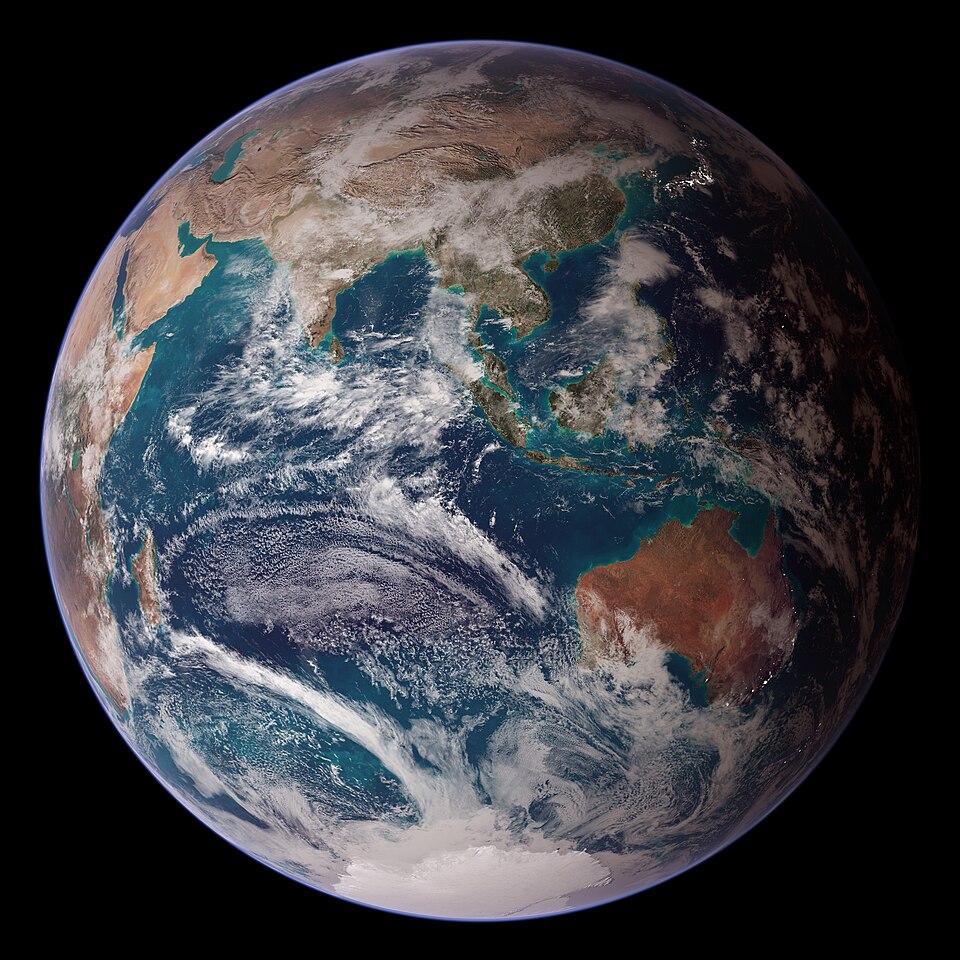
Several conditions come together to make this possible. Earth is at a suitable distance from the Sun, so its temperature allows water to stay liquid. Its gravity holds a thick atmosphere that supplies oxygen, traps enough heat through the greenhouse effect to keep the planet warm, and, through the ozone layer, blocks harmful ultraviolet rays.
Earth also has a magnetic field, generated deep inside it, which shields the surface from the charged particles of the solar wind. Its large Moon steadies the tilt of its axis, keeping seasons fairly stable over long periods.
Geographers describe Earth as four interacting spheres. The lithosphere is the solid rock and soil, the atmosphere is the air, the hydrosphere is all the water, and the biosphere is the narrow zone where life exists, overlapping the other three. Changes in one sphere ripple into the others: for example, cutting forests changes rainfall, soil and rivers.
Why it matters. The conditions that make Earth habitable are delicately balanced. Human actions such as burning fossil fuels, releasing ozone-depleting chemicals and destroying ecosystems disturb this balance. Seeing Earth as a connected system is the basis of environmental geography and of policies on climate change and conservation.
Seeing Earth from space
Our understanding of Earth changed when we began to look at it from above. Satellites now watch the planet constantly, measuring clouds, rainfall, sea surface temperature, crops, forests, snow and city growth.
India launched its first satellite, Aryabhata, in 1975, and today runs a large fleet of Earth observation, communication and weather satellites. Data from these satellites support weather forecasts, cyclone warnings, crop estimates, forest surveys, mapping and disaster response.
India also has its own regional navigation system, NavIC, which provides positioning services over India and the surrounding region. Combined with maps and ground data, satellite images help plan roads, monitor mining and track changes in rivers and coasts.
Why it matters. Space-based observation turns geography from a descriptive subject into a planning tool. For governance, it supports evidence-based decisions in agriculture, disaster management, urban planning and border security. It also helps India meet its international commitments on climate and environment.
Quick revision
- Big Bang: universe began about 13.7 billion years ago and is expanding. Light year ≈ 9.46 trillion km.
- Hubble's galaxy types: spiral, barred spiral, elliptical, irregular. Milky Way: spiral, about 100,000 light years across; Sun in an outer arm, one round in about 225 million years.
- Solar system formed 4.6 billion years ago; Sun has more than 99% of the mass; 1 AU ≈ 149.6 million km.
- Eight planets since 2006; dwarf planets: Pluto, Ceres, Eris.
- Mercury smallest and nearest; Venus hottest; Jupiter largest.
- Terrestrial: Mercury, Venus, Earth, Mars. Jovian: Jupiter, Saturn, Uranus, Neptune (Uranus, Neptune = ice giants).
- All revolve anticlockwise in nearly one plane; Venus and Uranus rotate the opposite way.
- Asteroid belt: Mars–Jupiter; Kuiper belt: beyond Neptune; Oort cloud: long-period comets.
- Moon: about 3,84,400 km; same side faces Earth. Meteor burns; meteorite lands.
- Earth: liquid water, atmosphere, ozone, magnetic field; four spheres.