

BPSC CCE · Module 73 · Mains depth · 20 min
Rock-cut caves: chaityas, viharas and the road from Barabar to Ajanta, Ellora and Elephanta
What BPSC CCE asks from this chapter
Syllabus lines this chapter covers:
- Mains: General Studies I · Modern history and culture of India
BPSC CCE has asked 2 questions from this chapter (2023); 7 from its whole module.
Read at full depth: basics, the standard layer and the Mains analysis.
Start from zero: a house you carve, not build
Most buildings are made by adding: brick on brick, beam on beam. Now imagine making a hall the opposite way, by taking away rock from a hill until a room appears. There are no walls to raise and no roof to lift, only the stone you choose to leave behind.
That is what India's cave-builders did for over a thousand years. From small cells in the Barabar hills of Bihar to the giant hall at Karle and the carved temple of Kailasa at Ellora, they cut more than a thousand caves. Most are Buddhist, but many are Jain and Hindu.
These caves have survived floods, wars and time far better than wooden or brick buildings. Because of them, we know how early prayer halls and monasteries looked. They also hold some of India's greatest sculpture and painting.
This chapter explains the two main cave types, the chaitya and the vihara. It then follows the caves from the west coast to Odisha, Ajanta, Ellora, Elephanta and Mahabalipuram, asking each time who cut them and why.
Why cut buildings into rock?
The monks' problem. Buddhist monks were wanderers, but in the rainy season they had to stay in one place. They needed shelter that was quiet, cool and away from busy towns, yet close enough for alms. Timber buildings were quick to make, but timber rots and burns.
The rock's answer. The hills of the western Deccan are made of thick, even layers of rock that carvers could cut cleanly. A rock-cut hall needed no foundations or roof, and it would last for centuries. Once cut, it also stayed cool in summer and dry in the rains.
Where it began. The very first caves were Mauryan, in the Barabar and Nagarjuni hills near Gaya, cut for Ajivika monks. You met the Lomas Rishi cave, with its wooden-hut doorway, in the Mauryan chapter. After the Mauryas, cave-cutting moved mainly to the western Ghats of Maharashtra, and the earliest rock-cut shrines there date to the early centuries of the Christian era.
Copying buildings in rock. Cave-builders were really turning a cave into a building. They copied the forms of wooden and brick structures, so they carved pillars that hold nothing up and ribs that support no roof. These details tell us how the lost wooden buildings of the time once looked.
How they were cut. Carvers first dressed the cliff face and marked the entrance. They then quarried from the top downwards and from front to rear, using chisels and iron hammers, so they never needed scaffolding. Even at Bhaja, real wooden beams were fixed inside, a sign of how closely the caves copied timber halls.
Why it matters. Rock-cut work is sculpture on a giant scale: builders removed rock rather than adding material. One mistake could not be undone, so planning had to be perfect. That skill reached its peak in the Kailasa temple at Ellora, centuries later.
Two kinds of caves: chaitya and vihara
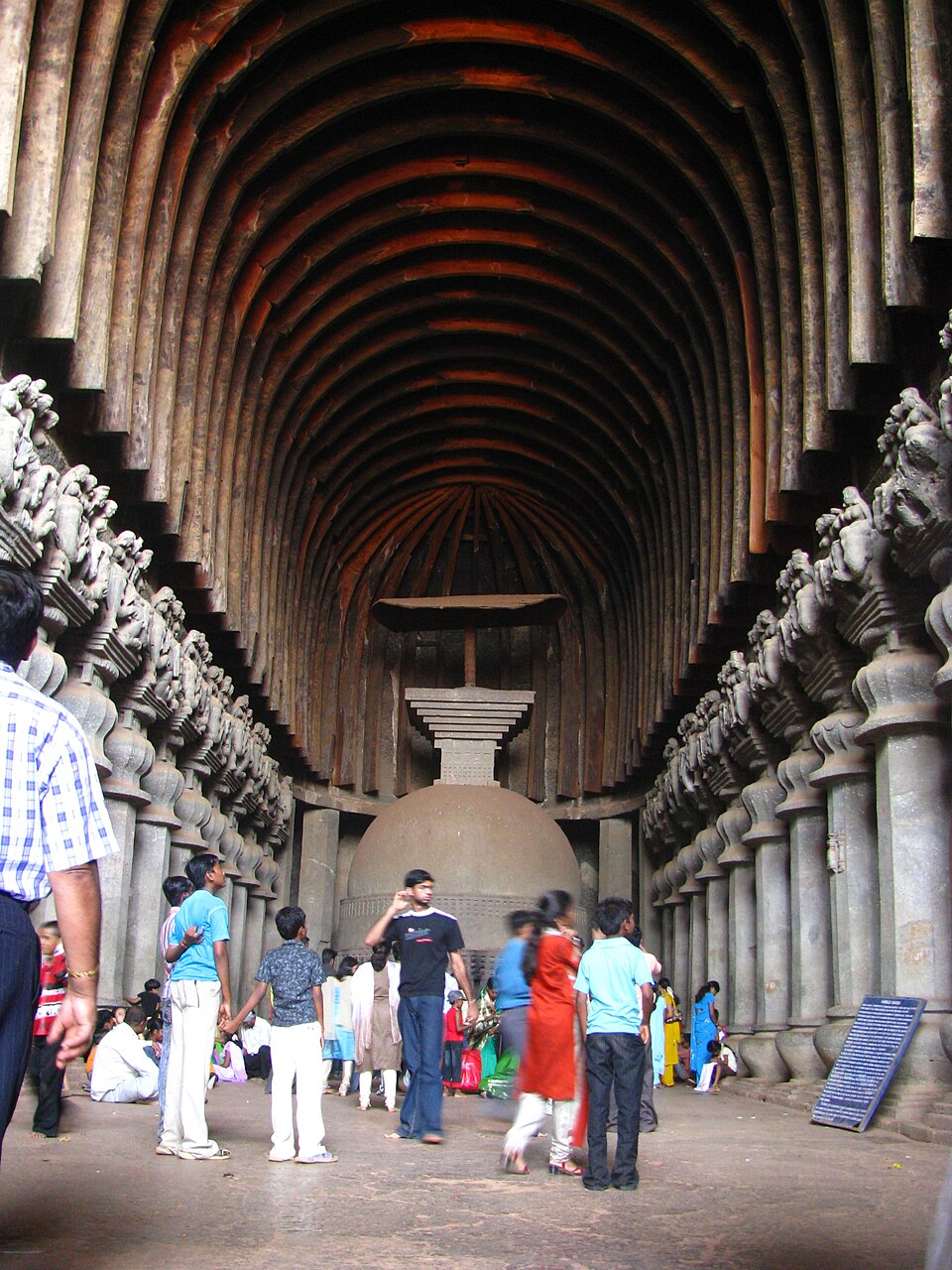
The chaitya: a hall for prayer. A chaitya is a long, rectangular hall that ends in a rounded far end (apse). Two rows of pillars divide it into a central nave and two side aisles, and the pillars continue around the back. At the apse end stands a stupa in early caves, or a Buddha image in later Mahayana caves.
The roof and the window. The ceiling is a barrel vault, curved like the inside of a drum, often with ribs copying timber. The doorway faces the stupa, and above it is a large horseshoe-shaped chaitya window that lets light fall on the stupa. Worshippers walk around the stupa along the aisles, just as they would around an open-air stupa.
The vihara: a home for monks. A vihara is a monastery. It has a central square or oblong hall, a pillared veranda in front and small square cells cut around the hall. Many cells have raised stone benches that served as beds.
How plans improved. Early vihara plans were irregular, cut wherever the rock allowed. Later ones became regular and symmetrical, with cells arranged neatly on three sides. In later Mahayana viharas, a shrine with a Buddha image was cut into the back wall, so a vihara also became a place of worship.
| Feature | Chaitya | Vihara |
|---|---|---|
| Purpose | It is a hall for group prayer. | It is a home for monks to live, study and meditate. |
| Plan | It is long, with an apse, a nave and two aisles. | It has a square hall with cells around it. |
| Focus | A stupa or Buddha image stands at the end. | Later ones have a shrine at the back. |
| Roof and facade | It has a barrel vault and a horseshoe window. | It has a flat ceiling and a pillared veranda. |
Why it matters. A simple way to remember: the stupa is for the relic, the chaitya is for prayer and the vihara is for living. Examiners often describe one feature, such as a horseshoe window or cells around a hall, and ask which type it is.
The western Deccan caves: Bhaja to Karle
A cluster of sites. The great Buddhist caves of the west include Bhaja, Kondane, Pitalkhora, Bedsa, Nasik, Karle, Kanheri and the earliest caves at Ajanta (9 and 10). Most were cut under the Satavahanas and their successors. They are dated by the inscriptions cut on them, by the style of their letters, or by their architecture.
Three phases. One well-known scheme puts the caves in three phases. Bhaja, Kondane, Pitalkhora and Ajanta Cave 10 come first, around 100-70 BCE. Bedsa follows around 100-200 CE, and Karle and Kanheri come last, around 200-300 CE.
Bhaja and Karle. Bhaja, near Pune, is among the oldest and simplest of these caves. Karle, in the Pune district, is the finest chaitya: it measures about 124 feet long, 46.5 feet wide and 45 feet high. Its ceiling has curved ribs copying timber, and its stupa still carries an umbrella made of wood, a rare survival.
Who paid? The inscriptions show that these caves were not paid for by kings alone. Guilds, merchants and artisans made many of the gifts, at sites such as Kanheri, Bhaja, Junnar and Bedsa. Monks and nuns also donated pillars and cells.
Why it matters. Many donors of the western caves were traders and craftsmen, so the caves show the strong link between Buddhism and trade in the early centuries AD. Karle, as the best chaitya, is a favourite exam example, just as Sanchi is for the stupa.
Udayagiri and Khandagiri: Jain caves of Odisha
Caves for Jain monks. Not all early caves were Buddhist. Near Bhubaneswar in Odisha, the twin hills of Udayagiri and Khandagiri hold a group of Jain caves. They were cut under Kharavela, the powerful king of Kalinga, who was a follower of Jainism.
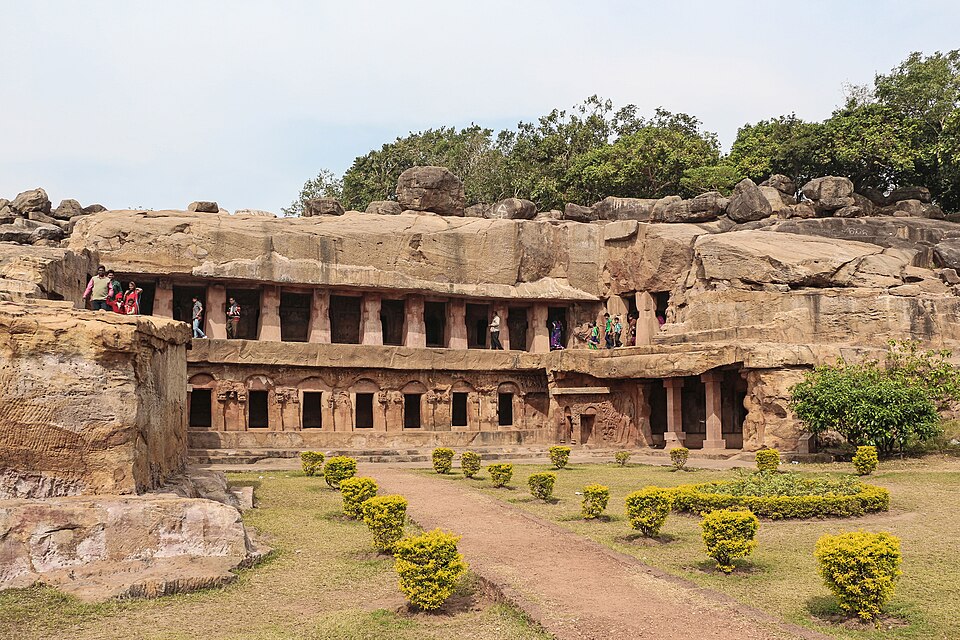
What they look like. There are about 35 excavations in two groups. Some are single cells and some have many cells around a courtyard. Their doorways have semicircular arches, and their walls carry carved friezes.
Rani Gumpha. The largest is Rani Gumpha, the "Queen's cave". It is double-storeyed, with rows of cells on two levels around an open court. Its carved friezes show lively scenes of processions, dance and daily life.
Hathi Gumpha and Manchapuri. The natural cavern called Hathi Gumpha (the elephant cave) carries the long inscription of Kharavela, the main record of his reign. Manchapuri is another double-storeyed cave, with inscriptions of Kharavela's successor. Smaller caves are named after animals, such as the Vyaghra (tiger) and Sarpa (snake) Gumphas, carved in those shapes.
Why it matters. These caves prove that Jainism also built rock-cut monasteries and enjoyed royal patronage in the east. They balance the picture of an all-Buddhist cave tradition. Examiners often ask which cave group was Jain and who its patron was, so remember Kharavela and Rani Gumpha.
Ajanta: from symbol to image in one gorge
The site. Ajanta has 30 caves cut into a horseshoe-shaped cliff above the Waghora river in Maharashtra. Caves 9, 10, 19, 26 and 29 are chaityas, and the rest are viharas. Together they cover about seven centuries of Buddhist art.
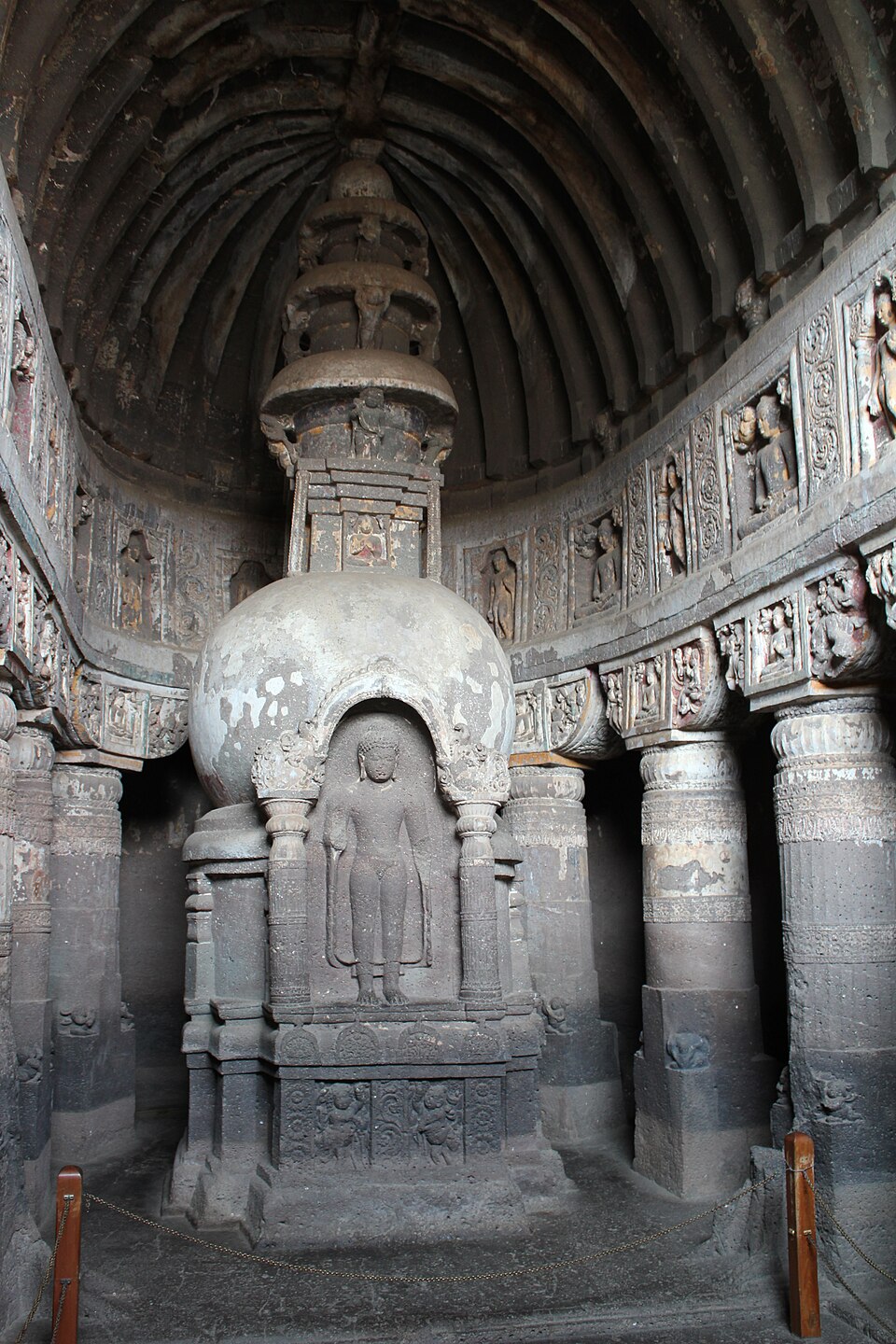
Two phases. The first phase, around the 2nd-1st century BCE under the Satavahanas, has six caves. It was Hinayana, so the Buddha appears only as symbols, and the chaityas have horseshoe windows. The second phase came in the 5th-6th century CE under the Vakatakas, and it was Mahayana, with Buddha images and the famous tempera murals.
Cave 19: a jewel of the second phase. Cave 19 is a chaitya with an inscription from the early reign of the Vakataka king Harishena. Its facade has a large sun-window framed by carved Buddhas, and its hall has fluted pillars with cushion-shaped capitals. Most striking of all, its stupa has a standing Buddha carved on its dome, so the symbol and the image are joined in one object.
Why it matters. Ajanta lets you see the whole story of Buddhist art in one place: the early, symbol-only halls and the later halls full of images. Its paintings, studied in the chapter on murals, are among the finest in Asia. Questions often test the two phases, their patrons and the chaitya numbers.
Ellora: three faiths on one hill
The site. Ellora has 34 caves cut between AD 600 and 1000 along a basalt cliff in the Charanandri hills near Aurangabad. Caves 1-12 are Buddhist, 13-29 are Brahmanical (Hindu) and 30-34 are Jain. No other site shows the three faiths side by side so clearly.
Buddhist caves. Cave 10 is the Visvakarma or "carpenter's" cave, a Buddhist chaitya whose ribbed ceiling copies timber. Cave 12, called Teen Tal, is a vihara three storeys high. These show the cave tradition at its most ambitious. Among the Hindu caves, Cave 15 (Dashavatara) is dated by an inscription of the Rashtrakuta king Dantidurga, who ruled just before Krishna I.
Kailasa: a temple carved like a statue. Cave 16, the Kailasa temple, was cut under the Rashtrakuta king Krishna I. Carvers cut deep trenches around a block of rock, then shaped the block from the top downwards into a complete temple, with shrine, hall, gateway, pillars and smaller shrines. Its ground plan is about the size of the Parthenon in Athens, and it is described as the largest monolithic temple.
Why it matters. Ellora is the best proof of religious coexistence in Indian art: Buddhist, Hindu and Jain caves share one hill and one community of craftsmen. Kailasa also shows the peak of rock-cut skill, where a cave became a free-standing temple. It links this chapter with the temple module, especially the Deccan temple chapter.
Elephanta, Badami and the Pallavas: the caves turn Hindu
Elephanta. The Elephanta caves stand on Gharapuri island in the harbour near Mumbai. They date from the mid-5th to 6th century AD and are dedicated to Shiva. Cave 1 holds a huge 7-metre three-faced Sadashiva, often called the Trimurti, surrounded by large panels of Shiva's stories.
A threat from the sea. Elephanta's rock faces a serious threat from salinity, as salt carried by the sea air harms the stone. It is a good example for questions on heritage conservation.
Badami: caves of the Chalukyas. In Karnataka, the Chalukyas of Badami cut four cave temples, three Brahmanical and one Jain. Each has a porch, a pillared hall and a square shrine cut deep into the rock. Cave 3, a Vishnu cave, is dated CE 578 under Mangalesha, and Cave 1 shows an 18-armed dancing Shiva.
The first Pallava caves. The Pallavas worked in hard granite and gneiss. Mahendravarman I began with the Lakshitayatana cave at Mandagapattu, whose inscription proudly says it was made without brick, mortar, wood or metal.
Mahabalipuram. In Tamil country, the Pallavas carried rock-cutting in a new direction at Mahabalipuram. Under Narasimhavarman I, carvers shaped rathas, each cut from a single stone; the five best known are named after the Pandavas. These are not caves but monolithic temple models, standing in the open.
Why it matters. Elephanta and Mahabalipuram show that the cave tradition, begun by Ajivikas and Buddhists, was taken up by Hindu patrons and became part of temple-building. Mahabalipuram's rathas are a bridge to structural temples, covered in the Pallava temple chapter. This path from cave to monolith to free-standing temple is a classic Mains theme.
Mains lens: debates and practice
Debate 1: why did caves give way to temples? Rock-cut halls lasted for centuries, but they could only be made where the rock was right. Free-standing structures could be built anywhere, near towns and kings. Over time, structural temples took over, but the rock-cut tradition taught builders the plans, proportions and sculpture they carried into the temple age.
Debate 2: faith and money. The caves were religious places, yet they were paid for by merchants, guilds and artisans as well as kings. This shows how closely religion and trade were linked. A good answer uses donor inscriptions to show that the cave tradition rested on a prosperous trading economy.
Debate 3: coexistence or rivalry? Ellora shows three faiths on one hill, which is often read as harmony. Some historians note that patrons also competed for prestige through grander caves. A balanced answer says the site shows shared craft and coexistence, without denying rivalry.
These are practice questions written by us, not past papers. Past questions from your exam appear in the PYQ panel.
| Angle | Question | Key points to cover |
|---|---|---|
| Architecture | Distinguish between a chaitya and a vihara with examples. | Give the purpose, plan, roof and focus of each, with Karle and an Ajanta vihara as examples. |
| Evolution | Trace the evolution of rock-cut architecture from the Mauryas to the Rashtrakutas. | Move from Barabar to the western Deccan, Ajanta, Elephanta, Mahabalipuram and Kailasa. |
| Religion | "Ellora is a symbol of religious harmony in ancient India." Discuss. | Give the three groups of caves, Kailasa and the shared skills, then add a balanced line on rivalry. |
| Economy | How do donor inscriptions in the western Deccan caves throw light on the economy of the period? | Mention guilds, merchants, artisans and trade routes, then link them to the Satavahana economy. |
| Heritage | What threats do rock-cut monuments face today, and how can they be protected? | Use Elephanta's salinity as the main example, add other risks you have studied, then suggest monitoring, careful repair and local involvement. |
Answer plan for the evolution question. Open with one line saying that India's rock-cut tradition ran for over a thousand years and served three faiths. In the body, move in four steps: Mauryan beginnings at Barabar, Buddhist chaityas and viharas of the western Deccan, the image-rich phase of Ajanta and Elephanta, and the monolithic temples of Mahabalipuram and Kailasa. Conclude that the caves trained builders for the structural temples that followed.
Quick revision
- The oldest caves are in the Barabar and Nagarjuni hills, cut for the Ajivikas under the Mauryas.
- A chaitya is an apsidal prayer hall with a nave, aisles, a barrel vault and a horseshoe window, and a vihara is a monastery with cells around a hall.
- Western Deccan caves include Bhaja, Kondane, Pitalkhora, Bedsa, Nasik, Karle and Kanheri, and many were paid for by guilds and merchants.
- Karle is the finest chaitya and keeps a wooden umbrella over its stupa.
- The Udayagiri-Khandagiri caves in Odisha are Jain, cut under Kharavela, and Rani Gumpha is the largest.
- Ajanta has 30 caves: a Hinayana phase under the Satavahanas and a Mahayana phase under the Vakatakas.
- Ellora has 34 caves of three faiths, and Kailasa was cut under the Rashtrakuta king Krishna I.
- Elephanta has the three-faced Sadashiva, and Mahabalipuram has the Pallava rathas (five named after the Pandavas).
BPSC CCE questions from this chapter
Write short notes on the following: (e) Development of Caves in Eastern India in Ancient Time
Write short notes on the following: (e) Cave Paintings of Eastern India in Ancient Period