

BPSC CCE · Module 50 · Mains depth · 22 min
Clean energy: solar, wind, bioenergy, biofuels and green hydrogen
What BPSC CCE asks from this chapter
BPSC CCE has asked 6 questions from this chapter (2025, 2024, 2023, 2020); 10 from its whole module.
Read at full depth: basics, the standard layer and the Mains analysis.
Start from zero: why switch on a cleaner light?
Every time you switch on a fan, charge a phone or ride a bus, energy is being used. For most of the last century, that energy came from burning coal, oil and gas. Burning them releases carbon dioxide, which warms the planet, and smoke, which harms the lungs.
Fossil fuels are also non-renewable. Coal and oil formed from plants and animals buried millions of years ago, and once used, they are gone. Countries that import oil also spend huge sums of foreign exchange and face price shocks.
Clean energy comes from sources that are renewable and cause little pollution while running, such as sunlight, wind, flowing water and plant matter. India has strong sunshine, long coastlines and a large farm sector, which give it natural advantages. In just over a decade, it has turned these advantages into one of the world's largest clean-energy systems.
This chapter explains the main clean-energy sources, their benefits and their hidden environmental costs. It covers biofuels and ethanol blending, the green hydrogen mission and solar power for farmers. India's climate targets for 2030 are explained in the chapter on India's climate missions, and this chapter focuses on the energy sources themselves.
Conventional and non-conventional energy
Two families. Conventional sources are those used on a large scale for a long time: coal, oil, natural gas, large hydropower and nuclear power. Non-conventional sources are newer in large-scale use: solar, wind, biomass, biogas, small hydro, geothermal, tidal and wave energy. Most non-conventional sources are also renewable.
Why the shift is needed. Fossil fuels will not last forever and their burning drives climate change and air pollution, explained in the chapter on air pollution. Large dams and nuclear plants are low in carbon but raise questions of displacement, safety and waste. Clean sources spread across the country can also bring power to remote villages that the grid does not reach.
Energy and development. Energy use is closely linked to development, because industry, farming, health and education all need power. India's energy use per person is still low compared with rich countries. So India must expand its energy supply, and the real choice is about which sources it uses.
Solar and wind: India's clean-power engines
How solar power works. Solar photovoltaic (PV) panels turn sunlight directly into electricity. The power can be used at once or stored in batteries for lighting, pumping water or running remote equipment. Solar heat can also warm water and cook food, and buildings designed for the sun need less energy for heating and cooling.
How wind power works. Wind turbines turn the energy of moving air into mechanical power, which drives a generator. Turbines are often grouped in wind farms at windy sites, mostly along coasts and in western and southern states. Wind often blows more strongly at night and in the monsoon, which complements solar power.
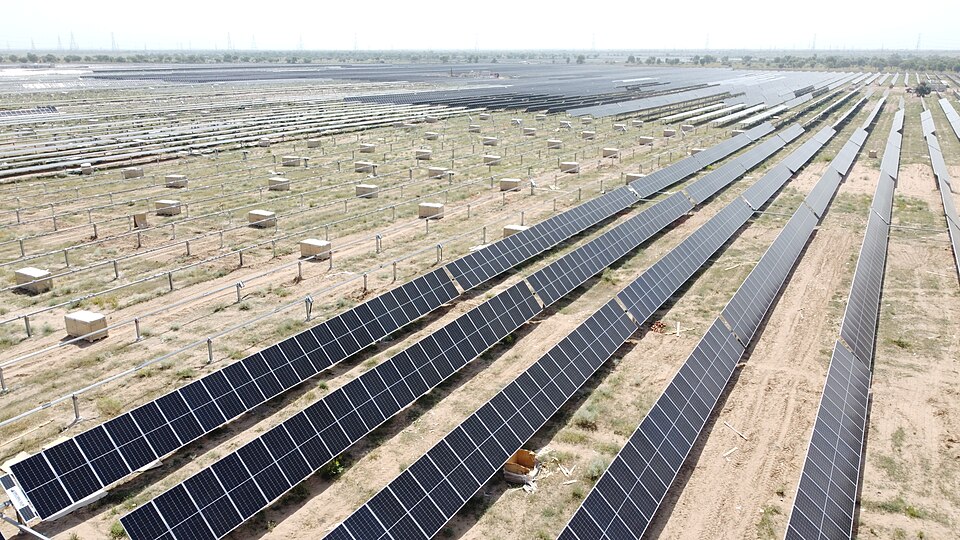
India's progress. As of 31 July 2026, India's installed power capacity was around 552 GW, of which non-fossil sources made up 300.50 GW, over 54%. Solar capacity had reached 164.59 GW and wind 58.14 GW. India ranks third in the world in renewable energy installed capacity and fourth in wind power capacity.
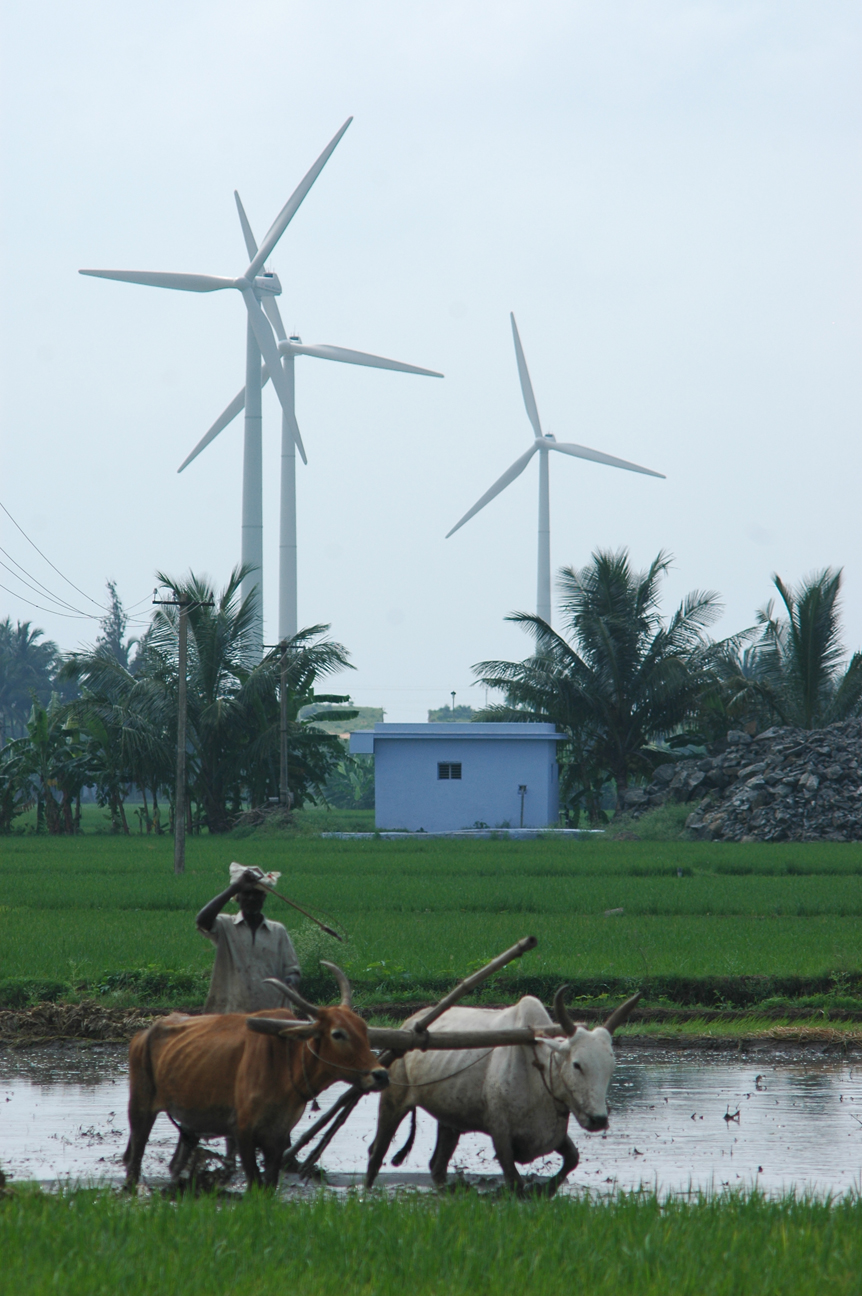
The 50% milestone. India had set a target of having half its installed electricity capacity from non-fossil sources by 2030. It reached the 50% mark in June 2025, five years early. Installed capacity is not the same as electricity actually produced, because solar and wind run only when the sun shines and the wind blows.
The intermittency problem. Sunlight and wind vary by hour and season, so the grid needs storage, such as batteries and pumped hydro, and flexible back-up power. Without storage, coal plants still supply much of the evening demand. This is why storage and grid upgrades are now as important as new panels.
Bioenergy: biomass, biogas and co-generation
Biomass. Biomass is energy from plant and animal matter, such as wood, crop residues, cattle dung and household organic waste. It is renewable, and in principle it does not add net carbon dioxide, because new plants absorb the carbon released when the old ones burn. That balance holds only if the biomass is regrown, not if forests are cut faster than they recover.
The chulha problem. Many rural homes still burn wood, dung cakes and crop residues in traditional chulhas. Inefficient burning causes serious indoor air pollution, which harms women and children most. Over-cutting of fuelwood also adds to deforestation and land degradation.
Better ways to use biomass. Biomass can be pressed into briquettes that burn more evenly, or turned into gas in a biomass gasifier. Biogas made from cattle dung in a closed tank contains about 55-70% methane and burns cleanly for cooking. The leftover slurry is a good manure, so a biogas plant gives both fuel and fertiliser.
Co-generation. A conventional thermal power plant turns only about 35% of the fuel's energy into electricity, because much heat is lost when steam is cooled. In co-generation, the leftover low-pressure steam is used for heating in factories. This raises overall efficiency to about 75-90%; sugar mills that burn bagasse are a classic example.
Biofuels and ethanol blending
What biofuels are. Biofuels are liquid or gaseous fuels made from biomass. Bioethanol, made from sugarcane, grains or crop waste, can be blended with petrol, while biodiesel, made from non-edible oils and used cooking oil, can be blended with diesel. They cut oil imports and can lower some tailpipe emissions.
The National Policy on Biofuels, 2018. The Cabinet approved the policy on 16 May 2018. It divides biofuels into basic biofuels, meaning first-generation (1G) bioethanol and biodiesel, and advanced biofuels, meaning second-generation (2G) ethanol, third-generation (3G) biofuels and bio-CNG. It allows ethanol from damaged food grains unfit for eating, and from surplus food grains with the approval of the National Biofuel Coordination Committee.
Why 2G matters. First-generation ethanol uses food crops such as sugarcane and grain. Second-generation ethanol uses crop residues such as rice straw, which would otherwise be burnt in fields. So 2G ethanol can cut both oil imports and the stubble smoke that chokes north India each winter.
E20: reached early. The original target of 20% ethanol blending in petrol was for 2030. A 2022 amendment to the policy advanced it to ethanol supply year 2025-26. India achieved 20% blending in 2025-26, meeting the advanced target.
The food-versus-fuel debate. Ethanol from sugarcane and grain needs large amounts of land and water. Sugarcane in particular is a very thirsty crop, and diverting grain to fuel could, in a bad year, affect food prices. This is why the policy pushes advanced, waste-based biofuels.
Green hydrogen: fuel for the hard-to-clean sectors
What hydrogen offers. Hydrogen burns or reacts to give energy with water as the main by-product, not carbon dioxide. In a fuel cell, hydrogen and oxygen react to produce electricity, heat and water without combustion. This makes hydrogen useful where batteries and direct electricity are hard to use.
Why "green" matters. Most hydrogen today is made from natural gas, which releases carbon dioxide. Green hydrogen is made by splitting water in an electrolyser using electricity from renewable sources. Only then is the whole chain close to carbon-free.
Where it is needed. Steel making, fertiliser production, oil refining, long-haul trucks and shipping are hard to run on batteries. These are called hard-to-abate sectors. Green hydrogen can replace fossil fuels in them and can also store surplus solar and wind power.
The National Green Hydrogen Mission. The Cabinet approved the mission in January 2023 with an initial outlay of ₹19,744 crore. It aims for green hydrogen production capacity of at least 5 million tonnes a year by 2030. Of the outlay, ₹17,490 crore is for the SIGHT programme (Strategic Interventions for Green Hydrogen Transition), with smaller sums for pilot projects and research.
The challenges. Green hydrogen is still costlier than grey hydrogen, and electrolysers need large amounts of clean power and fresh water. Storing and moving hydrogen is difficult, because it is very light and leaks easily. Success depends on falling solar costs and cheaper electrolysers.
Solar power for farmers and other clean sources
PM-KUSUM. PM-KUSUM was approved on 19 February 2019 to give farmers energy and water security, raise their income and de-dieselise farming. Its first component supports small solar plants of up to 2 MW on farmland. The other two support standalone solar pumps and the solarisation of existing grid-connected pumps, so farmers can sell surplus power.
Why solar pumps help and hurt. Solar pumps end diesel costs and smoke, and they can turn farmers into power sellers. But free daytime power can tempt farmers to pump more groundwater than is safe. Groundwater over-use is explained in the chapter on water, and good schemes link solar pumps with water-saving methods.
Small hydro, geothermal and the sea. Small hydro plants serve remote hill areas without big dams. Geothermal energy uses heat from hot springs, and India has known hot-spring zones in the Himalayas, such as the Puga valley in Ladakh, and along the western coast. Tidal and wave energy use the movement of the sea, but they remain small and costly in India.
Nuclear and large hydro. Nuclear power produces very little carbon dioxide but raises concerns about safety and radioactive waste, explained in the chapter on soil, noise, light and radiation. Large hydropower is clean in operation but can flood forests and displace people. These trade-offs are discussed in the chapter on forests, mines and dams.
The hidden costs of clean energy
Land. Large solar parks and wind farms need a lot of land. When placed on grasslands or common lands, they can harm wildlife such as the great Indian bustard, whose court case is explained in the chapter on the Constitution and courts, and take away grazing land. Rooftop solar and solar on canals and water bodies reduce this pressure.
Minerals and waste. Panels, wind turbines and batteries need minerals such as lithium, cobalt and rare earths, whose mining has its own environmental costs. Old panels and batteries will become a new waste stream in the coming decades. The battery and e-waste rules explained in the chapter on special wastes aim to recover these materials.
A just transition. Many districts in eastern India depend on coal mining for jobs and state revenue. A fast shift away from coal without new jobs could hurt workers and communities. A just transition plans retraining, new industries and support for these regions.
Weighing it up. Clean energy is not free of impact, but its costs are much smaller and more manageable than those of fossil fuels. The answer is careful siting, recycling and fair planning, not slowing the shift. This is a good balanced point for Mains answers.
Mains lens: three live debates on clean energy
1. Capacity or generation: is India's power really clean now? India's non-fossil capacity crossed 300 GW by July 2026, more than half of all installed capacity. That is a big milestone. But capacity is the size of the plant, not the electricity it actually produces.
Solar panels produce power only in daylight and wind turbines only when the wind blows, so their yearly output is a smaller share than their capacity suggests. Coal plants still supply most of the electricity at night and in calm weeks. A balanced answer celebrates the capacity record but argues that the real shift needs storage, a stronger grid and flexible demand, so that clean capacity turns into clean electricity.
2. Ethanol: fuel from fields or food from fields? India reached 20% ethanol blending in petrol in 2025-26, years ahead of the original 2030 date. This cuts oil imports, gives farmers and sugar mills a new market and lowers some tailpipe pollution. The 2018 policy also allows damaged grains and, with approval, surplus grains to be turned into ethanol.
Critics worry that sugarcane and grain for ethanol need large amounts of water and land, which could compete with food and drain groundwater. Others say that older vehicles may suffer with higher blends. A balanced view supports ethanol but pushes towards advanced, second-generation fuels made from crop residue and waste, which do not compete with food.
3. A just transition: what happens to coal regions? Moving away from coal will help climate and clean air. But in some districts coal mines, power plants and related trades are the main source of jobs, tax income and local business. If they close suddenly, whole towns can lose their livelihood.
One side says the shift must be fast because the climate cannot wait. The other side says that a slow, planned shift is fairer, with new industries, retraining and social support in coal regions before the mines shut. In Mains, explain the idea of a just transition and argue that India's growth needs and equity concerns make it essential.
Why it matters: Clean energy is where climate goals meet energy security, farm income and jobs. Mains questions reward answers that look beyond headline numbers to these hidden costs and trade-offs.
Mains lens: two kinds of questions and how to answer them
Type 1: "Why is it important, and what are the hurdles?" (new technology). Example: "Why is green hydrogen important for India's net-zero goal? What are the hurdles?"
- Intro: Note that the National Green Hydrogen Mission was approved in January 2023 with an outlay of ₹19,744 crore and a goal of at least 5 million tonnes a year by 2030.
- Body, why it matters: Explain that steel, fertiliser, refineries and heavy transport are hard to run on electricity alone, and that hydrogen made with clean power can replace fossil fuels there.
- Body, the support: Mention the SIGHT programme, which takes most of the outlay, to support electrolyser making and hydrogen production.
- Body, the hurdles: Point out the high cost today, the large need for clean electricity and water, and the challenges of storing and moving hydrogen safely.
- Conclusion: Conclude that green hydrogen is the missing piece for heavy industry, and that cost cuts and demand will decide its pace.
Type 2: "Can a solution create a new problem?" (side effects). Example: "Can solar pumps become a threat to groundwater? Suggest safeguards."
- Intro: Explain that PM-KUSUM, approved in 2019, gives farmers solar pumps and small solar plants to cut diesel use and raise income.
- Body, the benefit: Show that solar pumps cut fuel costs, reduce emissions and give daytime power for irrigation.
- Body, the risk: Explain that once the sun is free, a farmer has little reason to stop pumping, which can drain aquifers faster.
- Body, the safeguards: Suggest selling surplus solar power to the grid so that saving water earns money, along with drip irrigation and local groundwater limits.
- Conclusion: Conclude that good policy must price water and power wisely, so that one green goal does not hurt another.
Linking across papers. This chapter feeds GS-III (energy, infrastructure, agriculture and environment) and GS-II (government schemes and international cooperation). Just transition and energy security also make good Essay themes.
Mains practice: six questions, six angles
These are practice questions we have written, not past papers. Past questions for each exam are in this module's PYQ panel.
| Angle | Question | How to approach |
|---|---|---|
| Progress | India's non-fossil capacity has crossed half of its installed capacity. Does this mean India's power is now mostly clean? | Separate capacity from generation. Explain intermittency, storage and coal's evening role, and suggest grid fixes. |
| Biofuels | Examine the environmental benefits and risks of India's ethanol blending programme. | Cover oil imports and emissions, then water use, sugarcane and food security. End with 2G ethanol from crop residues. |
| Industry | Why is green hydrogen important for India's net-zero goal? What are the hurdles? | Explain hard-to-abate sectors and the mission's target and SIGHT. Discuss cost, water, storage and electrolysers. |
| Farmers | Can solar pumps become a threat to groundwater? Suggest safeguards. | Explain PM-KUSUM and the free-power incentive. Suggest selling surplus power, micro-irrigation and community water budgets. |
| Equity | What is a just transition? Why does it matter for India's coal regions? | Define it. Discuss jobs, state revenue and communities, and suggest retraining and new industries. |
| Essay | "The Stone Age did not end for lack of stone." | Use the idea that better technology, not scarcity, ends an era. Bring in solar, hydrogen, costs and fairness, and end with India's opportunity. |
How to use this table: each answer should first explain the what, then give the why from this chapter, and end with a way forward.
Quick revision
- 31 Jul 2026: total ~552 GW; non-fossil 300.50 GW (over 54%); solar 164.59 GW; wind 58.14 GW; RE rank 3rd, wind 4th; 50% reached June 2025.
- Biomass carbon-neutral only if regrown; chulha smoke; biogas 55-70% methane; co-generation 35% → 75-90%.
- NPB 2018 (16 May 2018): basic (1G) vs advanced (2G, 3G, bio-CNG); E20 advanced from 2030 to 2025-26, achieved 2025-26.
- NGHM (Jan 2023): ₹19,744 crore; ≥5 MMT/year by 2030; SIGHT ₹17,490 crore.
- PM-KUSUM (19 Feb 2019): plants ≤2 MW, standalone pumps, grid-pump solarisation.
- Hidden costs: land, minerals, waste, just transition.
BPSC CCE questions from this chapter
Examine the ecological and economic benefits of solar energy generation in India with suitable examples.
Renewable Energy means 1. Electricity produced from solar 2. Electricity produced from thermal plants 3. Electricity produced from coal 4. Electricity produced from wind
- (a) 1, 2 and 3 only
- (b) 1 and 3 only
- (c) 1, 3 and 4 only
- (d) 1 and 4 only
Show answer
(d) 1 and 4 only · our answer; official key awaited
How is Hydrogen stored physically ?
- (a) By compressing hydrogen gas
- (b) In form of hydrides
- (c) In form of water
- (d) None of the above
Show answer
(a) By compressing hydrogen gas · our answer; official key awaited
Steam methane reforming technique is used to obtain
- (a) Green Hydrogen
- (b) Brown Hydrogen
- (c) Grey Hydrogen
- (d) None of the above
Show answer
(c) Grey Hydrogen · our answer; official key awaited
'Net Metering' is sometimes seen in the news in the context of promoting
- (a) the installation of CNG kits in motorcars
- (b) the installation of water meters in urban households
- (c) a billing mechanism for solar energy by consumers for the electricity they add to the grid
- (d) the use of piped natural gas in the kitchens of households
Show answer
(c) a billing mechanism for solar energy by consumers for the electricity they add to the grid · our answer; official key awaited
Which one of the following States is a leading producer of solar energy in India?
- (A) Telangana
- (B) Karnataka
- (C) Andhra Pradesh
- (D) Rajasthan
- (E) None of the above/More than one of the above