

BPSC LDC · Module 12 · basic depth · 15 min
Harappan art: seals, bronze and stone figures, pottery and beads
What BPSC LDC asks from this chapter
Syllabus lines this chapter covers:
- Paper 2: General Knowledge (General Studies, General Science and Mathematics, Mental Ability) · India and neighbouring countries: history of neighbouring countries, history of India, culture
BPSC LDC questions from this module are being sorted into our bank.
Cut to basic depth for BPSC LDC. 12 deeper paragraphs are in the full chapter.
Start from zero: when the writing cannot be read
Imagine you find an old box in your grandparents' house. Inside are a clay toy cart, a few bangles, a painted pot and a small stamp with a strange sign on it. Nobody can read the sign, yet the box still tells you a lot: that children played, that people dressed up, and that someone needed to mark their goods.
This is exactly how we study the Harappan civilisation. Its people wrote, but nobody has yet read their script. So the art they left behind, their seals, statues, toys, pots and beads, is our main way into their minds.
The civilisation was found in 1920-22 at Harappa on the Ravi and Mohenjodaro on the Indus. Its mature phase lasted roughly from 2600 to 1900 BC. That makes these objects more than 4,000 years old.
This chapter treats each object as a witness. For every one, ask what it shows, what it was made of, and what it tells us about the people who made it.
Harappan art at a glance
This table lists the main kinds of Harappan art. Each one is explained in the sections below.
| Object | Material | Famous example or site | What it tells us |
|---|---|---|---|
| Seals | They are made of steatite and are usually square. | The unicorn seal and the "Pashupati" seal are the best known. | They show belief, trade and the script. |
| Metal sculpture | It is made of bronze. | The "dancing girl" comes from Mohenjodaro. | It shows skill in metal-working and a sense of movement. |
| Stone sculpture | It is made of stone. | The bearded man comes from Mohenjodaro. | It may show a priest or an important person. |
| Terracotta | It is baked clay. | Mother goddesses and toy carts, notably from Kalibangan, are common. | It shows popular belief and children's play. |
| Pottery | It is wheel-made clay, red with black paint. | Peepal leaves, fish and birds are painted on it. | It shows daily life and a shared style across a huge area. |
| Beads and ornaments | They use agate, carnelian, steatite, gold and silver. | Workshops have been found at Chanhudaro and Lothal. | They show craft skill, long-distance trade and differences of wealth. |
Notice one thing before you go on. There are no big temples, palaces or royal statues. Harappan art is mostly small, portable and practical, which is very different from the art of later Indian kingdoms.
Seals: tiny stones with big stories
What a seal is. A seal is a small carved stone that is pressed into soft clay to leave a mark. Shopkeepers and offices still use rubber stamps in the same way, to show who owns or has checked something. More than 2,000 Harappan seals have been found, which tells us that marking goods was a regular part of life.
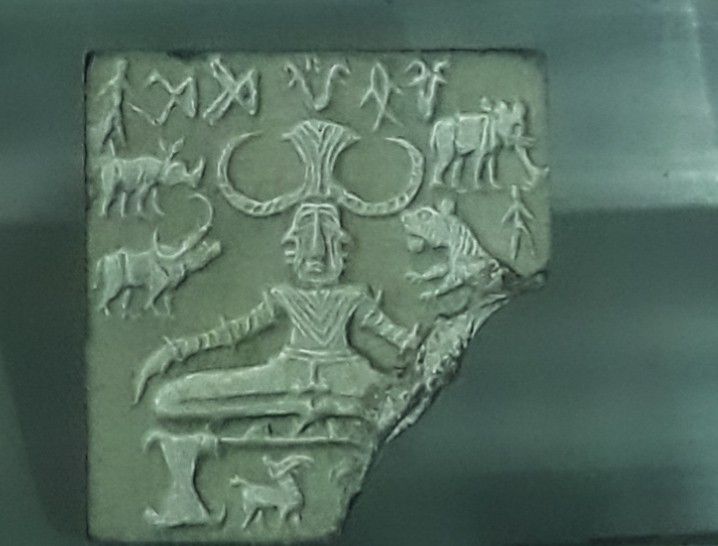
How they look. The seals are generally square and made of steatite, a soft stone that can be carved finely and then hardened by heating. Most show an animal with a short line of script above it. The animals include the one-horned "unicorn", the humped bull, the elephant and the rhinoceros, but never the horse.
The script. The signs belong to a script of about 400 signs, written from right to left. It has not been deciphered, partly because the inscriptions are very short and no bilingual text has been found. So we can see the writing, but we cannot yet hear the language.
The "Pashupati" seal. The most famous seal shows a horned male figure with three heads, seated in a yogic posture. He is surrounded by an elephant, a tiger, a rhinoceros and a buffalo. Many scholars call him Pashupati, "lord of animals", or a proto-Shiva, but others dispute this reading.
Seals and trade. Harappan seals have turned up at Susa and Ur in West Asia. A West Asian seal has been found at Lothal in Gujarat. These finds prove that Harappan merchants traded across the sea and marked their goods for distant buyers.
Why it matters. Seals are the closest thing we have to Harappan "documents". They show what animals people valued, hint at gods and rituals, and prove international trade. Yet they also teach caution, because without the script, words like "Pashupati" remain educated guesses.
Bronze: the dancing girl and the art of metal
Metals they knew. Harappans used all metals except iron. They knew how to mix metals into alloys, such as bronze, which is copper hardened with tin. Copper came from Khetri in Rajasthan, gold from Kolar and Himalayan river beds, and silver was actually more common than gold.
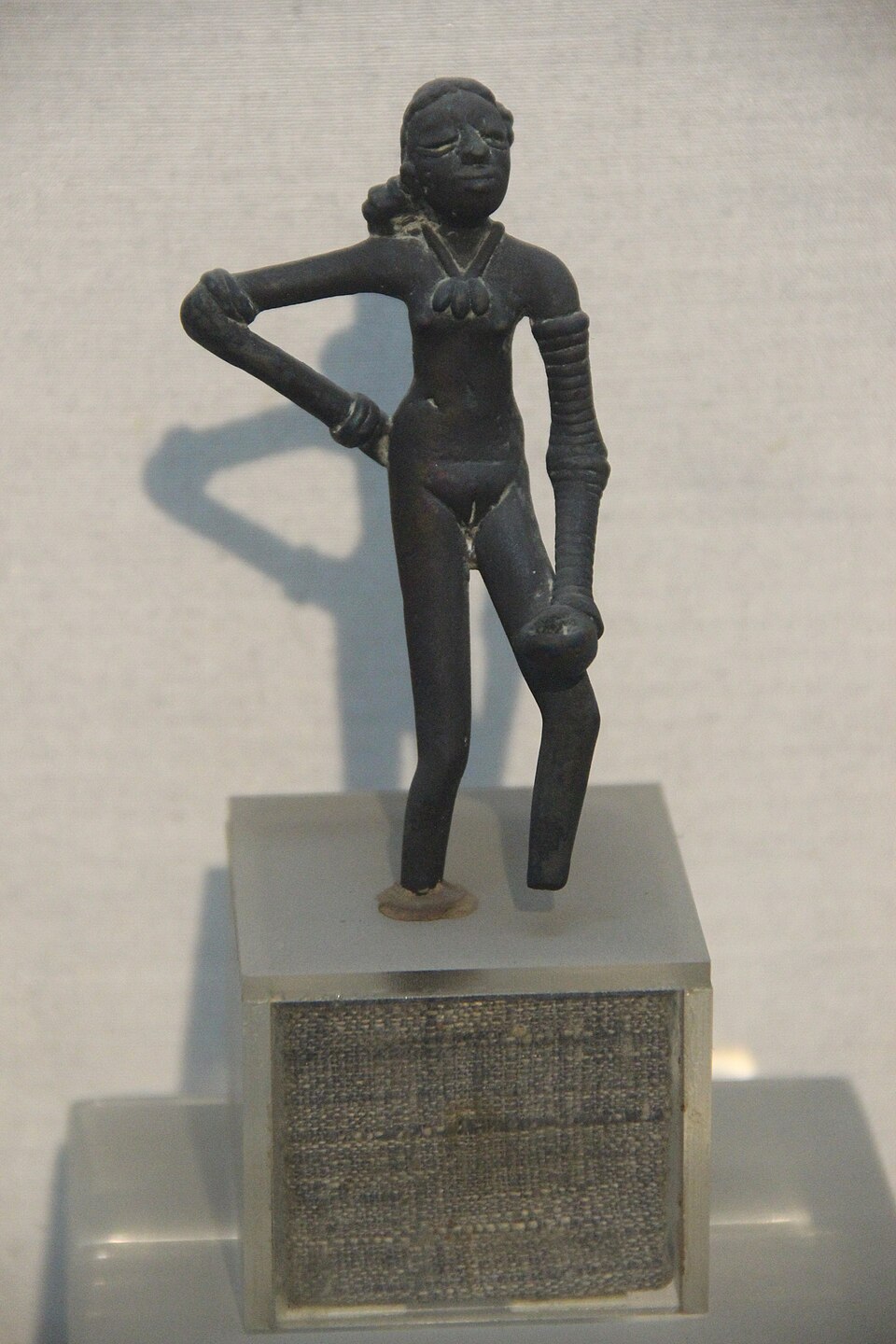
The dancing girl. The most famous Harappan metal object is a small bronze figure from Mohenjodaro, known as the "dancing girl". She stands with her right arm on her hip and her left arm hanging down, covered with many bangles. Her head is tilted, and her pose looks relaxed and confident.
Why she is special. The figure is only a few inches tall, yet it captures attitude and movement. It shows that Harappan artists could do more than make useful objects; they could catch a mood in metal. For this reason the figure is often cited as proof of their skill in sculpture and their sense of beauty.
Bangles then and now. The heavy bangles on her arm remind many people of bangles still worn in parts of India today. That link should not be pushed too far, because one object cannot prove a continuous tradition. Still, it shows how some forms of dress and ornament can last for a very long time.
Why it matters. Metal was costly and needed special skill, so a bronze figure tells us about specialist craftsmen and a society rich enough to support them. It also shows that India's long tradition of metal casting, later seen in Chola bronzes, has very old roots.
Stone sculpture and the missing monuments
The bearded man. A stone bust of a bearded man from Mohenjodaro is the best-known Harappan stone sculpture. His eyes are half closed, as if in meditation, and he wears an embroidered cloak over his left shoulder. Because of his calm face and fine dress, some scholars call it the bust of a priest.
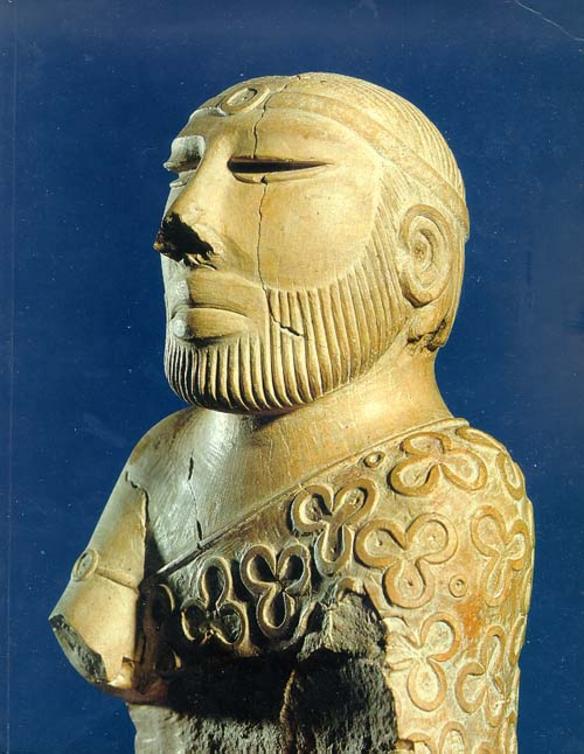
Few large statues. Apart from this bust and a few others, Harappan stone sculpture is rare and small. There are no giant statues of kings or gods like those of Egypt or later India. This absence is itself a clue that the Harappans may not have had all-powerful god-kings.
Planned cities, plain buildings. The Harappans were brilliant planners. They used burnt brick, laid out roads at right angles, built covered drains, used the corbelled arch and made public baths. Yet their surviving buildings look plain, with little decoration that shows an aim of beauty.
Two ways to read the plainness. One view says the Harappans valued order, hygiene and usefulness more than show. Another view says the buildings are simply ruined, so decoration in wood, plaster or paint has been lost. A good answer mentions both, and admits that the evidence is incomplete.
Why it matters. Later Indian art is famous for crowded, decorated temples. The Harappan contrast reminds us that Indian art did not always look like that. Each society shaped its art to its own priorities, and the Harappan priority seems to have been the well-run city.
Terracotta: the art of ordinary people
Clay for everyone. Bronze and fine stone were costly, but terracotta (baked clay) was cheap and everywhere. So terracotta shows us the art of ordinary homes. It is the Harappan equivalent of the clay toys and idols still sold at village fairs.
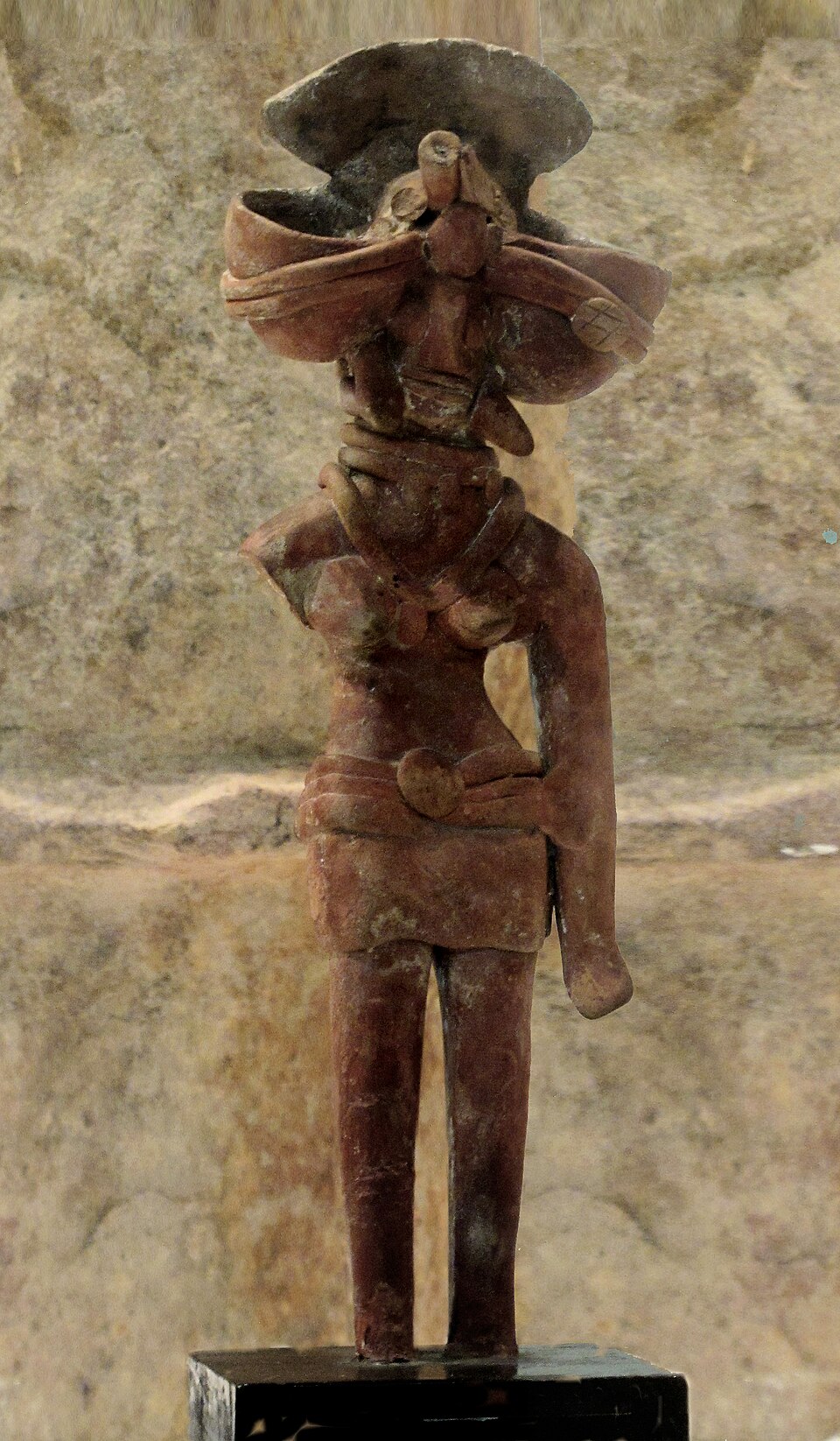
Mother goddesses. Terracotta figurines of women are far more common than those of men. Many wear a girdle, necklaces and a fan-shaped headdress. Scholars link them to the worship of a mother goddess, a giver of life and fertility; one figurine even shows a plant growing from a woman's womb, which suggests an earth goddess.
Animals and toys. Potters also made birds, monkeys, dogs, sheep, cattle, and both humped and humpless bulls. There are toy carts with wheels, notably from Kalibangan. Some of these were surely toys, while others may have been offerings or charms.
Why it matters. Terracotta tells us about popular religion and childhood, which kings' monuments never show. It also reveals that Harappan belief was centred on fertility, nature and animals, not on temples. When a Mains question asks about "continuity" in Indian culture, the village tradition of clay figures is a fair example to discuss, with care.
Pottery, beads and the trade behind them
Excellent potters. The Harappans were excellent potters. Most of their pots were made on a wheel, which gives an even, round shape. They were given a red coating and painted in black with horizontal lines, leaves, palm and peepal trees, birds, fish and animals.
One style over a huge area. The same style of pottery appears across sites hundreds of kilometres apart. This uniformity suggests strong links between towns, through trade, shared customs or some common authority. When the civilisation declined, this uniform pottery disappeared, which is one of the signs of collapse.
Beads and jewellery. Harappan bead-makers worked agate, carnelian and steatite, as well as gold and silver. Their workshops have been found at Chanhudaro and Lothal. Craftsmen also worked shell, ivory, bone and faience, a glazed paste, into bangles, inlays and ornaments.
Rich and poor. Ornaments also show differences of wealth. The rich wore gold, silver and semi-precious stones, while the poor wore terracotta ornaments. Art, in other words, reflects the shape of society.
A trade map in beads. The raw materials came from far away. Lapis lazuli came from Badakhshan in north-east Afghanistan, and agate and carnelian came from western India. Mesopotamian records name Meluhha (the Harappan region), Dilmun (Bahrain) and Magan (the Makran coast), and Mesopotamia imported carnelian, ivory, shell, lapis lazuli, pearls and ebony from Meluhha.
Why it matters. A single carnelian bead found in Mesopotamia tells a story of mines, workshops, ships and markets. This is why Harappan crafts are central to questions on early trade and urbanisation. They also show that India's fame for gems and fine crafts goes back more than 4,000 years.
Quick revision
- The civilisation was discovered in 1920-22 at Harappa (Ravi) and Mohenjodaro (Indus), and its mature phase is c. 2600-1900 BC.
- More than 2,000 seals have been found; they are square and made of steatite, and they show no horse.
- The script has about 400 signs, is written right to left and is not deciphered.
- The "Pashupati" seal shows a three-headed, horned figure in yogic posture with an elephant, tiger, rhinoceros and buffalo.
- Harappan seals have been found at Susa and Ur, and a West Asian seal has been found at Lothal.
- The bronze "dancing girl" comes from Mohenjodaro, with her right arm on her hip and many bangles.
- Harappans knew all metals except iron; copper came from Khetri and gold from Kolar and Himalayan rivers.
- The bearded man (stone, Mohenjodaro) has half-closed eyes and a cloak over his left shoulder.
- Terracotta includes mother goddesses, animals and toy carts (Kalibangan).
- Pottery is wheel-made, red with black painted designs.
- Bead workshops were at Chanhudaro and Lothal, and lapis lazuli came from Badakhshan.
- Mesopotamian records name Meluhha (Harappan region), Dilmun (Bahrain) and Magan (Makran).