

BPSC LDC · Module 53 · basic depth · 20 min
The ozone layer: how the world broke it and how it is healing
What BPSC LDC asks from this chapter
Syllabus lines this chapter covers:
- Paper 2: General Knowledge (General Studies, General Science and Mathematics, Mental Ability) · General awareness of the environment around the candidate and its application to society, and everyday matters in their scientific aspect
BPSC LDC questions from this module are being sorted into our bank.
Cut to basic depth for BPSC LDC. 9 deeper paragraphs are in the full chapter.
Start from zero: sunscreen in the sky
On a hot afternoon, a cricketer puts on sunscreen before going out to bat. The cream does not block the light, so the player can still see the ball. It blocks only the harmful part of sunlight that burns the skin.
The Earth has its own sunscreen, and it sits about 15 to 50 kilometres above our heads. It is a thin spread of a gas called ozone. It lets visible light through, but it soaks up most of the Sun's ultraviolet (UV) rays, which can burn skin, damage eyes and harm plants.
In the 1970s and 1980s, scientists found that chemicals made in factories were eating holes in this sunscreen. What happened next is one of the best stories in environmental history. The world agreed on a treaty, phased out the harmful chemicals, and the ozone layer is now healing.
This chapter explains what ozone is and why it matters, how the damage happened, why the hole appeared over Antarctica, and how the Vienna Convention, the Montreal Protocol and the Kigali Amendment repaired it. It also explains why this success is often held up as a model for fighting climate change.
What ozone is and what it stops
The oxygen we breathe is O2, two oxygen atoms joined together. Ozone is O3, three oxygen atoms joined together. High in the atmosphere, strong UV light splits O2 into single atoms, and some of these atoms join other O2 molecules to form ozone.
The atmosphere has layers. We live in the lowest one, the troposphere, where weather happens. Above it lies the stratosphere, from about 15 to 50 km, and this is where most ozone is found. Even here ozone is only a trace gas, and its peak concentration is about 300 parts per billion, at about 25 km near the equator and about 15 km near the poles.
This thin layer absorbs about 99% of the Sun's ultraviolet radiation, which is divided into three bands by energy. UVA has the least energy and is not absorbed by ozone. UVB has more energy and is dangerous, and most of it is absorbed, so only 2–3% reaches the surface. UVC has the most energy and is completely stopped high up by oxygen and ozone.
So the ozone layer acts mainly as a UVB filter. When it thins, more UVB reaches the ground, and that is what harms living things. This is why scientists watch the amount of ozone in a column of air so closely.
Measuring it: the Dobson unit. The total ozone above a place is given in Dobson units (DU). One Dobson unit is the amount of ozone that would make a layer of pure ozone 0.01 mm thick if it were brought down to 0 °C and normal air pressure. The whole layer averages only about 300 DU, which is just 3 mm of pure ozone, and an area with 220 DU or less is counted as part of the ozone hole.
Good ozone and bad ozone. The same gas plays two opposite roles. High in the stratosphere it protects us. Near the ground it is a pollutant formed from vehicle and factory fumes in sunlight, and it irritates lungs, damages crops and traps heat.
How factory chemicals reached the sky
Chlorofluorocarbons (CFCs) are compounds of chlorine, fluorine and carbon. Industry loved them because they are non-toxic, do not burn and do not react with other substances. They were used as the gas in spray cans (hair sprays, deodorants, paints, insecticides), as coolants in refrigerators and air-conditioners, and to blow the bubbles in foam for mattresses, furniture and packaging.
Their stability turned out to be the problem. Because CFCs do not react near the ground, they do not get washed out by rain. They stay in the air for 75 to 140 years, slowly drifting upward until they reach the stratosphere.
In 1974, two chemists, Mario Molina and F. Sherwood Rowland, explained what happens next. In the stratosphere, strong UV light breaks CFC molecules apart and frees chlorine atoms. A chlorine atom attacks an ozone molecule and turns it into ordinary oxygen, but the chlorine itself comes out unchanged and attacks again. This chain reaction means one chlorine atom can destroy thousands of ozone molecules before it is finally locked away.
CFCs were not the only culprits. Halons, which contain bromine and are used in fire extinguishers, are even stronger ozone destroyers. Carbon tetrachloride and methyl chloroform (1,1,1-trichloroethane), used as solvents and in dry cleaning, also deplete ozone. Together these are called ozone-depleting substances (ODS).
Why this matters for policy. Because ODS last so long, cutting emissions today helps only decades later. The chemicals already in the air keep working for a lifetime. This delay is why the treaties had to act early, before the damage was fully visible.
The ozone hole: why over Antarctica, and why in spring
The British Antarctic Survey began measuring ozone over Antarctica in 1957. In 1985 its scientists reported something alarming: every southern spring, ozone over the continent was dropping sharply. Satellites soon confirmed a huge region of very low ozone, which came to be called the ozone hole.
The word "hole" is a little misleading. The layer does not vanish completely. It becomes so thin over a large area that far more UVB passes through, and this thinning returns each year at the start of the southern spring, from about August to October.
Why Antarctica, when most CFCs were released in the industrial north? During the long, dark polar winter, a ring of strong winds called the polar vortex seals off the air above Antarctica. The air inside becomes so cold that rare polar stratospheric clouds form, and on the surfaces of their ice particles, harmless forms of chlorine are turned into active forms. When sunlight returns in spring, it releases this stored chlorine all at once, and ozone is destroyed very fast.
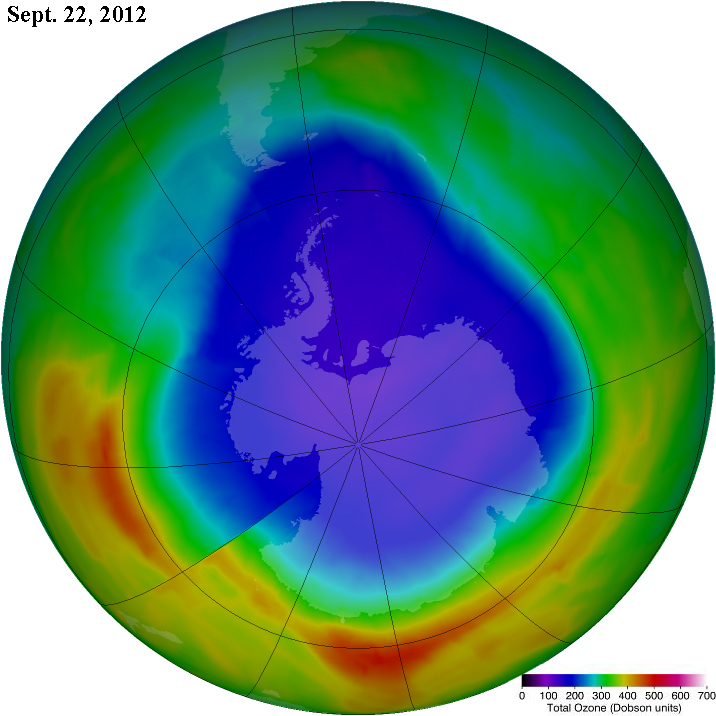
The Arctic sees some thinning too, and so do the mid-latitudes over North America and Europe. But the Arctic is usually warmer and its vortex weaker, so the losses are smaller and vary more from year to year. This is why the most dramatic hole is always in the south.
What more UVB does to life
A thinner ozone layer is not a distant problem. It reaches into hospitals, farms, oceans and even the objects we use every day.
Human and animal health. Extra UVB causes skin cancer and cataracts, the clouding of the eye's lens that leads to blindness. It also weakens the immune system, which raises the risk of infectious diseases. Animals face the same eye and skin damage.
Plants and crops. UVB disturbs the way plants grow and develop. It can reduce photosynthesis, so many species become smaller, less productive and lower in quality, and it can cause mutations. Over time this affects both food supply and biodiversity.
Oceans. Phytoplankton, the tiny floating plants at the base of ocean food chains, are harmed by UV. Fewer phytoplankton means less food for everything above them, including fish. UV also damages the early life stages of many aquatic animals, such as fish eggs and larvae.
Materials. UVB speeds up the breakdown of plastics and other polymers, so paints, pipes and outdoor materials age faster. This adds an economic cost to the health and ecological costs.
Vienna and Montreal: from warning to binding cuts
Governments moved in two steps. First came a framework, an agreement to cooperate and share research. Then came a protocol, with binding, dated cuts.
The Vienna Convention for the Protection of the Ozone Layer was adopted in 1985 and came into force in 1988. It did not set any targets. It committed countries to study the ozone layer, share information and take appropriate measures, and it created the legal home for a later protocol.
The Montreal Protocol on Substances that Deplete the Ozone Layer was signed on 16 September 1987 and came into force in 1989. It listed the ozone-depleting substances and set a schedule to phase out their production and consumption, starting with CFCs and halons. Developed countries were to act first, and developing countries were given more time.
The Protocol was designed to tighten as the science improved. It has been amended or adjusted six times, adding new chemicals and speeding up deadlines. A Multilateral Fund pays the extra costs that developing countries face in switching to safer technology, through four implementing agencies: UNDP, UNEP, UNIDO and the World Bank.
In 2009, the Vienna Convention and the Montreal Protocol became the first treaties in the history of the United Nations to be ratified by every country in the world. To mark the signing of the Protocol, 16 September is observed each year as the International Day for the Preservation of the Ozone Layer.
Why did it work so well? Several reasons came together. The science was clear and the danger, skin cancer, was easy for the public to understand. Substitutes for CFCs were available, so industry could switch. And the treaty was fair: it gave poorer countries more time and paid their switching costs.
Kigali: when the cure became a new problem
As CFCs were phased out, industry switched to substitutes. Many of the newer coolants were hydrofluorocarbons (HFCs). HFCs contain no chlorine or bromine, so they do not harm the ozone layer at all.
But HFCs turned out to be very powerful greenhouse gases, trapping far more heat per molecule than carbon dioxide. With air-conditioners and refrigerators spreading fast in warm, growing economies, HFC use was set to soar. Fixing the ozone layer was quietly making climate change worse.
The answer was the Kigali Amendment, agreed at the 28th Meeting of the Parties to the Montreal Protocol in Kigali, Rwanda, in October 2016. It came into force on 1 January 2019. It adds HFCs to the Montreal Protocol and requires countries to phase down, not fully phase out, their production and use.
The schedule follows the Montreal pattern of developed countries first. Developed countries began cuts in 2019. Developing countries are split into groups: most freeze their HFC use in 2024, and a second group, with hotter climates and fast-growing cooling demand, freezes in 2028, with cuts later reaching 15–20% of their baseline by the late 2040s.
The payoff is large. The 2022 scientific assessment estimates that the Kigali Amendment will avoid 0.3 to 0.5 °C of warming by 2100. That is why it is often called one of the biggest single steps against climate change, taken through an ozone treaty.
India's ozone story
India joined the Montreal Protocol by acceding to it on 17 September 1992, as a developing country with extra time. Seven of the twenty substances first controlled by the Protocol were being produced and used in India: CFC-11, CFC-12, CFC-113, halon-1211, halon-1301, carbon tetrachloride and methyl chloroform.
The environment ministry coordinates all Montreal Protocol work, and an Ozone Cell was set up as the national unit to implement and monitor it. Projects to help factories switch to safer technology are funded by the Multilateral Fund. The government also gave customs and excise duty exemptions to firms moving to non-ODS technology.
The legal backbone is the Ozone Depleting Substances (Regulation) Rules, 2000. They control the production, sale, consumption, import and export of these chemicals. In other words, the treaty was turned into domestic law that inspectors and courts can enforce.
The results were steady:
- Halons: production and consumption phased out from 1 January 2002.
- CFC-11, 12 and 113: production phased out from 1 August 2008, and consumption from 1 January 2010.
- Carbon tetrachloride: production and consumption phased out from 1 January 2010.
India also ratified the Kigali Amendment on 27 September 2021, so the same machinery now has to manage the phase-down of HFCs as demand for air-conditioning grows.
Why this matters. India shows that a large developing country can meet strict deadlines when finance, technology and clear rules come together. That lesson is directly useful for the much harder task of cutting greenhouse gases.
Healing: when will the layer be whole again?
Because ODS last for decades, the ozone layer could not recover overnight. Scientists from WMO and UNEP review its condition every four years. The 2022 assessment confirmed that the phase-out is working and that ozone-depleting substances in the atmosphere are falling.
It also gave dates for a return to 1980 levels, the time before the hole appeared:
- about 2040 for most of the world,
- about 2045 over the Arctic,
- about 2066 over Antarctica, where the damage was worst.
Recovery depends on every country continuing to follow the rules. Illegal production of banned chemicals, or new uses that release ODS, could delay it. Monitoring stations and satellites therefore keep watching for unexpected rises in these gases.
The bigger lesson. The ozone story shows that a global environmental problem can be solved when science, public concern, available substitutes and fair finance line up. Climate change is harder, because carbon dioxide comes from almost every activity in the economy. Even so, the Montreal model of clear schedules, help for poorer countries and regular tightening is widely studied for climate treaties.
Quick revision
- Ozone = O3; the layer sits in the stratosphere (15–50 km) and absorbs about 99% of UV; 1 DU = 0.01 mm of pure ozone, the layer averages about 300 DU, and the hole is 220 DU or less.
- UVA passes, most UVB is absorbed (2–3% reaches the ground), UVC is stopped completely.
- CFCs last 75–140 years; Molina and Rowland (1974) showed that chlorine released by UV destroys ozone in chain reactions; halons (bromine) also deplete ozone.
- British Antarctic Survey reported the Antarctic spring depletion in 1985; the hole forms in August–October because of the polar vortex, polar stratospheric clouds and returning sunlight.
- UVB effects: skin cancer, cataracts, weak immunity, crop damage, fewer phytoplankton, faster breakdown of polymers.
- Vienna Convention 1985 (framework, in force 1988); Montreal Protocol 16 Sep 1987 (phase-out schedule, in force 1989); first treaties ratified by every country (2009); 16 September is Ozone Day.
- Kigali Amendment (Kigali, Oct 2016; in force 1 Jan 2019) phases down HFCs, which are greenhouse gases, not ozone destroyers; avoids 0.3–0.5 °C by 2100.
- India: acceded 17 Sep 1992; Ozone Cell; ODS Rules 2000; halons ended 2002, CFC production 1 Aug 2008, CFC use and CTC 1 Jan 2010; ratified Kigali on 27 Sep 2021.
- Recovery to 1980 levels: about 2040 (world), 2045 (Arctic), 2066 (Antarctica).