BPSC TRE 4.0 · Module 51 · standard depth · 13 min
How a rocket works
What BPSC TRE 4.0 asks from this chapter
Syllabus lines this chapter covers:
Class 1 to 5 teacher · Part II, General Studies (120 questions): elementary mathematics, mental ability, general awareness, general science, social science, Indian National Movement, geography and environment (SCERT/NCERT-based).
Class 6 to 8 teacher · Part II, General Studies: elementary mathematics, general awareness, general science, Indian National Movement and geography (SCERT-based, at the level of the minimum qualification).
Class 9 to 10 teacher · Part II, General Studies: elementary mathematics, general awareness, general science, Indian National Movement and geography (SCERT-based, at the level of the minimum qualification).
Class 11 to 12 teacher · Part II, General Studies: elementary mathematics, general awareness, general science, Indian National Movement and geography (SCERT-based, at the level of the minimum qualification).
BPSC TRE 4.0 questions from this module are being sorted into our bank.
Cut to standard depth for BPSC TRE 4.0. 7 deeper paragraphs are in the full chapter.
Start from zero: how does anything go up?
Blow up a balloon, pinch the neck, and then let it go. It shoots across the room. Why?
A balloon and a rocket work the same way
The rubber squeezes the air inside, and the air rushes out of the open neck backwards. At the same moment the balloon zooms forwards. The air was pushed one way, so the balloon was pushed the other way.
You have felt this yourself. Stand on a skateboard and throw a heavy school bag forward: you roll backwards. Fire a toy water gun hard and your hand jerks back a little.
Step off a small boat onto the bank, and the boat slides away from the bank. In every case there is a push, and a push back.
A push and a push back, every day
Now think about what a rocket has to fight. Anything we throw up comes back down, because the Earth pulls everything towards its centre. This pull is called gravity, and a rocket must push hard enough to beat it.
So the first question of space travel is simple: how do we push something up with enough force to beat gravity? The answer hides in the balloon: throw gas out of the back, very fast. The machine that does this is called a rocket.
This chapter makes that one idea bigger, step by step. By the end you will know how a rocket engine pushes, why rockets burn different fuels, and why India's rockets drop several parts during flight. Where the rocket leaves its satellite, and how the satellite then stays up, is the story of orbits.
Push and push back: how a rocket engine works
The balloon follows a rule that Isaac Newton wrote down more than 300 years ago. It is called Newton's third law of motion: whenever one object exerts a force on a second object, the second object exerts an equal and opposite force on the first. You may know it in its short form: for every action there is an equal and opposite reaction.
Inside a rocket engine
Notice two words: equal and opposite. When the balloon pushes the air out backwards, the air pushes the balloon forwards just as hard. The two forces always come in a pair, and they act on different objects: one on the air, one on the balloon.
A rocket engine is a very powerful, very controlled balloon. Here is what happens inside it:
Fuel and oxidiser meet. Fire needs oxygen: on Earth, a stove or a car engine takes oxygen from the air. A rocket carries its own oxygen-giver, called the oxidiser, in a separate tank.
They burn in a combustion chamber. Burning makes a huge amount of gas at very high temperature and pressure.
The gas escapes through a nozzle. The nozzle is shaped like a bell. It speeds the gas up, so that it leaves at thousands of metres per second.
The rocket is pushed the other way. The gas is thrown down; by Newton's third law, the rocket is pushed up. This push is called thrust.
So what does a rocket push against? It pushes on its own exhaust gas, and the gas pushes back on the rocket.
That is why a rocket works even in space, where there is no air at all. A jet engine or a propeller would stop working there, because each of them needs outside air. A rocket keeps working, because it brings everything it needs.
What pushes harder: the thrust formula and three kinds of fuel
How strong is the push? Engineers write the answer in one line:
Three kinds of rocket fuel
F = ṁ·vₑ + (pₑ − p₀)·Aₑ
Read it slowly, it is simpler than it looks:
Reading the thrust formula
ṁ (say "m-dot") is the mass flow rate: how many kilograms of gas leave the nozzle every second (kg/s).
vₑ is the exit velocity: how fast the gas leaves (m/s).
pₑ − p₀ is the difference between the gas pressure at the nozzle mouth and the outside air pressure, and Aₑ is the area of the nozzle mouth (m²). This second part is a small correction.
So the main idea is ṁ × vₑ: throw out more gas, or throw it out faster, and you get more thrust. A garden hose shows this: open the tap wider (more water per second) or press your thumb on the mouth (faster water), and the hose kicks back harder in your hand.
Rocket designers choose fuels to get the best mix of power, weight and control. India's rockets use three kinds:
Gives the most push per kilogram of propellant, ideal for the top stage
Very hard to build: gases must be stored as super-cold liquids, and metals and seals behave differently at such low temperatures
Why cryogenic matters: reaching a high orbit like GEO needs a lot of extra speed near the end of the flight. A cryogenic upper stage gives the most speed for the least weight, so it is the key to heavy satellites. ISRO describes GSLV's Cryogenic Upper Stage as indigenously developed and flight proven; GSLV flew with it for the first time on 5 January 2014.
Why rockets come in stages
Now we know how a rocket gets its push. The next question is how to make the most of that push, and the answer is staging.
PSLV: four stages, solid and liquid by turns
Imagine walking up a long hill carrying a full water can. As you drink, the can gets lighter, but you still carry the heavy empty can all the way to the top. Wouldn't it be easier to throw away each empty can as you go?
That is exactly the idea of staging. Most of a rocket's weight at lift-off is propellant, held in big tanks and motor cases. Once a stage has burnt all its propellant, its empty shell is dead weight.
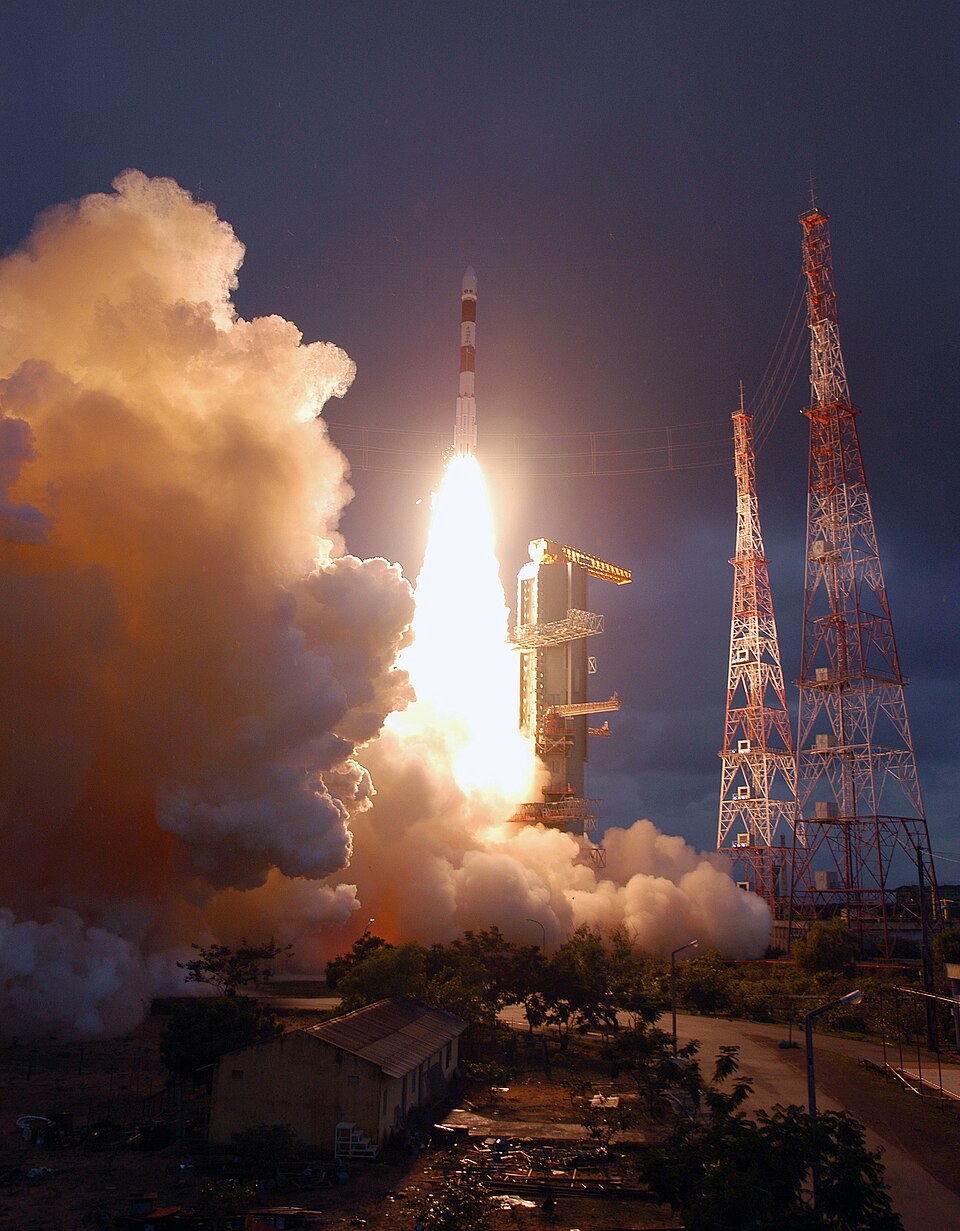
A PSLV launch from SriharikotaPhoto: NASA, Public domain, via Wikimedia Commons
So the rocket drops it, and the next, smaller stage fires. Each time the rocket gets lighter, the same push gives it more speed (a lighter cricket ball flies farther from the same throw).
India's PSLV is the best example to learn. It has 4 stages:
Why drop empty stages?
PS1, solid: the S139 motor, carrying 139 tonnes of HTPB-based solid propellant, which gives the huge push needed to lift the rocket off the pad.
PS2, liquid: the Vikas engine, burning UDMH with N₂O₄.
PS3, solid: a smaller HTPB-based solid motor.
PS4, liquid: two small engines burning MMH with MON; this top stage places the satellite precisely in its orbit.
So PSLV alternates solid → liquid → solid → liquid. That alternation is a favourite exam fact.
Strap-ons: extra solid boosters tied to the sides of the first stage, for more push at lift-off. PSLV comes in four versions: PSLV-XL with 6 strap-ons, PSLV-QL with 4, PSLV-DL with 2, and PSLV-CA ("core alone") with none. The mission chooses the version: a heavier satellite needs more strap-ons.
PSLV, the Workhorse of ISRO
Size: PSLV stands about 44 m tall (about a 15-storey building), and the XL version weighs 320 tonnes at lift-off. Almost all of that weight is propellant; the satellite at the top is a small fraction of it.
The Workhorse: PSLV is known as "the Workhorse of ISRO". It can put 1,750 kg into a sun-synchronous polar orbit about 600 km high, and 1,425 kg into a sub-GTO (a lower version of the transfer orbit to GEO). It launched Chandrayaan-1 (2008), the Mars Orbiter Mission (2013) and Aditya-L1 (2023). Its first flight was on 20 September 1993, and its first successful launch came in October 1994.
What changed because of these engineering choices
Knowing how a rocket works is only half the story. UPSC also asks so what? Each engineering choice in this chapter changed something real.
What these choices changed
1. The right rocket for each job. Because fuels differ, rockets can be matched to jobs. Solid motors are simple and quick to prepare, so the small SSLV uses them for its three main stages. A cryogenic upper stage gives the extra speed that heavy satellites need, so GSLV and LVM3 carry one.
2. Cost. Staging means a rocket does not carry empty tanks all the way up. So the same lift-off mass places a bigger satellite in orbit, and each kilogram in orbit costs less.
3. Self-reliance. The cryogenic stage was the hardest piece to build. Early GSLV flights used cryogenic stages supplied by Russia, and India's own stage first flew on 5 January 2014. Since then, India has launched its heavy satellites on Indian cryogenic engines.
4. New problems. Staging leaves used parts behind. Lower stages fall back to Earth, but spent upper stages can stay in orbit for years as space debris. So every launch must now plan what happens to its upper stage after use.
Previous years' questions
This section shows the real past questions on this chapter for the exam you have chosen. Each question is copied word for word from the official paper, with the year and paper, so that you can see how the topic is actually asked.
Questions are being collected from the official UPSC and BPSC papers. They will appear here once each one is checked against the original paper.
Quick revision
One-page revision card
A rocket works by Newton's third law: it throws gas back, and the gas pushes it forward. It carries its own oxidiser, so it works even in vacuum.
Thrust is given by F = ṁ·vₑ + (pₑ − p₀)·Aₑ. More gas per second, or faster gas, means more thrust.
Rockets use three kinds of fuel: solid (HTPB), liquid (UDMH + N₂O₄ in the Vikas engine) and cryogenic (LOX + LH₂). GSLV uses the CE-7.5 cryogenic engine and LVM3 uses the CE-20.
Staging drops empty weight during flight. PSLV has 4 stages (solid, liquid, solid, liquid), up to 6 strap-ons in the XL version, and is called the "Workhorse of ISRO".
Rockets drop stages to shed empty weight. Spent upper stages left in orbit become space debris.
Exam-style questions on this chapter. Pick an answer to see the explanation. 0 of 9 answered
Which law of motion best explains how a rocket moves forward?
Where does a rocket's thrust come from?
Assertion (A): A rocket can produce thrust in the vacuum of space.
Reason (R): A rocket carries its own oxidiser, so it does not need oxygen from outside air.
In the thrust formula F = ṁ·vₑ + (pₑ − p₀)·Aₑ, what does ṁ stand for?
From bottom to top, the four stages of PSLV use which fuels?
How many strap-on motors does the PSLV-XL version use?
Consider the following statements:
1. The third stage of GSLV Mk II is a cryogenic stage.
2. A cryogenic stage burns liquid oxygen and liquid hydrogen.
3. The CE-20 engine powers GSLV Mk II.
Which of the statements given above is/are correct?
Which Indian rocket uses two S200 solid boosters?
SSLV can carry a single satellite of up to about how much mass to a 500 km planar orbit?
Mains answer practice
Write your answer first, then open the points a good answer should cover.
Why is the cryogenic stage called the real test of self-reliance in launch vehicles? Trace how India built its own. (150 words)
Show answer points
The cryogenic stage burns super-cold LOX and LH₂ and is the hardest part of a heavy rocket to build.
It gives heavy satellites the extra speed they need to reach GTO.
Early GSLV flights used cryogenic stages supplied by Russia, so heavy launches depended on a foreign supplier.
ISRO's Cryogenic Upper Stage Project built the CE-7.5, which first flew on GSLV-D5 in January 2014.
The CE-20 now powers the C25 stage of LVM3, so India launches its heavy satellites on its own engines.
Previous year questions
Previous year questions for UPSC CSE will appear here once each one is checked word for word against the official question paper.
Frequently asked questions
Which law explains how a rocket flies?
Newton's third law: the exhaust is pushed one way and the rocket moves the other way.
Why can a rocket work in space?
It carries its own oxidiser, so it does not need air from outside.
What is a cryogenic engine?
An engine that burns very cold liquid hydrogen with liquid oxygen; it gives high efficiency and powers upper stages like GSLV's CE-7.5 and LVM3's CE-20.
How many stages does PSLV have?
Four: solid, liquid, solid and liquid, in that order.