

BPSSC SI Special Branch · Module 2 · standard depth · 17 min
The Early Vedic period
What BPSSC SI Special Branch asks from this chapter
Syllabus lines this chapter covers:
- Prelims: general knowledge and social issues · General knowledge and current affairs
- Mains Paper I (objective): GS 50, Maths 40, Reasoning 40, English 20, Hindi 20, Bihar GK 30 · General studies
BPSSC SI Special Branch questions from this module are being sorted into our bank.
Cut to standard depth for BPSSC SI Special Branch. 8 deeper paragraphs are in the full chapter.
Start from zero: who were the Vedic people?
After the Harappan cities faded, as we saw in the chapter on Harappan decline, north-west India became a land of villages and herders. Around the same broad time a new body of sacred poetry was being composed there. These hymns, the Rig Veda, are India's oldest surviving texts.
The people who composed them called themselves arya and are known to us as the Vedic people. They have left us almost no buildings or cities. What they left is words: over a thousand hymns to their gods, full of clues about how they lived.
Those clues paint a picture very different from the Harappans. Wealth was counted in cows, not in bricks and seals. People moved with their herds, tribes raided one another, and chiefs were chosen by their kinsmen.
This chapter explains what the Rig Veda tells us about economy, society, politics and religion, and how historians test it against archaeology. It also tackles the much-debated 'Aryan question'. Understanding this early phase is the key to seeing how caste, kingship and Brahmanical religion later took shape.
The Early Vedic age at a glance
| Theme | Early Vedic picture | Key words |
|---|---|---|
| Time and text | Rig Veda, c. 1500-1000 BC; oral | Mandalas II-VII oldest |
| Region | Punjab, Haryana and the north-west | Sapta-Sindhava |
| Economy | Pastoral; cattle as wealth; some barley | gomat, gavishti, yava |
| Society | Tribal, kin-based, patriarchal; no caste yet | jana, vis, grama, kula |
| Polity | Chosen chief and assemblies | raja, gopati, Sabha, Samiti |
| Religion | Nature gods; sacrifice for material goals | Indra, Agni, Varuna, Soma |
| Technology | Copper and stone; no iron | Horse and chariot in war |
One source, many limits. Almost everything here comes from a single kind of source: religious hymns composed by priests. They tell us what priests and chiefs valued, not the whole of society. Wherever possible, historians test them against archaeology.
The sources and the 'Aryan question'
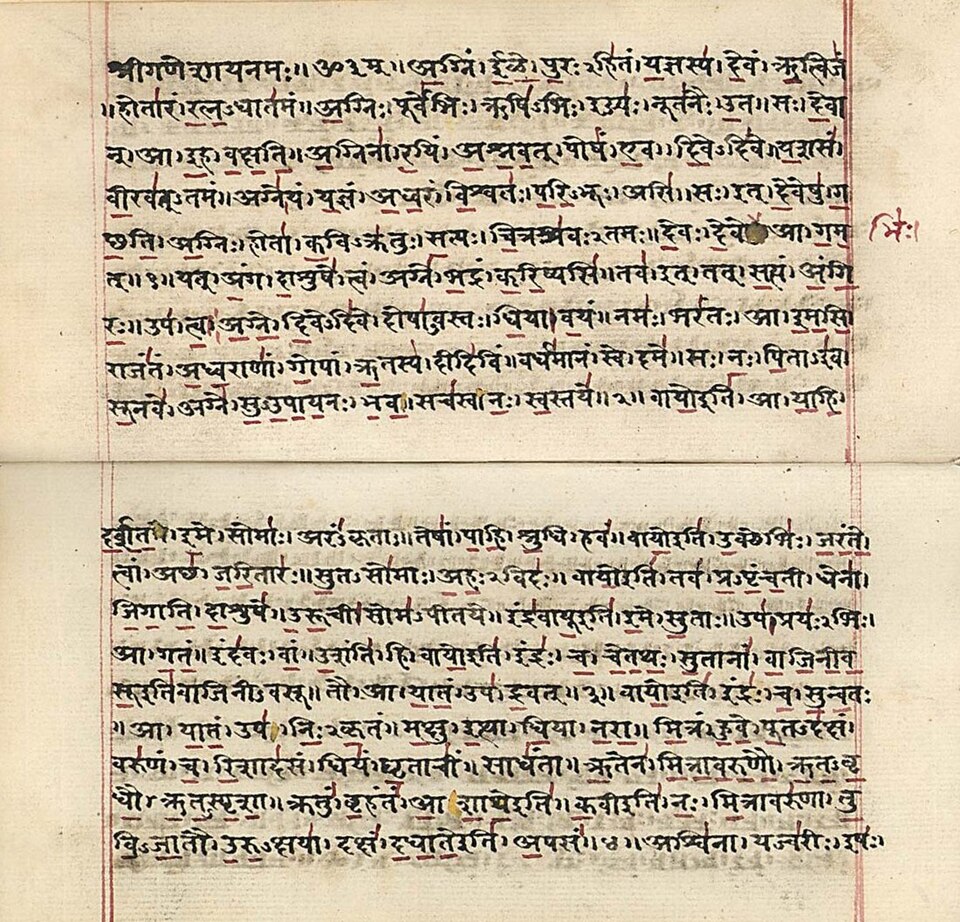
What 'Veda' means. The word Veda comes from vid, 'to know'. There are four Vedas, also called Samhitas or collections: Rig, Sama, Yajur and Atharva. Each is a collection of hymns, chants or formulas gathered over centuries.
Four very different books. The Rig Veda holds hymns addressed mainly to Agni, Indra and Soma. The Samaveda rearranges Rig Vedic hymns for singing, so it adds little new. The Yajurveda sets mantras in the order they are used in sacrifices and contains some of the earliest Sanskrit prose, while the Atharvaveda has charms to cure illness and win success in love and life, giving a rare view of popular beliefs.
Dating an oral text. The hymns were meant to be recited, learnt and transmitted orally, not written. So no Samhita can be dated exactly, and each was built up over several centuries. The Rig Veda is usually placed between about 1500 and 1000 BC, though some scholars put its beginnings earlier.
Old and new layers. The Rig Veda has ten mandalas. Books II to VII, called the family books because each was composed by one family of priests, are the oldest and belong to the Early Vedic phase. The tenth mandala is among the latest parts, and that matters: some big ideas, like the four varnas, appear only there.
Where it was composed. The core area is Sapta-Sindhava, the 'land of seven rivers', meaning Punjab and Haryana. Rig Vedic geography also reaches the Gomal plains, southern Afghanistan and southern Jammu and Kashmir. Rivers like the Indus, Sutlej, Ravi and Ghaggar are named, and they often changed course.
The 'Aryan' idea. Scholars noticed that the language of the Rig Veda is very close to that of the Avesta, the oldest Iranian text. From this they argued that a people called 'Aryans' migrated from West Asia and Iran into India. For a long time this was told as a story of a superior race conquering the subcontinent.
What archaeology says. That story has been heavily revised. Archaeology shows no clear evidence of a large-scale migration around 1500 BC and no proof that newcomers destroyed the Harappan cities. 'Aryan' is best seen as a linguistic label, not a racial or ethnic one, and it cannot be matched with any one type of pottery.
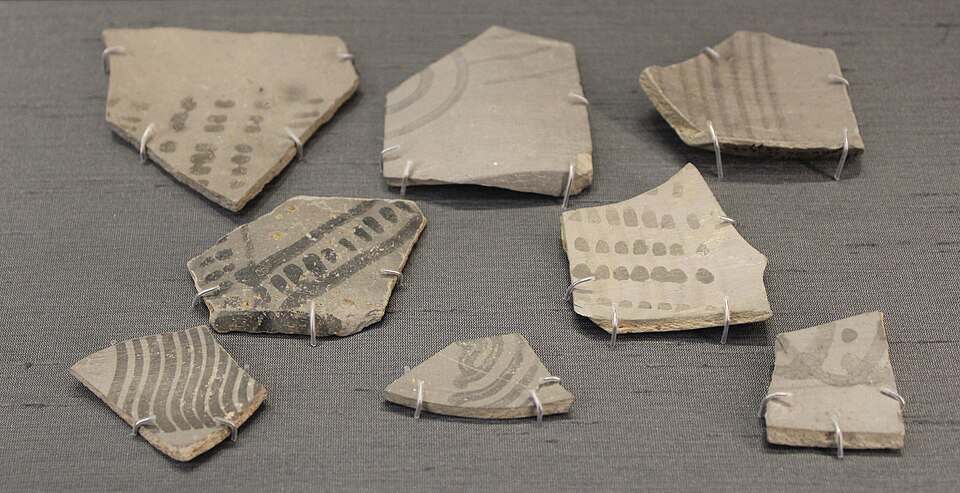
The pottery test. The Painted Grey Ware (about 900-500 BC) has often been called Aryan. But it is found mainly in Haryana, the upper Ganga basin and eastern Rajasthan, not along the supposed route of migrants through Bahawalpur and Punjab. At Bhagwanpura, Dadheri (Haryana) and Manda (Jammu), Late Harappan and Painted Grey Ware occur together without a break, which argues against a sudden invasion.
So what is the Rig Veda worth? Even if the old invasion story falls, the Rig Veda remains priceless. It gives insights into economy, kinship, kingship and beliefs that no pot or bead can provide. The best approach is to read it alongside the post-Harappan village cultures of the north-west, as the chapter on sources suggests for every text.
A cattle economy
Why pastoralism? Pastoralism means living mainly off animals rather than crops. It suits regions where large-scale farming is hard. The Rig Vedic region had low rainfall and rivers that kept changing course, and without big irrigation works the riverside land could not be farmed permanently.
Cows everywhere in the language. The Rig Veda is full of words built on gau, the cow. A wealthy man was gomat, the chief was gopati, 'protector of cows', and the word for battle, gavishti, literally means 'search for cows'. A daughter was duhitr, 'one who milks', distance was gavyuti, dusk was godhuli, and kin groups were gotra.
Cattle raids. Because cattle were wealth, they were also the main cause of conflict. The hymns speak of the Panis, who hid their cows in mountains and forests, and ask Indra to release them. Such passages suggest that cattle raids between groups were common.
A little farming. References to agriculture are few, and most belong to later parts of the text. Barley (yava) is the only grain named. Hoes, sickles and axes are mentioned, but they were probably used to clear land for shifting cultivation, with fire used to burn forest.
No iron yet. The Early Vedic people used copper and stone tools, not iron. Copper was too soft and scarce to transform farming. This is one reason agriculture stayed secondary.
On the move. Pastoralism and shifting farming made people semi-nomadic: they left villages for part of the year to feed their herds. Even the word for settlement, vis, appears with prefixes meaning 'settling near', 're-entering' and 'coming back'. Life was not fully settled.
Gifts, not markets. Wealth moved mainly through gift-giving and redistribution. Defeated groups paid bali, tribute, to victorious chiefs, clansmen shared the booty, and the chief fed and rewarded his people at ceremonies to win prestige. There is little evidence of trade, and land was not private property.
A tribal society
Built on kinship. Early Vedic society was tribal: relations of blood and kinship mattered most. Even chiefs, priests and artisans were part of clan networks. There was no caste division yet.
From family to tribe. The basic unit was the kula, the family, headed by the kulapa, usually the eldest male. Families formed clans, called vis, which settled in villages, grama. Many clans together made up the tribe, the jana.
Tribes at war. Tribes fought often, mostly over cattle. The most famous conflict is the Battle of Ten Kings (Dasharajna). In it Sudas led the Bharata tribe, and tribes such as the Purus, Yadus, Druhyus, Anus and Turvasus took part.
A patriarchal society. Society was patriarchal, and prayers for sons run through the hymns. Prayers for daughters are almost absent, though there are prayers for children in general. The father-son bond, of mutual support, is the tie that figures most often.
Yet women had a voice. Women held a fairly important place compared to later times. They could be educated, attend assemblies, and some composed hymns. They could choose their partners and marry late, though they were always seen as dependent on fathers, brothers or husbands.
Two kinds of household. The Rig Veda knows the dam, a household run jointly by husband and wife, called the dampati, who were expected to act in harmony. It also knows the grha, headed by a single male grhapati. Over time the grha became the only recognised form, a sign of hardening patriarchy.
Arya and dasa. The hymns contrast the arya with the dasa and dasyu, who are described as dark, speaking a hostile tongue and living in fortified places. But these references are few, fewer than forty in over 10,000 verses. The difference was of language, customs and religion, not race, as older scholars claimed.
Friends and foes. Groups fought and allied by turns. The Panis were rich in cattle, and the word later came to mean merchants. The great chief Sudas has a name ending like 'dasa', hinting at links between groups that texts present as opposites.
Varna had barely begun. The idea of four ranked varnas appears only once, in the Purusha Sukta of the late tenth mandala. It says the brahmana came from the mouth of a primeval man, the kshatriya from his arms, the vaishya from his thighs and the shudra from his feet. This implies that the order is divine and hierarchical, but apart from this hymn the varna terms barely appear.
Occupations and inequality. The hymns mention weavers, smiths, carpenters, leather workers, chariot-makers and priests; chariot-makers enjoyed special status. There are no references to beggars or wage-earners. Still, some people were rich in chariots and cattle and gave lavish gifts, so society was unequal but not caste-bound.
Chiefs, priests and assemblies
The raja. The tribal chief was called the raja or gopati. He led in battle and protected the tribe and its cattle. His office was not hereditary: he was chosen from among the clansmen.
Assemblies. The Rig Veda names several tribal assemblies: the Sabha, Samiti, Vidatha and Gana. The Sabha may have been a council of select clan members, while the Samiti perhaps included the whole clan. These bodies shared in governing, helped select the raja, and so kept the warriors' power in check.
Not fully equal. Tribal polity was not entirely egalitarian. The hymns distinguish the rajanya, the warriors, who were seen as the senior lineages, from the ordinary clansmen, the vis, the junior lineages. Frequent wars over cattle and pasture made the warriors more important.
The rise of the purohita. Clans held large yajnas to help their warriors win. The purohita, the priest, acted as the go-between with the gods and sought blessings for the chief. As wars grew, so did the sacrifices, and the priest began to receive a major share of the chief's gifts.
Seeds of later change. Early on, the whole clan shared in sacrifices and in the wealth handed out there. Over time the raja and purohita moved apart from the rest. These shifts prepared the ground for the kshatriya and brahmana varnas and for stronger kingship in the later Vedic age.
Gods and sacrifice
Nature made divine. The Vedic people worshipped the forces of nature they could not control: wind, water, rain, thunder and fire. They imagined these forces as gods in human form, mostly male. Very few goddesses were worshipped, reflecting a patriarchal society.
Indra. Indra, god of thunder, rain and strength, was the most important. He was invoked to destroy enemies and to release the waters and the cattle. His character mirrors a tribal war-chief, and he is called Purandara, 'breaker of forts'.
Agni. Agni, the fire god, came next. He was the messenger between gods and people: offerings poured into the fire were thought to rise to the gods as smoke. He presided over the domestic hearth, and marriages took place in his presence.
Varuna, Soma and others. Varuna upheld the natural order of the universe. Soma was both a god and a sacred drink made from a plant. Other deities include Surya, Savitri, Rudra and Yama, the god of death, along with beings like the Maruts, Gandharvas and Apsaras.
Sacrifice for material ends. Religion centred on the yajna, the sacrifice. People prayed for cattle, sons and victory, not for spiritual liberation or abstract ideas. In the Rig Veda these were often collective goals of the clan.
Why animal sacrifice? One explanation links animal sacrifice to pastoral life. Herders had to dispose of old animals that no longer gave milk or calves, and sacrifice did this in a sacred way. In farming societies old oxen still pull ploughs, so killing them is frowned upon, which helps explain later changes in attitude.
Side effects of ritual. Laying out altars needed careful measurement, which encouraged geometry. Frequent animal sacrifice taught anatomy. And as sacrifices grew more elaborate, so did the importance and wealth of the priests.
Quick revision
- Rig Veda c. 1500-1000 BC; 10 mandalas; family books II-VII oldest; tenth late; oral.
- Veda from vid; Samaveda (melodies), Yajurveda (ritual order, early prose), Atharvaveda (charms, popular beliefs).
- Region: Sapta-Sindhava (Punjab, Haryana) plus Gomal, south Afghanistan, south J&K.
- Aryan = linguistic (Avesta link), not racial; no proof of large migration; PGW (c. 900-500 BC) in Haryana, upper Ganga, east Rajasthan; Bhagwanpura, Dadheri, Manda continuity.
- Economy pastoral: gomat, gopati, gavishti, duhitr, gavyuti, godhuli, gotra; Panis; only yava; no iron; shifting cultivation.
- Bali to chiefs; redistribution; no private land.
- Society: jana > vis > grama > kula (kulapa); Battle of Ten Kings (Sudas, Bharatas).
- Women educated, in assemblies, composed hymns, chose partners; patriarchal; prayers for sons.
- Arya vs dasa: fewer than 40 references; cultural not racial.
- Varna: only Purusha Sukta (10th mandala); occupations; chariot-makers' status.
- Raja/gopati chosen; Sabha, Samiti, Vidatha, Gana; rajanya vs vis; purohita rising.
- Gods: Indra (Purandara), Agni (messenger), Varuna (order), Soma, Surya, Savitri, Rudra, Yama; yajna for material goals.