

BPSSC SI Special Branch · Module 16 · standard depth · 17 min
The Preamble: what each word means
What BPSSC SI Special Branch asks from this chapter
Syllabus lines this chapter covers:
- Prelims: general knowledge and social issues · General knowledge and current affairs
- Mains Paper I (objective): GS 50, Maths 40, Reasoning 40, English 20, Hindi 20, Bihar GK 30 · General studies
BPSSC SI Special Branch questions from this module are being sorted into our bank.
Cut to standard depth for BPSSC SI Special Branch. 7 deeper paragraphs are in the full chapter.
Start from zero: why do we need rules at all?
Imagine your class on the first day of school. Forty students, one blackboard, one cricket bat at break time. Within a week there are fights: who sits in front, who bats first, who cleans the board.
So the class sits down and agrees on a few rules: sit by roll number, take turns with the bat, a duty chart for cleaning. Once everyone has agreed, the fights become fewer, because people now know what is fair.
Now make the group bigger. A housing society of 200 families needs rules too: how the water tank is shared, who pays for the lift, how the secretary is chosen. These rules are usually written in a small book, so that a new family can read them and nobody can twist them later.
A country is the same idea at a giant scale. India has more than a billion people, many languages and religions, and thousands of towns and villages. It needs rules about the biggest questions of all:
- Who will make the laws? (Parliament and the State legislatures)
- Who will run the government? (the executive, led by the President, Prime Minister and Council of Ministers)
- Who will settle disputes? (the courts)
- What can the government never do to a citizen? (the Fundamental Rights)
The book that answers these questions is the Constitution. It is the highest law of the country: every other law must follow it.
Now one more step. Before the rule book of a club or a school begins, there is often a short opening paragraph: "We, the members, set up this club to promote sports and friendship." That opening tells you who made the rules and why. It is called a preamble, from a Latin word meaning "to walk before". India's Constitution has one too, and it is the subject of this chapter.
Keep three simple questions in your head as you read: Who made this Constitution? What kind of country does it create? What does it promise its people? The Preamble answers all three in one paragraph.
The Preamble, word for word
India's Constitution is one of the longest in the world, with hundreds of Articles. The Preamble is just one paragraph, yet almost every big idea in those Articles is already present in it in seed form. That is why teachers, courts and examiners keep coming back to it. If you understand the Preamble well, the rest of Polity becomes easier, because you will keep recognising the same ideals inside the Fundamental Rights, the Directive Principles, the working of Parliament and the courts.
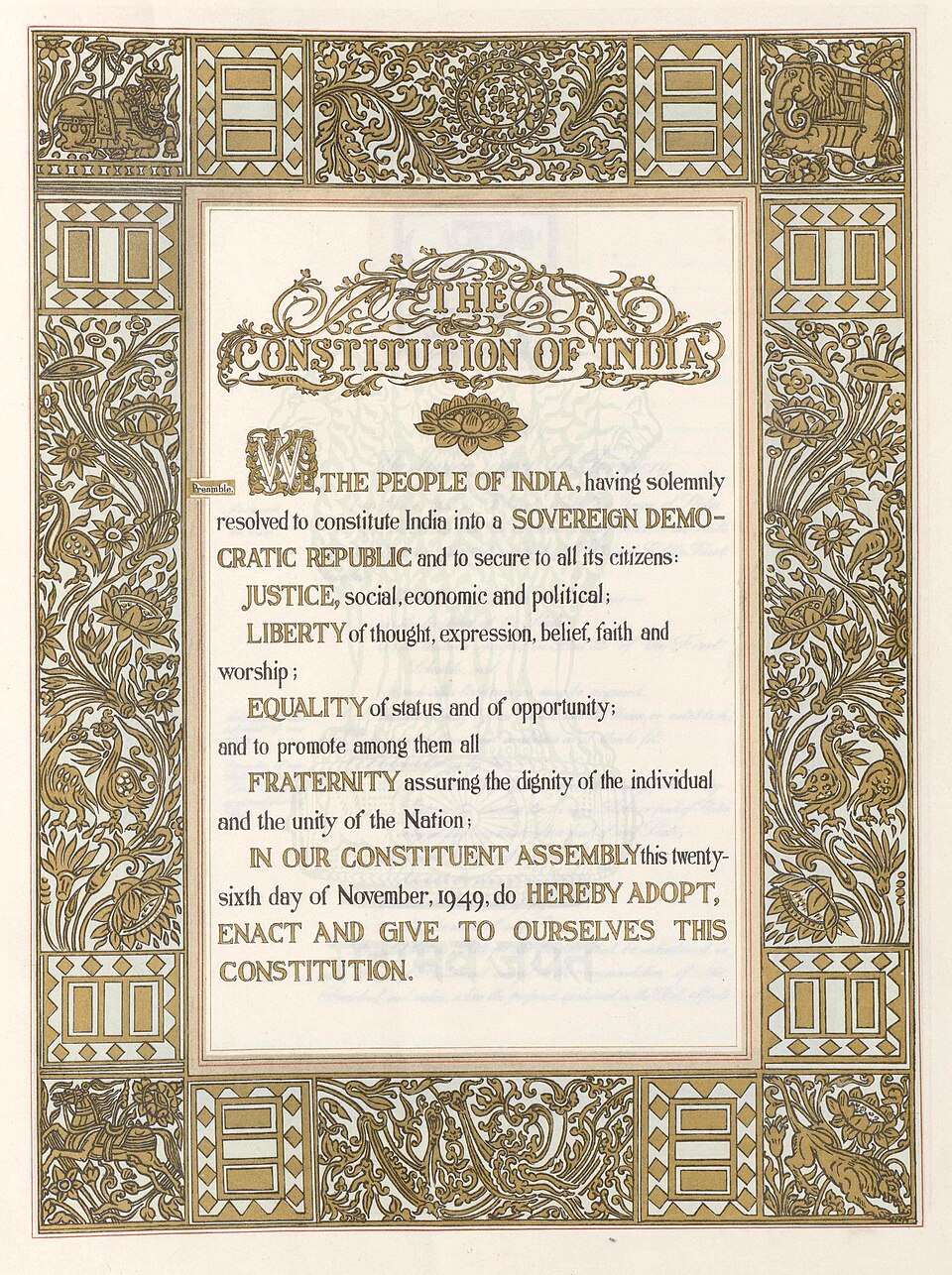
Here is the Preamble as it reads today:
WE, THE PEOPLE OF INDIA, having solemnly resolved to constitute India into a SOVEREIGN SOCIALIST SECULAR DEMOCRATIC REPUBLIC and to secure to all its citizens:
- JUSTICE, social, economic and political;
- LIBERTY of thought, expression, belief, faith and worship;
- EQUALITY of status and of opportunity;
- and to promote among them all FRATERNITY assuring the dignity of the individual and the unity and integrity of the Nation;
IN OUR CONSTITUENT ASSEMBLY this twenty-sixth day of November, 1949, do HEREBY ADOPT, ENACT AND GIVE TO OURSELVES THIS CONSTITUTION.
Read it slowly once more and notice that it has four parts, which match the three questions from the last section:
- The source of authority (who made it?): "We, the people of India".
- The nature of the State (what kind of country?): Sovereign, Socialist, Secular, Democratic, Republic.
- The objectives (what does it promise?): Justice, Liberty, Equality and Fraternity.
- The date and act of adoption: 26 November 1949, when the people, through the Constituent Assembly, adopted the Constitution.
The rest of this chapter takes these parts one by one.
The Preamble in one picture
Before going deeper, fix the skeleton in your mind. The Preamble answers four questions, and each answer is a short list you can learn by heart:
- Who gives the Constitution? The people of India.
- What kind of State is India? Sovereign, Socialist, Secular, Democratic, Republic. A simple way to remember the order is the letters S-S-S-D-R.
- What will the State secure for citizens? Justice (social, economic, political), Liberty (of thought, expression, belief, faith, worship), Equality (of status, of opportunity) and Fraternity (dignity of the individual, unity and integrity of the Nation). Remember J-L-E-F.
- When? 26 November 1949.
Exams like to test the exact sub-parts, so be precise. For example, Liberty has five parts (thought, expression, belief, faith, worship), but Equality has only two (status and opportunity). Justice has three (social, economic, political).
"We, the people of India": where power comes from
Go back to the class rules. Would the class follow the rules more willingly if the students made them together, or if a stranger from another school wrote them and pinned them on the wall? Rules feel like ours when we make them ourselves.
For almost two centuries before 1950, the laws that ran India were made in Britain. The Regulating Act of 1773 and the Government of India Acts of 1858, 1919 and 1935 were all passed by the British Parliament and applied to India. Indians had little or no say in them.
The Preamble breaks that chain with its very first words. It does not say "the British Parliament enacts" or "the King grants". It says "We, the people of India ... do hereby adopt, enact and give to ourselves this Constitution." Three verbs carry the meaning:
- Adopt: we accept it as ours.
- Enact: we make it law.
- Give to ourselves: no outside power is gifting it to us; the people are both the givers and the receivers.
This idea is called popular sovereignty: in a democracy, final authority belongs to the people. Every institution you will study later, whether Parliament, the President, the Prime Minister or the Supreme Court, gets its power from this Constitution, and the Constitution gets its authority from the people.
A fair question: the Constituent Assembly was not elected directly by all adults; most of its members were chosen by the provincial legislatures. So how can it speak for "the people"? The usual answer is that it was the most representative body possible at the time, it debated openly for nearly three years, and the Constitution it framed has since been accepted and worked by the people through every general election held under it. In Mains, you can use this as a "critically examine" point.
Sovereign and Republic: free, and led by an elected head
Start simple. In your home, your family decides what to cook, when to wake up and how to spend its money. The neighbours can give advice, but they cannot give orders.
Your family is the boss of its own house. That is what sovereign means for a country.
Sovereign means India is free from external control. It makes its own laws and its own policies, including its foreign policy, and no other country or empire can overrule them. Before 1947, British Parliament could legislate for India; after 1950 nobody outside India can.
Does joining international bodies reduce sovereignty? No. India chooses to join the United Nations, to sign treaties or to stay in the Commonwealth, and it can choose to leave. A sovereign country can make promises to others; what it cannot have is a master. Sovereignty also has an inside meaning: within India, the Constitution is supreme, and every authority works under it.
Now Republic. In some countries the Head of State is a king or queen, and the crown passes from parent to child. Britain is a democracy, but its Head of State is a hereditary monarch, so it is not a republic. A republic is a country whose Head of State is elected, not born into the post.
India chose this path. Article 52 says there shall be a President of India, and Article 54 says the President is elected by an electoral college made up of the elected members of both Houses of Parliament and of the State Legislative Assemblies. So the election is indirect, but it is still an election, and the term is fixed.
The republican idea has a second, quieter meaning: every public office is open to every citizen. No post in India is reserved for a family or a class by birth. A farmer's daughter can become President. That links directly to equality of opportunity, which you will meet again in Article 16.
Socialist: the State as a partner in fairness
Think of a cricket match where one team has old bats and no pads. Calling the game "fair" because both teams follow the same rules is not enough; someone has to make sure both sides have the basic kit. That "someone" making sure everyone gets a fair start is the core idea of socialism in the Indian Constitution.
The word Socialist was not in the original Preamble. It was added by the 42nd Amendment (1976). But the idea behind it was present from the start in the Directive Principles, which ask the State to reduce inequality and to stop wealth from being concentrated in a few hands.
What does socialist mean here? It does not mean that the State owns every factory and farm. It means:
- the State plays a major role in the economy, especially where the market alone would leave people behind;
- a commitment to remove inequalities of income and opportunity;
- minimum basic needs such as food, health and education for all;
- equal pay for equal work for men and women.
Because India mixes a strong public sector with private enterprise, it is often described as following democratic socialism: change through elections and law, not through revolution or force. Since 1991 the economy has opened up much more to private and foreign investment. Whether the word "socialist" still fits is a favourite Mains debate.
Secular: equal respect, no State religion
Picture a school with students from many families: some go to a temple, some to a mosque, a church or a gurdwara, and some to none. A fair principal does not declare one of these the "school religion", does not give extra marks to one group, and lets every child celebrate their festival. But if some practice harms a child, say, a rule that some children cannot drink from the common water pot, the principal steps in and stops it. That principal is acting in a secular way, Indian style.
Secular was added to the Preamble in 1976 by the 42nd Amendment, but like socialist, the idea was in the Constitution from 1950. Indian secularism means:
- there is no State religion; India does not officially belong to any faith;
- every person is free to follow, practise and spread any religion, or none;
- the State does not discriminate between citizens on the basis of religion.
A short line often used to sum it up: India is neither religious, nor irreligious, nor anti-religious. The State is not against religion; it simply does not take sides.
You can see secularism working in specific Articles:
- Article 15 bars discrimination on grounds of religion (along with race, caste, sex and place of birth).
- Article 25 gives every person freedom of conscience and the right to profess, practise and propagate religion.
- Article 27 says no one can be forced to pay a tax whose money is used to promote a particular religion.
- Article 28 says no religious instruction shall be given in an educational institution wholly maintained out of State funds.
How is Indian secularism different? In some Western countries, secularism means a high wall: the State and religion stay completely apart. India's version keeps an equal distance from all religions, but the State can step in to reform social practices linked to religion. Article 25(2) lets the State regulate the secular (non-religious) activities connected with religious practice and make laws for social welfare and reform, including opening Hindu religious institutions of a public character to all classes and sections of Hindus.
Article 17, which abolishes untouchability, is another example of the State using law to end an unjust practice. This mix of respect and reform is what makes Indian secularism its own model.
Democratic: power to the people, every five years and every day
In a class of forty, the students cannot all run the class together every minute, so they elect a monitor. If the monitor behaves badly, next term they choose someone else. That is democracy in miniature: the people choose who leads, and the leader has to answer to them.
Democratic means the government is elected by the people and answerable to them. India practises representative democracy: citizens elect representatives to Parliament and the State Assemblies, and those representatives make laws and form governments.
The foundation is Article 326: elections to the Lok Sabha and the State Legislative Assemblies are held on the basis of adult suffrage. Every citizen who is at least 18 years old can vote, whatever their religion, caste, sex, education or wealth. The voting age was 21 at first; the 61st Amendment (1988) lowered it to 18. India gave the vote to every adult from the very start.
But democracy is more than voting. The Preamble's idea of democracy is political, social and economic:
- Political democracy: free elections, a government that can be voted out, freedom of speech and of the press, and courts that can check power.
- Social democracy: no one is treated as lower by birth; dignity for every citizen.
- Economic democracy: a fair chance at a decent livelihood, so that political rights do not stay empty for the poor.
That is why the Preamble does not stop at the word "democratic". It goes on to promise justice, liberty, equality and fraternity, which are the conditions that make democracy real.
Equality in the text. The promise of "equality of status and of opportunity" is carried by Article 14 (equality before law), Article 16 (equality of opportunity in public employment), Article 17 (untouchability abolished) and Article 18 (titles abolished).
Here is how all four ideals map onto the Constitution:
| Ideal in the Preamble | Where it appears |
|---|---|
| Justice: social, economic, political | Articles 15, 17, 38, 39, 46, 326 |
| Liberty: thought, expression, belief, faith, worship | Articles 19, 25 |
| Equality: status and opportunity | Articles 14, 16, 17, 18 |
| Fraternity: dignity, unity and integrity | Articles 17, 51A(e) |
Quick revision
- The Preamble starts with "We, the people of India" and ends with the date 26 November 1949.
- India is a Sovereign Socialist Secular Democratic Republic (S-S-S-D-R).
- The 42nd Amendment (1976) added Socialist, Secular and integrity, in force from 3 January 1977.
- Republic means an elected Head of State (Articles 52, 54). Democratic means adult suffrage at 18 (Article 326). For Secular, see Articles 15 and 25 to 28.