

CSBC Constable · Module 10 · basic depth · 9 min
Making of the Constitution
What CSBC Constable asks from this chapter
Syllabus lines this chapter covers:
- Written exam (12th level, OMR) · Social science: history, geography, civics, economics
- Written exam (12th level, OMR) · General knowledge and current affairs
CSBC Constable questions from this module are being sorted into our bank.
Cut to basic depth for CSBC Constable. 27 deeper paragraphs are in the full chapter.
Start from zero: how does a big group write rules together?
Suppose your whole class of forty wants to plan a picnic. If all forty try to write the plan at once, nothing gets done. So what do good classes do?
- They agree on what they want: "a fun day, safe for everyone, within budget." That is the goal.
- They form small teams: one for food, one for transport, one for games. Each team studies its part.
- One small group writes the full plan from all the teams' ideas.
- The whole class reads the plan, suggests changes, argues, and finally votes to accept it.
India did almost exactly this in 1946–49, only the "picnic" was a whole new country and the "class" was the Constituent Assembly: a group of a few hundred people from every region, religion and community.
- The goal was set by the Objectives Resolution.
- The small teams were the Assembly's committees.
- The writing team was the Drafting Committee, led by Dr B. R. Ambedkar.
- The whole class debating and voting was the Assembly itself, sitting for nearly three years.
Keep this picture in mind. Every fact in this chapter fits one of these four steps.
The Assembly is born
By 1946 it was clear that British rule was ending. India needed its own rulebook, written by Indians. Under a plan drawn up by the Cabinet Mission (1946), a Constituent Assembly was set up. It was formed on 6 December 1946 and first met on 9 December 1946 in New Delhi.
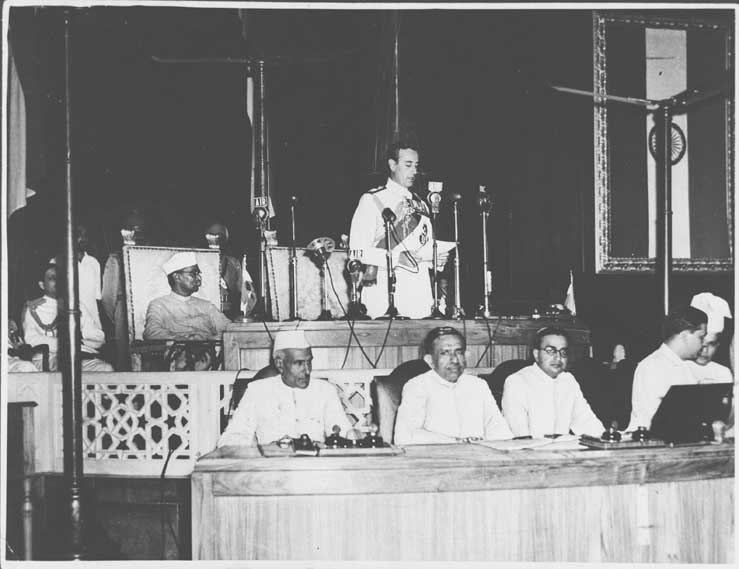
That first meeting was attended by 205 members, including 9 women. Because the Assembly had no President yet, the senior-most member, Dr Sachchidananda Sinha, chaired it.
Two days later, on 11 December 1946, the Assembly elected Dr Rajendra Prasad as its President. He led the Assembly through the whole journey and later became the first President of India.
A flag before a Constitution
The Assembly did more than write the Constitution. Even before independence, at its meeting on 22 July 1947, it adopted the National Flag. On 15 August 1947, that flag became the official flag of the Dominion of India.
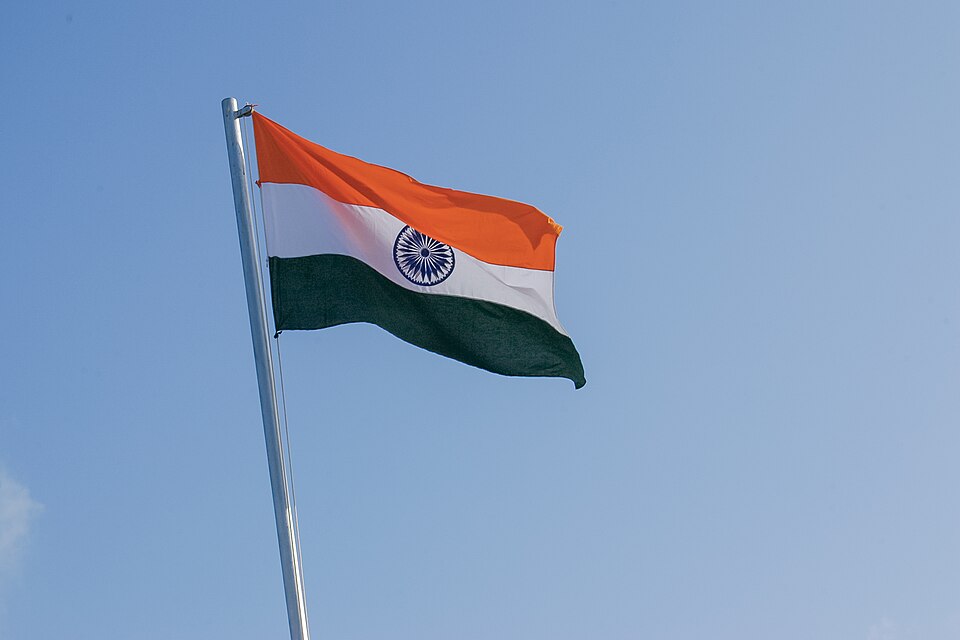
The flag is a tricolour of saffron, white and green, with the Ashoka Chakra, a 24-spoke wheel in navy blue, at the centre. The ad hoc Committee on the National Flag, chaired by Rajendra Prasad, handled this work.
Why does this matter for Polity? It shows that the Assembly was not only a drafting body; it was the place where the new nation made its first symbolic choices.
The finishing line: adopted, signed, in force
26 November 1949: adopted. At the end of the third reading, Dr Ambedkar moved the final motion: "the Constitution as settled by the Assembly be passed." It was carried, and the Constitution was adopted on 26 November 1949. Since 2015, this day is observed as Constitution Day.
Some Articles started at once. Under Article 394, a few provisions, such as those on citizenship and elections, came into force immediately on 26 November 1949, so that the country could prepare for the new system.
24 January 1950: signed. At the Assembly's last meeting, the members signed the Constitution.
26 January 1950: in force. The rest of the Constitution came into force, India became a Republic, and we celebrate this day as Republic Day. The date was chosen to honour 26 January 1930, when Purna Swaraj Day was observed.
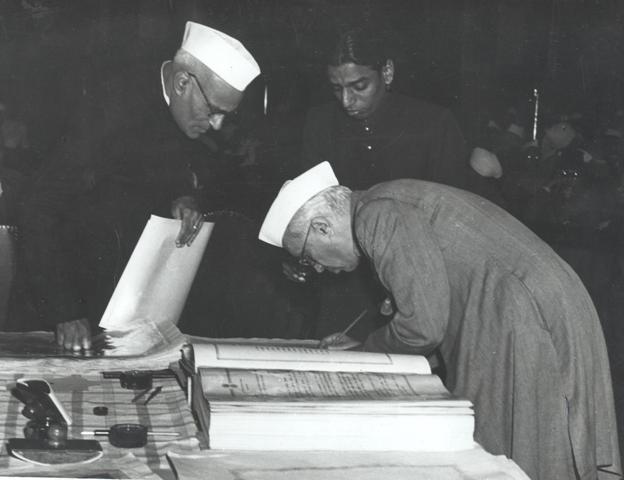
How big was it? The original Constitution had 395 Articles, 22 Parts and 8 Schedules. Amendments have added more since then; today there are 12 Schedules.
Memory trick: November is when the book was finished; January is when the country started living by it.
Why it was done this way, and what it changed
Knowing the dates is not enough. A good answer also explains why each step was taken and what difference it made. This table puts the main decisions side by side.
| Decision | Why it was needed | What it changed |
|---|---|---|
| An Assembly of Indians (1946) | Earlier laws like the 1935 Act were made in London; India wanted to write its own rules | The Constitution was made by Indians, not handed down by a foreign power |
| Indirect election through Provincial Assemblies | A fresh nationwide vote in 1946 was not practical; the Cabinet Mission scheme used existing bodies | Quick start, but a lasting debate about how representative the Assembly was |
| Objectives Resolution first (13 Dec 1946) | The Assembly needed an agreed goal before writing details | It became the base of the Preamble and guided every later debate |
| Work through committees | Hundreds of members could not draft every clause together | Experts drafted; the full House debated and decided |
| Long, open debate (7,653 amendments proposed) | A text for a diverse country had to hear many voices | Wider acceptance; many compromises were built into the text |
| Flag adopted before the Constitution (22 Jul 1947) | Independence on 15 Aug 1947 needed a national symbol at once | The new Dominion had its flag on day one |
| Some Articles in force on 26 Nov 1949 (Art 394) | Citizenship and elections had to be ready before the Republic began | A smooth handover on 26 January 1950 |
The big picture. Each choice traded speed against perfect representation. The framers chose to start quickly with the bodies they had, then made up for it with a long, open debate. That is why the Assembly's method is criticised, while its result is widely accepted.
Why it still matters today. The way a constitution is made shapes how far people trust it. Because the Indian Constitution was argued over openly, clause by clause, courts and citizens still read the Constituent Assembly Debates to understand what a provision was meant to do.
Quick revision
- The Assembly was formed on 6 December 1946 and first met on 9 December 1946, with 205 members including 9 women, under the chair of Sachchidananda Sinha. Rajendra Prasad was elected President on 11 December 1946, and Nehru moved the Objectives Resolution on 13 December 1946.
- The National Flag was adopted on 22 July 1947, and the Drafting Committee was set up on 29 August 1947 with Ambedkar as chairman.
- The second reading ran from 15 November 1948 to 17 October 1949; in it 7,653 amendments were proposed and 2,473 were discussed.
- The Constitution was adopted on 26 November 1949 (marked as Constitution Day since 2015), signed on 24 January 1950 and brought into force on 26 January 1950 (Republic Day).
- 389 seats were planned (292 + 93 + 4), but only 299 members remained after Partition. On 31 December 1947 the largest groups were the United Provinces (55), Madras (49) and Bihar (36).
- The work took 2 years, 11 months and 17 days, with 11 sessions and 165 days of sittings, 114 of them on the draft; about 60 constitutions were studied.
- The original Constitution had 395 Articles, 22 Parts and 8 Schedules; today it has 12 Schedules.