

CSBC Operator · Module 7 · basic depth · 13 min
To the Moon, Mars and the Sun: India's science missions
What CSBC Operator asks from this chapter
Syllabus lines this chapter covers:
- Written exam: GK & social issues 25, Physics 25, Chemistry 25, Maths 25 (intermediate level) · General knowledge and social issues
CSBC Operator questions from this module are being sorted into our bank.
Cut to basic depth for CSBC Operator. 23 deeper paragraphs are in the full chapter.
Start from zero: why go beyond Earth?
Satellites near the Earth help us with TV, maps and weather. So why would anyone spend years sending a spacecraft to the Moon, Mars or towards the Sun? The answer has two parts: what we can learn there, and what we learn by getting there.
Think of a student who has only studied in one classroom. To understand the world, they must also go out, see other places and solve new problems on the way. A country's space programme grows the same way, because each new destination forces it to master a harder skill.
Reaching the Moon means escaping the comfortable orbits near Earth and steering precisely across hundreds of thousands of kilometres. Landing there means slowing down to a gentle touch without any air to help. Reaching Mars or the point from which we watch the Sun means travelling for months and working far from home.
This chapter follows India's journey step by step. It starts with orbiting the Moon, moves on to Mars and landing on the Moon, and ends with watching the Sun. You already know the trick that makes these trips affordable: climb slowly with orbit raising instead of using a giant rocket.
Why India explores, and when it all happened
Why should a developing country explore the Moon and Mars? There are three honest reasons. The first is science: we still do not fully know how the Moon formed, whether it holds water, or how the Sun's storms reach Earth.
The second reason is technology. Every mission forces engineers to build better navigation, propulsion, landing and communication systems, and these skills flow back into ordinary satellites and industry. The third reason is standing: a country that can reach other worlds is taken seriously as a partner in global science.
When it happened:
- 22 October 2008: Chandrayaan-1, India's first mission to the Moon, was launched by PSLV-C11.
- 5 November 2013: the Mars Orbiter Mission (MOM) was launched by PSLV-C25, and it entered Mars orbit on 24 September 2014.
- 28 September 2015: AstroSat, India's first dedicated astronomy satellite, was launched by PSLV-C30.
- 22 July 2019: Chandrayaan-2, with an orbiter, a lander and a rover, was launched by GSLV Mk III.
- 14 July 2023: Chandrayaan-3 was launched by LVM3, and it landed near the Moon's south pole on 23 August 2023.
- 2 September 2023: Aditya-L1, India's first mission to study the Sun, was launched by PSLV-C57.
Where they go from. All of these missions left from Sriharikota. Notice that the lighter ones used PSLV, while the heavier landers needed the more powerful GSLV Mk III, now called LVM3.
Chandrayaan-1: the first visit and the water story
India's first step was to go around the Moon, not to land on it. Chandrayaan-1 was launched on 22 October 2008 by PSLV-C11 from Sriharikota. It weighed 1,380 kg and circled the Moon at a height of 100 km, which was raised to 200 km in May 2009.
What it carried. The spacecraft carried 11 instruments. Indian ones included a Terrain Mapping Camera and a Moon Impact Probe, which was released to strike the surface. Foreign ones included NASA's Moon Mineralogy Mapper (M3) and a small radar called Mini-SAR.
Carrying instruments from other countries was itself a choice. It shared costs and knowledge, and it showed that India could host international science on its spacecraft.
The big result. Chandrayaan-1 conclusively discovered traces of water on the Moon, and it found water ice in the Moon's north polar region. For decades the Moon had been thought of as completely dry, so this changed how scientists saw it.
How it ended. The mission made more than 3,400 orbits and worked for 312 days. Contact was lost on 29 August 2009, earlier than planned, but most of its science goals had already been met.
Chandrayaan-2: a near miss that still delivered
After orbiting the Moon, the next goal was to land on it. Chandrayaan-2 was launched on 22 July 2019 by GSLV Mk III-M1. At 3,850 kg it was much heavier than Chandrayaan-1, because it carried three parts: an orbiter, the lander Vikram and the rover Pragyan.
Why the south pole? Chandrayaan-2 aimed at the Moon's south polar region, which no mission had explored on the ground. After Chandrayaan-1's water findings, the polar regions had become the most interesting places on the Moon.
What happened. The spacecraft entered lunar orbit on 20 August 2019, and Vikram separated from the orbiter on 2 September 2019. Vikram's descent went normally down to a height of 2.1 km, and then its communication with the ground was lost.
Why it still counts. The landing failed, but the mission did not. The orbiter has worked for almost seven years instead of the one year planned, and its camera, at 0.3 m resolution, is the sharpest of any lunar mission so far.
The lesson. Landing is the hardest part of any lunar mission, because the spacecraft must brake from orbital speed to almost zero with no air to slow it. The lessons from Vikram's last 2.1 km went straight into the design of Chandrayaan-3.
Chandrayaan-3: landing near the south pole
Chandrayaan-3 had one clear job: to finish what Vikram started. So it did not carry a new orbiter. Its three objectives were to show a safe and soft landing, to show a rover moving on the Moon, and to do experiments on the spot.
The journey. LVM3 launched Chandrayaan-3 on 14 July 2023 from Sriharikota into an Earth orbit of about 170 × 36,500 km. The spacecraft then raised its orbit step by step and entered lunar orbit on 5 August 2023.
A propulsion module carried the lander down to a 100 km circular polar orbit around the Moon. The lander separated on 17 August, and it touched down on 23 August 2023.
What it achieved. India became the fourth country to land on the Moon and the first to land near its southern polar region. The landing site was named the Shiv Shakti point, and 23 August was declared National Space Day.
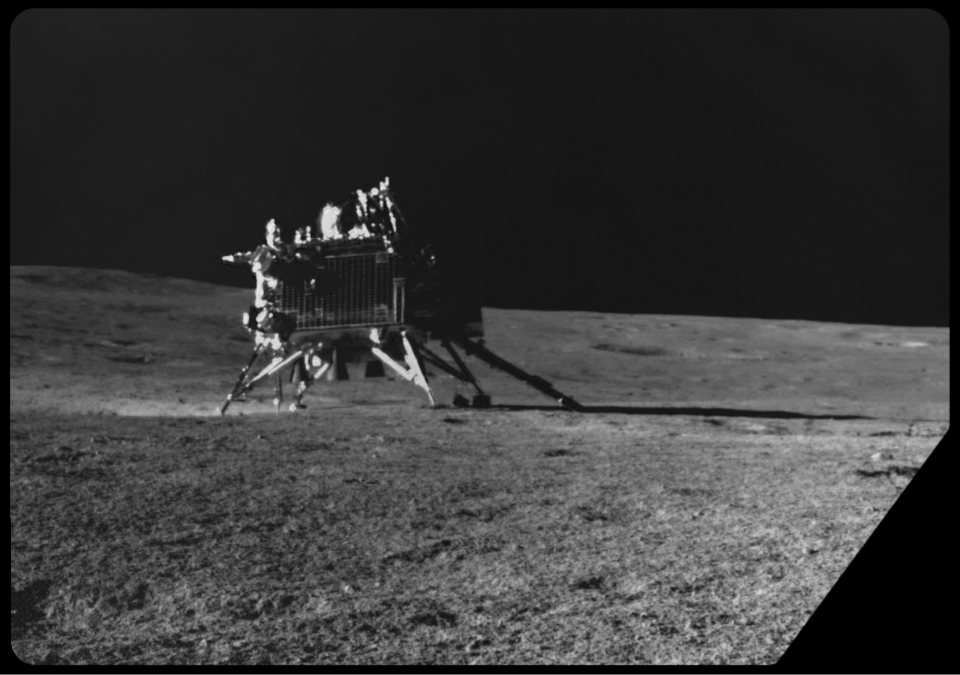
What it carried:
- On the lander, RAMBHA studied the thin plasma near the surface, ChaSTE measured how heat moves through the soil, ILSA listened for moonquakes, and a Laser Retroreflector Array reflects laser beams for precise distance measurements.
- On the rover, APXS and LIBS measured which elements the soil and rocks contain.
- On the propulsion module, SHAPE studied Earth from far away, as an example of what a habitable planet looks like.
What it found. The Pragyan rover drove about 101 m around the landing site. Its APXS found that the soil at Shiv Shakti point closely resembles a lunar meteorite called ALHA 81005, with less aluminium and more iron and magnesium than typical lunar highlands. All the science data were released to the public on 23 August 2024, so scientists anywhere can study them.
Mars Orbiter Mission: Mars on the first try
Mars is much farther than the Moon, and many missions to it have failed. So when India decided to go there, the main aim was to prove that it could. ISRO describes MOM's objectives as primarily technological: to design, build and launch a spacecraft that could reach and work at Mars.
The journey. PSLV-C25 launched MOM on 5 November 2013 from Sriharikota. PSLV is not a heavy rocket, so the spacecraft first raised its orbit around Earth in steps and then set off on a long arc to Mars.
On 24 September 2014, MOM entered Mars orbit in its first attempt. Its total cost was about ₹450 crore, a small sum for a journey to another planet.
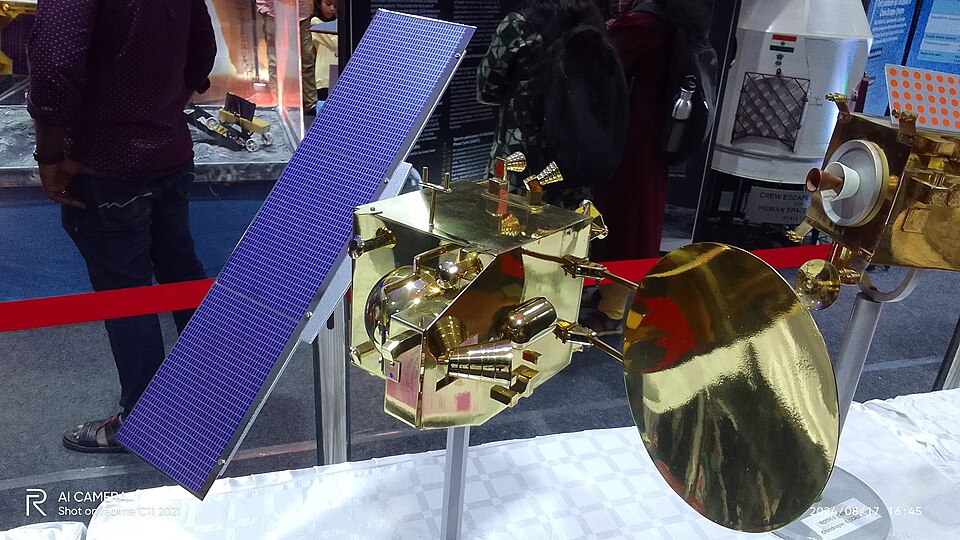
What it carried. MOM had five payloads: a Mars Colour Camera, a Thermal Infrared Imaging Spectrometer, a Methane Sensor for Mars, a Lyman Alpha Photometer and an instrument to study the thin upper atmosphere called MENCA. The methane sensor mattered because methane on Mars could point to geological activity or even life.
How long it lasted. MOM was designed to work for six months. It went on for far longer and completed seven years in Mars orbit on 24 September 2021. Among its results was the first image of the far side of Deimos, one of the two small moons of Mars.
Previous years' questions
This section shows the real past questions on this chapter for the exam you have chosen. Each question is copied word for word from the official paper, with the year and paper, so that you can see how the topic is actually asked.
Questions are being collected from the official UPSC and BPSC papers. They will appear here once each one is checked against the original paper.
Quick revision
- Chandrayaan-1 (22 Oct 2008, PSLV-C11) orbited the Moon with 11 instruments. It conclusively found water traces and water ice near the north pole.
- Chandrayaan-2 (22 Jul 2019, GSLV Mk III-M1) had an orbiter, Vikram and Pragyan. Vikram lost contact at 2.1 km, but the orbiter has worked for almost seven years.
- Chandrayaan-3 (14 Jul 2023, LVM3 M4) landed on 23 Aug 2023 at the Shiv Shakti point. India became the fourth country to land on the Moon and the first near its south polar region.
- 23 August is National Space Day. Pragyan drove about 101 m, and the data were opened to the public on 23 Aug 2024.
- MOM (5 Nov 2013, PSLV-C25) reached Mars orbit on 24 Sep 2014 on the first attempt, for about ₹450 crore. It had five payloads and lasted seven years against a six-month design.
- Aditya-L1 (2 Sep 2023, PSLV-C57) is India's first solar mission. It reached a halo orbit at L1 on 6 Jan 2024 and carries seven Indian payloads.
- AstroSat (28 Sep 2015, PSLV-C30) is India's first dedicated astronomy satellite, observing in X-ray, optical and UV together.