

GPSC Class 1-2 · Module 22 · Mains depth · 15 min
Weathering, mass movement, soil formation and the cycle of erosion
What GPSC Class 1-2 asks from this chapter
Syllabus lines this chapter covers:
- General Studies · Geography of India, the world and Gujarat.
- GS 3 · Geography of India and Gujarat.
GPSC Class 1-2 questions from this module are being sorted into our bank.
Read at full depth: basics, the standard layer and the Mains analysis.
Start from zero: how mountains turn to sand
Leave an iron nail outside and it rusts. Leave a stone wall for a hundred years and its corners round off and cracks appear. Rocks in nature face the same attack, every day, for millions of years.
This attack has three steps. First, weathering breaks rocks into smaller pieces where they stand. Then gravity pulls loose material downhill in mass movement. Finally, erosion by rivers, wind, ice and waves carries it away and deposits it somewhere else.
Together these exogenic processes are called denudation, meaning "laying bare". They work against the endogenic forces that raise land, slowly wearing even the greatest mountains down towards sea level.
Why it matters. Weathering makes soil, the foundation of farming and forests. It also releases nutrients, shapes landforms, and controls the cost and safety of roads, buildings and dams in hilly regions.
Physical weathering: breaking without changing
How fast and in what way rocks weather depends on several factors. Rocks with many joints, cracks and bedding planes let in water, air and roots. Climate matters most: temperature and moisture decide which processes work. Slope and vegetation decide how much rock is exposed and how quickly debris is removed.
Physical or mechanical weathering breaks rocks into pieces without changing their chemical makeup. The most powerful kind in cold regions is frost wedging. Water seeps into a crack, freezes and expands by about 9%, prising the crack wider; when it thaws, more water enters, and the cycle repeats night after night.
In hot deserts, rock surfaces heat strongly by day and cool sharply at night. The outer layer expands and contracts more than the inside, so it peels away in curved sheets, a process called exfoliation, which leaves rounded rock domes. In dry regions, salt crystals growing in pores as water evaporates can also break rocks apart grain by grain.
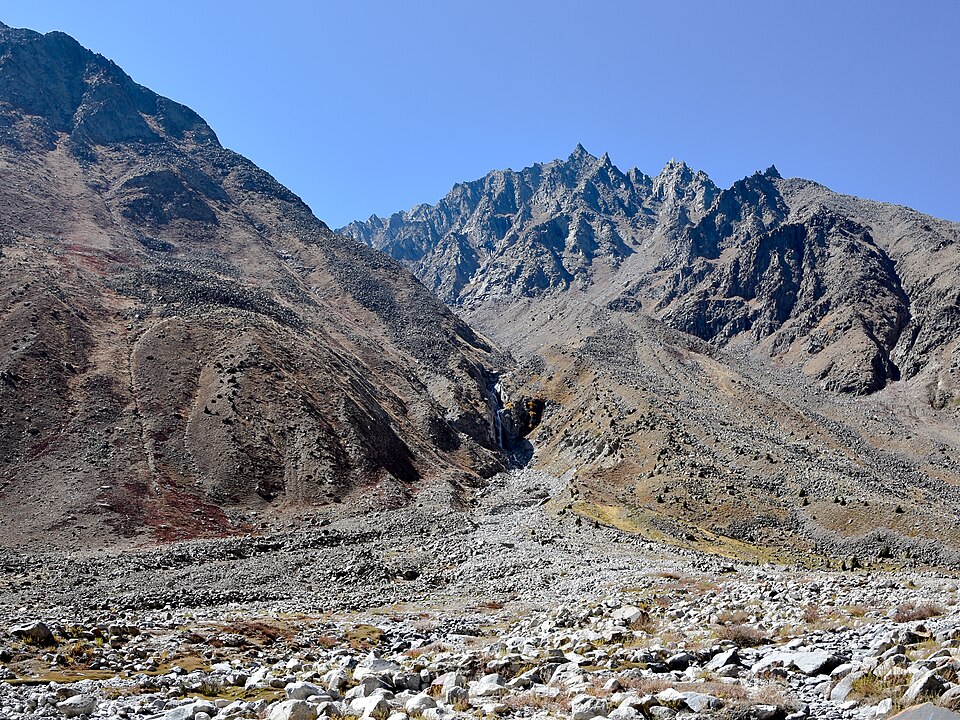
Living things help too. Plant roots grow into cracks and widen them, and burrowing animals loosen soil. The broken fragments that fall from cliffs collect at their feet as sloping piles of talus or scree, a common sight on Himalayan slopes.
Why it matters. Frost wedging loosens rocks that fall onto mountain roads, and exfoliation shapes many granite hills. Physical weathering also prepares rock for chemical attack by increasing the surface area exposed to water and air.
Chemical weathering: rocks that dissolve and rust
Chemical weathering changes the minerals in rocks into new substances, usually softer or more soluble ones. Water is the key, often helped by oxygen, carbon dioxide and acids from plants. It works fastest where it is hot and wet, so it dominates in tropical regions such as the Western Ghats and the North-East.
Carbonation: rainwater absorbs carbon dioxide from the air and soil, forming weak carbonic acid. This acid dissolves limestone and dolomite, carrying the calcium away in solution. Over thousands of years it carves caves, sinkholes and other karst landforms in limestone areas.
Hydrolysis: water reacts chemically with minerals such as feldspar, turning them into soft clay minerals like kaolinite. Because feldspar is the commonest mineral, hydrolysis slowly rots granite into a crumbly mass of quartz grains and clay. Hydration is the absorption of water by some minerals, which makes them swell and weaken.
Oxidation: oxygen combines with iron in minerals, producing iron oxides, much like rust on a nail. This gives many soils and rocks their red, yellow or brown colours, which is why red soils are common on the old crystalline rocks of the Peninsula.
Solution also removes minerals such as rock salt and gypsum that dissolve readily in water. In practice, physical and chemical weathering work together, and in most places it is hard to separate their effects.
Why it matters. Chemical weathering builds the deep, red, clay-rich soils of the tropics and releases plant nutrients. It also slowly removes carbon dioxide from the air over geological time, and it explains damage to limestone and marble monuments from acid rain.
Mass movement and landslides
Weathered material on a slope is pulled downhill by gravity. When it moves as a mass, without being carried by a river or glacier, the process is called mass movement or mass wasting. Water often helps by adding weight and reducing friction between grains.
Mass movements range from very slow to sudden. The slowest is soil creep, a gradual downhill shuffle of soil caused by wetting and drying or freezing and thawing. It is invisible day to day but shows up as tilted fence posts, leaning poles and tree trunks that curve at the base.
Faster movements are grouped as falls, slides and flows. In a rockfall, pieces of rock drop freely from a cliff. In a slide, a mass of rock or soil moves as a block along a slip surface; a slump is a slide on a curved surface that leaves a scar and a tilted block. In flows, material saturated with water moves like a thick liquid, as in earthflows and fast, deadly mudflows and debris flows.
Landslides are triggered when slopes become unstable. Natural causes include steep slopes, heavy rain that soaks the ground, earthquakes, weak or highly jointed rocks, and rivers cutting into the base of slopes. Human activities such as deforestation, cutting slopes for roads, mining and building on unstable ground make landslides far more frequent.
Slopes can be made safer. Engineers build retaining walls, pin loose rock with rock bolts and wire mesh, and dig drains so that rainwater does not soak the slope. Planting deep-rooted trees and grasses binds soil, and mapping landslide-prone zones keeps new houses and roads away from the most dangerous slopes.
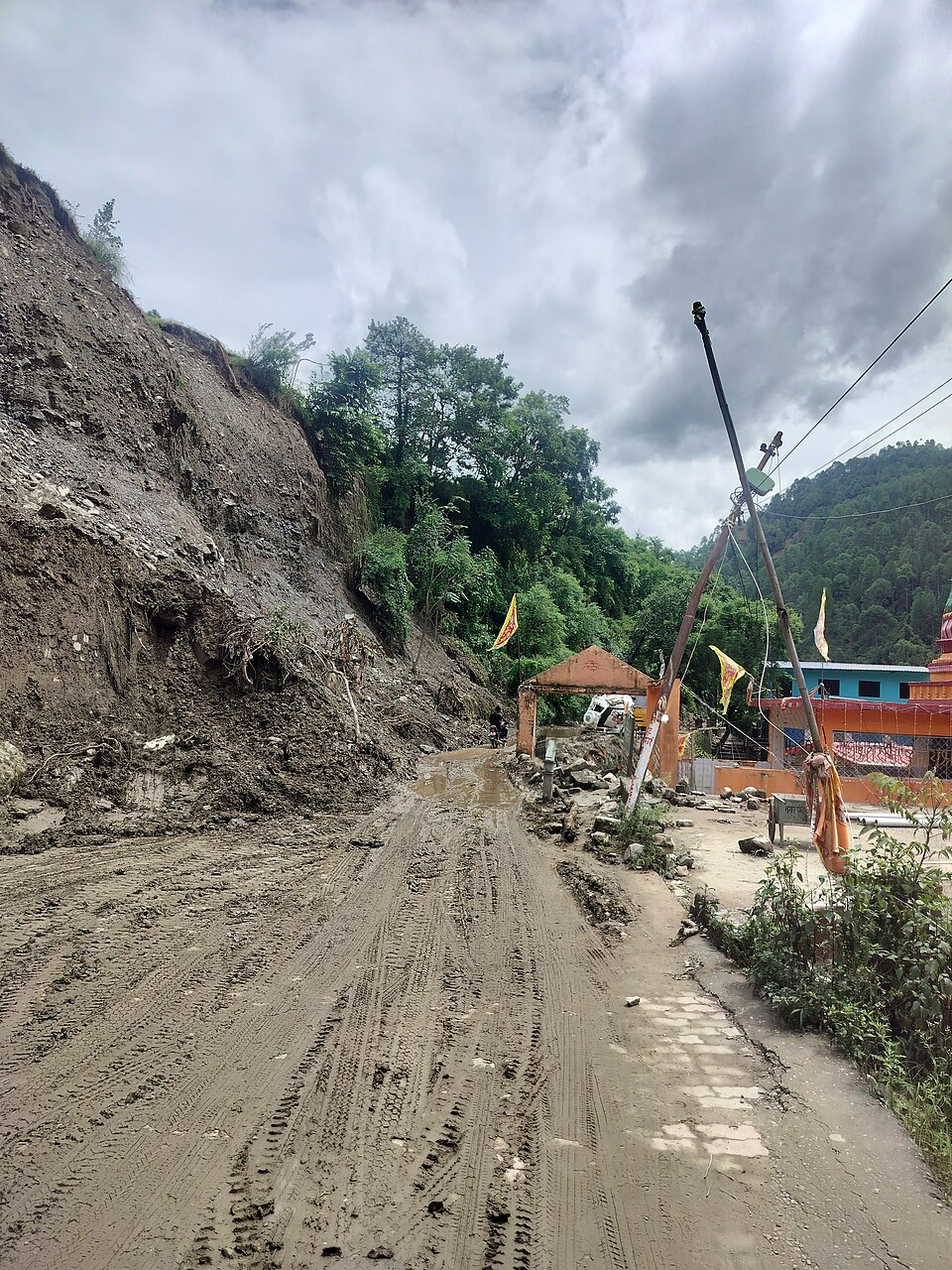
Why it matters. Landslides kill people and cut roads every monsoon in the Himalaya, the North-East and the Western Ghats. Understanding their causes guides slope protection, drainage, careful road building and early warnings; the Indian pattern is covered in landslides in India.
From weathered rock to soil
Weathering produces a loose layer of broken rock over solid bedrock, called regolith. It becomes true soil only when living things move in. Plants, fungi, bacteria and worms add humus, the dark organic matter from decaying leaves and roots, and mix it with mineral particles.
Five factors control what kind of soil forms. The parent material is the rock or sediment the soil comes from, which gives it its minerals and texture. Climate decides how fast weathering and decay happen and whether water washes nutrients down (leaching) or draws salts up.
Relief matters because steep slopes lose soil quickly and stay thin, while gentle slopes and valleys collect thick soils. Organisms add humus, nitrogen and channels for air and water. Time allows layers to develop; young soils on fresh river deposits are thin and simple, while old soils are deep and layered.
Over time, a soil develops distinct layers called horizons, from humus-rich topsoil to weathered rock below. How these layers form and the main soil types of India are covered in soil profiles and soil formation in India.
Climate's role is easy to see in India. In the very wet, hot parts of the Western Ghats and the North-East, heavy rain leaches away silica and bases, leaving iron- and aluminium-rich laterite. In the dry west, evaporation draws salts upward, forming saline and alkaline patches, while on the basalt of the Deccan the same rock and a seasonal climate produce black soils that hold moisture well.
Why it matters. It can take hundreds of years to form a few centimetres of fertile soil, but heavy rain can wash it away in a single season. This is why soil conservation, cover crops and protecting forests on slopes are vital for food security.
How landscapes age: Davis and Penck
In 1899, the American geographer William Morris Davis proposed the cycle of erosion, the first big theory of how landscapes develop. He said a landscape is a function of structure (the rocks), process (the agents at work) and stage (how long they have worked). He imagined land being uplifted quickly and then worn down in stages, like the life of a living being.
In youth, rivers cut deep, narrow V-shaped valleys with waterfalls and rapids, while broad flat divides between them remain. In maturity, valleys widen, waterfalls disappear, divides become sharp ridges and relief is greatest. In old age, rivers meander slowly across wide floodplains and the whole land is worn down to a low, almost flat surface called a peneplain, with a few resistant hills, called monadnocks, left standing. If the land is uplifted again, rivers start cutting down afresh, a process called rejuvenation.
The German geomorphologist Walther Penck, in the 1920s, disagreed with the idea of quick uplift followed by erosion. He argued that uplift and erosion happen at the same time, and that the shape of slopes reflects the balance between them. Where uplift is faster than erosion, slopes are convex; where they balance, slopes are straight; and where erosion wins, slopes become concave.
Neither model fits every landscape, and modern geomorphology studies processes directly. But the language of youth, maturity, old age, peneplain and rejuvenation is still widely used, including for Indian rivers and plateaus.
Why it matters. These models help read the history of a landscape. The rejuvenated Narmada falls and gorges, the worn-down Aravalli and the old plateaus of the Peninsula can all be described in these terms in answers.
Mains lens: what, why, where and so what
This chapter supports GS Paper I (geomorphology) and links to disasters, agriculture and environment in GS Paper III. Here are four angles.
1. Climate controls weathering. Chemical weathering in the humid tropics and physical weathering in deserts and cold mountains explain different landscapes and soils across India.
2. Landslides as a human-made hazard. Natural slope instability is worsened by deforestation, road cutting, mining and unplanned construction. Answers on Himalayan or Western Ghats landslides should combine both.
3. Soil as a slow resource. Soil formation takes centuries, so erosion is a long-term loss. This supports arguments for watershed management and conservation farming.
4. Reading landscapes. Davis's stages and Penck's balance of uplift and erosion help describe Indian landforms such as the Aravalli and rejuvenated rivers.
Mains lens: practice questions and answer plans
Now turn this understanding into written answers. The four questions below are written in the UPSC style, but they are our own practice questions, not previous-year questions. The real previous-year questions of your exam appear in the "Previous year questions" box once we have matched them with the official papers.
Q1. "Distinguish between physical and chemical weathering. How does climate influence each?" (150 words)
- Define both with processes.
- Link chemical weathering to hot, wet climates and physical weathering to deserts and cold regions.
Q2. "Landslides in the Himalaya are as much a human-made as a natural hazard. Discuss." (150 words)
- Give natural factors: slope, rain, earthquakes, rock.
- Give human factors: roads, deforestation, mining, construction.
- End with mitigation.
Q3. "Explain the factors of soil formation and why soil conservation is important for India." (250 words)
- Introduction: Define weathering, regolith and soil.
- Body: Explain the five factors with Indian examples; describe erosion and leaching.
- Conclusion: Link to food security and watershed programmes.
Q4. "Compare the views of Davis and Penck on landscape evolution." (150 words)
- Explain structure, process and stage, and the three stages.
- Contrast with Penck's simultaneous uplift and erosion.
Useful keywords: denudation, weathering, erosion, joints, frost wedging, exfoliation, salt weathering, carbonation, hydrolysis, oxidation, karst, mass wasting, soil creep, slump, landslide, mudflow, regolith, humus, leaching, parent material, cycle of erosion, peneplain, monadnock, rejuvenation.
Quick revision
- Weathering = breakdown in place; erosion = removal and transport. Together with mass movement: denudation.
- Factors: rock structure and joints, climate, slope, vegetation.
- Physical: frost wedging (water expands about 9%), exfoliation (deserts), salt crystals, roots; talus/scree at cliff feet.
- Chemical: carbonation (limestone, karst), hydrolysis (feldspar → clay), oxidation (iron → red colours), hydration, solution. Fastest in hot, wet climates.
- Mass movement: creep (slowest), falls, slides, slumps, earthflows, mudflows. Triggers: slope, rain, earthquakes, deforestation, road cutting, mining.
- Soil from regolith + humus; five factors: parent material, climate, relief, organisms, time.
- Davis (1899): structure, process, stage; youth → maturity → old age → peneplain; rejuvenation. Penck (1920s): uplift and erosion together.