

GPSC Class 1-2 · Module 62 · Mains depth · 18 min
India and Russia: the special and privileged strategic partnership
What GPSC Class 1-2 asks from this chapter
Syllabus lines this chapter covers:
- General Studies · Indian Constitution, polity, social justice and international relations.
- General Studies · General knowledge and current events.
- GS 2 · Current events of national and international importance, including IR.
GPSC Class 1-2 questions from this module are being sorted into our bank.
Read at full depth: basics, the standard layer and the Mains analysis.
Start from zero: the old friend who stayed
Every family has an old friend who stood by it in hard times. Even when new friends arrive and the old friend's own fortunes change, the family keeps that bond, because trust built in difficult years is hard to replace.
For India, Russia plays that role. Russia, and before 1991 the Soviet Union, supplied weapons, built industries and backed India at critical moments. The official description calls Russia a longstanding and time-tested partner and says that ties with Russia are a key pillar of India's foreign policy.
Today the world looks very different. India has grown close to the United States, Russia has grown close to China and Russia faces Western sanctions. Yet India and Russia still meet every year at the summit level and describe their ties as a Special and Privileged Strategic Partnership.
This chapter explains how the friendship began, what keeps it alive today and how India balances it with its other partnerships.
From the 1971 treaty to a strategic partnership
The 1971 treaty. On 9 August 1971, India and the Soviet Union signed the Treaty of Peace, Friendship and Cooperation in New Delhi, valid for 20 years. Each side promised not to join any military alliance against the other and to consult immediately if either was attacked or threatened. It came just months before the 1971 war, and it was not a military alliance. You read more about it in foreign policy from 1947 to 1991.
How the treaty worked. The treaty ran for 20 years and would extend automatically for five-year periods unless either side gave notice. It did not commit either country to fight for the other. Instead, the promise of immediate consultations signalled to outside powers that India was not alone, at a time when the crisis in East Pakistan was pushing the region towards war.
After the Soviet Union. When the Soviet Union broke up in 1991, India had to rebuild ties with the new Russia. In October 2000, the two sides signed the Declaration on the India-Russia Strategic Partnership, which gave the relationship a new character across politics, security, trade and culture.
A special label. During the Russian President's visit in December 2010, the partnership was raised to a Special and Privileged Strategic Partnership.
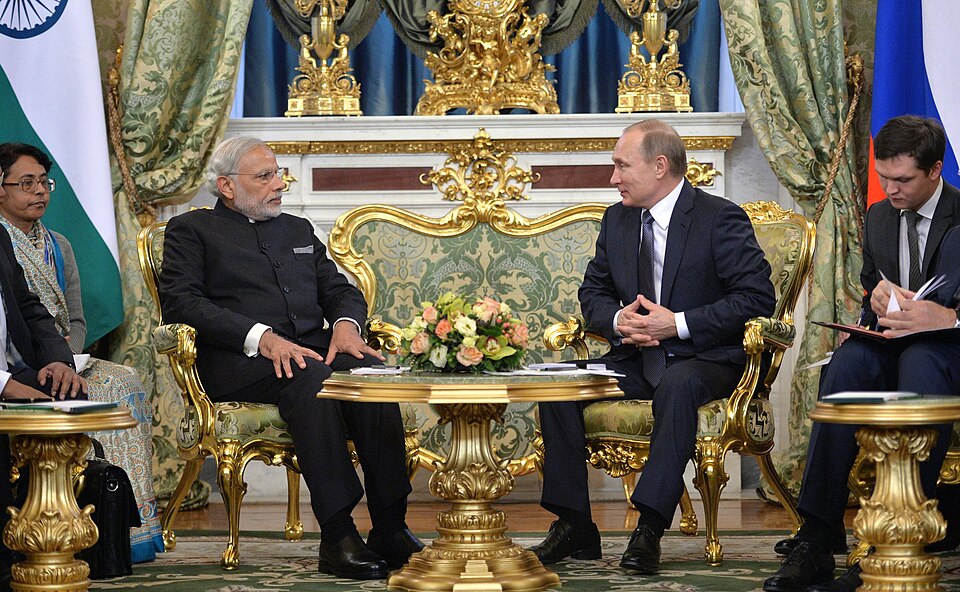
Regular meetings. The Annual Summit between India's Prime Minister and Russia's President is the highest institutional dialogue mechanism. Twenty-three summits have been held, the latest in New Delhi on 4-5 December 2025. A 2+2 dialogue of foreign and defence ministers was added in December 2021.
Why it matters. Few partnerships have such a long, unbroken record of summit meetings. That regularity keeps the ties steady even when world politics shifts.
Steel plants to a new treaty: how the friendship was built and rebuilt
Building India's industry. The real start came with Nehru's visit to Moscow in 1955 and the return visit of Khrushchev and Bulganin the same year. Soviet help built the Bhilai and Bokaro steel plants and public sector firms such as BHEL, ONGC and HAL. For a planned economy short of capital, this was help that the West was slow to give.
A friend at the UN. The Soviet Union backed India at the UN on Kashmir, the liberation of Goa and the Bangladesh war. In turn, India did not join Western criticism of Soviet actions in Czechoslovakia (1968) and Afghanistan (1980s). The 1962 war with China and the Sino-Soviet split pushed Delhi and Moscow even closer.
The shock of 1991. Under Mikhail Gorbachev, Soviet reforms called perestroika (restructuring) and glasnost (openness) could not save the system, and the Soviet Union broke up in 1991. India lost its security shield and the convenient rupee-rouble trade at the very moment it ran short of foreign exchange. The new Russia under Boris Yeltsin looked west, and some in Moscow wanted to end the special tie with India.
The reset. In 1993 the two countries signed a new Treaty of Friendship and Cooperation, replacing the 1971 treaty and dropping its security clause. They settled old debts and the rupee-rouble exchange rate, and Russia went ahead with cryogenic rocket engines for India despite US objections. In December 1998, Russian Prime Minister Yevgeny Primakov proposed a Russia-India-China (RIC) 'strategic triangle' to balance US dominance.
Why it matters. The 1993 treaty marks the shift from an ideological friendship to a practical one. The Strategic Partnership of 2000 and the military-technical commission set up the same year built on that more businesslike base.
Defence: from buying to building together
The backbone of the ties. Defence has long been the core of India-Russia relations. A dedicated commission on military and military-technical cooperation, headed by the two defence ministers, guides this work. Russia remains an important source of defence equipment, engines, spare parts and components.
Making in India. The relationship has moved from a buyer-seller framework to joint research, development and production. T-90 tanks and Su-30 MKI fighter aircraft are produced in India. BrahMos is a co-developed system, and the two sides are exploring its export to other countries.
Recent steps. The stealth frigate INS Tamal was commissioned in Kaliningrad on 1 July 2025. The 14th edition of the army exercise INDRA was held at Bikaner in October 2025, and the navies held their own INDRA exercise in the Bay of Bengal. In September 2025, 65 personnel from all three Indian services took part in Russia's Zapad-2025 exercise, and an air force exercise was held at Thanjavur in December 2025.
Why it matters. Much of India's existing military equipment is of Russian origin, so spares and upgrades matter for readiness. Co-production also supports India's goal of building its own defence industry.
Trade and energy: a boom with an imbalance
A record jump. India-Russia trade reached a record US$ 68.7 billion in 2024-25. Most of it came from Indian imports of oil and petroleum products, along with sunflower oil, fertilisers, coking coal and precious stones. India sells pharmaceuticals, chemicals, iron and steel and marine products to Russia.
A deep imbalance. In 2025-26, Indian exports were only about US$ 4.9 billion, while imports were about US$ 55.4 billion. The two sides want to fix this through a long-term economic programme and talks on a free trade agreement with the Eurasian Economic Union, a bloc led by Russia.
Big targets. The leaders have set a target of US$ 100 billion in trade by 2030. Talks focus on removing tariff and non-tariff barriers, improving logistics and making payments smoother.
Investment both ways. Russian investment in India is mainly in oil and gas, petrochemicals, banking, railways and steel. Indian investment in Russia is mainly in oil and gas and pharmaceuticals. The leaders had set a target of US$ 50 billion in two-way investment by 2025.
Why it matters. Energy imports from Russia have helped India meet its fuel needs, but a one-way trade pattern is fragile. Diversifying what India sells to Russia would make the partnership more balanced and durable.
Corridors, oil fields and UN votes
The corridor problem. Trade with Russia has always been held back by distance, since goods go the long way round through the Suez Canal. In September 2000, India, Russia and Iran signed an agreement in St Petersburg to build the International North-South Transport Corridor (INSTC). It links Mumbai by sea to Iran, and then by road and rail through Iran and the Caspian region to Russia and northern Europe.
What it could deliver. Studies estimate the corridor can carry 20-30 million tonnes of goods a year. Once fully working, it is expected to be about 30% cheaper and 40% shorter than the Suez route. Sanctions on Iran and slow work on missing rail links have delayed it for years.
Energy as glue. Indian oil companies have bought stakes in Russian fields such as Vankor in Siberia, and Russia's Rosneft bought Essar Oil, which owns the large refinery at Vadinar in Gujarat. These deals tie the two economies together in a way that defence sales alone cannot.
Standing together at the UN. India and Russia often vote alike. India opposed NATO's 1999 bombing of Yugoslavia without Security Council approval, abstained with Russia on the 2011 Libya resolution, and in March 2014 abstained on the US-EU resolution that called Crimea's 'reintegration' with Russia illegal. Both also back a multipolar world with a strong role for the UN.
Why it matters. The INSTC shows how geography shapes the relationship, and the UN votes show the trust built over decades. Together they explain why India keeps Russia close even while its ties with the West grow.
Nuclear, space, students and the world stage
Nuclear and space. Kudankulam in Tamil Nadu is India's only nuclear power plant established with another country, built with Russia. Russia also cooperates on India's human spaceflight programme, Gaganyaan. In the early years after independence, Soviet help in science and industry laid foundations that India still uses.
People. About 20,000 Indian students study in Russia, most of them medicine. In 2025, more than 90,000 Indians visited Russia and over 1,70,000 Russians visited India. Yoga and Indian cinema remain popular in Russia.
On the world stage. India and Russia work together in the UN, G20, BRICS and SCO. Russia has consistently supported India's bid for a permanent seat on the UN Security Council. Both say they are committed to a multipolar world, in which no single power dominates.
New links in 2025. The 23rd summit in December 2025 produced 16 agreements and MoUs in areas such as mobility of workers, fertilisers, health, food safety and maritime cooperation. Russia has raised its annual quota for Indian workers to 72,000, and more than 60,000 Indian workers arrived in 2025, mainly in construction, logistics and textiles. India opened new consulates in Kazan and Yekaterinburg in November 2025.
Standing together on terrorism. After the Pahalgam attack, the two leaders spoke on 5 May 2025 and reaffirmed their resolve to fight terrorism in all its forms. An all-party Indian delegation visited Russia later that month to explain India's position after Operation Sindoor.
Why it matters. Shared views on a multipolar world give the relationship a purpose beyond arms and oil. They fit India's idea of strategic autonomy, which you met in foreign policy after 1991.
When, where and why: the partnership at a glance
The table sets out the key steps in the relationship.
| When | What | Why it matters |
|---|---|---|
| 9 Aug 1971 | Indo-Soviet Treaty, New Delhi | Support before the 1971 war |
| Oct 2000 | Declaration on Strategic Partnership | New start after the Soviet era |
| Dec 2010 | Special and Privileged Strategic Partnership | Unique label |
| Dec 2021 | First 2+2 dialogue | Foreign and defence ministers together |
| 2024-25 | Record trade of US$ 68.7 billion | Energy-driven boom |
| 1 Jul 2025 | INS Tamal commissioned | Continuing naval ties |
| Oct 2025 | INDRA exercise at Bikaner | Army cooperation |
| 4-5 Dec 2025 | 23rd Annual Summit, New Delhi | Steady summit tradition |
Why it matters. The table shows a relationship that has adapted from Soviet times to today without breaking.
Mains lens: balancing an old friend
1. Why Russia still matters. Russia supplies defence equipment and spares, energy and fertilisers, and supports India on the world stage. It also gives India a partner that is not part of any Western bloc, which helps India keep its options open.
2. New strains. Russia's close ties with China, Western sanctions on Russia and the huge trade imbalance create real challenges. Payments and logistics are harder, and India's partners in the West sometimes question its ties with Moscow.
3. India's response. India keeps the summit tradition, pushes for co-production rather than imports and tries to diversify trade. At the same time, it deepens ties with the US, Europe and Japan, so that no single partner dominates its choices.
4. A balanced conclusion. India's approach is multi-alignment: keep the old friendship, adjust it to new realities and use it to protect strategic autonomy. A stable India-Russia partnership also gives India a voice in shaping Russia's choices in Asia.
Mains practice: five questions, five angles
These are practice questions written by us, not past papers. Past questions from each exam are in the PYQ panel of this module.
| Angle | Question | Key points to cover |
|---|---|---|
| History | Assess the significance of the 1971 Indo-Soviet Treaty for India's security. | Give the date, term and key articles. Explain why it was not an alliance yet still deterred threats. |
| Defence | "India-Russia defence ties have moved from buyer-seller to co-production." Discuss. | Use T-90, Su-30 MKI and BrahMos. Then discuss dependence on spares and diversification. |
| Economy | Examine the causes and consequences of the trade imbalance between India and Russia. | Use the 2024-25 and 2025-26 figures and the import mix. Suggest the EAEU FTA and export diversification. |
| Balancing | How does India balance its ties with Russia and the United States? | Explain multi-alignment and strategic autonomy. Give examples from defence and energy. |
| World order | What does a shared commitment to a multipolar world mean for India-Russia relations? | Cite cooperation in BRICS, SCO and support for India's UNSC bid. Note Russia-China ties as a limit. |
How to use this table: each answer should give one dated event or figure, explain why Russia matters to India, admit a strain and end with India's balancing strategy.
Quick revision
- The Indo-Soviet Treaty was signed in New Delhi on 9 August 1971 for 20 years and was not a military alliance.
- The Strategic Partnership was declared in October 2000 and raised to a Special and Privileged Strategic Partnership in December 2010.
- The Annual Summit is the top mechanism; the 23rd was held in New Delhi on 4-5 December 2025, and a 2+2 dialogue began in December 2021.
- The Intergovernmental Commission has two parts: trade and culture, and military-technical cooperation.
- Trade hit a record US$ 68.7 billion in 2024-25, mostly Indian oil imports, with a target of US$ 100 billion by 2030.
- Defence ties moved from buyer-seller to co-production: T-90, Su-30 MKI and BrahMos.
- INS Tamal was commissioned in July 2025, and the INDRA exercise was held at Bikaner in October 2025.
- Kudankulam is India's only nuclear power plant set up with another country.
- About 20,000 Indian students study in Russia, and Russia supports India's permanent UNSC seat.