

HPSC Engineering · Module 16 · standard depth · 18 min
Foundations of Indian music: swara, raga, tala and their ancient roots
What HPSC Engineering asks from this chapter
Syllabus lines this chapter covers:
- Screening test (general) · Indian culture, polity and economy
HPSC Engineering questions from this module are being sorted into our bank.
Cut to standard depth for HPSC Engineering. 6 deeper paragraphs are in the full chapter.
Start from zero: what makes sound into music?
Hum a tune you love. You are using three things without thinking: notes that go up and down, a rhythm that you could tap your foot to, and a pattern that makes the tune recognisable. Indian music gives these three things names: swara, tala and raga.
One word, three arts. In the old Indian sense, sangeet meant more than singing. It was geet (vocal music), vadya (instrumental music) and nritya (dance) together. That is why music and dance share so many terms, as you saw in the dance foundations chapter.
Why this chapter matters. Every later chapter in this module, on Hindustani, Carnatic and folk music, uses the ideas here. If you understand swara, raga and tala, the names of gharanas and composers will make sense instead of being a list to cram.
What you will learn. First, where Indian music came from. Then the three elements, one by one. Then the two streams of marga and desi, the great texts on a timeline, and how one music split into two classical systems.
The ancient roots: from Vedic chant to the veena coin
Harappa: a silence. We know very little about the music of the Harappan civilisation. The dancing girl of Mohenjo-daro suggests that music and dance existed, but no instrument or text tells us how it sounded. Our clear story begins with the Vedas.
The Samaveda. The Samaveda is the Veda of chanted hymns. Its verses, mostly taken from the Rig Veda, were set to melody for singing at rituals. It is seen as the earliest root of Indian music, because here words were first sung in a fixed, careful way.
Vedic songs and instruments. Vedic texts mention many kinds of songs, such as gatha and saman. They also name instruments: the veena (a stringed instrument), the venu (flute), the dundubhi (a drum) and others. So vocal, instrumental and dance music were all present in the Vedic age.
Why chant mattered. In Vedic ritual, the exact sound of a hymn was believed to carry its power. Priests therefore trained for years to keep every note and syllable correct. This care for exact pitch and memory became a lasting habit of Indian music, and UNESCO lists the tradition of Vedic chanting as intangible heritage of humanity.
The Natyashastra. The Natyashastra, the great text on drama ascribed to Bharata, has six chapters on music. It treats music as part of theatre, alongside dance. It discusses notes, scales and instruments, and its ideas of rasa apply to music as much as to dance.
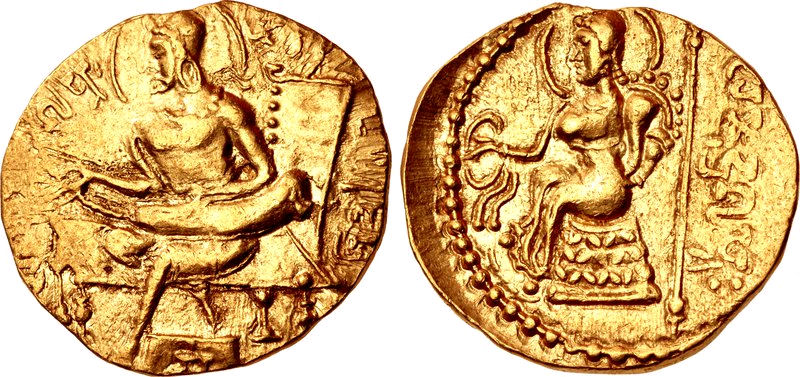
A king with a veena. Gupta gold coins show Samudragupta playing the veena. The Gupta age is also the age of classical Gupta sculpture. A ruler chose to be shown as a musician, which tells us how much music was respected. Indian music also travelled: it shaped the arts of South-East and Central Asia.
Swara: the seven notes and the 22 shrutis
What a swara is. A swara is a musical sound with a clear identity. Any noise is sound, but a swara has a definite place among other sounds. Music is made of different arrangements of swaras.
The seven swaras. Indian music has seven swaras, sung as Sa, Re, Ga, Ma, Pa, Dha, Ni. Their full names are shadja, rishabha, gandhara, madhyama, panchama, dhaivata and nishada. Together they form a saptak, an octave, after which Sa returns at a higher pitch.
| Short | Full name | A simple way to remember |
|---|---|---|
| Sa | Shadja | The base; the word links it to the six others |
| Re | Rishabha | Second step |
| Ga | Gandhara | Third step |
| Ma | Madhyama | The middle note |
| Pa | Panchama | The fifth; stays fixed with Sa |
| Dha | Dhaivata | Sixth step |
| Ni | Nishada | Seventh step, leading back to Sa |
Sa can be anywhere. In Western music each note has a fixed, absolute pitch. In Indian music there is no such fixed pitch: the musician chooses where Sa will be, and the other six find their places from it. That is why a male and a female singer can sing the same raga comfortably in different pitches.
Shrutis: the finer steps. Between the swaras lie finer intervals called shrutis, or microtones. To count as a swara, a shruti must be clearly audible and must resonate. Tradition counts 22 shrutis in a saptak, from which the seven swaras are drawn.
Komal and tivra. Some swaras can be sung slightly lower or higher, as komal (soft, flat) or tivra (sharp) forms. Sa and Pa never change. This gives Indian music many more shades than seven plain notes suggest.
Raga: a melody with a personality
More than a scale. A raga is not just a set of notes. It is a melodic framework with its own rules: which swaras it uses, how it rises and falls, which notes it stresses and which phrases make it recognisable. Two ragas may use the same notes yet sound different, because they move through them differently.
It must delight. The word raga comes from the idea of colouring the mind: a raga must delight (ranjayati) the listener. A set of notes that does not please is not a raga. A raga must also carry sentiment; without feeling, the melody becomes mechanical.
Melody, not harmony. Western music is known for harmony: many notes sounded together in chords. Indian music is built on melody: one line of notes unfolding in time, often over a steady drone. In this, Indian music shares a family resemblance with the music of Iran, Arabia and Central Asia.
Mood and time. Each raga is linked to a mood, and many are linked to a time of day or a season. Raga Malhar, for instance, is tied to the rains. This links music to the theory of rasa, the shared idea behind all Indian performing arts.
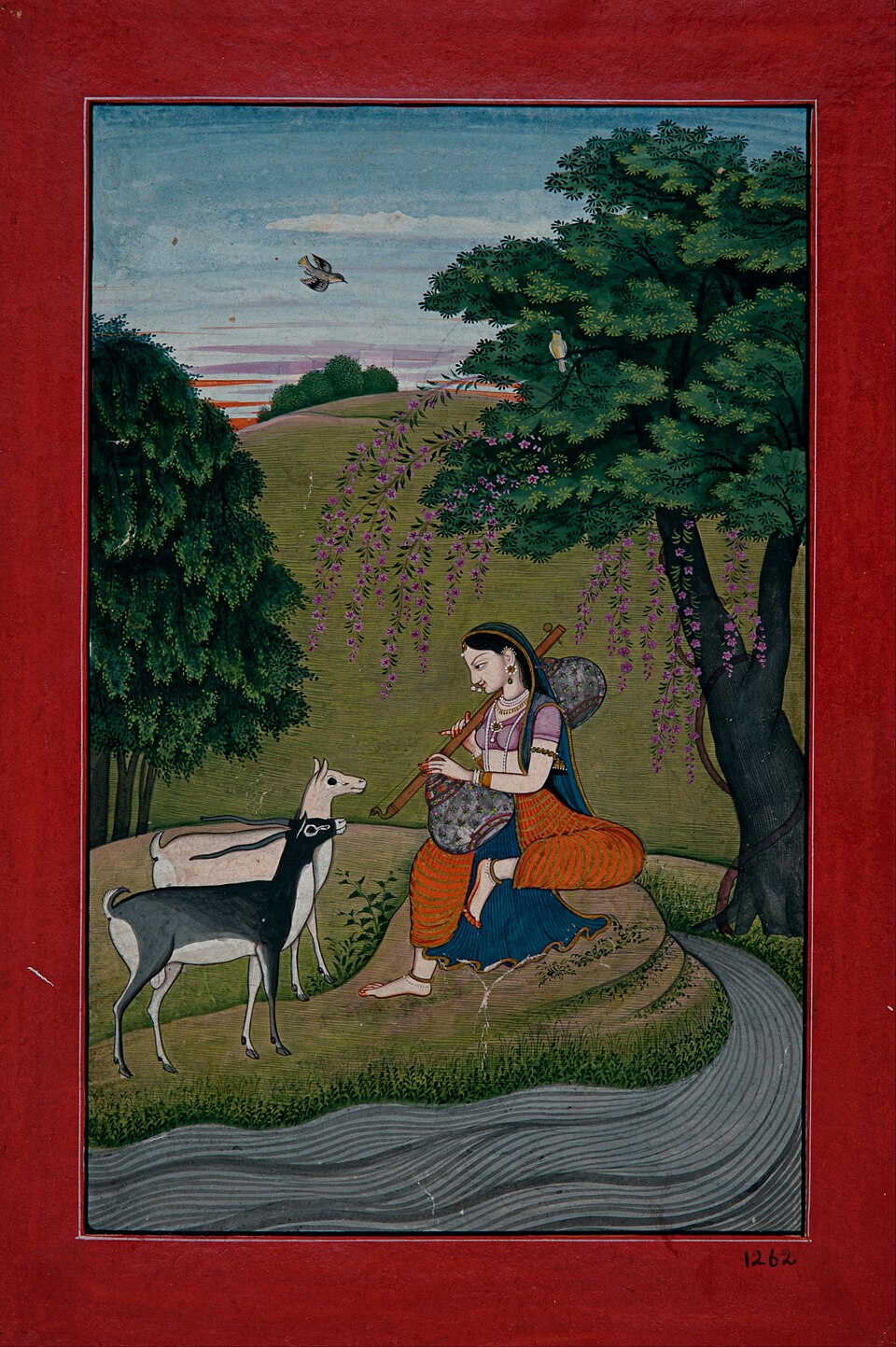
Ragas and raginis in painting. Tradition imagined some ragas as male and others as female raginis. Painters gave them faces and scenes in the Ragamala paintings, which show the mood of each raga as a picture. You will see these in the Rajput and Pahari painting chapter.
Grouping the ragas. Musicians later grouped ragas into families by their scales. The Carnatic system uses melakarta (parent) ragas with janya (derived) ragas, and the Hindustani system uses thaats. The next two chapters explain each.
Tala and laya: the cycle of time
Tala as a cycle. Tala is how rhythm is organised in Indian music. A tala is a cycle of a fixed number of beats that repeats again and again. A composition fits inside this cycle, and musicians improvise around it while always returning to its first beat.
The first beat. The first beat of the cycle, called sam in Hindustani music, is the point everyone waits for. When the singer and drummer land together on sam after a long, complex passage, listeners often nod or clap. It is the moment where the tension of the rhythm is released.
Laya: the speed. Laya is the tempo. It can be vilambit (slow), madhya (medium) or drut (fast). A performance often begins slowly and grows faster, letting the raga unfold fully before the excitement builds.
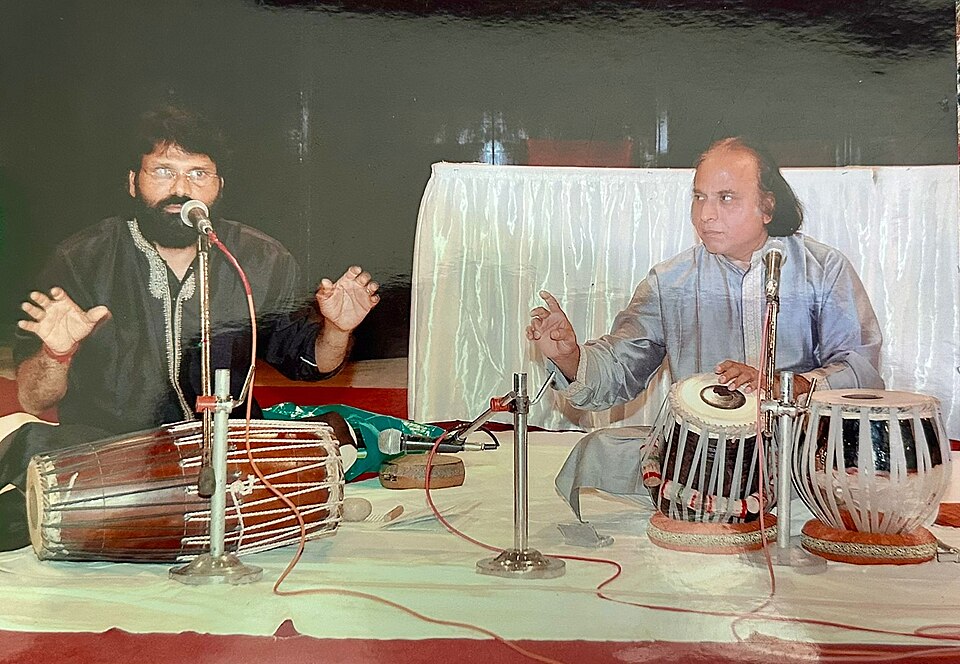
Many talas. Indian music has many talas of different lengths. Tradition speaks of a very large number, sometimes counted as 1008, though only a few dozen are commonly used. In Hindustani music, teental, a cycle of 16 beats, is among the most common.
Drums and their language. Tala is played on percussion: the tabla and pakhawaj in the north, the mridangam in the south, and cymbals such as the manjira and jhanjh. Drummers use a spoken language of syllables (bols) to learn and recite rhythms. Words such as theka (the basic pattern) and tihai (a phrase repeated three times to land on sam) belong to this language.
Marga and desi: two streams from one spring
Two streams. From very early times, Indian music flowed in two streams. One was used in religious ceremonies and became refined and rule-bound; it was called marga. The other was the music of festivals and public entertainment, rich in regional variety; it was called desi.
Same parent. Both streams came from the same parent: popular music. As ritual music became the work of specialists, the marga stream moved away from ordinary people and was later called classical. Desi stayed with the people and took many forms across the regions.
An image to remember. Think of marga as a wide, calm river like the Ganga, and desi as a quick, noisy hill stream. Today, dhrupad and khayal are counted as marga music. Ghazal and thumri sit closer to the desi side.
Exchange both ways. The two streams never stayed apart. Khayal was once looked down on as semi-classical in the age of dhrupad, but it rose to become a full classical form. Ragas such as Khamaj, Kafi, Piloo, Maand and Sarang came from popular music, and folk forms such as chaiti, kajri and rasiya are now sung by classical artists.
Why this matters. Classical music stays alive only by drawing fresh ideas from popular music. If it loses that contact, it risks becoming static and soulless. Popular music, in turn, keeps borrowing from the classical, as film music shows.
The great texts on music
Why texts matter. Music disappears the moment it is sung, so texts are our main window into its past. Indian musicians wrote treatises that defined notes, ragas and talas, and later musicians argued with them. Exams often ask you to match a text with its author or its idea.
| Text | Author and place | Date | Why it matters |
|---|---|---|---|
| Natyashastra | Bharata | c. 2nd century BCE–2nd century CE | Six chapters on music within drama |
| Brihaddeshi | Matanga | c. 8th–9th century | First to name and discuss ragas; notes regional varieties |
| Gita Govinda | Jayadeva, Odisha | 12th century | A poem of songs set to ragas (raga-kavya) |
| Sangita Ratnakara | Sharngadeva, Yadava court of Devagiri | 1210–1247 | First systematic account; 264 ragas; also dance |
| Ghunyat-ul-Munya | Compiled in Gujarat under a governor of Firoz Tughluq | 14th century | Earliest known Persian work on Indian music |
| Raga Tarangini | Lochana | 15th century | Begins grouping ragas by parent scales |
| Swaramela Kalanidhi | Ramamatya, Kondavidu (Andhra) | 1550 | Janaka (parent) and janya (derived) ragas |
| Chaturdandi Prakashika | Venkatamakhin, Thanjavur | c. 1650 | Base of the Carnatic raga system |
Commentaries and courts. Texts were read and re-read. At the Vijayanagara court, Kallinatha wrote a famous commentary on the Sangita Ratnakara under King Mallikarjuna (1446–65). Somanatha's Ragavibodha (1609) even brought some north Indian ideas into a southern text.
A Persian bridge. The Ghunyat-ul-Munya was compiled in Gujarat at the request of Malik Shamsuddin Abu Raja, a governor under Firoz Tughluq. It explained Indian music to the Persian-reading elite and preserved parts of Sanskrit texts that are now lost. It shows that Sultanate courts did not reject Indian music but studied it.
The modern revival. Around 1900, two scholars worked to bring classical music back to the public: Vishnu Narayan Bhatkhande and Vishnu Digambar Paluskar. They collected compositions, wrote books and set up schools. You will meet them again in the Hindustani music chapter.
One music, two classical systems
The two systems. Indian classical music today has two systems. Hindustani music is sung across the north, west and east. Carnatic music belongs to Tamil Nadu, Andhra Pradesh, Telangana, Karnataka and Kerala.
One source. Both come from the same source: the Samaveda, the Natyashastra and the early texts. The difference is one of regional colour, which grew slowly. Matanga's Brihaddeshi already speaks of regional varieties.
When and why they parted. From about the 7th century, regional variations began to grow. Between the 7th and 13th centuries, Indian music also met the music of other lands, especially Persian music, which left its mark mainly on the north. Haripala's Sangita Sudhakara, from Saurashtra in Gujarat, is the first text to name the division into Hindustani and Karnatak styles.
Where the line ran. Hemadri, a 13th-century minister of Devagiri, placed the southern style south of the Krishna river. By the 16th century, the Marathi poet-musician Dasopant referred to the Carnatic style as distinct from the northern one.
How they differ, in brief. Carnatic music keeps each note pure and exact and follows its texts strictly, while Hindustani music lets notes glide into each other and allows more freedom. Carnatic music gives equal weight to words and notes; Hindustani music puts the note first. The next two chapters explore each system in depth.
Coming closer. In the last hundred years, the two systems have borrowed from each other. Carnatic ragas such as Hamsadhwani and Abhogi are now sung in Hindustani music. Artists such as M. Balamuralikrishna and Amjad Ali Khan have blended features of both.
Quick revision
- Sangeet = geet + vadya + nritya. Three elements: swara, tala (laya), raga.
- Roots: Samaveda; Vedic songs (gatha, saman) and instruments (veena, venu, dundubhi); Natyashastra has six chapters on music; Samudragupta's veena coin.
- 7 swaras (Sa Re Ga Ma Pa Dha Ni; shadja to nishada) in a saptak; 22 shrutis; no fixed pitch; Sa and Pa fixed; komal and tivra.
- Raga must delight and carry mood; melody (India) vs harmony (West); raga-time and season; Ragamala paintings.
- Laya: vilambit, madhya, drut; tala = cycle; sam; teental = 16 beats; tabla, pakhawaj, mridangam, manjira; bols, theka, tihai.
- Marga (ritual, classical) and desi (popular); khayal rose to classical; ragas Khamaj, Kafi, Piloo from popular music.
- Texts: Brihaddeshi (Matanga, first ragas); Sangita Ratnakara (Sharngadeva, Devagiri, 1210–47, 264 ragas); Ghunyat-ul-Munya (first Persian work); Swaramela Kalanidhi (Ramamatya, 1550); Chaturdandi Prakashika (Venkatamakhin, c. 1650).
- Two systems from one source; regional colour from 7th c; Persian contact; Haripala first names the division; Hemadri: south of the Krishna.