

HPSC Engineering · Module 8 · standard depth · 20 min
Colonialism under the Crown: industry, famine and poverty
What HPSC Engineering asks from this chapter
Syllabus lines this chapter covers:
- Screening test (general) · History of India; Indian and world geography
HPSC Engineering questions from this module are being sorted into our bank.
Cut to standard depth for HPSC Engineering. 12 deeper paragraphs are in the full chapter.
Start from zero: why did India grow poorer while Britain grew richer?
Imagine two farms joined by one road. One farm makes machines, the other grows cotton, and the owner of the machine farm also writes the rules of the road, sets the prices and collects the tolls. Year after year the machine farm gets richer, and the cotton farm stays poor, however hard its people work.
That, in simple terms, is how many historians describe India's place in the British Empire after 1858. The Company had gone, and the Crown now ruled directly, as explained in India under the Crown after 1858. But the economy that took shape under the Crown kept India poor, hungry and mostly agricultural.
Historians sum up colonialism in two features. The first is subordination: the colony's economy is shaped for the needs of the ruling country. The second is appropriation of surplus: the wealth the colony produces is taken away in many forms, from land revenue to profits and salaries.
This chapter asks what that meant in real life, through industry, famine, farming and income. Keep one question in mind as you read. Was India's poverty under British rule an accident of bad policies, or the result of a system?
The colonial economy at a glance
This table gathers the key dates and numbers of this chapter. Each is explained in the sections below.
| When | What | Why it matters |
|---|---|---|
| 1854 | First Indian cotton mill in Bombay | Indian industry begins, but grows slowly. |
| 1860-64 | Cotton boom during the American Civil War | India fixed as a raw-material supplier. |
| 1860s | Naoroji's estimate: Rs 20 income per head | Poverty measured for the first time. |
| 1860-1880 | India takes 10-12% of British exports, about 20% of its textile exports | India as a captive market. |
| Mid-19th to early 20th century | Official famines: at least 1.52 crore dead, 39.7 crore affected | Hunger as the face of colonial 'normalcy'. |
| 1904-05 | Army takes nearly 52% of revenues; about 45,000 km of railways | Money for empire, little for development. |
| 1931 | Landless labourers 37.8% of agriculturists | The village pyramid at its widest base. |
| 1940-44 | Industry still only 16.7% of national product | India leaves British rule mostly agricultural. |
Read down the last column and a pattern appears. Each number shows India serving Britain's needs first, from markets and raw materials to soldiers and revenue.
The third stage: investment, rivalry and a tighter grip
Three stages in brief. Historians often divide British colonialism in India into three stages, which the chapter on the colonial economy explains in detail. The first was monopoly trade and direct plunder under the Company, when the drain equalled 2 to 3 per cent of Britain's national income. The second was free trade, when India became a market for British goods and a source of raw materials; between 1860 and 1880 it absorbed 10 to 12 per cent of British exports and nearly 20 per cent of Britain's textile exports.
Why a new stage from the 1860s? Britain was no longer the only industrial country, because industry had spread to Europe, the United States and Japan. Science entered industry through chemicals, petroleum and electricity, and faster shipping joined the world into one market. Rich countries now had surplus capital to invest abroad, so they competed for colonies as safe fields for investment, markets and raw materials.
A tighter grip on India. Facing rivals, Britain tightened its control over India, and liberal talk gave way to the reactionary policies of Lytton, Dufferin, Lansdowne and Curzon. British capital flowed into railways, loans to the Government of India and, to a lesser extent, plantations, coal, jute, shipping and banking. By 1905 nearly 45,000 km of railways had been built, and the administration reached deeper into every district.
India's army for Britain's empire. India also supplied soldiers and money for Britain's wars. The Indian army was the chief instrument for defending and expanding the empire in Asia and Africa. The result was a costly standing army that took nearly 52 per cent of Indian revenues in 1904.
From training to 'trusteeship'. The ideology of rule changed too. Earlier talk of training Indians for self-government died away, and the aim became permanent 'trusteeship' over a people described as immature, almost a 'child' people. Race, climate, religion and history were cited to prove that Indians could never govern themselves, while slogans such as 'the Sun never sets on the British Empire' bred pride among British workers at home.
How critics explained empire: Europe and India
Hobson's argument. In 1902 the British writer J.A. Hobson published Imperialism, arguing that capitalism itself bred empire. Because workers were paid little, they could not buy all that factories produced, which he called under-consumption. Profits piled up with nowhere to invest at home, which he called over-saving, so capitalists pushed for colonies as markets and fields for investment.
Hilferding, Luxemburg and Lenin. In 1910 Rudolf Hilferding showed how big banks and industrial monopolies merged into finance capital. Rosa Luxemburg wrote on the accumulation of capital in 1913. In 1916 Lenin's tract on imperialism described it as a late stage of capitalism, written to show that the world war came from rivalry among financial monopolies.
India's own critique came first. Independently of these writers, Indian economic nationalists such as Naoroji, Ranade and R.C. Dutt built a sharp critique of British rule. It had five main points: the drain of wealth; the destruction of crafts; free trade that made India England's 'agricultural farm'; excessive land revenue, which Dutt blamed for frequent famines; and heavy spending on the army and police, while irrigation was starved. Its roots and its impact on politics are traced in the chapter on why nationalism grew and the chapter on the Moderates.

How the two differed. The Indian critique dealt with formal imperialism, where a colony is ruled directly. European theorists also studied informal imperialism, as in China or Latin America, where economic control came without formal conquest, and they saw empire as a product of the capitalist system, not of wrong policies. Later leaders such as Jawaharlal Nehru, M.N. Roy and R.P. Dutt joined these wider ideas to the nationalist critique.
Did India de-industrialise? The great debate
What the word means. De-industrialisation is the reverse of industrialisation: a country loses industry instead of gaining it. In India, as the colonial economy chapter shows, the Company's monopoly first squeezed weavers, and then British machine-made cloth took away first the export market and then the home market. The question historians argue about is how deep and how lasting this loss was.
The sceptics. Morris David Morris argued that the evidence was not decisive. In his view population and income grew under British peace, so the market for cloth expanded enough for both Manchester mills and Indian weavers. Critics answer that he offered no proof that population and income per head actually rose in the nineteenth century.
The regional evidence. Studies of Madras, Bengal, Andhra, Maharashtra and Bihar support the de-industrialisation thesis. A.K. Bagchi estimated that in the middle Gangetic region the weight of industry in people's livelihoods was halved between 1809-13 and 1901. The early nationalists lacked these methods, but later research confirmed their conclusion.
Thorner and the census. Daniel Thorner argued that the censuses of 1881 to 1931 show no substantial de-industrialisation once job categories are regrouped. At first sight the census shows the male workforce in agriculture rising from 65 to 72 per cent and in industry falling from 16 to 9 per cent, but Thorner merged categories and set aside the figures for women as unreliable. His critics reply that the worst damage came before the first reliable census of 1881, that women's figures show a sharper shift out of industry, and, as J. Krishnamurthy argued, that workforce shares are a weak test compared with output and income.
'Good for both countries'? Some defenders of empire accepted that India had de-industrialised but called it a sensible division of labour. As late as 1911 the economist John Maynard Keynes wrote that industrialising India was neither possible nor desirable. A real achievement of the nationalist economists was to defeat this view and make industrialisation part of the freedom movement's programme.
Famine and food: hunger as the 'normal' state
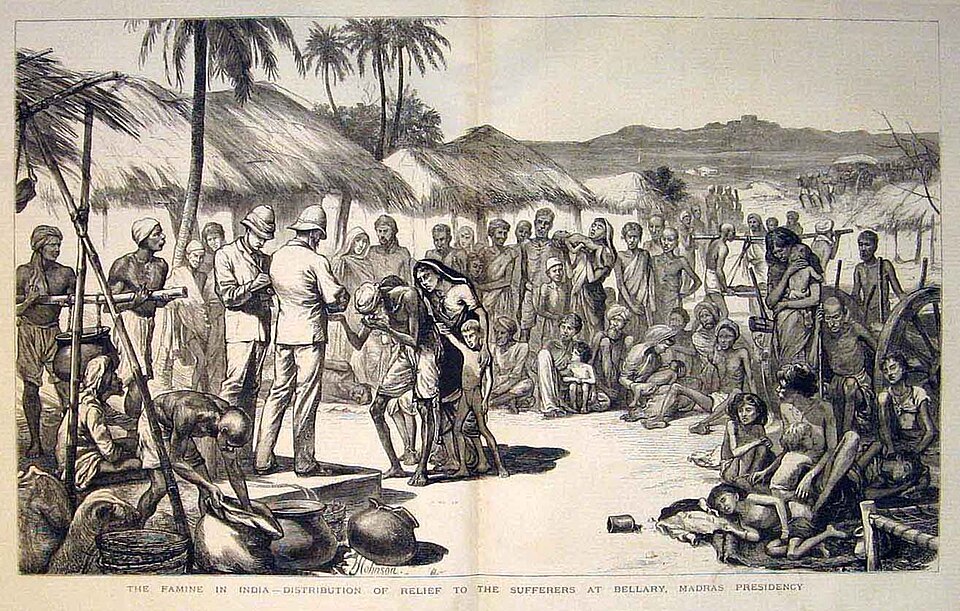
The scale of death. From the middle of the nineteenth century, a series of famines struck India, from the Madras and Bombay Presidencies to Rajputana, Bihar, Orissa and the Deccan. By the government's own estimates, the famines it acknowledged killed at least 1 crore 52 lakh people and affected 39.7 crore. These numbers point to repeated crises of survival, not to a few unlucky years.
Drought was the trigger, not the cause. The immediate cause was usually drought and crop failure. But the roots lay in the 'normal' state of farming: stagnant technology, almost no investment to raise yields, and the steady drain of the cultivator's resources to revenue intermediaries, moneylenders and grain dealers. Government spent little on irrigation, and R.C. Dutt argued that heavy land revenue left farmers with nothing to fall back on when the rains failed.
Laissez faire in the face of hunger. The colonial state claimed it should not interfere in markets. It used this idea to avoid controlling the grain trade, including the export of grain, even during famines in the late nineteenth and early twentieth centuries. The same state did not hesitate to intervene when British investors needed a guaranteed return.
Less food for each person. Food per person fell in the last half-century of British rule. Estimates of grain available per person fell from 0.23 to 0.16 ton in British India (George Blyn), from 0.2 to 0.14 ton in undivided India (Sivasubramonian) and from 0.17 ton in 1901 to 0.16 ton in 1946 (Alan Heston). The estimates differ in size, but all point the same way.
Grain lagged, cash crops raced. Between 1891 and 1947 population grew by about 0.67 per cent a year, while foodgrain output grew by only about 0.11 per cent and yield per acre actually fell by 0.18 per cent a year. Non-food crops such as cotton, jute, tobacco, sugarcane and oilseeds rose by 1.31 per cent a year in output. India was growing more for the market and the world, and less food for its own people.
Cotton boom and the village bania: how commercialisation split the village
A war far away. The freeing of slaves under Abraham Lincoln and the American Civil War caused a huge shortfall in the world's cotton supply between 1860 and 1864. Cotton prices shot up, and cotton exports and cotton acreage in India grew fast. Peasants in the cotton districts were suddenly drawn into the world capitalist market.
Who gained from the boom? The great export houses of Bombay, wholesale traders, brokers and the village bania who lent money for cotton growing all made large profits. Together with earlier profits from opium and indigo, this helped some Indian businessmen to build up capital. More important, the boom fixed India's role as a supplier of raw materials to the industrial West, the other side of de-industrialisation.
The bania at the centre. As farming became more commercial, the ordinary cultivator came to depend on the village bania for credit, for selling his crop, for loans in lean seasons and even for cash to pay the land revenue. The bania was also the agent through which imported goods, especially Manchester cloth, reached the village. Poor peasants often grew crops that were virtually pledged in advance to the moneylender.
Richer and poorer peasants. Better-off peasants could store grain, wait for better prices, cart crops to town markets and choose what to grow, and some became moneylenders themselves. Poorer peasants had none of these choices and lost land steadily, becoming 'de-peasanted' labourers. Landless labourers had existed before British rule, especially in the south, but the scale of depeasantisation was new.
The village pyramid in 1931. Estimates based on the 1931 census give a picture of village India. At the bottom were landless labourers, 37.8 per cent of agriculturists, including bonded labourers who sometimes worked for generations for one master. Above them were tenants-at-will and sharecroppers (24.3 per cent) and small holders below 5 acres (9 per cent), then farmers above 5 acres (25.3 per cent), and at the narrow top rent receivers (3.6 per cent), many of whom did not farm at all.
Industry, income and the colonial state
Indian industry: a slow and uphill start. Railways and other infrastructure opened the way for foreign capital in jute mills, coal mines and tea and coffee plantations, and also for Indian capital. Indians invested first in cotton textiles, starting with the first Indian mill in Bombay in 1854, despite the hostility of Manchester and an unfriendly tariff policy. Progress stayed painfully slow until the First World War, when Indian capital grew and diversified.
Still a farm country in 1947. Even in the last fifty years of British rule, industry's share of the net domestic product rose only from 12.7 per cent in 1900-04 to 16.7 per cent in 1940-44. The primary sector fell from 63.6 to 47.6 per cent, and services rose from 23.7 to 35.7 per cent. India therefore left British rule as a mainly agricultural country, with only a thin layer of modern industry.
A stagnant income. In the 1860s Naoroji estimated India's income per head at Rs 20 a year, at a time when Britain's, in 1870, was worth about Rs 568. Later estimates show India's income per head almost stuck in the last half-century of British rule: Rs 52.2 in 1900-04, Rs 57.3 in 1915-19 and Rs 56.6 in 1940-44, at 1938-39 prices. That is the clearest single measure of colonial stagnation.
'Laissez faire plus policeman'. The British claimed their state should only keep order and leave the economy alone. In practice it intervened whenever British interests gained, for example by guaranteeing interest on British capital in railways whether they made profits or losses. But it insisted on laissez faire when that suited Britain, by refusing real duties on Manchester cloth and by refusing to control the grain trade during famines.
Who shaped the policy? British business could influence Indian policy through Parliament, the Secretary of State, who sat in the British Cabinet, the Governor-General and the higher bureaucracy, especially before the First World War. From the 1920s the need for financial stability, compromises with Indian business and nationalist pressure softened policy somewhat. These hostile policies explain why Indian capitalists increasingly allied with the national movement.
Quick revision
- Colonialism = subordination of the colony + appropriation of its surplus; best seen as a structure.
- Third stage from the 1860s: foreign investment, rivalry for colonies; reactionary viceroys Lytton, Dufferin, Lansdowne, Curzon; ideology of 'trusteeship'.
- Army about 52% of revenues (1904); railways about 45,000 km (1905); India took 10-12% of British exports, ~20% of textile exports (1860-80); early drain 2-3% of Britain's national income.
- Theories: Hobson 1902 (under-consumption, over-saving); Hilferding 1910 (finance capital); Luxemburg 1913; Lenin 1916.
- Indian critique (Naoroji, Ranade, R.C. Dutt): drain, de-industrialisation, 'agricultural farm', heavy land revenue and famines, army spending.
- De-industrialisation debate: sceptics Morris, Thorner (census 1881-1931: men in agriculture 65→72%, industry 16→9%); support Bagchi (industry share halved, 1809-13 to 1901); Keynes 1911.
- Famines (official): ≥1.52 crore dead, 39.7 crore affected; grain per head falling (Blyn 0.23→0.16 t).
- 1891-1947: population +0.67%/yr, foodgrain +0.11%/yr, non-food +1.31%/yr.
- Cotton boom 1860-64 (American Civil War); 1931 pyramid: landless 37.8%, tenants and sharecroppers 24.3%, rent receivers 3.6%.
- First Indian mill Bombay 1854; industry in NDP 12.7% → 16.7%; income per head: Naoroji Rs 20 (1860s), later Rs 52-57 (1938-39 prices).
- Colonial state: 'laissez faire plus policeman', but railway guarantees; no famine grain-trade controls.