

HPSC Engineering · Module 1 · standard depth · 17 min
Harappan Civilisation II: society, religion, script and decline
What HPSC Engineering asks from this chapter
Syllabus lines this chapter covers:
- Screening test (general) · History of India; Indian and world geography
HPSC Engineering questions from this module are being sorted into our bank.
Cut to standard depth for HPSC Engineering. 17 deeper paragraphs are in the full chapter.
Start from zero: who were the Harappans and what happened to them?
In the chapter on Harappan cities we saw how the cities were planned and how their economy worked. But a city is also people: rich and poor, priests and potters, families and strangers. This chapter asks who ruled them, what they believed and how they lived.
Answering is hard because we cannot read their script. Everything comes from objects: houses, graves, seals, figurines and the layout of towns. So historians must reason carefully, and you will meet many 'perhaps' and 'some scholars think'.
Then comes the great puzzle. Around 1900 BC, the cities shrank, the script and standard weights disappeared, and people moved away. Why did India's first urban civilisation end?
There is no single answer, and that is exactly why it is a favourite Mains question. You will learn the main theories, their limits and the view most historians hold today. You will also see that the Harappan way of life did not vanish; it was transformed.
Harappan society and its end at a glance
| Theme | What we know | Key evidence |
|---|---|---|
| Polity | An early state; one state or several city-states is debated | Uniform weights, seals, script; planned towns |
| Society | Socially varied: rich and poor, craft specialists | House sizes, barracks, ornaments |
| Burials | Little sign of hierarchy; cemeteries away from towns | North-south burials; Lothal joint burials |
| Religion | Varied local cults | Mother goddess, 'Pashupati' seal, fire altars, Great Bath |
| Seals | 2,000+, mostly square steatite | Unicorn most common; no horse |
| Script | About 400 signs, right to left, unread | Seals, tablets, pottery |
| Decline | Urban phase ends around 1900 BC | Abandoned sites; seals and weights vanish |
| Afterwards | Late Harappan rural cultures; migration east and south | Cemetery H, Jhukar; doab sites; Daimabad |
Keep one rule in mind: with an unread script, every interpretation is an inference. Good answers say so.
How people lived: society, dress and death
A mixed city population. Cities brought together people who were not kin, so ties of residence and interdependence mattered more than in villages. Yet kin groups survived, as in Bronze Age Mesopotamia and China. Labour and resources may still have been organised along kin lines.
Signs of inequality. House sizes varied from one-room units to large homes with many rooms. Near the Harappa granary stood rows of small quarters, often read as workmen's quarters, and Lothal had workshops and houses of coppersmiths and bead-makers. A rare 12 cm carnelian bead was copied in clay by those who could not afford it.
But not simple. Variation in house size may reflect family size, not only wealth. There is no neat link between big houses and rich objects. Rich and poor lived side by side in Mohenjodaro's lower town.
Occupations. The population included priests, warriors, peasants, traders and artisans such as masons, weavers, goldsmiths and potters. Some crafts needed full-time skill and special facilities, like metallurgy, bead-making and seal-cutting. But many 'specialists' may also have done some farming.
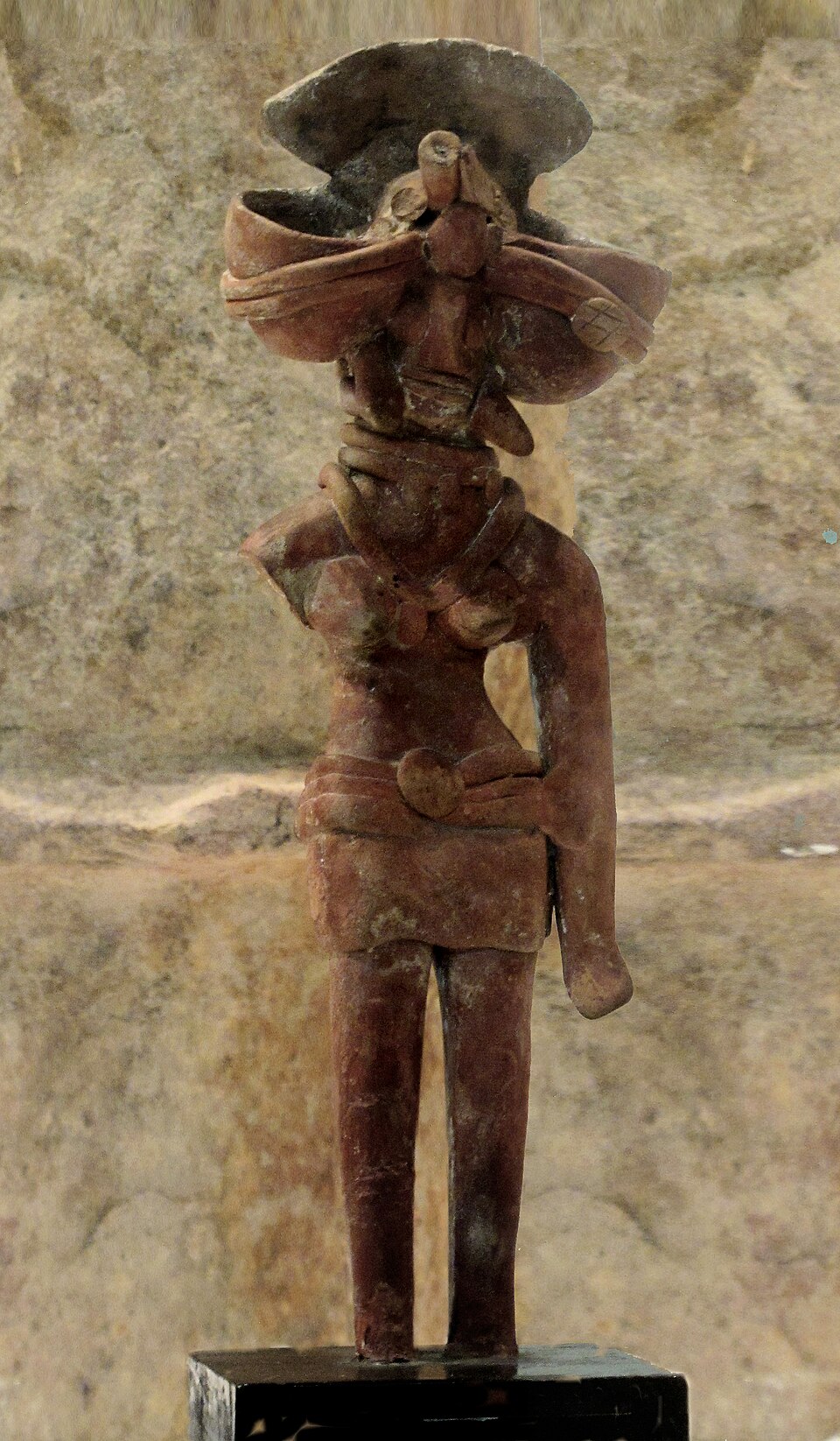
Dress and ornaments. Figurines show men in a garment wrapped round the lower body, with a cloth over the left shoulder, and women in a skirt-like garment. People wore cotton and wool, and spindle whorls and needles show spinning and sewing. Men and women both wore necklaces, armlets, earrings and bangles; the rich used gold, silver and semi-precious stones, the poor terracotta.
Was it matriarchal? The popularity of female figurines has led some to suggest that Harappan society gave women a high place, even that it was matriarchal. But without the script this cannot be tested. Treat it as a weak suggestion, not a fact.
Burials. The dead were mostly buried in cemeteries away from settlements. Bodies were usually laid north-south, head to the north, with pots and ornaments such as bangles, beads and copper mirrors, suggesting a belief in life after death. Burials were extended, in urns, in coffins, or symbolic.
Notable graves. Lothal has joint burials of a man and a woman. Kalibangan has a symbolic burial, with pots but no skeleton. These differences may reflect varied beliefs.
Equal in death? Harappan graves show little sign of hierarchy. There is nothing like the pyramids of Egypt or the Royal Cemetery of Ur, where some graves hold great wealth. Either the elite displayed status in other ways, or Harappan society hid inequality in death.
Seals as identity. More than 2,000 seals have been found, mostly square steatite with a pierced boss at the back, so they could be strung and worn. Each bears an animal or scene and a few signs of the script. They probably marked identity or authenticity in dealings with strangers, and sealings on packed goods at Lothal show their trade use.
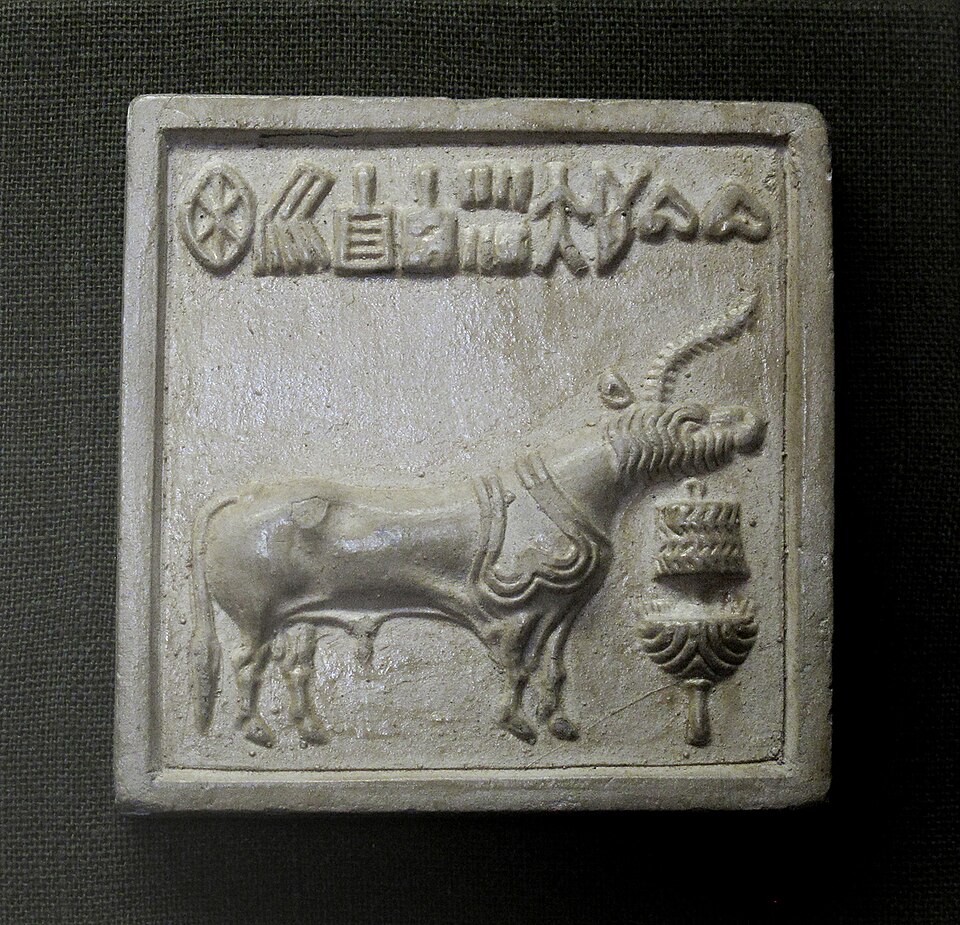
Seal motifs. The 'unicorn', a one-horned mythical animal, is the most common motif. Seals also show the bull, elephant, tiger and rhinoceros, but not the horse, which has fuelled debate on whether the Harappans knew it. No motif is concentrated in one region, a point used to argue for a single state.
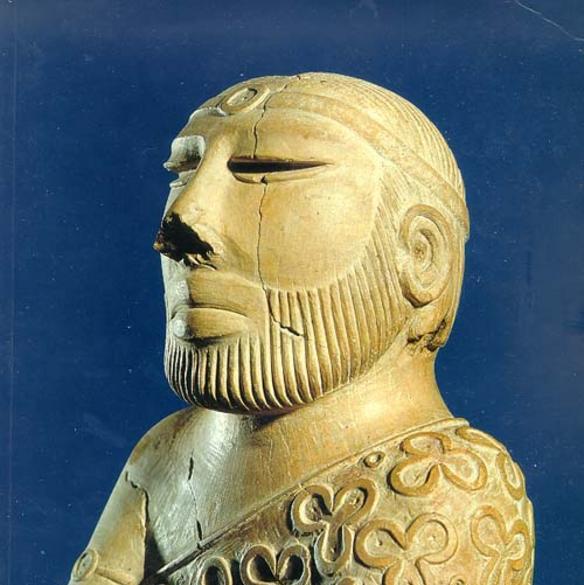
Art in stone and clay. A stone bust of a bearded man with half-closed eyes and a patterned cloak over the left shoulder, from Mohenjodaro, is often called a 'priest'. Terracotta figurines of men, women and animals were common, and female ones outnumber male. Bronze work peaked in the 'dancing girl' described in the previous chapter.
Beliefs and the unread script
Reading religion from objects. With no texts, Harappan religion must be inferred from figurines, seals, buildings and burials. Interpretations often draw on later Indian religion. That is useful but risky, because it can read later ideas into older objects.
Mother goddess. Many terracotta female figurines, some with fan-shaped headdresses, are read as mother goddesses. One seal shows a plant growing from a woman's body, probably an earth or fertility goddess. But such figurines are absent in Kutch, so this was not a universal cult.
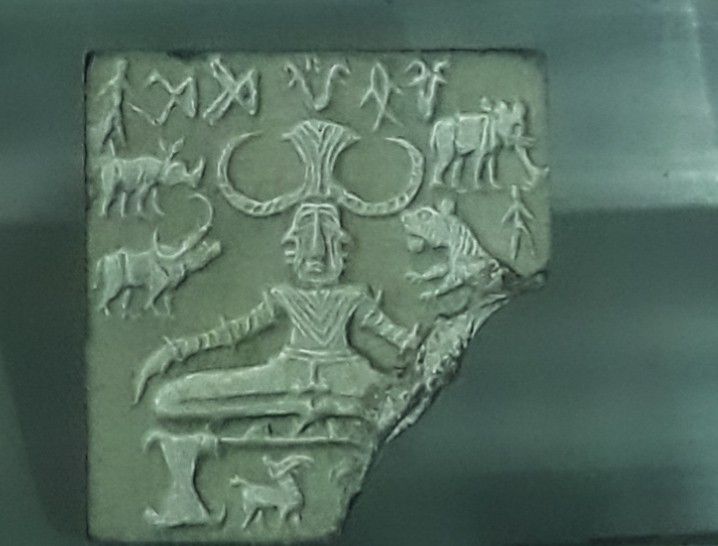
The 'Pashupati' seal. A famous seal shows a horned figure seated in a yogic posture, surrounded by an elephant, tiger, rhinoceros and buffalo. John Marshall called it a proto-Shiva or Pashupati, 'lord of animals'. More recently some scholars read the same figure as evidence of shamanistic beliefs, so the identification is disputed.
Trees and animals. One seal shows a horned deity between pipal branches with a kneeling worshipper, suggesting tree worship. Animals like the bull appear often, and animal worship seems to have been common. Narrative scenes on seals may depict rituals.
Fire altars. At Kalibangan and Lothal, brick platforms with pits of ash and animal bones are identified as fire altars. They are absent at Harappa and Mohenjodaro. So if there was a fire cult, it was limited to a few centres.
The Great Bath. The Great Bath at Mohenjodaro is often seen as the site of a public or royal ritual of purification by water. Ritual bathing on that scale may have been confined to Mohenjodaro. Some see links with later Indian ideas of ritual purity.
Linga and yoni? Some scholars identify certain stone objects as linga and yoni, but others doubt it. Treat such claims with caution. The overall picture is of many local cults under a broad shared culture, a 'great tradition' over many 'little traditions'.
The script. The Harappans were literate. Their script has about 400 signs, which is too many for an alphabet and suggests word-signs or pictorial signs. It was written from right to left, as shown by how signs crowd at the left edge.
Why we cannot read it. Most inscriptions are very short, a few signs on a seal. There is no bilingual inscription, like the Rosetta Stone that unlocked Egyptian hieroglyphs. The language behind it is unknown; some have suggested Brahui or other Dravidian links, but nothing is proven.
Who could read? Because writing appears mainly on seals and small objects used in exchange, literacy was probably limited to a few people, perhaps traders, officials or priests. Seals used in trade do not prove that ordinary people could read. Long-distance contacts may also have made some people bilingual.
The end of the cities
What changed around 1900 BC? Between about 1900 and 1800 BC the material record changes. Many settlements in the core areas of Sind, west Punjab and the Hakra valley are abandoned, and surveys along the Hakra show their number falling sharply in the Late Harappan period. Mesopotamian texts also stop mentioning Meluhha around this time.
Signs of decline in the cities. In Mohenjodaro, Harappa and Kalibangan, building standards fell. Houses of old, reused bricks encroached on roads and streets, and entry points to the Great Bath were blocked until it and the granary fell out of use. The cities were turning into slums, with fewer figurines, beads and inlay work in the late levels.
The hallmarks vanish. The typical Harappan objects disappear: cubical weights, long and etched carnelian beads, square steatite seals and the script. Fewer raw materials were used, and most were local. Town planning and uniform pottery also faded.
Theory 1: floods and earthquakes. Mohenjodaro was rebuilt at least three times over layers of silt. The hydrologist R.L. Raikes argued that earthquakes raised land in the lower Indus, damming the river into a lake that drowned the city. H.T. Lambrick replied that the Indus would easily breach such a dam, and that the 'silt' may be wind-blown; at best the theory explains one region.
Theory 1b: the river moved. Lambrick's own view was that the unstable Indus shifted its course away from Mohenjodaro, starving the city and its villages of water. But people used to such shifts could simply have built a new city. It explains the desertion of Mohenjodaro, not the end of a civilisation.
Theory 2: drying and climate. D.P. Agrawal and Sood stressed growing aridity and the drying of the Ghaggar-Hakra after the Sutlej was captured by the Indus and the Yamuna shifted east to the Ganga. This explains the desertion of sites in the Cholistan desert. But the drying has not been firmly dated, and it would not explain abandonment in Sind or Gujarat.
Theory 3: Aryan invasion. Mortimer Wheeler blamed invading Aryans. He cited skeletons lying in Mohenjodaro's late streets, Indra's title Purandara ('destroyer of forts') and a Rig Vedic battle at Hariyupiya on the Ravi, a name like Harappa. The theory has long been rejected: the decline is dated before the Vedic people arrived, the cities were already decaying, and there is no evidence of a military assault.
Theory 4: ecological strain. W.A. Fairservis calculated that a city like Mohenjodaro needed food from very many villages. He argued that growing numbers of people and cattle wore out the forests, pasture and fuel of a fragile semi-arid land, bringing more floods and droughts and pushing people towards Gujarat and the east. Critics note that the soils stayed fertile and that his numbers rest on scanty data.
Theory 5: a crisis of the state. Most historians now see no single cause. Environmental stress, changing rivers and loss of trade may have combined with inherent weaknesses in the socio-political structure. Around 1900 BC the Harappan state seems to have collapsed or entered a crisis, leading to widespread desertion and migration.
Where did people go? People moved to outlying areas: Kathiawar in Gujarat, eastern Punjab, Haryana and the upper Ganga-Yamuna doab. A 1984 list counts 31 Mature Harappan but 130 Late Harappan sites in the doab, and in Gujarat about 13 Mature Harappan settlements gave way to 200 or more. Such growth in a few generations can only mean migration: a shift of population, not its disappearance.
Late Harappan cultures. In the Indus valley, the Cemetery H culture (near Harappa) and the Jhukar culture took over as smaller, mostly rural settlements. Cemetery H people, known from their burials and distinct pottery, appeared at Harappa before it was abandoned; at Jhukar and Chanhudaro people still lived in brick houses but gave up the planned layout, and used circular stamp seals and metal objects with Iranian parallels.
In Kutch and Saurashtra, Rangpur even grew more prosperous, using Lustrous Red Ware. In Maharashtra, Daimabad had a Late Harappan phase with 4:2:1 bricks and script signs on pottery.
Mixing with local cultures. Migrating Harappan groups joined local cultural sequences. In the doab they mixed with the Ochre Coloured Pottery culture, and in Maharashtra with the Savalda and Chalcolithic cultures described in the Stone Age and Chalcolithic chapter. Harappan traditions thus flowed into the wider Indian village world.
Transformation, not collapse. What disappeared were the state, urban life, writing and long-distance trade. Farming, herding, crafts and basic technologies continued.
That is why historians speak of decline and transformation rather than a sudden end. Since the late 1960s, scholars such as Malik and Possehl have studied these continuities instead of hunting for a single cause.
Quick revision
- State debate: chiefdom (Fairservis, Shaffer); city-states (S.P. Gupta, B.B. Lal, Kenoyer); single state (Jacobson, Ratnagar). No coins, bureaucracy or standing army.
- Society: varied houses; barracks near Harappa granary; priests, warriors, peasants, traders, artisans; cotton and wool.
- Burials: cemeteries away from towns; north-south, head north; little hierarchy; Lothal joint burials; Kalibangan symbolic burial.
- Seals: 2,000+, square steatite, pierced boss; unicorn most common; bull, elephant, tiger, rhino; no horse.
- Religion: mother goddess (not in Kutch); 'Pashupati'/proto-Shiva seal (elephant, tiger, rhino, buffalo; shaman reading); pipal deity; fire altars at Kalibangan and Lothal (not Harappa, Mohenjodaro); Great Bath.
- Bearded 'priest' bust (Mohenjodaro).
- Script: about 400 signs, right to left, undeciphered; short texts, no bilingual; literacy limited.
- Decline c. 1900-1800 BC: Hakra sites fall sharply; Meluhha vanishes from Mesopotamian texts; weights, seals, beads, script vanish; Great Bath disused.
- Theories: Raikes earthquake-floods; Lambrick Indus shift; Agrawal and Sood aridity, Ghaggar drying; Wheeler Aryan invasion (Purandara, Hariyupiya; rejected); Fairservis ecological strain; state crisis.
- Continuity: Gujarat 13 → 200+ sites; Rangpur (Lustrous Red Ware); Malik and Possehl.
- Late Harappan: Cemetery H, Jhukar; Kathiawar, east Punjab, Haryana, doab (31 → 130); Daimabad 4:2:1 bricks and script; mixing with OCP.