

KPSC KAS · Module 76 · Mains depth · 17 min
Human spaceflight: Gaganyaan and beyond
What KPSC KAS asks from this chapter
Syllabus lines this chapter covers:
- GS 3 · Role of science and technology in the development of India; information technology.
KPSC KAS has asked 2 questions from this chapter (2020); 9 from its whole module.
Read at full depth: basics, the standard layer and the Mains analysis.
Start from zero: what does a human need in space?
Sending a satellite into space is hard, but sending a person is much harder. A satellite does not breathe, eat or feel cold, and if it fails, nobody dies. A human body, on the other hand, is built for life at the bottom of a thick blanket of air.
Think about what keeps you alive right now. You breathe air with oxygen in it, and the air presses on your body from all sides. You stay warm, you drink water and eat food, and the atmosphere shields you from much of the harmful radiation from space.
In space, none of this is free. So a crewed spacecraft must carry its own small "piece of Earth": air at the right pressure, a comfortable temperature, water, food and protection. It must also bring the crew home safely through the fiery heat of re-entry and land them gently.
That is why human spaceflight is the toughest test of a space programme. This chapter looks at how India is preparing for it, step by step, from the rocket and the capsule to the astronauts themselves.
Why India wants to send humans, and when the steps happened
Why should India send its own astronauts when robots already do so much? The official objective of Gaganyaan is to demonstrate India's own capability to fly humans to low Earth orbit. Only a few countries can do this, and the skills it needs go far beyond those for satellites.
There are deeper reasons too. A country that can fly people safely has mastered reliability, life support and rescue at the highest level, and these skills spill over into medicine, materials and industry. Human flight is also the gateway to a future space station and longer missions, where India would want its own place rather than a borrowed seat.
When the steps happened:
- 18 December 2014: on LVM3's first flight, a full-size crew module was tested for re-entry and recovered from the Bay of Bengal.
- 30 January 2019: the Human Space Flight Centre (HSFC) was inaugurated at ISRO headquarters in Bengaluru to run Gaganyaan.
- October 2023: the TV-D1 test showed that the crew escape system works in flight.
- 18 December 2024: the launch campaign for the first uncrewed flight, HLVM3-G1, began at Sriharikota.
- 25 June 2025: Indian Air Force test pilot Shubhanshu Shukla flew to the International Space Station on Axiom Mission 4.
Where it happens. The project is managed from Bengaluru, where HSFC and the astronaut training facility are located. Launches will take place from Sriharikota, and the crew will land in Indian sea waters.
The Gaganyaan mission: how it is designed
Now that we know why, let us see what the mission will actually do. Gaganyaan aims to send a crew of three into an orbit 400 km above the Earth for a three-day mission. At the end, the crew will come back and land in Indian sea waters.
The rocket. The launcher is HLVM3, the human-rated version of LVM3. "Human-rated" means it is built with extra reliability for human safety, and it carries a Crew Escape System on top.
The spacecraft. The part that goes into orbit is called the Orbital Module, and it has two pieces.
- The Crew Module is where the astronauts live. It keeps an Earth-like environment inside, with air, pressure and temperature that the body needs.
- The Service Module supports the Crew Module in orbit with things like power and propulsion, and it is left behind before the Crew Module returns.
The plan in steps. The government approved two uncrewed missions and one crewed mission, at a total cost of about ₹9,023 crore. Flying without a crew first lets engineers test every system before risking lives.
When? In July 2025, ISRO said the first uncrewed flight was targeted for the last quarter of 2025 and the first crewed flight by the first quarter of 2027. Dates like these often move, so in the exam always check the latest official announcement.
Keeping the crew safe: escape, re-entry and recovery
A rocket carrying people must answer one question before anything else: what happens if something goes wrong? Satellites can be lost, but a crew must be saved. So ISRO tested the safety systems one by one, long before any astronaut flies.
The Crew Escape System. On top of HLVM3 sits a Crew Escape System powered by quick-acting, high-burn-rate solid motors. If the rocket fails during the climb, these motors fire in an instant and pull the crew module away from the rocket, and parachutes then bring it down.
TV-D1: testing the escape in flight. In October 2023, a special single-stage liquid test vehicle using a modified Vikas engine flew the TV-D1 mission. At Mach 1.2, just faster than sound, the flight was deliberately aborted. The crew escape system pulled the crew module away, and the module was then separated and safely recovered.
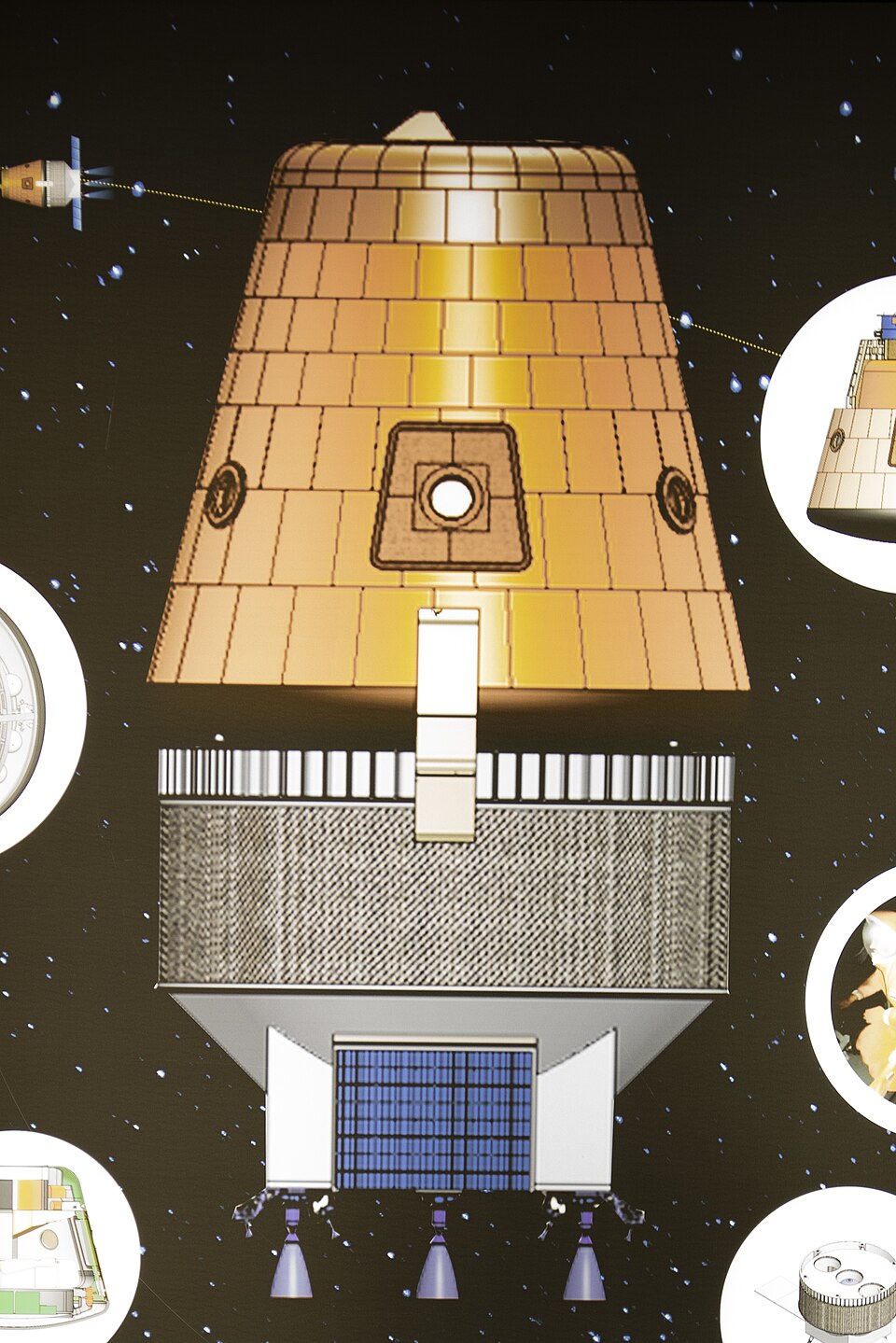
Re-entry: coming back through the fire. A returning capsule hits the air at enormous speed, and friction heats its outer shell to very high temperatures. On LVM3's first flight on 18 December 2014, a 3,775 kg crew module tested this re-entry. The Indian Coast Guard recovered it from the Bay of Bengal about 1,600 km from Sriharikota.
Why test in this order? Each test removes one big risk before the next step: re-entry in 2014, escape in flight in 2023, and full uncrewed missions after that. Only when all of them work does it make sense to put a crew on board.
The astronauts: selection, training and a first trip
A spacecraft is only half the mission, and the other half is the crew. Who should fly first, and how do you prepare someone for a place no Indian spacecraft has taken a person before?
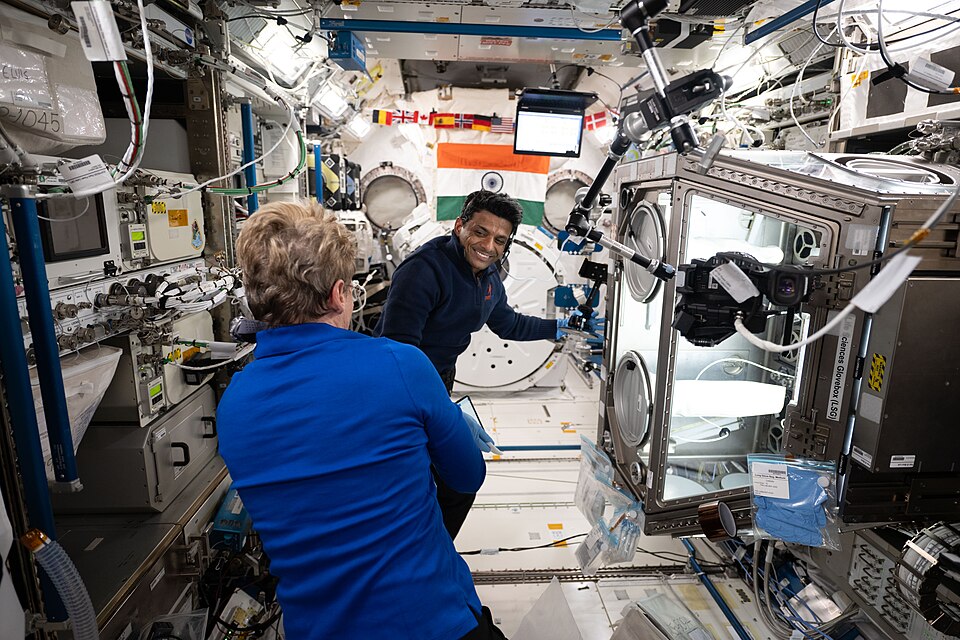
Selection. India chose to pick its first astronaut trainees from test pilots, because they are used to flying new machines under stress and reporting exactly what happens. The selection criteria were defined jointly by ISRO and the Indian Air Force, and four IAF test pilots were selected for Gaganyaan training.
Training. The Astronaut Training Facility in Bengaluru gives classroom training, physical fitness training, simulator training and flight suit training. The whole project is run by the Human Space Flight Centre, set up on 30 January 2019, which handles mission planning from start to end.
A first trip on someone else's spacecraft. Before Gaganyaan, India gained real experience through Axiom Mission 4 (Ax-04). It was launched on 25 June 2025 on a SpaceX Falcon 9 rocket from the Kennedy Space Centre in Florida, USA.
- Shubhanshu Shukla of India was the mission pilot, and Prashanth B. Nair was the backup crew member.
- The crew docked with the International Space Station on 26 June 2025.
- They undocked on 14 July and splashed down on 15 July 2025.
Why Ax-04 matters. ISRO says the mission gives valuable inputs for Gaganyaan. Living and working on a real space station, doing experiments and coming home safely teaches lessons that no simulator can.
After Gaganyaan: towards a space station
Gaganyaan is a three-day trip, but a space station is a home in orbit where people can live and work for months. So once India can fly people safely, the next natural step is a station of its own, the Bharatiya Antariksh Station (BAS).
Why docking is the key. A space station is too big to launch in one piece. Its modules must go up on separate rockets and then join together in orbit, and crews and supplies must keep arriving and docking with it. That is why docking technology is called essential for building and operating BAS.
India took a first step in this direction with a mission that joined two small satellites in orbit. You can read how that worked, and why it matters, in space policy, private sector and space debris.
The open questions. The detailed plan and dates for the station are still being worked out. So for now, remember the logic: crewed flight first, then docking, and then a station built piece by piece.
What changes when India flies humans
Knowing the plan is only half the story. UPSC also asks so what? Human spaceflight changes things far beyond the three days in orbit.
1. Technology that spreads. Life support, heat shields, parachutes, rescue systems and space medicine all have uses on the ground. Building them in India grows industry and research.
2. Strategic standing. Very few countries can launch their own crews. Joining them strengthens India's voice in global space decisions, including future stations and missions beyond Earth orbit.
3. People and inspiration. An Indian astronaut on an Indian rocket inspires students to take up science and engineering. Ax-04 already showed how much public interest a crewed flight creates.
4. Cost and risk. The programme costs about ₹9,023 crore, and a human flight carries a risk to life that no satellite mission does. So the work must be slow, careful and fully tested, and delays are a sign of caution rather than failure.
Mains lens: one debate and three kinds of questions
GS-III asks about "achievements of Indians in science and technology" and "awareness in the field of space". On this chapter, a good answer explains why human flight is a different level of challenge and how India is reducing its risks.
The questions in this section are practice questions written by us, not past papers.
Debate: humans or robots?
- For crewed flight: humans can adapt, repair and judge in ways machines cannot, and crewed flight builds national capability and inspiration.
- For robots: robotic missions cost far less, carry no risk to life and have already done most of the science in space.
- Balanced view: robots should do most of the science, while crewed flight builds capability for a space station and long missions where humans add real value.
Question type 1: "Explain" (the concept question). Example: Explain the key technologies India must master for human spaceflight under the Gaganyaan programme.
- Intro: Say that human flight needs reliability, life support and rescue at a much higher level than satellites.
- Body: Describe the human-rated HLVM3, the Crew Module with an Earth-like environment, the Service Module, the Crew Escape System tested in TV-D1, and re-entry tested in 2014.
- Conclusion: End by noting that each test removes one risk before a crew flies.
Question type 2: "Discuss the significance" (the application question). Example: Discuss the significance of the Gaganyaan programme for India.
- Intro: State the mission: three crew, 400 km, three days, return to Indian waters.
- Body: Cover capability, technology spin-offs, industry, strategic standing, and the path to a space station, with Ax-04 as early experience.
- Conclusion: Note the cost, about ₹9,023 crore, and the need for patience.
Question type 3: "Critically examine" (the both-sides question). Example: "Human spaceflight is a prestige project with little benefit for the common citizen." Critically examine.
- For the statement: high cost, risk to life, and robotic missions doing most of the science.
- Against: technology spin-offs, skills, industry, inspiration, and a base for future stations.
- Way forward: keep costs transparent, involve industry and research institutions, and link the programme to clear science goals.
Useful keywords: human-rated launch vehicle, crew module, service module, crew escape system, in-flight abort, re-entry, life support, astronaut training, docking, Bharatiya Antariksh Station.
Previous years' questions
This section shows the real past questions on this chapter for the exam you have chosen. Each question is copied word for word from the official paper, with the year and paper, so that you can see how the topic is actually asked.
Questions are being collected from the official UPSC and BPSC papers. They will appear here once each one is checked against the original paper.
Quick revision
- Gaganyaan aims to fly a crew of three to a 400 km orbit for three days and land them in Indian sea waters. Its objective is to show India's own human spaceflight capability.
- The government approved two uncrewed + one crewed missions, at about ₹9,023 crore. The rocket is HLVM3, the human-rated LVM3 with a Crew Escape System.
- The Orbital Module has a Crew Module, where the crew lives in an Earth-like environment, and a Service Module, which supports it in orbit.
- CARE (18 Dec 2014) tested crew module re-entry, and TV-D1 (Oct 2023) tested the crew escape at Mach 1.2.
- HSFC was inaugurated in Bengaluru on 30 Jan 2019. Astronauts are chosen from IAF test pilots and trained at the Astronaut Training Facility in Bengaluru.
- Ax-04 launched on 25 Jun 2025 on Falcon 9, with Shubhanshu Shukla as pilot. It docked with the ISS on 26 Jun and splashed down on 15 Jul 2025.
KPSC KAS questions from this chapter
Which of the following statement/s is/are correct ? A. A female astronaut Christina Koch spent 328 days, a record breaker in space during 2019 – 20. B. Christina Koch was accompanied by astronauts Luca Parmitano and Alexander Skvortsov. C. Research during the mission was growing protein crystals for potential use in treatment for Parkinson’s and Alzheimer’s. Choose the correct answer from the options given below :
- (a) Only A is correct
- (b) A and B are correct
- (c) B and C are correct
- (d) A, B and C are correct
Show answer
(d) A, B and C are correct
It has been observed that the astronauts lose substantial quantity of calcium through urine during space flight. This is due to _______.
- (a) Hypergravity
- (b) Microgravity
- (c) Intake of dehydrated food tablets
- (d) Low temperature in cosmos
Show answer
(b) Microgravity