

MPPSC SSE (State Service) · Module 93 · Mains depth · 20 min
Land and agriculture: land degradation, soil health, natural farming and agro-forestry
What MPPSC SSE (State Service) asks from this chapter
MPPSC SSE (State Service) questions from this module are being sorted into our bank.
Read at full depth: basics, the standard layer and the Mains analysis.
Start from zero: the thin skin that feeds us
Almost all our food grows in the top few centimetres of the Earth's surface. This thin layer of soil holds water, air, minerals and billions of living organisms. It takes nature hundreds or even thousands of years to build a few centimetres of fertile topsoil.
Yet one heavy storm on bare land can wash that topsoil away in a single day. Years of over-irrigation can leave a white crust of salt on once-green fields. Too much chemical fertiliser and too little organic matter can leave soil hard, lifeless and hungry for ever more inputs.
India feeds about a sixth of humanity on a small share of the world's land. So the health of its land and soil is a question of food security, farmers' incomes and the environment all at once. Degraded land also stores less water and carbon, which links it to droughts and climate change.
This chapter explains how land degrades, how modern farming adds to the damage, and what India is doing about it. It covers desertification and land degradation neutrality, soil health cards, natural and organic farming, agro-forestry and the revival of common lands. Soil pollution is covered in the chapter on soil, noise, light and radiation, and the global land treaty in the chapter on chemicals, land and ocean treaties.
Land as a resource, and how it degrades
Why soil is "non-renewable". Soil forms through the slow weathering of rock by physical, chemical and biological forces, followed by the build-up of organic matter. Microbes break down dead plants and animals into simple minerals (mineralisation), and the leftover dark organic matter is humus. Because a layer of topsoil can take thousands of years to form, it is treated as effectively non-renewable on a human time scale.
Why humus matters. Humus gives soil a loose texture, so air and roots move freely. Being colloidal, it holds water and nutrients like a sponge. Soil rich in organic matter is more fertile, resists drought better and supports more soil life.
What land degradation is. Land degradation is a reduction in the capacity of land to produce goods and services in quality and quantity. Human causes include deforestation, overgrazing, faulty farming, damming of rivers, mining, industry, roads and urban growth. Natural disasters such as droughts, floods and landslides also degrade land.
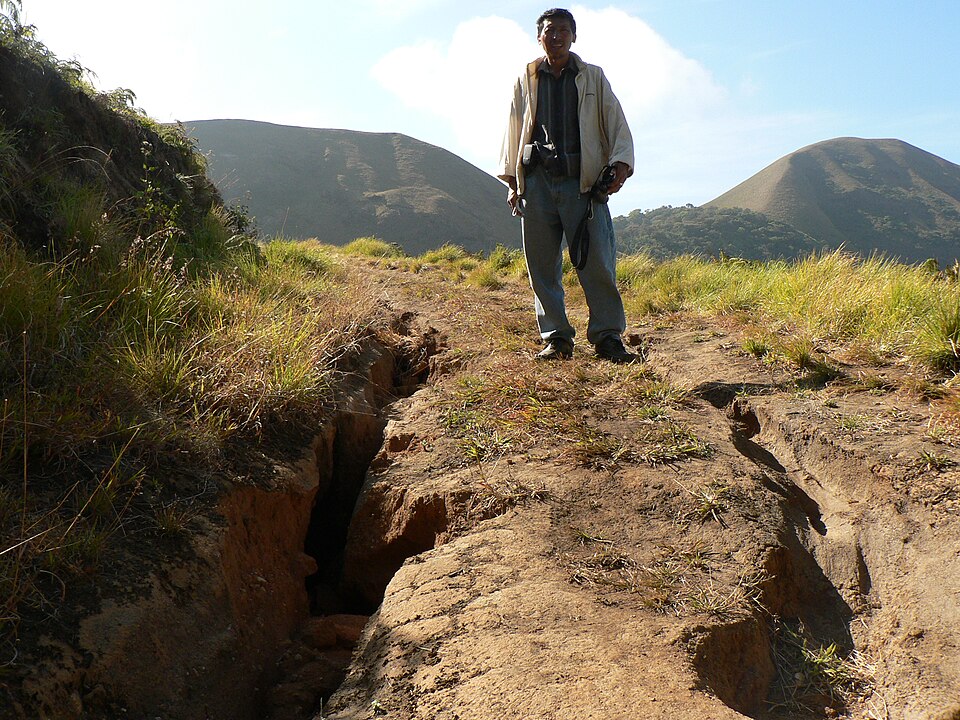
Wastelands. A large share of India's private and common land is degraded to some degree and is often called wasteland, meaning land that does not produce its potential biomass. Wasteland development regenerates such land through soil and water conservation, planting suitable species, protecting them and sharing the benefits with local people. Without benefit sharing, protection rarely lasts.
What modern farming does to land
Two kinds of change. Traditional farming caused deforestation, loss of soil structure, erosion and loss of nutrients. Modern agriculture shares these effects and adds new ones of its own. These new harms come from the very tools that raised yields: irrigation, chemicals and high-yielding varieties.
Waterlogging and salinity. Excessive irrigation raises the water table until the root zone is soaked, causing waterlogging. As this water evaporates, it leaves salts behind, causing salinisation, the white crust seen in parts of Punjab, Haryana and canal-irrigated areas. At the same time, over-pumping elsewhere depletes groundwater, as explained in the chapter on water.
Chemical overload. Heavy use of chemical fertilisers speeds up the loss of micronutrients from soil, while runoff causes eutrophication of water bodies, explained in the chapter on water pollution. Nitrates in drinking water can harm infants. Pesticides can poison food and kill non-target friendly organisms such as pollinators and natural predators of pests.
Monoculture risks. High-yielding varieties grown over vast areas create monocultures. A single pest or disease can then sweep through the whole crop, causing epidemics. Monocultures also shrink the genetic diversity of crops, losing traditional varieties suited to local stresses.
Desertification and land degradation neutrality
What desertification is. Desertification is land degradation in dry areas, arid, semi-arid and dry sub-humid, caused by climate variation and human activity. It does not mean that deserts are moving forward like sand dunes. It means that productive dry land is losing its ability to support plants, crops and livestock.
Mapping the problem. The Desertification and Land Degradation Atlas of India, released in June 2021, was prepared by the Space Applications Centre of ISRO, Ahmedabad. It gives state-wise areas of degraded land for 2018-19 and tracks change since 2003-05. Satellite mapping lets the government see where land is getting worse and target restoration.
Land degradation neutrality. Land Degradation Neutrality (LDN) means that the amount of healthy, productive land stays stable or increases, because new degradation is avoided and degraded land is restored. India has committed to achieve LDN by 2030. It has also committed to restore 26 million hectares of degraded land by 2030.
Why it matters. Degraded land produces less food and fodder, holds less water and stores less carbon. It pushes farmers into debt and migration, especially in drylands. Restoring land therefore supports food security, climate goals and rural incomes together, and links to the global desertification treaty explained in the chapter on chemicals, land and ocean treaties.
Knowing your soil: Soil Health Cards
The problem of blind fertiliser use. Many farmers apply fertilisers by habit or advice from dealers, without knowing what their soil actually lacks. This often means too much nitrogen, too little of other nutrients, and money wasted. Over time, such unbalanced use harms the soil and the water around it.
The Soil Health Card scheme. The Soil Health Card scheme was launched nationwide on 19 February 2015 from Suratgarh in Rajasthan, with the slogan "Swasth Dharaa, Khet Haraa" (healthy earth, green farm). Soil samples are tested, and each farmer gets a card showing the health of the soil and the nutrients it needs. The idea is to apply the right fertiliser in the right amount.
Why it helps the environment. Balanced fertiliser use reduces nutrient runoff into rivers and lakes, and lowers nitrate pollution of groundwater. It saves farmers money and can raise yields. Combined with organic manure, it helps rebuild soil organic matter.
The limits. A card helps only if farmers trust it and if the recommended fertilisers are available and affordable. Testing must be repeated over time, and advice must reach farmers in their own language. Soil health also depends on organic matter and soil life, which a chemical test cannot fully capture.
Natural and organic farming
The idea. Organic farming avoids synthetic fertilisers and pesticides and relies on compost, manure, crop rotation and biological pest control. Natural farming goes further in cutting costs: it relies mainly on on-farm resources such as cow dung and urine-based preparations, mulching and mixed cropping. Both aim to restore soil life and reduce dependence on purchased chemicals.
The National Mission on Natural Farming. The Union Cabinet approved the National Mission on Natural Farming on 25 November 2024. Its total outlay is ₹2,481 crore, of which ₹1,584 crore is from the Centre and ₹897 crore from the States, up to March 2026. It aims to promote nature-based, sustainable farming systems and reduce farmers' dependence on externally purchased inputs.
Why it is attractive. Lower input costs can protect small farmers from debt. Healthier soils hold more water and carbon, and fewer chemicals mean less pollution of water and food. Diverse crops and natural pest control also support biodiversity on farms.
The debate. Critics worry that yields may fall during the shift, especially for crops used to heavy fertiliser, which could affect food security if done too fast or too widely. Supporters say yields recover as soil health improves and that costs fall sharply. A sensible path is gradual adoption, with research, training and market support for farmers who switch.
Trees on farms and life in the commons
Agro-forestry. Agro-forestry grows trees together with crops or livestock on the same land. Trees on field boundaries and between crop strips give fodder, fruit, fuel and timber, provide shade for cattle and protect soil from wind and water erosion. They also store carbon and give farmers a second source of income when crops fail.
Common lands matter. In dry regions, common lands such as village pastures are vital for the cattle of small and landless farmers. In Rajasthan, these grazing commons are called charagahs. When they degrade, poor families lose fodder, and pressure shifts to forests.
A community success. In Udaipur district of Rajasthan, the NGO Prayatna Samiti regenerated village grazing land by building cattle-proof trenches and stone walls, conserving soil and water, and sowing grass and tree seeds. Within four years, the grass produced was worth about ₹32.5 lakh. Local species returned and soil erosion fell sharply.
The lesson. Such efforts work when the community protects the land and shares the benefits fairly. Government support for soil and water conservation, combined with local rules, can turn wasteland into productive commons. This is land degradation neutrality in practice at the village level.
Mains lens: three live debates on land and farming
1. The Green Revolution: success with a bill attached? High-yielding seeds, irrigation, fertilisers and pesticides made India self-sufficient in grain and ended the fear of famine. That success was real and saved millions of lives. But the same methods, used heavily for decades, brought waterlogging and salt in irrigated fields, loss of micronutrients, pesticide harm and a narrow base of a few crop varieties.
One side says that these costs were the price of feeding a hungry nation and can be fixed with better management. The other side says that the model itself must change, because the soil and water it depends on are running down. A balanced answer gives the Green Revolution its due and then argues for a second shift towards soil health, water saving and crop diversity.
2. Natural farming: future or fashion? The National Mission on Natural Farming, approved in November 2024, promotes farming that relies less on bought inputs and more on local, nature-based methods. Supporters say that it cuts costs, rebuilds soil life and reduces chemical runoff. Many farmers who try it say that their input bills fall sharply.
Critics worry that yields may fall, at least in the first years, and that a sudden national switch could threaten food security. Some also say that evidence from large trials is still limited. A balanced view supports natural farming step by step, starting in rainfed and hill areas where chemical use is already low, with research, extension support and fair prices for produce.
3. Can a card change a farmer's habits? Soil Health Cards, launched nationwide in 2015, tell each farmer what nutrients the soil has and what it lacks. In principle, this lets the farmer use the right fertiliser in the right amount. In practice, a card helps only if the farmer understands it, trusts it and can buy the advised inputs.
Some say that the scheme has created awareness and a large soil database. Others say that cards are often not explained, tests may be infrequent, and cheap urea still pushes farmers to overuse nitrogen. In Mains, argue that the card is a good tool that needs extension workers, timely testing and balanced fertiliser prices to work.
Why it matters: Topsoil forms so slowly that it is effectively non-renewable, so every policy on farming is also a policy on land. Mains questions link food security, farm income and environment, and these debates show you how to join them.
Mains lens: two kinds of questions and how to answer them
Type 1: "Explain the target and assess progress." Example: "What is land degradation neutrality? Assess India's progress towards it."
- Intro: Define land degradation as a fall in the land's capacity to produce goods and services, and neutrality as a state where new degradation is balanced by restoration.
- Body, the causes: List deforestation, overgrazing, faulty farming, mining, industry, urban growth and disasters.
- Body, India's commitment: State that India has committed to neutrality by 2030 and to restoring 26 million hectares of degraded land by 2030.
- Body, the tools: Mention the satellite atlas released in 2021, which maps degraded land state by state, along with soil health testing, natural farming and watershed work.
- Conclusion: Conclude that India has clear targets and good maps, and that success will depend on restoring land with farmers and communities.
Type 2: "Can it ensure both?" (a trade-off question). Example: "Can natural farming ensure both soil health and food security in India?"
- Intro: Explain natural farming as a low-input system that relies on local, nature-based practices instead of bought chemicals.
- Body, the case for: Show that it lowers costs, improves soil life and reduces chemical runoff into water.
- Body, the concerns: Point out possible yield dips in early years and the need for evidence from large areas.
- Body, a middle path: Suggest starting in rainfed and hill regions, supporting research and training, and keeping the main grain belt on balanced, science-based fertiliser use.
- Conclusion: Conclude that soil health and food security can go together if the shift is gradual and backed by evidence.
Linking across papers. This chapter feeds GS-III (agriculture, land reforms and environment), GS-I (soils and geography) and GS-II (government schemes). Soil and food make strong Essay openings too.
Mains practice: six questions, six angles
These are practice questions we have written, not past papers. Past questions for each exam are in this module's PYQ panel.
| Angle | Question | How to approach |
|---|---|---|
| Causes | "The Green Revolution's success has left a costly environmental bill." Discuss with reference to land and soil. | Cover waterlogging, salinity, micronutrient loss, pesticides and monoculture. End with balanced fertiliser use and diversification. |
| Targets | What is land degradation neutrality? Assess India's progress towards it. | Define LDN, give the 2030 targets and the satellite atlas. Discuss restoration, watersheds and agro-forestry. |
| Farming | Can natural farming ensure both soil health and food security in India? | Explain the mission and its benefits. Weigh the yield concerns and suggest gradual adoption with support. |
| Scheme | Examine the role of Soil Health Cards in sustainable agriculture. | Explain blind fertiliser use and balanced nutrients. Discuss trust, availability and repeat testing. |
| Commons | Why are common lands important for rural livelihoods in drylands? How can they be revived? | Use charagahs and the Prayatna Samiti example. Stress community protection and benefit sharing. |
| Essay | "The nation that destroys its soil destroys itself." | Explain slow soil formation and degradation. Bring in farming practices, desertification and restoration, and end with farmers as stewards. |
How to use this table: each answer should first explain the what, then give the why from this chapter, and end with a way forward.
Quick revision
- Soil forms slowly (weathering, mineralisation, humus) → effectively non-renewable.
- Land degradation = loss of productive capacity; causes: deforestation, overgrazing, faulty farming, mining, urban growth, disasters.
- Modern farming: over-irrigation → waterlogging + salinity; fertilisers → micronutrient loss, eutrophication; pesticides; monoculture.
- Desertification = degradation in drylands; Atlas (June 2021, SAC-ISRO), 2018-19 data; LDN by 2030; 26 Mha by 2030.
- Soil Health Card: 19 Feb 2015, Suratgarh, "Swasth Dharaa, Khet Haraa".
- Natural Farming Mission: 25 Nov 2024, ₹2,481 crore (1,584 + 897).
- Agro-forestry; charagahs; Prayatna Samiti (Udaipur).