

MPSC Rajyaseva · Module 67 · Mains depth · 17 min
Gupta sculpture: the classical image from Sarnath and Mathura to Udayagiri, Eran and Deogarh
What MPSC Rajyaseva asks from this chapter
Syllabus lines this chapter covers:
- GS I · Indian heritage and culture: art forms, literature and architecture from ancient to modern times, with Maharashtra.
MPSC Rajyaseva questions from this module are being sorted into our bank.
Read at full depth: basics, the standard layer and the Mains analysis.
Start from zero: when a statue became calm
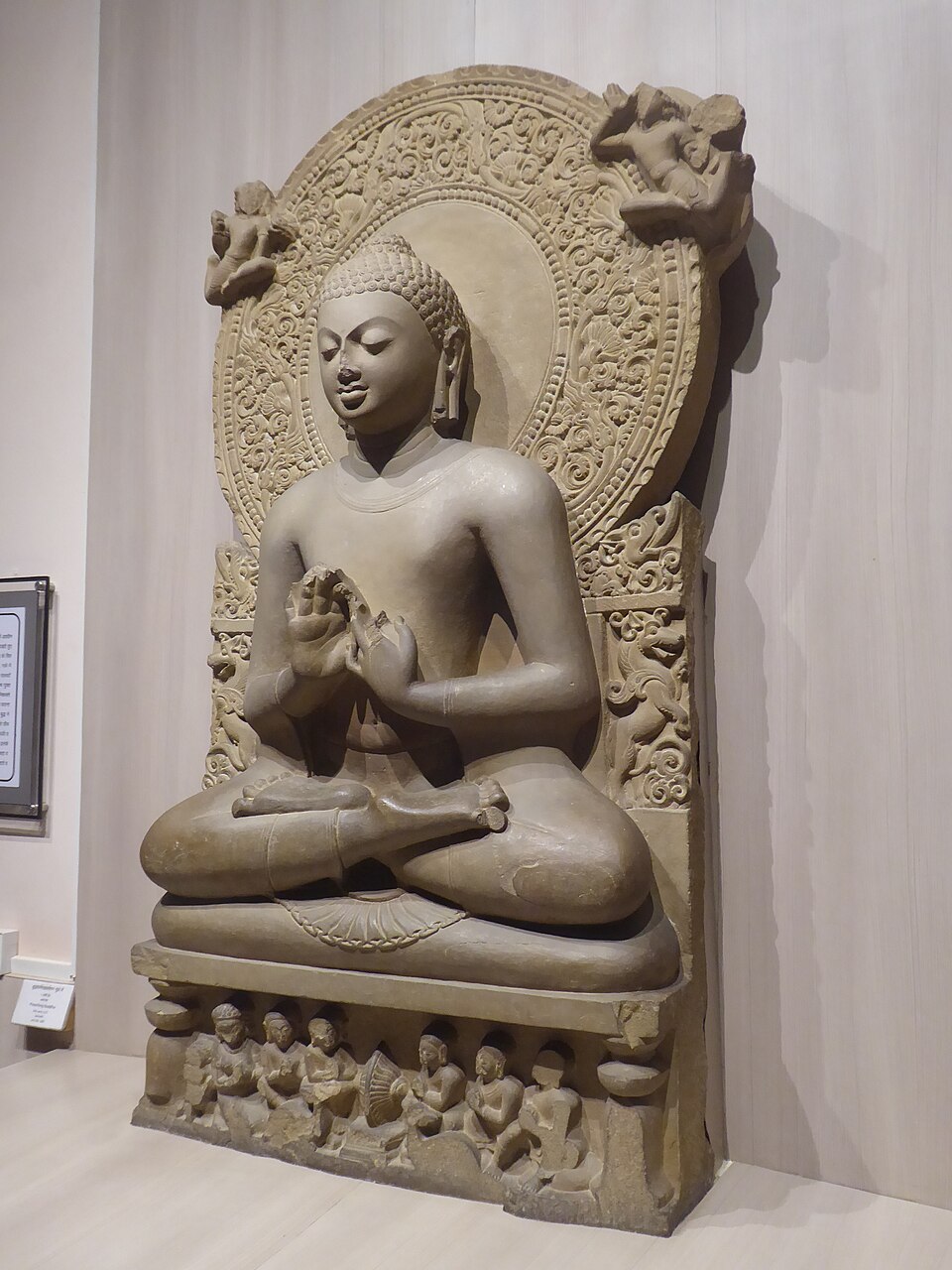
Look at a good Gupta Buddha and you notice something at once: stillness. The eyes look down, the lips hold a faint smile, and the body seems to breathe under a robe so thin it is almost invisible. Nothing shouts, yet the figure fills the space around it.
This calm did not appear from nowhere. In the last chapter, you saw three schools give the Buddha three faces: Greek-looking in Gandhara, sturdy in Mathura and slender in Amaravati. Under the Guptas, from the 4th to the 6th century CE, these strands came together into one classical image.
The Gupta age also gave Hindu gods their settled forms. At Udayagiri, Eran and Deogarh, Vishnu, Shiva and the river goddesses took the shapes that temples would repeat for centuries. Metal workers made a giant Buddha and an iron pillar that still has not rusted.
This chapter shows you how to recognise Gupta sculpture, the main sites and works, and why this age is called classical. The temples themselves are explained in the first temple chapter.
Why "classical"? The Gupta formula
Rules made perfect. In the Gupta period, the iconographic canons, the rules for how each god or teacher should look, were perfected and standardised for Brahmanical, Jain and Buddhist images alike. A Vishnu now had fixed attributes, and a Buddha had fixed gestures and marks. Later artists across India worked from these rules.
Two inheritances. Gupta sculptors took plasticity, the sense of full, rounded form, from Mathura. They took elegance, the light, graceful line, from Amaravati. This simple formula, "plasticity from Mathura, elegance from Amaravati", is worth remembering word for word.
The human figure at the centre. Gupta sculpture puts the human body at the centre, shown soft and smooth, with less drapery and less jewellery than before. Nudity was eliminated as a rule. Where Kushana drapery revealed the flesh, Gupta drapery covered it, and the goal was spiritual calm rather than physical power.
How the Buddha changed. Compared with Kushana images, the Gupta Buddha has curly hair instead of a shaven head, uses a wider range of mudras and drops the Greek influence of Gandhara. Gupta kings were Hindu, yet they were tolerant, and Buddha images were made at Nalanda, Mathura, Sarnath, Paharpur, Nagarjunakonda and Ajanta.
Why it matters. "Classical" means a style that sets the standard for what follows. Gupta forms shaped temple sculpture in India for centuries and travelled across Asia, which is why examiners call this the classical or "golden" age of Indian art.
The Gupta Buddha: Mathura and Sarnath
Two great studios. Gupta Buddhas came mainly from two workshops: Mathura and Sarnath. Earlier, even the images at Sarnath had been made at Mathura and carried there. In the last quarter of the 5th century, Sarnath developed a style of its own.
The Mathura Buddha. The 5th-century standing Buddha of Mathura, carved in red sandstone, raises the right hand in abhaya mudra while the left holds the robe's hem. The face smiles gently with downcast eyes, the hair is in spiral curls with an ushnisha, and a large halo carries rich bands of ornament. The robe covers both shoulders, with folds shown as neat, clinging lines; one such image is dated 434 CE.
The Sarnath Buddha. At Sarnath, artists dropped the folds altogether, so the robe looks wet or transparent, and only its fringe is visible. The body bends slightly at the hip, a pose called abhanga, which gives a lithe feel instead of Mathura's columnar rigidity. A monk named Abhayamitra donated a standing Buddha here in 473 CE, and two more three years later.
The preaching Buddha. The most famous Sarnath image is the seated Buddha in Chunar sandstone, with hands in the dharmachakrapravartana mudra, the gesture of turning the wheel of law. It recalls his first sermon, preached at Sarnath itself. He sits on a throne, backed by a round halo carved with foliage and flying figures.
| Feature | Mathura (Gupta) | Sarnath |
|---|---|---|
| Stone | It uses red sandstone. | It uses cream Chunar sandstone. |
| Robe | The robe shows clinging folds on both shoulders. | The robe has no folds and looks transparent. |
| Body | The body stands straight, like a column. | The body bends slightly in abhanga. |
| Key work | The standing Buddha dated 434 CE is key. | The preaching Buddha and Abhayamitra's 473 CE Buddha are key. |
Why it matters. Questions often ask you to tell Mathura and Sarnath apart. Remember: folds and a straight body mean Mathura; no folds and a gentle bend mean Sarnath.
Udayagiri: where Hindu art took its form
The site. On a sandstone hill near Vidisha in Madhya Pradesh lie about 20 rock-cut chambers, the Udayagiri caves. Two inscriptions name Chandragupta II and one names Kumaragupta. These are the oldest Hindu cave temples, and together they form the earliest intact body of Hindu art.
Simple shrines, rich doorways. Most caves are small single-room shrines with a pillared porch. The interiors are plain, but the doorways are richly carved. They show that Hindu iconography was already settled by the early 5th century.
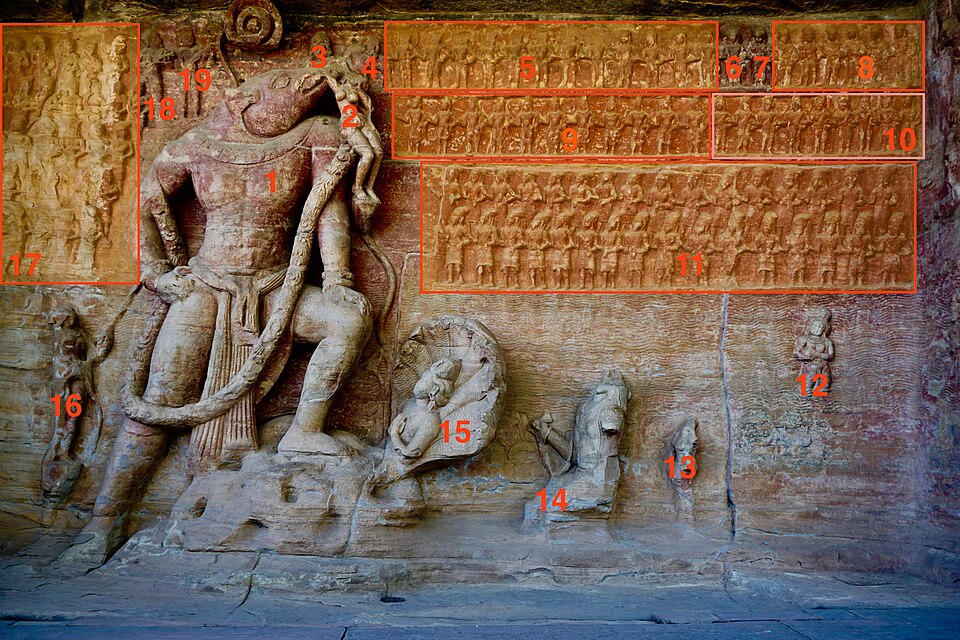
The great Varaha (Cave 5). The most famous panel shows Vishnu as Varaha, the boar-headed god, rescuing the earth goddess from the ocean. He stands with his left leg on a rock as nagas bow in homage, while sages and celestial beings crowd above. Beside the panel, Ganga on a makara and Yamuna on a tortoise flow towards the ocean.
Other caves. Cave 4 holds an ekamukha linga, a linga with one face of Shiva carved on it. Cave 3 has a standing Karttikeya, and a Ganesha is carved outside Cave 6. Cave 13 shows Vishnu reclining on the serpent Ananta, a theme that reaches its peak at Deogarh.
Why it matters. The Varaha panel is often read as a political message: just as Vishnu rescued the earth, the Gupta king saved his land. It shows how art served royal ideology. It is also a key Prelims site, often confused with the Jain caves of Udayagiri in Odisha.
Eran, Deogarh and the river goddesses
Eran: a site across the Gupta age. Eran in Madhya Pradesh was active from the time of Samudragupta to the Huna invasions of the early 6th century. Its first Varaha, of Samudragupta's time, shows the god with a boar's head and a human body, with the earth hanging from his tusk. A second Varaha, of the time of the Huna ruler Toramana, is a full boar carrying the earth goddess on its tusk and rows of sages carved on its body.
The Eran Garuda pillar. Eran also has a Garuda pillar set up in 485 CE by a local ruler. Its capital carries lions and a double-sided Garuda holding serpents. The lions recall the Mauryan lion capitals, a sign of continuity across eight centuries.
Deogarh: Vishnu at rest. The Dashavatara temple at Deogarh carries one of the finest Gupta panels: Sheshashayi Vishnu. Vishnu reclines on the seven-hooded serpent Adisesha, floating on the cosmic ocean, with Lakshmi at his feet. Above and around him, gods watch as the demons Madhu and Kaitabha are about to be defeated.
Ganga and Yamuna at the door. Gupta temples place the river goddesses Ganga on a makara (crocodile) and Yamuna on a tortoise on either side of the shrine door. The 4th-century Shiva temple at Ahichchhatra gave terracotta figures of both goddesses, along with heads of Shiva and Parvati. Their creatures may reflect the real animals of the two rivers.
Why it matters. Eran and Deogarh show Vishnu's forms, Varaha, Narasimha and Sheshashayi, settling into the shapes later temples repeated. The river goddesses at the door also became a standard feature of temple doorways, which you will meet again in the temple chapter.
Metal and royal works: Sultanganj, Mehrauli and more
The Sultanganj Buddha. Found at Sultanganj, near Bhagalpur in Bihar, this Gupta-period Buddha is a metal image nearly 6 feet tall and weighing over a tonne. Casting such a large figure needed great skill in melting, pouring and finishing metal. Very few Gupta bronzes survive, which makes this one even more precious.
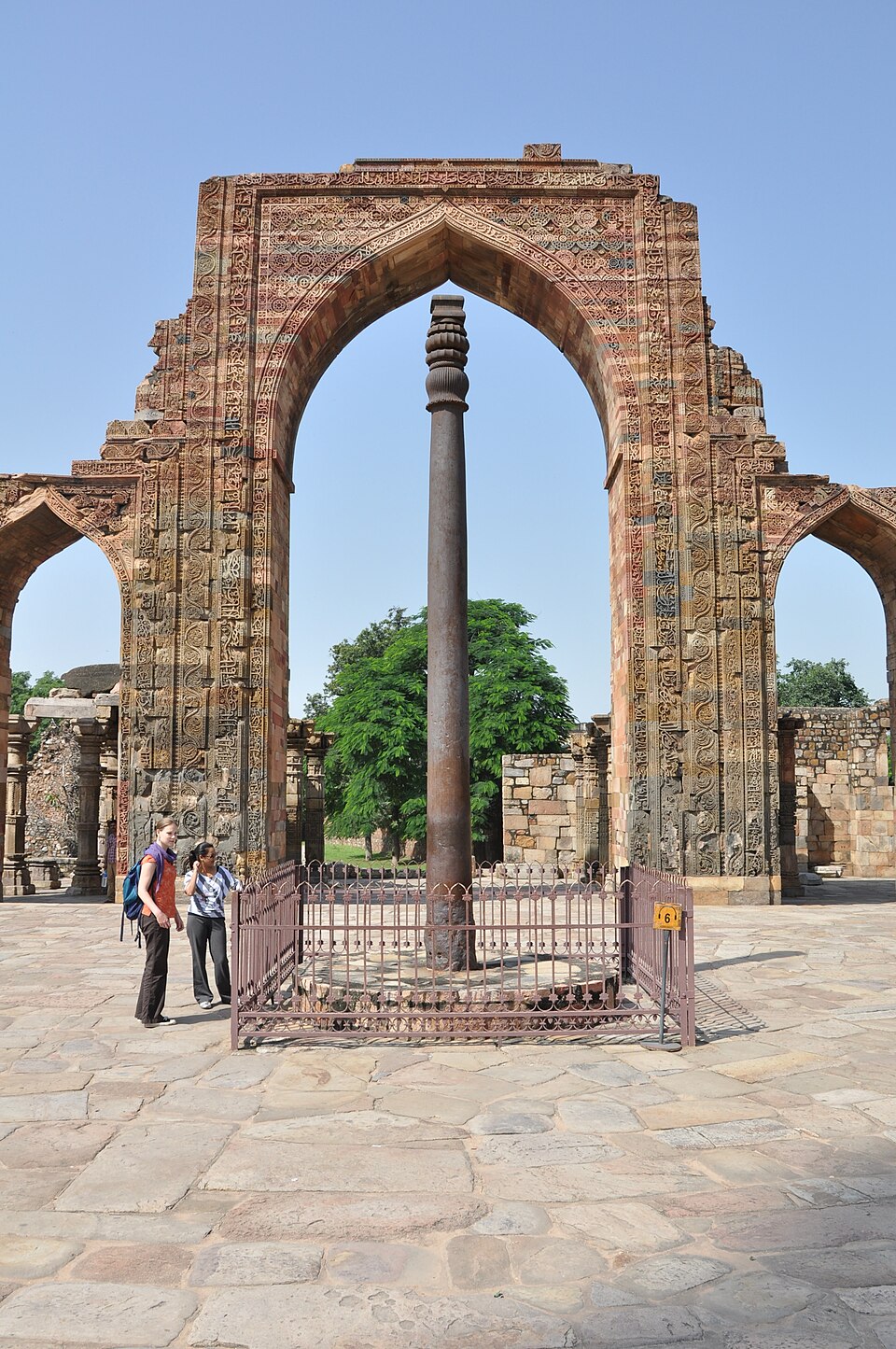
The Mehrauli iron pillar. The iron pillar at Mehrauli in Delhi dates to about the 4th century CE. It is a solid shaft of wrought iron weighing about 6 tonnes, and it has not rusted for more than 1,500 years. It is proof of a very high level of Indian metallurgy.
Jain images and a royal horse. At Durjanpura, near Vidisha, three Jain images in dhyana mudra were found with inscriptions of Ramagupta, giving evidence of his reign. They join a Kushana-type body with a Gupta-style halo. A larger-than-life stone horse from Khairigarh in Uttar Pradesh is believed to be linked to Samudragupta's ashvamedha, a horse sacrifice also shown on his coins.
Why it matters. These works show that Gupta art was not only religious sculpture in stone. It included metal casting, engineering and royal display. The iron pillar is also a favourite example in questions on ancient Indian science and technology.
Beyond the Gupta heartland
The Vakatakas and Ajanta. In the Deccan, the Vakatakas were the leading power in Gupta times. The later caves of Ajanta, with their Buddha images and paintings, are the high point of Vakataka art. You met them in the caves chapter, and their murals appear in the painting module.
Gandhara in a new material. In the north-west, Gandhara art continued in Gupta times at sites such as Hadda in Afghanistan. Artists now worked in stucco instead of blue schist or green phyllite, and their faces became softer. This shows how the Gupta mood of calm reached even the old Greek-influenced school.
Across Asia. The Gupta Buddha type was adopted and modified in Siam (Thailand), Cambodia, Burma (Myanmar), Java, Central Asia, China and Japan. Pilgrims, monks and traders carried images and ideas along land and sea routes. The calm, inward-looking Buddha of Sarnath became a model for much of Buddhist Asia.
Why it matters. This spread is a strong example of India's soft power in the ancient world. It is useful for Mains questions on India's cultural links with South-East and East Asia.
Mains lens: debates and practice
Debate 1: was it really a "golden age"? Gupta art set lasting standards, and that is why the term "classical" fits. But the label "golden age" partly came from nationalist historians who wanted a glorious past to set against colonial rule. A balanced answer praises the art while noting that the benefits of the age did not reach all sections of society.
Debate 2: Hindu kings, many faiths. The Gupta rulers were devotees of Vishnu, yet Buddhist and Jain art flourished under them, at Sarnath, Nalanda and Durjanpura. Answers on religious tolerance can use this, along with the role of nobles and rich donors who spent their surplus on art.
Debate 3: art and kingship. The Udayagiri Varaha and the Khairigarh horse suggest that art carried royal messages. Answers on the link between religion and political legitimacy in ancient India can use these examples.
These are practice questions written by us, not past papers. Past questions from your exam appear in the PYQ panel.
| Angle | Question | Key points to cover |
|---|---|---|
| Style | Why is the Gupta period called the classical age of Indian sculpture? | Cover standard canons, the Mathura and Amaravati inheritance, the calm human figure and the spread across Asia. |
| Comparison | Distinguish between the Mathura and Sarnath styles of the Gupta Buddha. | Cover stone, robe, body pose, key dated works and mudras. |
| Religion | How does Gupta art reflect the growth of Vaishnavism? | Use Udayagiri's Varaha, Eran's Varahas and Garuda pillar, and Deogarh's Sheshashayi Vishnu. |
| Science | What do the Mehrauli iron pillar and the Sultanganj Buddha tell us about Gupta technology? | Mention weight, material, rust resistance, the skill of large casting, and the rarity of surviving bronzes. |
| Culture | Trace the influence of Gupta art on the art of Asia. | Name the regions, the routes, the Sarnath model and the role of monks and traders. |
Answer plan for the classical-age question. Open with one line saying that "classical" means a style that set the standard for later art. In the body, give four points: perfected canons, the Mathura-Amaravati formula, the calm human figure with examples from Sarnath and Deogarh, and the spread across Asia. Conclude with a short balance line on the "golden age" label.
Quick revision
- Gupta sculpture (4th-6th century CE) is the classical phase: plasticity from Mathura, elegance from Amaravati.
- The body is soft and calm, nudity is eliminated and the thin robe covers rather than reveals.
- Mathura Buddhas show folds on both shoulders and stand straight; one is dated 434 CE.
- Sarnath Buddhas have no folds and a slight abhanga bend; Abhayamitra's Buddha is dated 473 CE.
- The seated Sarnath Buddha in Chunar sandstone shows the dharmachakrapravartana mudra.
- Udayagiri (MP) has the oldest Hindu cave temples and the great Varaha of Cave 5.
- Eran has two Varahas and a Garuda pillar of 485 CE, and Deogarh has the Sheshashayi Vishnu panel.
- The Sultanganj Buddha is a metal image over a tonne, and the Mehrauli iron pillar has not rusted for 1,500 years.
- The Gupta Buddha spread to South-East Asia, Central Asia, China and Japan.