

MPSC Rajyaseva · Module 70 · Mains depth · 17 min
Modern Indian art: Company school, Raja Ravi Varma, Bengal School, Progressives
What MPSC Rajyaseva asks from this chapter
Syllabus lines this chapter covers:
- GS I · Indian heritage and culture: art forms, literature and architecture from ancient to modern times, with Maharashtra.
MPSC Rajyaseva questions from this module are being sorted into our bank.
Read at full depth: basics, the standard layer and the Mains analysis.
Start from zero: what made art "modern"?
In the regional painting chapter, painters worked for kings and temples. From the late 18th century, India came under British rule, and a whole new world of patrons, materials and ideas arrived. Painting had to answer a big question: what should Indian art look like in a modern, colonial world?
New patrons and new tools. British officials wanted pictures of Indian life, birds and plants to send home. The British also set up art schools in provincial capitals, which taught European methods such as oil painting and drawing from life. Later, the printing press and photography changed how images reached people.
Four answers. Indian artists gave several answers to that big question. The Company school mixed Indian skill with European taste for British buyers. Raja Ravi Varma used European oil technique for Indian myths, while the Bengal School rejected this and looked back to Ajanta and the Mughals.
Into the modern age. Finally, artists such as Amrita Sher-Gil, Jamini Roy and the Progressive Artists' Group looked for a language that was both Indian and modern. Each answer was partly a reaction to the one before. Seeing this chain of reactions is the key to this chapter.
The Company school: Indian hands, British eyes
What it was. Company painting (also called Kampani kalam) gets its name from the East India Company. It was an Indo-European style: Indian artists, many trained in Mughal or regional traditions, painted for British officials and their families. They used European watercolour on paper and tried to show things as they looked.
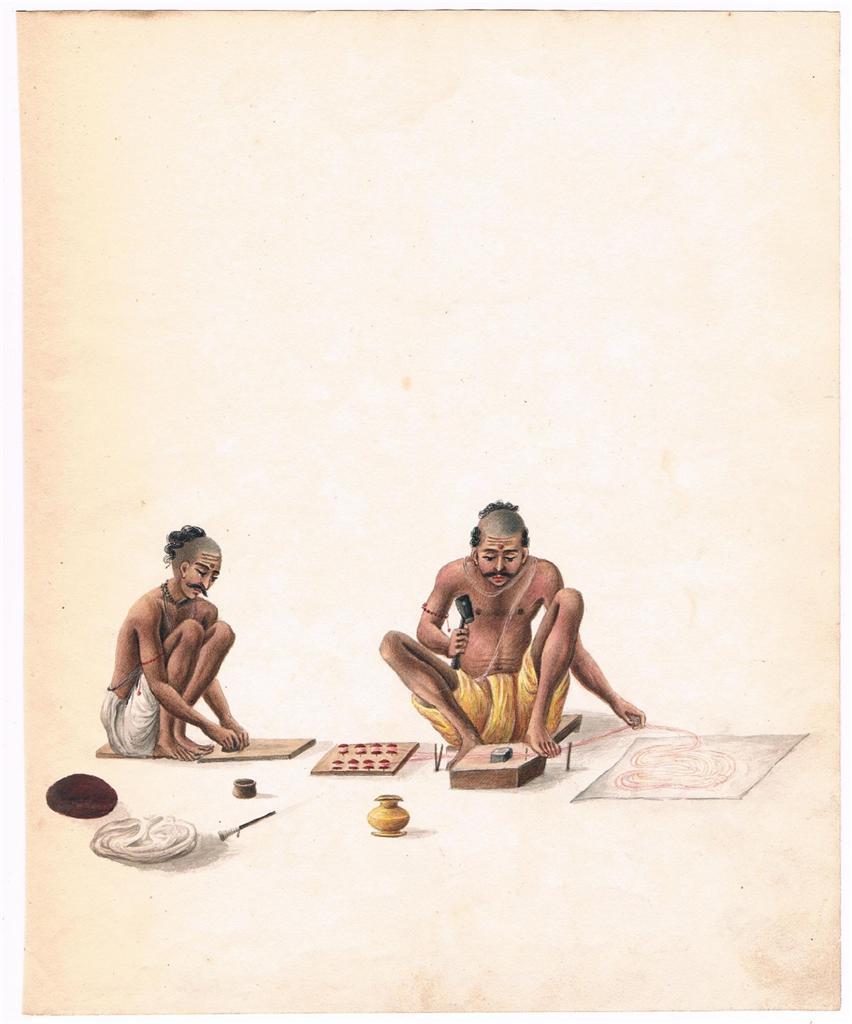
Where it grew. It first appeared in the Madras Presidency, where artists from Tanjore worked for the British. It then spread to Murshidabad, Patna, Banaras, Lucknow and Delhi. At Lucknow, an album made for the Frenchman Claude Martin is well known.
What they painted. The British wanted records of a land new to them. So artists painted natural history (birds, animals, plants), festivals, and sets of pictures showing different trades and occupations. In Delhi, artists painted fine miniatures of Mughal monuments, sometimes on ivory.
Patna Kalam and decline. At Patna, artists such as Sewak Ram and later Shiv Dayal Lal (whose market scene of 1850 is well known) painted daily life. Ishwari Prasad, who died in 1950, is called the last of the Patna painters. Company painting faded when photography made such records easy, but it remains a valuable picture of 19th-century India.
Raja Ravi Varma: gods in oil, for everyone
Who he was. Raja Ravi Varma was born on 29 April 1848 at Kilimanoor in present-day Kerala and died on 2 October 1906. He mastered European oil painting and academic realism. He then used this technique to paint Indian myths, epics and portraits.
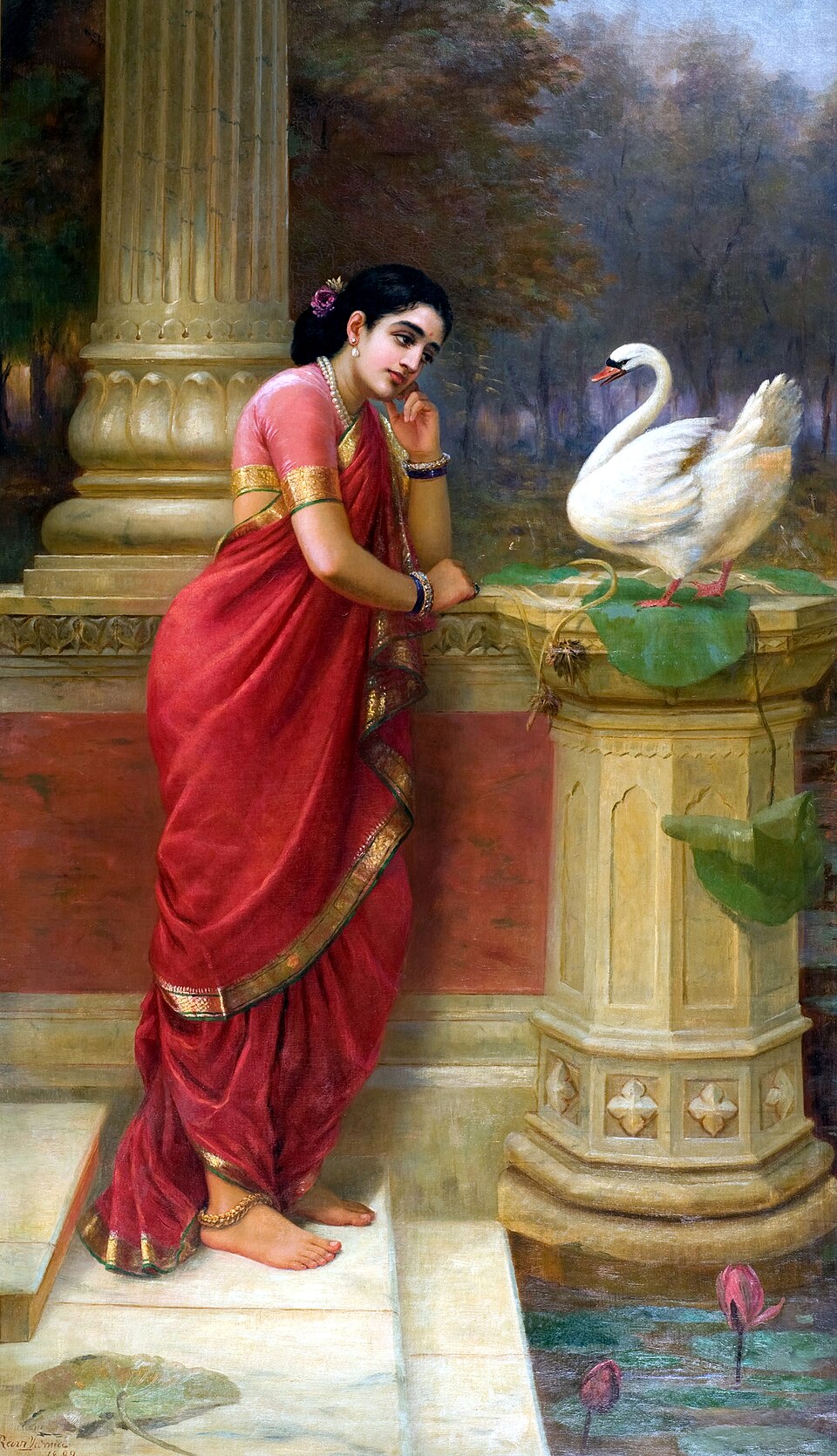
What he painted. His famous works include Damayanti talking to a swan, Nala and Damayanti, Shantanu and Matsyagandha, and scenes from the Ramayana. His goddesses and heroines were shown as real, beautiful women in rich saris and settings. He won prizes abroad, including at Vienna (1873) and at Chicago (1893), and received the Kaisar-i-Hind medal.
Art for everyone. Ravi Varma's most lasting step was to set up a lithographic press in Bombay, later moved to Lonavala. It printed his paintings as cheap colour prints called oleographs. For the first time, ordinary families could hang pictures of gods in their homes, and this gave birth to Indian calendar art.
Praise and criticism. Critics later called his work showy and too European. Yet he made art accessible to millions and shaped how Indians imagined their gods for a century. Both sides are worth writing in a Mains answer.
The Bengal School: looking back to look forward
Why it began. In the age of the Swadeshi movement, many Indians felt that copying European oil painting was a kind of cultural surrender. E.B. Havell, principal of the Calcutta art school, and the young artist Abanindranath Tagore (1871–1951) wanted an art rooted in India. Together they started what became the Bengal School.
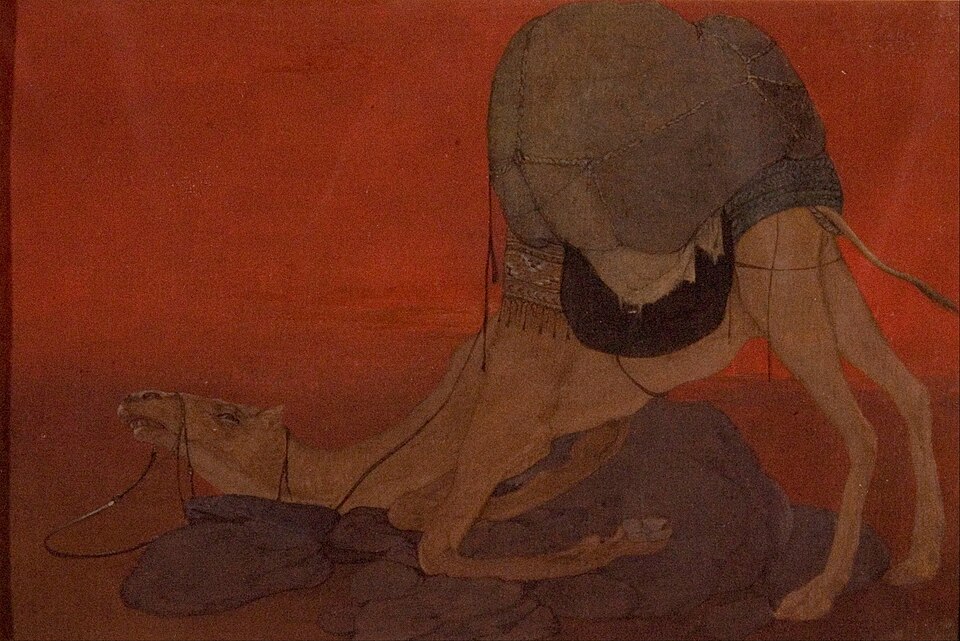
What it did. The Bengal School rejected Ravi Varma's oil realism. It looked back to Ajanta murals and Mughal and Rajput miniatures, and, under Japanese influence encouraged by the scholar Okakura, adopted the soft wash technique. Abanindranath founded the Indian Society of Oriental Art in 1907, and his Journey's End (1913) shows his gentle, misty style.
Its artists. Abanindranath's students and followers spread the style across India. They included Nandalal Bose, Asit Kumar Haldar, Kshitindranath Majumdar and M.A.R. Chughtai. Santiniketan, along with Kolkata, became a major centre of the movement.
Beyond revival. Some artists felt the Bengal School was too backward-looking. In the 1920s, Rabindranath Tagore broke with revivalism and made strong, expressive drawings and paintings. His brother Gaganendranath Tagore experimented with cubism and sharp social satire.
Jamini Roy: the modern folk painter
From Bankura. Jamini Roy (1887–1972) was born in Bankura district of Bengal. He began within the art of his time, when European realism and the Bengal School wash were the main choices. He went his own way and looked for something simpler and closer to the people.
Turning to folk art. Roy turned to the art of the people around him. He took inspiration from Kalighat pats and from the folk forms of Bankura, such as its terracotta figures and dolls. You met Kalighat painting in the folk painting chapter.
His style. Roy's paintings have bold, simple outlines, flat colours made from local materials and calm, rounded figures. His themes are often simple and timeless, and Mother and Child (1940) is a well-known work. The style looks easy, but it is carefully designed.
Why he matters. Jamini Roy showed that folk art could be the base of modern Indian art, not just a craft. He broke the wall between "fine art" and "folk art". This idea later influenced many artists after Independence.
Amrita Sher-Gil: East meets West
Early life. Amrita Sher-Gil was born in Budapest on 30 January 1913. She studied at the École des Beaux-Arts in Paris from 1930 to 1934. Her painting Young Girls (1932) won her recognition, and in 1933 she became an Associate of the Grand Salon in Paris.
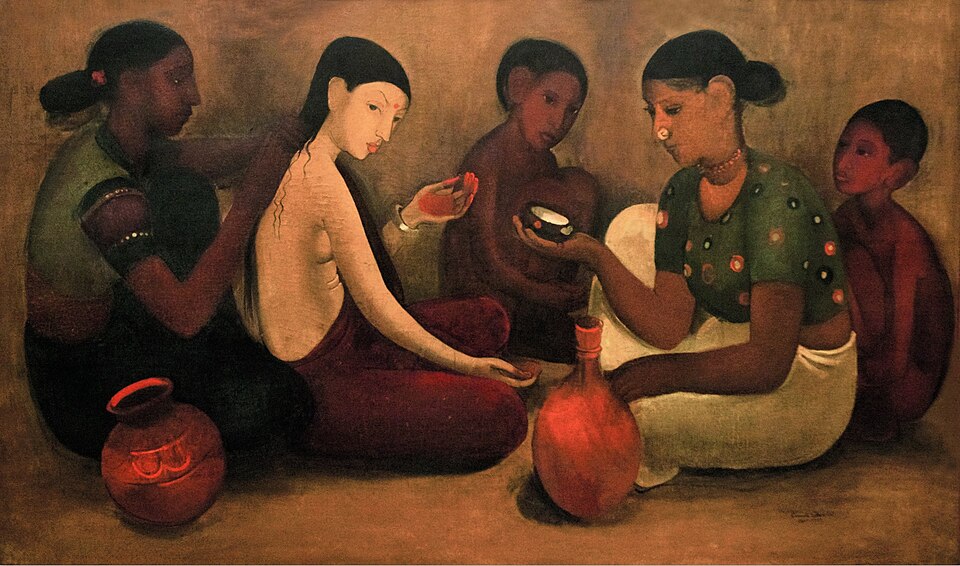
Return to India. In 1934 she returned to India, determined to paint Indian life. She travelled widely and was moved by Ajanta and by Indian miniatures. Her later works blend European modern painting with the colour and rhythm of Indian traditions.
Her subjects. Sher-Gil painted ordinary Indian people, especially women, often with a sense of quiet sadness and dignity. Famous works include Bride's Toilet (1937), Hill Women and works painted at Saraya in Gorakhpur. Her paintings in India are treated as National Art Treasures.
A short life. Sher-Gil died in December 1941, aged only 28. In a few years she had shown a path between the Bengal School's revival and plain copying of Europe. She is often called a bridge between traditional and modern Indian art.
Santiniketan and the famine years: art turns to land and people
A school against the art school. By the early twentieth century, British-run art schools in Calcutta, Bombay and Madras had taught Indians to copy European models for more than fifty years. In 1919, Rabindranath Tagore opened Kala Bhavana at Santiniketan, a rural campus far from the city, to try something different. Under Nandalal Bose, students learned by drawing the fields, trees and people around them instead of plaster casts.
Art for everyone, made together. Santiniketan treated crafts such as weaving, pottery and textiles as seriously as painting. Students and teachers painted murals on campus buildings together, so art became a shared, public activity rather than a private one. This mix of fine art, craft and community life gave modern Indian art a path that was neither a copy of Europe nor a repeat of the Bengal School.
Three Santiniketan names to know. Nandalal Bose painted the bright Haripura posters for the Congress session of 1938 at Gandhi's request, using bold folk-style colours and lines. His student Benode Behari Mukherjee found his themes in everyday life and kept working through collage even after losing his sight in 1956. Ramkinkar Baij made powerful outdoor sculptures in cement, such as Santhal Family, which showed tribal workers as strong and dignified.
The 1940s: art faces hunger. The Bengal famine of 1943 killed millions and filled the streets of Calcutta with the starving. Artists such as Zainul Abedin, Chittaprosad and Somnath Hore sketched what they saw directly, in rough and urgent lines, and Chittaprosad also made sharp political posters. This turn from gods and landscapes to real suffering prepared the ground for the artist groups of the 1940s.
Why it matters: these artists answered a key Mains question in their own way, which is how to be modern without copying the West. Their answer was to look closely at Indian land and people and to make art part of community life.
The Calcutta Group and the Progressives
A new generation. By the 1940s, young artists wanted to go beyond both revivalism and academic realism. They looked at international modern art, such as expressionism and cubism, but wanted it to speak of India. Two groups led the way.
The Calcutta Group (1943). The Calcutta Group was formed in 1943. Like the later Bombay group, its members wanted an art that was modern but rooted in Indian life. It showed that the search for Indian modernism had begun in more than one city.
The Progressive Artists' Group (1947). In Bombay in 1947, the year of Independence, Francis Newton Souza, Sayed Haider Raza, Maqbool Fida Husain, Krishnaji Howlaji Ara, Hari Ambadas Gade and Sadanand Bakre founded the Progressive Artists' Group (PAG). It held its first exhibition in 1949. Later artists linked with it include Tyeb Mehta, Vasudeo Gaitonde, Krishen Khanna and Ram Kumar.
What each brought. Souza painted with fierce expressionism and cubist distortion. Raza later became famous for the bindu (dot), a symbol drawn from Indian thought, while Husain, born in 1915 at Pandharpur, became known for his horses and epic themes. Bakre was a sculptor, showing that the group was not only about painting.
| Movement | Period | Key idea | Names |
|---|---|---|---|
| Company school | Late 18th–19th c | Indian artists, British patrons, records | Sewak Ram, Shiv Dayal Lal, Ishwari Prasad |
| Academic realism | Late 19th c | European oil for Indian myths; prints | Raja Ravi Varma |
| Bengal School | From c. 1900; ISOA 1907 | Revival; Ajanta, miniatures; wash | Abanindranath, Havell, Nandalal Bose |
| Beyond revival | 1920s–1940s | Expression, folk base, East-West blend | Rabindranath, Jamini Roy, Sher-Gil |
| Modernist groups | 1943; 1947 (show 1949) | Modern and Indian | Calcutta Group; Souza, Raza, Husain |
Mains lens: practice questions
Art and nationalism. The Bengal School was part of the Swadeshi spirit: it tried to free Indian art from colonial taste. Yet Ravi Varma's prints also built a shared national imagination of gods and heroes. A balanced answer shows that both, in different ways, shaped Indian identity.
Who is modern? Modern Indian art was not one road but a chain of reactions: Company school, Ravi Varma, Bengal School, then Sher-Gil, Jamini Roy and the Progressives. Each group asked how to be Indian and modern at once. Good answers show this debate rather than just listing names.
These are practice questions written by us, not past papers. Past questions from your exam appear in the PYQ panel.
| Angle | Question | Key points to cover |
|---|---|---|
| Nationalism | Discuss the role of the Bengal School in the cultural nationalism of India. | Swadeshi; Havell, Abanindranath; ISOA 1907; Ajanta, miniatures; rejection of oil realism; limits of revivalism. |
| Evaluation | Raja Ravi Varma democratised art but westernised it. Critically examine. | Oil, academic realism; myths; press, oleographs, calendar art; Bengal School critique; lasting impact. |
| Colonialism | How did colonial rule change Indian painting? | New patrons; Company school; art schools; oil; printing; photography; reactions. |
| Synthesis | Trace the search for an Indian modernism from Sher-Gil to the Progressive Artists' Group. | Sher-Gil East-West; Jamini Roy folk base; Rabindranath expression; Calcutta Group 1943; PAG 1947, Raza bindu, Husain. |
Answer plan for the Ravi Varma question. Open with who he was and his technique. In the body, give the gains (reach, shared imagery, calendar art) and the critique (European look, showiness, Bengal School reaction), with a named painting. Conclude with a balanced judgement on his place in Indian art.
Quick revision
- Big question: how to be Indian and modern under colonial rule; each movement reacts to the last.
- Company school: Indian artists, British patrons; Madras Presidency first, then Murshidabad, Patna, Banaras, Lucknow, Delhi; natural history, trades; Sewak Ram, Shiv Dayal Lal, Ishwari Prasad (d. 1950); declined with photography.
- Raja Ravi Varma (1848 Kilimanoor – 1906): oil, Indian myths; Damayanti and the swan; lithographic press, oleographs, calendar art; Kaisar-i-Hind.
- Bengal School: Abanindranath Tagore + E.B. Havell; Indian Society of Oriental Art 1907; wash technique (Japanese); Ajanta, miniatures; Journey's End 1913; Nandalal Bose, Asit Kumar Haldar, Chughtai.
- Rabindranath (1920s) expressive; Gaganendranath cubism, satire.
- Jamini Roy (1887–1972, Bankura): Kalighat + Bankura folk; bold outlines; Mother and Child 1940.
- Amrita Sher-Gil (Budapest 1913 – 1941): Paris; returned 1934; Bride's Toilet 1937, Hill Women; National Art Treasures.
- Calcutta Group 1943; PAG Bombay 1947 (first show 1949): Souza, Raza (bindu), Husain, Ara, Gade, Bakre.