

MPSC Rajyaseva · Module 35 · Mains depth · 24 min
The ecosystem: structure, food chains and the flow of energy
What MPSC Rajyaseva asks from this chapter
Syllabus lines this chapter covers:
- Paper I: General Studies · General issues on environmental ecology, biodiversity and climate change.
MPSC Rajyaseva questions from this module are being sorted into our bank.
Read at full depth: basics, the standard layer and the Mains analysis.
Start from zero: where does your lunch come from?
Think of the rice on your plate today. It grew in a field, the field needed sunlight and water, and the plant used them to make food. So every grain of rice is, in a sense, stored sunlight.
Now look at that field a little longer. A grasshopper nibbles the rice leaves, a frog catches the grasshopper, a snake swallows the frog and an eagle carries off the snake. When the straw and the dead animals fall to the ground, fungi and bacteria break them down, and the soil gets its minerals back.
In that one field you have seen sunlight, water, soil, plants, animals and microbes all working together as one system. Ecologists call such a working system an ecosystem. It is the most important unit in all of environmental studies, because almost every problem, from a dying lake to a failing harvest, is a problem of an ecosystem.
In this chapter we will open up an ecosystem and look inside. We will see what it is made of, how food passes from one living thing to the next, why so much energy is lost on the way, and how nature keeps its balance. These ideas explain why some policies work and others fail.
What is an ecosystem, and what is it made of?
The British scientist A.G. Tansley coined the term ecosystem in 1935. An ecosystem is a functional unit of nature in which the living (biotic) and non-living (abiotic) parts interact in complex ways. The word "functional" is the key, because an ecosystem is defined by what it does, not by a line on a map.
The non-living part. The abiotic components fall into three groups. First come physical factors such as sunlight, temperature, rainfall, humidity and pressure. Then come inorganic substances such as carbon dioxide, nitrogen, oxygen, phosphorus, sulphur, water and minerals, and finally organic compounds such as carbohydrates, proteins, fats and humus, which link the living and non-living parts.
The living part has three roles. The first role belongs to producers, the green plants that make food from sunlight by photosynthesis; because they feed themselves, they are called autotrophs. The second role belongs to consumers, which cannot make their own food and are called heterotrophs. Herbivores such as the cow, deer and rabbit eat plants, carnivores such as the lion and cat eat animals, and omnivores such as humans, pigs and sparrows eat both.
The third role belongs to decomposers, mostly bacteria and fungi, also called saprotrophs. They release enzymes onto dead plants and animals, digest them outside their bodies and absorb the simple products. In doing so they play a very important role in recycling nutrients, returning minerals to the soil for producers to use again.
Why this structure matters. Remove the producers and no new food enters the system. Remove the decomposers and dead matter piles up while the soil runs short of nutrients. So every role is essential, and a healthy ecosystem needs all three working together.
Kinds of ecosystems and the four jobs they do
Not all ecosystems run on the same fuel. Most natural ecosystems, such as forests, grasslands, oceans, lakes, rivers and deserts, depend entirely on sunlight. Some natural ecosystems, such as tropical rain forests, tidal estuaries and coral reefs, also receive extra energy from wind, rain and tides, and these "energy subsidies" help make them very productive.
Ecosystems made by people. Humans have built ecosystems too. Agricultural fields and fish-farming ponds still run on sunlight, but people manage them. Cities and industrial areas, however, run mainly on fossil fuels such as coal, oil and gas, so they depend on energy brought in from far away.
Why this difference matters. A forest can sustain itself for centuries on sunlight alone. A city cannot, because it imports food, water and fuel and exports waste and heat. This is why cities have such a large "footprint" on the ecosystems around them.
Four jobs every ecosystem does. First, it passes energy through food chains. Second, it cycles nutrients such as carbon and nitrogen between living things and the air, water and soil. Third, it changes slowly over time through ecological succession, and fourth, it keeps itself in balance through homeostasis, a kind of self-regulation by feedback.
The rest of this chapter looks closely at energy flow and homeostasis. Nutrient cycles and succession are large topics of their own, and you can study them in the chapter on biogeochemical cycles and the chapter on populations, communities and succession.
A pond: the classic model ecosystem
Textbooks love the pond, and for good reason. It is small enough to see in one look, yet it has every part of an ecosystem. It runs on solar energy and is often described as a complete and largely self-contained system.
Layers of light. Sunlight does not reach every part of the pond equally. The top layer, which gets plenty of light, is the euphotic zone, below it lies the dimmer mesophotic zone, and at the bottom of a deep pond lies the aphotic zone, where no light reaches at all. Because plants need light, most food is made near the surface.
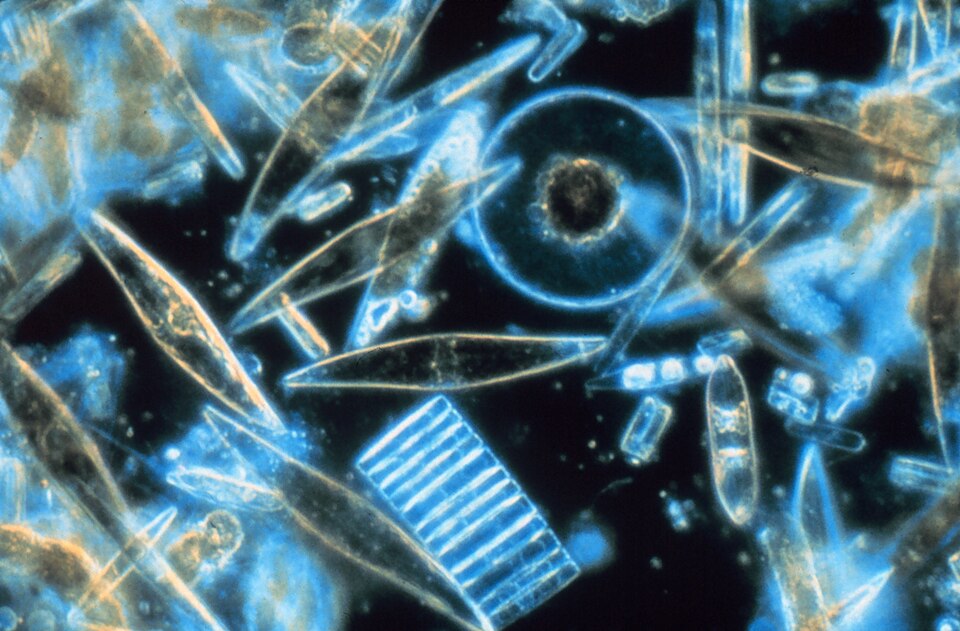
Who lives where. Near the surface float tiny plants called phytoplankton, the main producers, along with tiny animals called zooplankton that graze on them. Rooted plants grow along the edges. Fish and other strong swimmers, called nekton, move freely through the water, while snails, worms and insect larvae, the benthic animals, live on the bottom.
The clean-up crew. Decomposers such as bacteria and fungi are found throughout the pond, but they are most abundant in the mud at the bottom. There they break down dead plants and animals that sink, releasing nutrients back into the water. When too much dead matter sinks, they use up the oxygen, and the water can turn foul.
Why the pond model matters. The same layers and roles appear in lakes, reservoirs and even the sea. So when a lake is choked with algae or its fish die, you can trace the problem using the pond model. This makes it a powerful tool for understanding water pollution.
Food chains and food webs: who eats whom
We saw food passing from the rice plant to the eagle. Ecologists call such a sequence a food chain: the transfer of food energy from producers through a series of organisms, each eating the one before and being eaten by the next. A simple example is grass → grasshopper → frog → snake → hawk.
Trophic levels. Each step in the chain is a trophic level, from the Greek word for "nourishment". Producers form the first level, herbivores (primary consumers) the second, and carnivores the higher levels as secondary and tertiary consumers. Omnivores can feed at more than one level, and decomposers work at every level.
Why chains are short. Food chains rarely have more than four or five steps. At every step, much of the energy is lost as heat, so very little is left after a few transfers. This is why there are far fewer eagles than grasshoppers in any field.
Two kinds of chains. A grazing food chain starts from living green plants, as in our field. A detritus food chain starts from dead organic matter, such as fallen leaves eaten by worms and microbes, which are in turn eaten by other animals. The two chains are linked, forming what is sometimes called a Y-shaped food chain.
From chains to webs. In real life, a frog eats many kinds of insects, and a snake eats both frogs and mice. So chains cross and join to form a food web, a network of interconnected food chains. A food web is a more realistic picture of energy flow, and it also explains why ecosystems with many links are more stable: if one food source fails, animals can switch to another.
Why it matters for policy. Food chains also carry poisons. When a pesticide that does not break down enters a chain, it can build up at each step, a process called biomagnification, so top predators and humans receive the highest doses. Studying food chains therefore helps us understand both how energy moves and how pollutants spread.
Energy flow and the 10 per cent rule
Food chains are really channels for energy. Every bit of energy in an ecosystem starts as sunlight captured by producers. From there it moves from one level to the next, and at each step some of it leaves as heat.
Energy flows one way. The flow of energy in an ecosystem is always one way, or unidirectional. Sunlight becomes plant food, plant food becomes animal tissue, and at each step heat escapes into the surroundings and never comes back to the plants. Nutrients go round in cycles, but energy does not; it passes through and must be renewed by the Sun every day.
How much do plants capture? The total rate at which plants store the Sun's energy by photosynthesis is called gross primary production (GPP). Plants use part of this for their own breathing (respiration). What remains, the net primary production (NPP), is the food available to all the consumers, so GPP = NPP + plant respiration.
The 10 per cent rule. In 1942 the American ecologist Raymond Lindeman first defined ecological efficiencies and proposed the 10 per cent rule. Roughly a tenth of the energy at one level reaches the next. If producers hold 10,000 units, herbivores get about 1,000, carnivores about 100 and top carnivores about 10, though real efficiencies range from about 5 to 35 per cent.
Where does the rest go? At each level, much energy is used up in respiration to keep the organisms alive, and more is lost as heat during each transfer. Some is also left in parts that are not eaten, such as bones and roots, and passes to decomposers instead. So only a small share is turned into new body mass for the next level to eat.
Why it matters. The 10 per cent rule explains why big predators are rare and need large territories. It also explains why the same land can feed far more people on grain than on meat from animals fed that grain. This simple rule therefore links ecology directly to food security and land use.
Ecological pyramids: drawing the food chain
If we stack the trophic levels on top of one another, with producers at the base, we get a picture called an ecological pyramid. There are three kinds, depending on what we measure. Each tells a slightly different story, and exams love the cases where a pyramid turns upside down.
Pyramid of numbers. This counts the individuals at each level. In a grassland it is upright, with many grass plants, fewer grasshoppers and very few hawks. But it can be inverted, because a single large tree can feed many caterpillars and insects, so the herbivores outnumber the producer.
Pyramid of biomass. This measures the mass of living matter at each level at a given moment, the "standing crop". On land it is usually upright. In a pond, however, it can be inverted, because tiny phytoplankton live for a very short time and are eaten as fast as they grow, so at any one moment their total mass can be smaller than the mass of the animals feeding on them.
Pyramid of energy. This measures the energy flowing through each level over a period of time. Because energy is lost at every step, each level always has less than the one below. That is why the pyramid of energy is never inverted.
Why it matters. Pyramids turn the 10 per cent rule into a picture that is easy to remember and to draw in a Mains answer. The inverted cases teach a deeper lesson: a snapshot of numbers or mass can mislead, while the rate of energy flow gives the true picture of an ecosystem's health.
Homeostasis: how an ecosystem keeps its balance
If energy keeps flowing and animals keep eating one another, why doesn't one species simply take over? The answer is that ecosystems regulate themselves. This capacity for self-regulation is called homeostasis.
Negative feedback. Homeostasis works through negative feedback, in which a change sets off a response that pulls the system back. Suppose the zooplankton in a lake multiply rapidly. They eat so many phytoplankton that their own food runs short, so their numbers fall, the phytoplankton recover, and the cycle starts again. In this way the two populations rise and fall around a balance point instead of running out of control.
The limits of balance. This self-control has limits. A system can absorb small shocks, but a large or sudden change can push it past the point where feedback can restore it. Humans are now the greatest source of such disturbance, through pollution, clearing land and over-harvesting.
Every species counts. Because each species is tied to others through food webs, removing even a single species can upset the balance. When predators are removed, for example, their prey may multiply and strip the vegetation. So conservation is not only about saving beautiful animals but about keeping the feedback loops of the whole system intact.
Why it matters. Homeostasis explains why a forest can recover from a small fire but not from repeated burning, and why a lake can clean itself of a little sewage but not of a constant flood of it. For policy, the lesson is to keep human pressure within the limits that ecosystems can absorb.
Mains lens: why energy flow shapes policy
Ecosystem science is not just theory for Prelims. It gives you ready arguments for questions on food security, pollution and conservation. Here are four you should be able to use.
1. Food security and diet. Because only about a tenth of the energy passes up each level, a plant-based food system feeds more people per hectare than one that runs through animals. This does not mean that everyone must give up meat or dairy. It means that land, water and feed are used most efficiently when the food chain is short.
2. Pesticides and biomagnification. Persistent chemicals become more concentrated at each step of the food chain. So the case for integrated pest management and safer chemicals rests on ecology as well as on health. Use this argument in answers on agriculture, water pollution and public health.
3. Predators and the balance of nature. Top predators are few and need large areas because of energy loss, so they are the first to vanish when habitats shrink. Losing them can break feedback loops and let prey species damage vegetation. This supports large protected areas and landscape-level planning.
4. Limits to self-cleaning. Homeostasis shows that ecosystems can absorb some pressure but not unlimited pressure. A river can handle a little waste, but a city's untreated sewage overwhelms it. This gives a scientific basis for pollution standards and for treating waste before it reaches nature.
Linking across papers. These ideas feed GS-III (environment, agriculture and food security), GS-II (health) and the Essay paper on themes of development and sustainability. Starting an answer with one clear ecological principle makes your argument stand out.
Mains practice: six questions, six angles
These are practice questions written by us, not past papers. Past questions from each exam appear in the PYQ panel of this module.
| Angle | Question | Key points to cover |
|---|---|---|
| Structure | What are the structural components of an ecosystem? Explain the role of decomposers. | List the three groups of abiotic components and the three biotic roles. Then explain how decomposers digest dead matter outside their bodies and return nutrients to the soil. |
| Energy | Energy flow in an ecosystem is unidirectional. Explain with reference to the 10 per cent rule. | Explain GPP, NPP and the loss of energy as heat at each step. Then give Lindeman's rule with the 10,000 to 10 example and contrast energy flow with nutrient cycling. |
| Pyramids | Why can the pyramids of number and biomass be inverted but not the pyramid of energy? | Give the tree-and-insects case and the fast-turnover phytoplankton case. Then explain that energy is measured as a flow over time and always falls at each level. |
| Pollution | What is biomagnification? How does an understanding of food chains help in controlling it? | Define biomagnification and show how persistent chemicals build up at each level. Then suggest safer chemicals, integrated pest management and monitoring of top predators. |
| Stability | Food webs make ecosystems more stable than simple food chains. Discuss. | Explain how alternative food sources protect animals when one link fails. Then connect this to homeostasis and to the risk of losing species. |
| Way forward | Ecosystems have a limited capacity for self-regulation. What does this imply for development planning? | Explain negative feedback and its limits with the plankton example. Then argue for pollution standards, waste treatment and keeping human pressure within ecological limits. |
How to use this table: each answer should first explain the what, then give the why from this chapter, and end with a way forward.
Quick revision
- Ecosystem: a functional unit of living and non-living parts, a term coined by A.G. Tansley in 1935.
- Producers are autotrophs, consumers are heterotrophs, and decomposers (bacteria and fungi, called saprotrophs) recycle nutrients.
- Rain forests, tidal estuaries and coral reefs receive energy subsidies, while cities run mainly on fossil fuels.
- The pond has euphotic, mesophotic and aphotic zones, and its life includes phytoplankton, zooplankton, nekton and benthos.
- Food chains have 4 to 5 steps. Grazing chains start from green plants and detritus chains from dead matter, and food webs are more stable.
- Energy flows one way, and GPP = NPP + plant respiration.
- Lindeman (1942) proposed the 10 per cent rule, though real efficiencies run from about 5 to 35 per cent.
- The pyramid of energy is never inverted, while those of number and biomass can be.
- Homeostasis works through negative feedback and has limits.