

MPSC Rajyaseva · Module 14 · Mains depth · 20 min
Composition and structure of the atmosphere
What MPSC Rajyaseva asks from this chapter
Syllabus lines this chapter covers:
- Paper I: General Studies · Maharashtra, India and world geography: physical, social and economic geography.
- GS I · Physical geography of the world, India and Maharashtra; resources and location of industries; geophysical phenomena.
MPSC Rajyaseva questions from this module are being sorted into our bank.
Read at full depth: basics, the standard layer and the Mains analysis.
Start from zero: the blanket we live inside
Hold your breath for a few seconds and you will feel how much you need the air around you. We live at the bottom of a deep ocean of air, just as fish live at the bottom of an ocean of water. This ocean of air wraps the whole planet, and we call it the atmosphere.
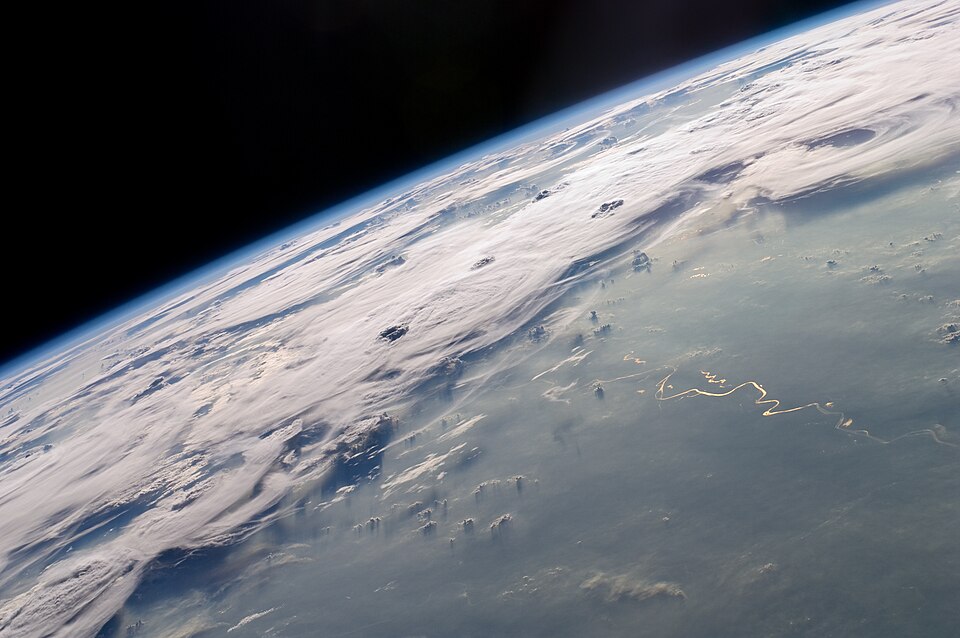
Why does the air not fly away into space? The answer is the same pull that makes a ball fall back when you throw it up: gravity. Gravity holds the air close to the Earth, so the air is thickest near the ground and becomes thinner and thinner as we go up. Most of the air by weight lies within roughly the lowest 30 km, which is less than the distance many people travel to work each day.
From space, this whole blanket looks like a thin blue line on the edge of the planet. Yet this thin layer does three jobs that make life possible. It gives us the oxygen we breathe, it keeps the Earth warm enough at night, and it blocks harmful rays from the sun.
To understand weather, climate, monsoons and even climate change, we first need to know two things about this blanket. What is it made of? And how is it arranged, layer by layer, from the ground up?
Why it matters. Almost every topic in climate geography begins here. Winds, clouds, rain, heatwaves and cyclones all happen inside this blanket, and they depend on what the air contains and how its temperature changes with height. When we later ask why the Earth is warming or why the ozone layer thinned, the answer again goes back to the gases in this thin layer.
What air is made of: the main gases
Air looks like nothing, but it is a mixture of gases. If we take a sample of dry air and count its parts, about 78% is nitrogen and about 21% is oxygen. Almost all of the remaining 1% is argon, a gas that does not react with anything.
That leaves a very small share for everything else. Carbon dioxide makes up only about 0.04% of the air, that is, about four parts in every ten thousand. It is tiny, yet it is one of the most important gases on the planet.
Why does such a small gas matter so much? Sunlight comes in and warms the ground, and the warm ground then gives off heat. Carbon dioxide lets the incoming sunlight pass but absorbs part of the outgoing heat and sends some of it back down. This keeps the lower air warm, much like the glass of a greenhouse keeps plants warm, and so it is called the greenhouse effect.
Without any greenhouse effect, the Earth would be far too cold for most life. The trouble begins when the share of carbon dioxide keeps rising. Burning coal, oil and gas releases carbon dioxide that was locked underground for millions of years, so the greenhouse effect grows stronger and the planet warms.
Why it matters. Nitrogen and oxygen keep us alive, but the gases in tiny amounts decide the temperature of the planet. This is why climate talks argue over very small numbers of carbon dioxide. For India, a warmer atmosphere means stronger heatwaves, changes in monsoon rain and rising seas along a long coastline.
Water vapour and dust: small amounts, big jobs
Hang wet clothes on a line and they dry, because the water turns into an invisible gas and joins the air. This gas is water vapour. Unlike nitrogen and oxygen, its amount changes a lot from place to place and from day to day.
In warm and wet tropical places, water vapour can make up as much as about 4% of the air. In cold or dry places such as deserts and polar regions, it can be less than 1%. It also decreases with height, so most of it stays in the lower few kilometres of the atmosphere.
Water vapour has two big jobs. First, it is the raw material of every cloud and every drop of rain. Second, like carbon dioxide, it absorbs heat given off by the Earth, so humid nights stay warmer than dry desert nights.
The air also carries tiny solid particles: dust from dry land, salt from sea spray, smoke and soot from fires and factories, and pollen. These specks are so small that we see them only in a beam of sunlight in a dark room. Yet they matter, because water vapour needs something to gather on before it can turn into droplets.
The particles act as nuclei, tiny seeds around which water vapour condenses to form cloud droplets. Without them, clouds would form far less easily. This is why dust and salt particles are linked to cloud formation, and why heavy pollution can change how clouds and fog behave.
Why it matters. Water vapour connects the oceans to our fields, because the monsoon is, at its heart, water vapour carried from the sea to the land. Dust and smoke, on the other hand, link the atmosphere to human health. The same tiny particles that help clouds form also make winter smog dangerous to breathe in north Indian cities.
Ozone: the invisible sunscreen of the planet
Sunlight contains rays we can see and rays we cannot. Among the invisible ones are ultraviolet (UV) rays, the rays that cause sunburn. In large amounts they damage skin and eyes, cause skin cancer and harm plants and tiny sea creatures.
Most of these harmful rays never reach us, because a special form of oxygen called ozone stops them. Ordinary oxygen has two atoms joined together, while ozone has three. Ozone is found mainly between about 10 and 50 km above the ground, and it absorbs most of the sun's UV rays before they reach the surface.
In the 1970s and 1980s, scientists found that this shield was thinning, most sharply over Antarctica in the southern spring. The main cause was a group of man-made chemicals called chlorofluorocarbons (CFCs), used in refrigerators, air conditioners and spray cans. Once these chemicals drift up into the stratosphere, they break ozone apart.
Countries responded with the Montreal Protocol in 1987, an agreement to phase out CFCs and other ozone-depleting substances. It is often called one of the most successful environmental agreements in history, because nearly every country joined and the use of these chemicals fell sharply. The shield is now slowly recovering.
Why it matters. The ozone story shows why international rules about the air are needed: a spray can in one country can harm people on another continent. It also shows that such rules can work when science is clear and cheaper substitutes exist. For UPSC, it is the standard example used when comparing the success of ozone diplomacy with the much harder task of cutting carbon dioxide.
The layers of the atmosphere: the troposphere
If we climb up through the air, the temperature does not simply keep falling. It falls, then rises, then falls again and finally rises once more. Scientists use these changes in temperature to divide the atmosphere into five layers: the troposphere, stratosphere, mesosphere, thermosphere and exosphere.
The lowest layer, where we live, is the troposphere. Its name comes from a Greek word meaning "turning" or "mixing", because the air here is always moving up and down. Almost all weather happens in this layer: clouds, rain, storms, fog and most of the dust and water vapour are found here.
The troposphere is about 13 km thick on average, but it is not equally thick everywhere. It is about 18 km thick over the equator and only about 8 km over the poles. Strong heating at the equator makes air rise to great heights, which pushes the top of this layer higher.
In the troposphere, temperature falls as we go up. On average it drops by about 1°C for every 165 m, which is about 6.5°C per km. This is called the normal lapse rate, and it explains why hill stations like Shimla or Ooty are cooler than the plains below them.
Why does the air get colder with height when it is closer to the sun? Because the air is heated mainly from below, by the warm ground, not directly by sunlight. The farther we move from the heated ground, the colder the air becomes, just as it is warmer close to a fire than far from it.
At the top of the troposphere lies a boundary zone called the tropopause. Here the temperature stops falling. It is extremely cold, about minus 80°C over the equator and about minus 45°C over the poles, because the troposphere is thickest and reaches highest over the equator.
Why it matters. All the weather we forecast, every monsoon, cyclone and heatwave, happens in this thin lowest layer. The lapse rate explains why mountains are cold, why snow lies on Himalayan peaks even in summer and why crops change with altitude. Air pollution is also mainly a troposphere problem, because smoke and dust stay trapped in this layer.
Above the weather: stratosphere, mesosphere, thermosphere and exosphere
Above the tropopause lies the stratosphere, which extends up to about 50 km. Here the air is calm and dry, with very few clouds and almost no weather. This is the layer that holds the ozone layer.
Something surprising happens in the stratosphere: temperature rises with height. The reason is ozone. As ozone absorbs ultraviolet rays from the sun, it warms the air around it, so the upper stratosphere is warmer than its lower part.
Above the stratosphere comes the mesosphere, up to about 80 km. Here temperature falls again with height and drops to about minus 100°C near its top, making it the coldest part of the atmosphere. Most small meteors burn up in this layer, which is what we see as "shooting stars" on a clear night.
Next is the thermosphere, where the air is very thin. Within it, roughly between 80 and 400 km, lies the ionosphere. Here sunlight knocks electrons off gas atoms, so the air holds electrically charged particles called ions.
The ionosphere has a useful property: it reflects radio waves back towards the Earth. This is how long-distance radio signals could travel around the curve of the planet before satellites existed. The beautiful auroras, the glowing curtains of light seen near the poles, also form in this region.
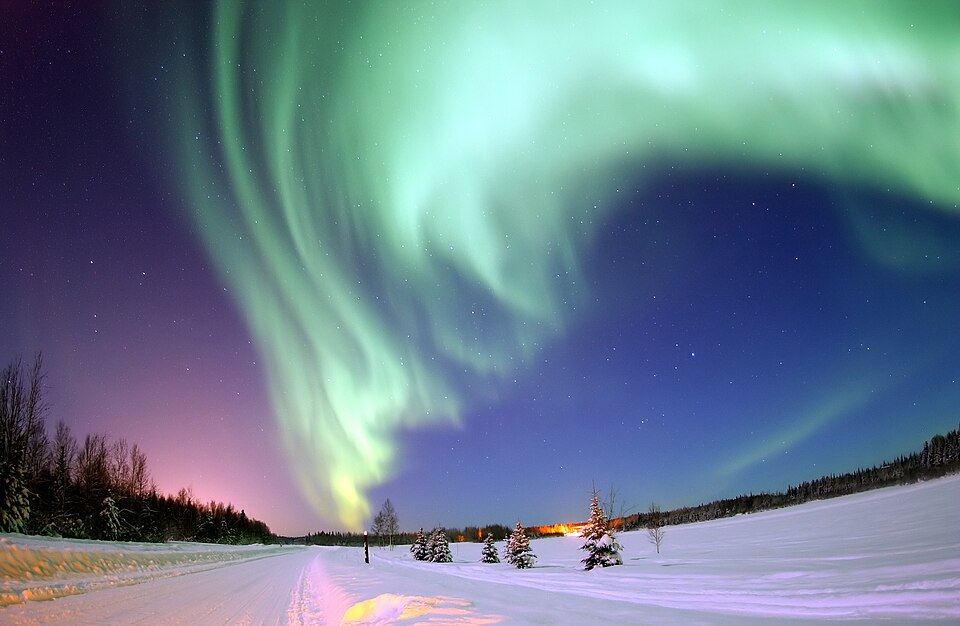
The last and uppermost layer is the exosphere. Here the air is so thin that its particles rarely meet each other, and the atmosphere slowly fades into outer space. There is no sharp line where the air ends.
Scientists also divide the air in a second way, by what it is made of rather than by temperature. Up to about 80 to 90 km, winds keep the gases well mixed, so their proportions stay the same; this part is the homosphere. Above it lies the heterosphere, where the gases separate into layers by weight, with nitrogen lowest, then oxygen, then helium, and the lightest gas, hydrogen, at the very top.
Why it matters. The upper layers seem far from daily life, but they are not. The stratosphere's calm, stable air and the ozone shield protect life on the ground. The ionosphere carries radio signals, and storms on the sun that disturb it can upset radio communication and navigation systems.
Mains lens: what, why, where and so what
UPSC Mains (GS Paper I and III) rarely asks you only to list the layers or the gases. It asks why the composition of the air matters and what happens when people change it. Here are three angles that turn this basic science into answers on real issues.
1. Climate change: a small gas, a big effect. Carbon dioxide is only a tiny share of the air, yet a rise in that share strengthens the greenhouse effect and warms the troposphere. The warming is linked to stronger heatwaves, heavier bursts of rain and rising seas. In an answer, always start from the mechanism: incoming sunlight passes, outgoing heat is trapped, and more of the gas traps more heat.
The policy implication follows from the science. Because carbon dioxide stays in the air for a long time and comes from energy, transport and industry, cutting it means changing how countries produce power. This is why climate negotiations are harder than most environmental talks, and why ideas such as fairness between rich and developing countries enter every debate.
2. The ozone success story: why it worked. The Montreal Protocol is the model case of global cooperation on the atmosphere. It worked because the science was clear, the damage was easy to explain, substitutes for CFCs could be found and almost every country signed. The ozone layer is now slowly recovering.
A good Mains answer compares this with climate change. Ozone needed a few chemicals to be replaced, while carbon dioxide is tied to the whole economy. So the lesson is not only that agreements can work, but that they work best when solutions are cheap and widely available.
3. Pollution in the troposphere: where we breathe. Almost all dust, smoke and water vapour stay in the lowest layer, close to people. In winter, cold air near the ground can stay trapped under warmer air above, so pollution cannot rise and spread out. North Indian cities then face thick smog for days.
This links atmosphere science to public health, crop burning, vehicle rules and city planning. An answer that explains why the air traps pollution, not only who emits it, shows the examiner a deeper understanding.
Mains lens: practice questions and answer plans
Now turn this understanding into written answers. The four questions below are written in the UPSC style, but they are our own practice questions, not previous-year questions. The real previous-year questions of your exam appear in the "Previous year questions" box once we have matched them with the official papers.
Q1. "Describe the vertical structure of the atmosphere. Why does temperature behave differently in the troposphere and the stratosphere?" (250 words)
- Introduction: Define the atmosphere and say that its layers are based on how temperature changes with height.
- Body: Describe the five layers with heights, and draw a simple temperature line. Explain that the troposphere is heated from the ground, so it cools with height, while ozone heats the stratosphere from within, so it warms with height.
- Conclusion: Link the layers to life: weather in the troposphere, protection in the stratosphere and radio communication in the ionosphere.
Q2. "The Montreal Protocol succeeded where climate agreements have struggled. Explain why." (150 words)
- Start with the ozone problem, its cause and the 1987 agreement.
- Then give the reasons for success: clear science, few chemicals, available substitutes and near-universal membership.
- After that, contrast this with carbon dioxide, which is tied to energy and growth.
- End with the lesson that cheap, available alternatives make agreements work.
Q3. "Carbon dioxide is a tiny part of the atmosphere but a major driver of climate. Discuss." (150 words)
- Begin with its share in the air and the greenhouse mechanism.
- Next, explain why its rise warms the lower atmosphere.
- Then give the effects on India: heatwaves, changes in rain and sea-level rise.
- Close with the need to cut emissions and adapt.
Q4. "Why is the troposphere thicker at the equator than at the poles, and what does this mean for weather?" (150 words)
- Give the figures: about 18 km at the equator and about 8 km at the poles.
- Then explain the cause: strong heating and rising air at the equator.
- Finally, link it to tall rain clouds and heavy rain in the tropics.
Useful keywords: composition of air, greenhouse effect, normal lapse rate, tropopause, ozone layer, UV absorption, Montreal Protocol, ionosphere, temperature inversion, trapped pollution.
Quick revision
- The atmosphere is a layer of gases held by gravity, and most of its mass lies in roughly the lowest 30 km.
- Dry air is about 78% nitrogen, about 21% oxygen and nearly 1% argon, while carbon dioxide is only about 0.04% but traps heat.
- Water vapour ranges from about 4% in the warm, wet tropics to under 1% in dry or cold places, and it falls with height.
- Dust, salt and smoke particles act as nuclei for cloud droplets.
- Ozone, found mainly between about 10 and 50 km, absorbs most ultraviolet rays, and the Montreal Protocol (1987) phased out the CFCs that harmed it.
- The five layers from the ground up are the troposphere, stratosphere, mesosphere, thermosphere and exosphere.
- The troposphere is about 13 km thick on average, about 18 km at the equator and 8 km at the poles, and temperature falls by about 1°C per 165 m in it.
- Temperature rises with height in the stratosphere because of ozone, falls again in the mesosphere to about minus 100°C, and the ionosphere reflects radio waves.