

RPSC Sub Inspector · Module 1 · standard depth · 17 min
Sources of ancient Indian history
What RPSC Sub Inspector asks from this chapter
Syllabus lines this chapter covers:
- Paper II: General Knowledge and General Science · Ancient and medieval India: landmarks, art, culture, literature and architecture, major dynasties and their administration, socio-economic conditions and movements.
RPSC Sub Inspector questions from this module are being sorted into our bank.
Cut to standard depth for RPSC Sub Inspector. 16 deeper paragraphs are in the full chapter.
Start from zero: how do we know about the distant past?
Imagine you want to know how your great-great-grandparents lived. Nobody alive remembers them. You would look for old letters, photographs, land papers, a house they built, perhaps a coin from their time. Historians of ancient India do the same, only across thousands of years.
Everything we know about early India comes from sources: traces left by people of the past. Some are texts, like the Vedas or the Arthashastra. Some are objects: inscriptions, coins, pots, tools, buildings. Some are descriptions by outsiders, like Greek or Chinese visitors.
No source speaks for itself. A hymn may praise a god but also tell us that wealth was counted in cattle. A coin may be tiny but date a king's reign. The historian's job is to ask the right questions and to check one source against another.
This chapter is the foundation for every ancient chapter that follows. You will learn the main kinds of sources, what each can and cannot tell us, and how the writing of Indian history itself changed. UPSC and BPSC ask both direct questions on sources and analytical questions on how to use them.
Sources at a glance
| Type | Examples | What it tells us | Limits |
|---|---|---|---|
| Religious texts | Vedas, epics, Puranas, Tripitaka, Jaina Angas | Beliefs, society, values, some politics | Hard to date; added to over centuries |
| Secular texts | Arthashastra, Sangam poems, Harshacharita, Rajatarangini | Polity, economy, court life, regions | Praise of patrons; ideal not reality |
| Inscriptions | Ashokan edicts, prashastis, copper-plate grants | Rulers, dates, boundaries, land, religion | Damaged, one-sided, boastful |
| Coins | Punch-marked, Indo-Greek, Kushana, Gupta, Roman | Rulers, dates, trade, economy | Hoards move; need context |
| Material remains | Harappan cities, Inamgaon, pottery, tools | Daily life, technology, settlement, diet | Silent on names, language, beliefs |
| Foreign accounts | Megasthenes, Periplus, Fa-hsien, Hsuan Tsang | Outsider's view of society and trade | Misunderstanding, hearsay, bias |
Prehistory, protohistory, history. Where there is no writing, as in the Stone Age, we speak of prehistory. Where writing exists but cannot be read, as with the Harappan script, we speak of protohistory. Once readable texts and inscriptions appear, we are in the historical period.
Religious literature: Vedas to Jatakas
Not written as history. Ancient Indian texts were not composed mainly to record events. They were collections of hymns, rituals, rules, stories and teachings. That is why European scholars of the colonial period complained that India had no 'history', even though the tradition used the word itihasa, 'thus it was'.
The Vedas. There are four Vedas: Rig, Sama, Yajur and Atharva, composed roughly between 1500 and 500 BC. They were followed by the Brahmanas, Aranyakas and Upanishads, the last also called Vedanta, which discuss the soul (atma) and the supreme being. These are our main sources for the Vedic age.
The Rig Veda as a source. The Rig Veda, dated roughly to 1500-1000 BC, is the earliest text. It has 1,028 hymns in ten mandalas, of which books II to VII are the oldest and the tenth is among the latest. It was not written down for centuries but passed on orally by fixed methods of recitation, which preserved it with remarkable accuracy.
Reading between the lines. The Rig Veda praises gods like Indra and Agni, but its similes reveal daily life. Wealth was counted in cattle, the cow was highly valued, and horses and chariots mattered in war. So a religious text tells us the society was largely pastoral and tribal, and it points archaeologists to what to look for.
The epics. The Mahabharata, attributed to Vyasa, began as a bardic tale of about 8,800 verses called Jaya. It grew to 24,000 verses as Bharata and finally to about 1,00,000 verses. The Ramayana is attributed to Valmiki, and both epics reached their final form by about AD 400.
Using the epics carefully. Because the epics grew over many centuries, a single passage may come from a much later time than the story it tells. Historians therefore use them for broad social values, not for exact events or dates. The same caution applies to the Puranas, which mix genealogy, myth and later additions.
Sutras and law books. The Sutras (about 600-300 BC) include Shrautasutras on public sacrifices and Grihyasutras on domestic rites such as birth and marriage. The Dharmashastras lay down social rules and duties. The Manu Smriti is the earliest of these law books, and the British translated it in 1776 to use in courts.
Prescriptive, not descriptive. Law books tell us how their authors thought society should work, not necessarily how it did. A rule repeated many times may show that people often broke it. Reading them alongside inscriptions and archaeology gives a truer picture.
Buddhist texts. The earliest Buddhist texts are in Pali. The Tripitaka ('three baskets') has the Sutta Pitaka (teachings), Vinaya Pitaka (monastic rules) and Abhidhamma Pitaka (philosophy). The Jatakas, over 550 stories of the Buddha's previous births, give vivid pictures of towns, trade and everyday life.
Jaina texts. Jaina texts were written in Prakrit. The main canon, including the Angas, was finally compiled at Vallabhi in Gujarat in the 6th century AD. Like Buddhist texts, they are rich sources for trade, towns and religious movements of the Ganga valley.
Secular literature: kings, courts and the Tamil south
The Arthashastra. Kautilya's Arthashastra is a treatise on statecraft, administration, law and economy. It is a key source for Mauryan polity, though parts may have been added later. Like the law books, it describes an ideal state as much as a real one.
Grammar and poetry. Panini's Ashtadhyayi, a grammar of Sanskrit, incidentally preserves information on places, peoples and society. Kalidasa, of the Gupta period, wrote works such as Abhijnanashakuntalam, Meghaduta and Ritusamhara. Such literature reveals courtly tastes, values and the world of the elite.
Biographies of kings. Court poets wrote charitas, life stories of their patrons, such as Bana's Harshacharita about Harsha. They are valuable but exaggerate their heroes' achievements. A telling example: Harsha's defeat by the Chalukya king Pulakeshin II is not mentioned by Bana, while Pulakeshin's own inscriptions proudly record it.
Kalhana's Rajatarangini. The Rajatarangini, written by Kalhana in the 12th century, is a history of the kings of Kashmir. It is the closest ancient India came to history-writing in the modern sense. Colonial scholars treated it as the great exception.
Sangam literature. In the far south, Sangam literature in Tamil was composed in assemblies of poets patronised by chiefs and kings in the early centuries AD. It is secular, describing love, war, chiefs, trade and landscapes. It is the main source for south India from about 300 BC to AD 300.
Tamil epics. The Tamil epics Silappadikaram and Manimekalai add to this picture of urban life, trade and religion in the south. Together with Sangam poems, they show that India's past cannot be told from Sanskrit texts alone. Regional literatures give regional histories.
Inscriptions and coins: history written in stone and metal
Why inscriptions matter. Epigraphy is the study of inscriptions, writing engraved on stone, metal plates, pillars and cave walls. They are among the most reliable sources because they are usually contemporary and cannot easily be changed later. They record rulers, wars, gifts, boundaries, taxes and religious acts.
Ashoka's edicts. Ashoka was the first ruler to issue inscriptions on a large scale. Most are in Prakrit written in the Brahmi script. In the north-west some are in Kharosthi, and in Afghanistan some are in Greek and Aramaic, chosen so local people could read them.
Unlocking Brahmi. For centuries nobody could read Ashoka's script. James Prinsep deciphered Brahmi in 1837, opening up the Mauryan age. Brahmi is written left to right, while Kharosthi is written right to left.
Kinds of inscriptions. Prashastis are poems in praise of rulers, like the Allahabad pillar inscription of Samudragupta. Others record donations to monasteries or temples. Land grants, usually on copper plates, appear from about the 1st century BC, and the Satavahanas were the first to issue them; they become very common later.
How they are dated. Some inscriptions carry dates in eras like the Saka or Vikrama era. Others are dated by palaeography, the study of how letter shapes changed over time. This lets historians place an undated inscription within a century or so.
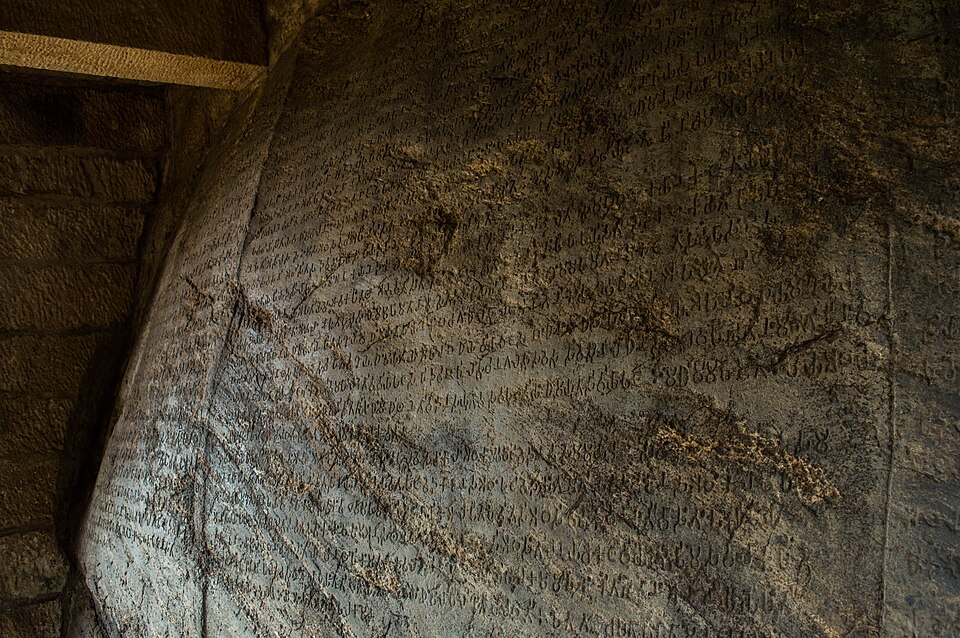
Limits of inscriptions. Many are faint or damaged, and some words are unclear. Prashastis boast and leave out defeats. Inscriptions mostly record what rulers and donors wanted remembered, so ordinary lives appear only at the edges.
Coins as sources. Numismatics is the study of coins. Coins of gold, silver and copper reveal rulers, dates, the spread of a kingdom, and the state of the economy. Where they are found tells us about trade routes and contacts.
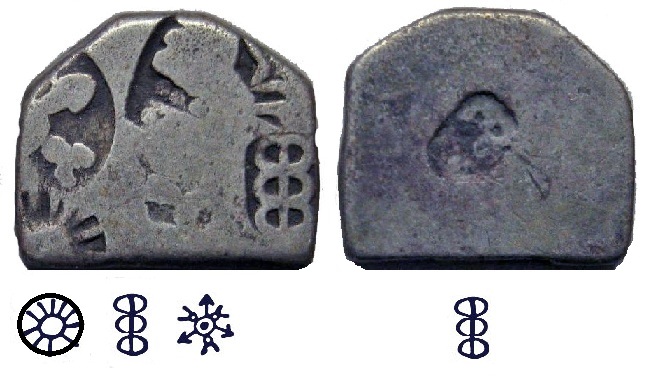
A short history of Indian coins. The earliest are punch-marked coins of silver and copper, from about the 6th century BC. The Indo-Greeks (about the 2nd century BC) first issued coins with rulers' names and portraits. The Kushanas (about the 1st century AD) first issued gold coins on a large scale, and the Guptas issued many gold coins, the early ones of high purity.
Coins solve problems. Roman coins found in India, especially in the south, prove trade with the Roman Empire. The Jogalthambi hoard of coins confirmed Puranic accounts of the Satavahanas. Some coins were even issued by merchant guilds with royal permission.
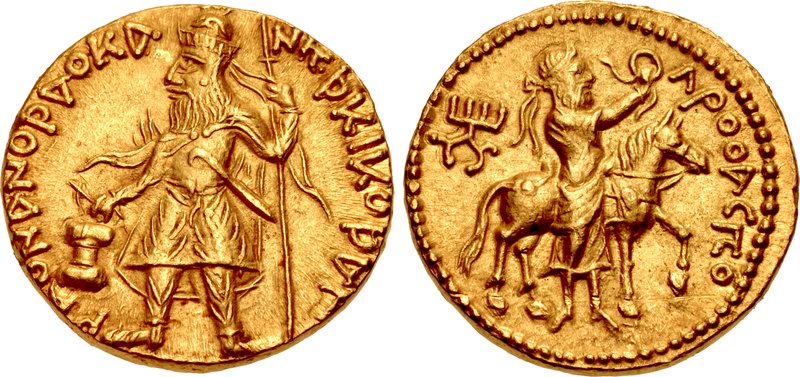
Coins and economic debates. Coins also shape big arguments. The theory of urban decay after the Guptas rests largely on the scarcity of coins and their lower precious-metal content. So a change in coinage is read as a change in trade and towns.
Archaeology: when the ground becomes the text
What archaeology studies. Archaeology studies the material remains of the past: buildings, monuments, pottery, seals, tools, ornaments, grain and skeletons. For the long ages before writing, it is our only source. Even for later periods, it shows the lives of ordinary people that texts ignore.
Context is everything. Most finds are things people threw away or left behind. A pot or bead means little on its own; it makes sense only in the context and layer where it was found. Reading these layers, called stratigraphy, tells archaeologists what came earlier and what later.
Dating the finds. Scientific methods help fix dates. Radiocarbon (C-14) dating measures the decay of carbon in once-living material like bones, wood or grain. Pollen analysis shows changes in plants and has been used to suggest early cultivation in Kashmir and Rajasthan.
A site as a text: Inamgaon. Inamgaon, a Chalcolithic village in Maharashtra, was excavated by Deccan College from 1968 to 1983, one of the longest excavations of its kind in India. It shows life from about 1600 to 700 BC in three phases: Malwa, Early Jorwe and Late Jorwe. With no inscriptions or texts, the site itself had to be read like a book, as we saw in the Stone Age and Chalcolithic chapter.
Rediscovering a civilisation. In 1826 the traveller Charles Masson noticed the ruined walls of Harappa. Decades later Alexander Cunningham collected seals there, and in the 1920s the civilisation was finally recognised under John Marshall, as told in the chapter on Harappan cities. The Archaeological Survey was strengthened under Lord Curzon.
Limits of archaeology. Objects cannot tell us names, languages or ideas directly. Archaeology alone cannot prove the ethnic identity of a people, though differences in remains may suggest different groups. That is why the unread Harappan script leaves so much of their society uncertain, as the chapter on Harappan society shows.
A discipline of its own. Archaeology is not just a helper to history in the way epigraphy and numismatics are. It has its own methods and debates, and its findings can confirm, deny or offer alternatives to what texts say. The best history uses both together.
Foreign accounts: India through outsiders' eyes
Early Greek images. Between the 6th and 4th centuries BC, Greek writers built up an exotic picture of India. Scylax, sent by the Persian king Darius around 515 BC to explore the Indus, and later Herodotus wrote about it. Their accounts mixed fact with fantasy, such as gold-digging ants.
Megasthenes. Megasthenes, a Greek envoy at the court of Chandragupta Maurya, wrote the Indika around 300 BC. The book itself is lost and survives only in fragments quoted by later writers. It describes Pataliputra, administration and Indian society, though some details reflect Greek ideas.
Trade guides. The Periplus of the Erythraean Sea, a Greek guide to the sea trade, lists Indian ports, goods and trade with the Roman world. Ptolemy's Geography names Indian places. These match the evidence of Roman coins and finds at Indian ports.
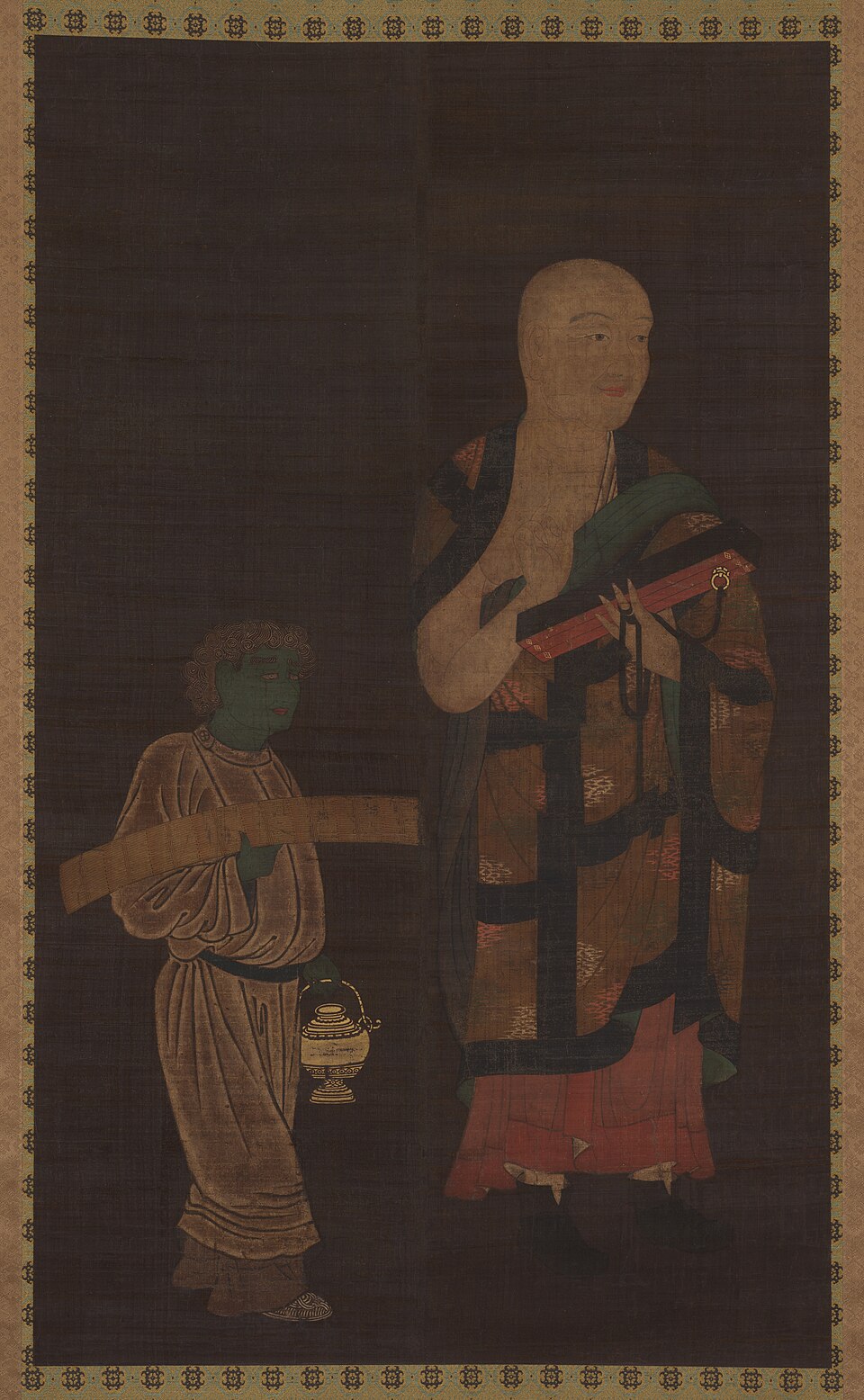
Chinese pilgrims. Buddhist monks from China travelled to India to collect texts and visit holy places. Fa-hsien came in the 5th century during the Gupta period. Hsuan Tsang came in the 7th century, in Harsha's time, and studied at Nalanda.
Using foreign accounts. Outsiders noticed things locals took for granted, which makes them useful. But they often did not know local languages, relied on hearsay and saw India through their own beliefs. Pilgrims, for example, focused on Buddhism and may have exaggerated its strength.
Quick revision
- Three groups: literary (religious, secular), archaeological (inscriptions, coins, material remains), foreign accounts.
- Itihasa = 'thus it was'; Rajatarangini (Kalhana, 12th c., Kashmir) the main ancient 'history'.
- Vedas c. 1500-500 BC; Rig Veda c. 1500-1000 BC, 1,028 hymns, 10 mandalas (II-VII oldest, 10th late), oral; cattle wealth.
- Mahabharata (Vyasa): 8,800 (Jaya) → 24,000 (Bharata) → 1,00,000; Ramayana (Valmiki); final form by c. AD 400.
- Sutras c. 600-300 BC: Shrauta (public), Grihya (domestic); Manu Smriti earliest law book, translated 1776.
- Buddhist: Pali, Tripitaka (Sutta, Vinaya, Abhidhamma), Jatakas 550+; Jaina: Prakrit, compiled at Vallabhi, 6th c. AD.
- Secular: Arthashastra, Kalidasa, Harshacharita (Bana), Sangam (c. 300 BC-AD 300), Silappadikaram, Manimekalai.
- Ashoka first large-scale inscriptions: Prakrit in Brahmi; Kharosthi in NW; Greek and Aramaic in Afghanistan; Prinsep 1837.
- Land grants from c. 1st c. BC, Satavahanas first, copper plates.
- Coins: punch-marked (c. 6th c. BC), Indo-Greek portraits (c. 2nd c. BC), Kushana gold (c. 1st c. AD), Gupta gold, Roman coins.
- Inamgaon: Deccan College, 1968-83, c. 1600-700 BC; C-14 dating; stratigraphy.
- Foreign: Megasthenes Indika (lost), Periplus, Ptolemy, Fa-hsien (5th c.), Hsuan Tsang (7th c.).
- Historiography: Asiatic Society 1784; James Mill; Oriental Despotism; V.A. Smith 1904; nationalists; Kosambi; Basham.