

TNPSC Group 4 · Module 14 · basic depth · 10 min
Mughal architecture: from Humayun's Tomb to the Taj Mahal
What TNPSC Group 4 asks from this chapter
Syllabus lines this chapter covers:
- Part B: General Studies · History and culture of India.
TNPSC Group 4 questions from this module are being sorted into our bank.
Cut to basic depth for TNPSC Group 4. 16 deeper paragraphs are in the full chapter.
Start from zero: what made Mughal buildings special?
In the Sultanate chapter and the provincial styles chapter, we saw how arches and domes entered India and took local forms. The Mughals, who ruled from 1526, brought these ideas together into one grand imperial style. They combined the old Indian trabeate tradition with the arcuate style of arch and dome.
What the Mughals added. They brought ideas from Persia and Central Asia, such as the char bagh (a garden divided into four parts by water channels) and the double dome. Indian craftsmen added carving, brackets, chhatris (domed kiosks) and fine inlay. The result was a style that was both imperial and Indian.
Two materials, two moods. Under Akbar, buildings were mostly of red sandstone, strong and bold. Under Jahangir and especially Shah Jahan, white marble with coloured inlay took over, creating an "age of marble". This shift from red to white is one of the easiest ways to date a Mughal building.
Why build so grandly? Mughal buildings were statements of power and order. A garden tomb pictured paradise, a fort showed strength and a great mosque showed piety. The grandest of all, the Taj Mahal, is today a World Heritage Site and a symbol of India.
Babur, Humayun and the first great tomb
Babur's gardens. Babur ruled for only about five years and built little of lasting value; his mosques at Panipat and Sambhal are modest. His real love was gardens. The Ram Bagh and Zahra Bagh at Agra and a garden at Dholpur were laid out in the Central Asian manner, though they have since been altered.
Humayun's Tomb. The first great Mughal building is Humayun's Tomb in Delhi. It was begun in 1564 by his widow Hamida Banu Begum, under the Persian architect Mirak Mirza Ghiyas. It is often called an "Indian rendition of a Persian concept", and it belongs to Akbar's reign.
Its new features. It is the earliest Mughal tomb set in a walled garden, on a high arcaded platform of sandstone. It has a double dome, a porch with a pointed arch on each side, and a central grave chamber with smaller rooms at the corners for family members. It uses red sandstone with white marble, a combination the Mughals loved.
Why a double dome? A single high dome would make the inside ceiling feel too far away. With two shells, the inner dome sits lower and fits the room, while the outer dome rises high for a grand skyline. This idea had long been used in West Asia, and you met an early Indian example in Sikandar Lodi's tomb.
Akbar: red sandstone and Fatehpur Sikri
Akbar's style. Akbar's reign was the formative period of Mughal architecture. His buildings used red sandstone, much trabeate (beam-and-bracket) construction and arches that were often only decorative. Pillars had many-sided shafts topped by bracket capitals, and walls were boldly carved, inlaid and brightly painted inside.
The forts. Akbar built great forts at Agra, Allahabad and Lahore. Inside Agra Fort, the Jahangiri Mahal survives, with its central court, pillared halls and serpentine brackets. Its Delhi Gate, with two octagonal towers and white marble inlay on red sandstone, is seen as the start of a new era.
Fatehpur Sikri. About 40 km west of Agra, Akbar built a new capital, Fatehpur Sikri (1571–85). It has no single overall plan and is deliberately asymmetrical. Stone members were cut to size and fitted together, often without mortar, and a rule is easy to remember: religious buildings are arcuate, secular buildings are trabeate.
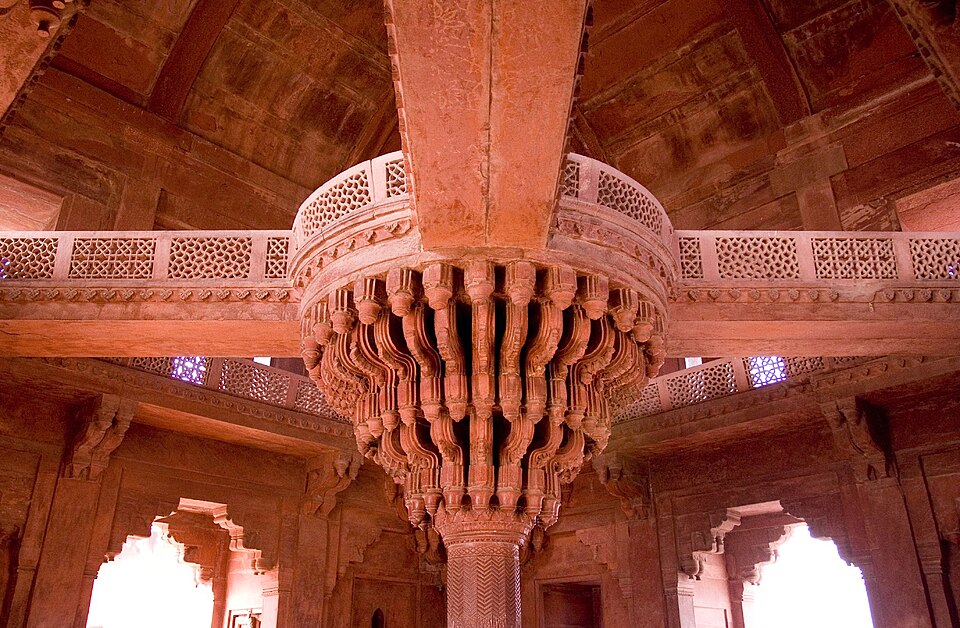
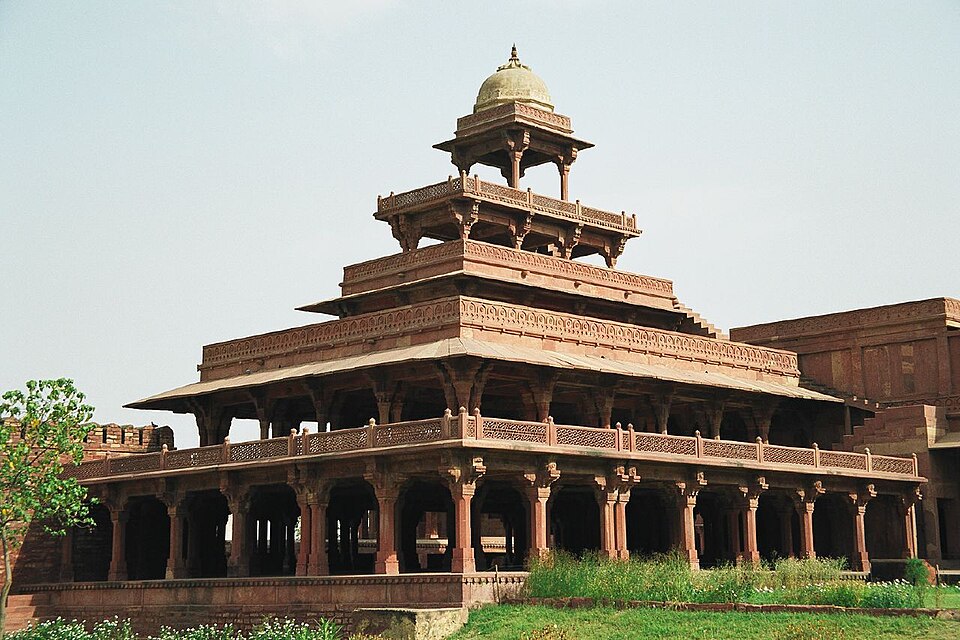
Its buildings. The Jami Masjid has a huge courtyard, and its gateway, the Buland Darwaza, was built to mark Akbar's conquest of Gujarat. Inside the courtyard is the marble tomb of Salim Chishti with serpentine brackets and lattice screens. Other famous buildings are the Panch Mahal (five storeys of diminishing size), the Diwan-i-Khas with its single carved central pillar and bridges, the Diwan-i-Am, and Jodh Bai's palace with blue glazed tiles.
Jahangir: Sikandra, Itimad-ud-Daula and pietra dura
Akbar's tomb at Sikandra. Akbar planned and began his own tomb at Sikandra, near Agra, and Jahangir finished it with changes. It stands in a garden with four gateways, of which only the southern one is a real entrance; the other three are there for symmetry. The tomb rises in three storeys of red sandstone pavilions, topped by a white marble court with screens, and its south gateway has four white marble minarets.
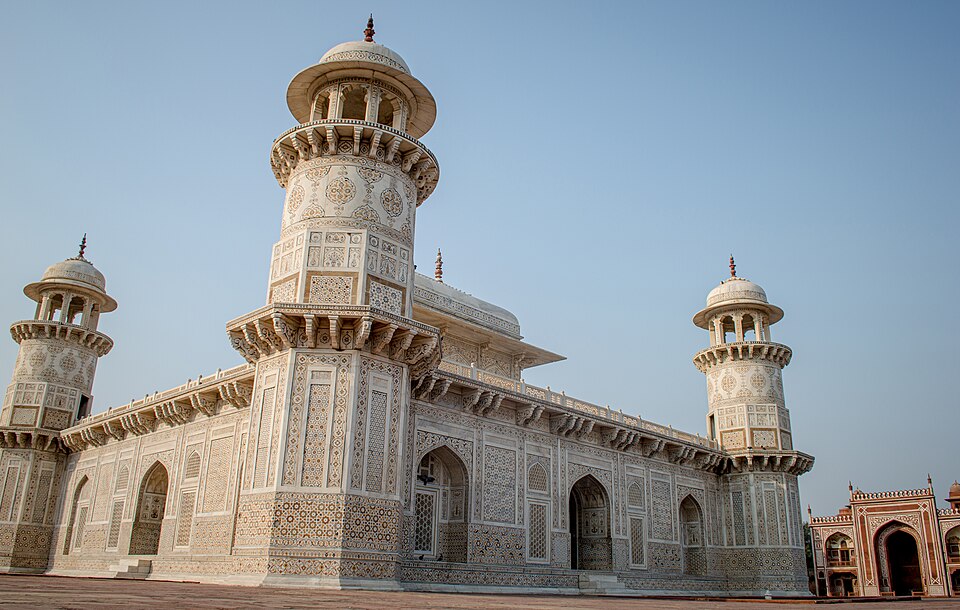
Itimad-ud-Daula. The tomb of Itimad-ud-Daula at Agra (1622–28) was built by Nur Jahan for her father, Mirza Ghiyas Beg. It is small and square, with four octagonal corner towers, and is covered in white marble with mosaic and inlay of coloured stones. It marks the change from the robust Akbari style to a more delicate, refined one.
What is pietra dura? Pietra dura (Italian for "hard stone"), called parchin kari in India, is a technique of fitting precisely cut coloured stones, such as lapis lazuli, jasper, onyx and carnelian, into marble to form flowers and patterns. Unlike mosaic, each stone is cut to the shape of part of the picture. It flourished from the later years of Jahangir's reign and reached its height under Shah Jahan.
Jahangir's gardens. Jahangir loved painting and gardens more than big buildings. In Kashmir, he laid out the famous Shalimar Bagh, with terraces and flowing water. You met his love of nature in the Mughal painting chapter.
Shah Jahan: the age of marble and the Taj Mahal
Features of the age. Under Shah Jahan (1628–58), Mughal architecture reached its most refined form. Typical features are white marble, cusped (foliated) arches with nine curves, arcades with engrailed arches and bulbous domes on a narrow neck. Double domes became common, and inlay of coloured stones covered surfaces.
Delhi's Red Fort and Jami Masjid. Shah Jahan built a new capital in Delhi with the Red Fort (Lal Qila), a rectangle with a river wall, the Delhi and Lahore gates and round bastions. Inside, the Diwan-i-Am and Rang Mahal have paired columns finished in polished lime plaster, and the throne canopy has a curved Bengal-style roof. The Jami Masjid of Delhi, on a raised platform with three marble domes, is described as the largest mosque in India.
The Taj Mahal. The Taj Mahal at Agra, built by Shah Jahan for his wife Mumtaz Mahal, was begun in 1632 and mostly finished by 1643. It stands on a raised platform overlooking the Yamuna, with four circular minarets, and is built of Makrana marble from Rajasthan. The tomb is square with bevelled corners, with deep alcoves, a double dome, an inverted lotus finial and calligraphy and inlay outside, with pietra dura inside.
The Taj complex. The tomb is set at the end of a char bagh garden divided by canals, entered through a grand southern gateway. To its west stands a mosque, and to its east an identical building called the jawab ("answer"), added for symmetry. The Moti Masjid in Agra Fort, all of marble with three bulbous domes and no minarets, is another gem of this age.
Quick revision
- Mughal style = trabeate + arcuate; Persian ideas (char bagh, double dome) + Indian craft (brackets, chhatris, jali).
- Babur: gardens (Ram Bagh, Agra). Humayun's Tomb (1564, Hamida Banu Begum, architect Mirak Mirza Ghiyas): first garden tomb, high platform, double dome, red sandstone + marble.
- Sur: Sher Shah's tomb, Sasaram (in a tank); Purana Qila, Qila-i-Kuhna Masjid (step to four-centred arch).
- Akbar: red sandstone, trabeate, bracket capitals; Agra Fort (Jahangiri Mahal, Delhi Gate); Fatehpur Sikri 1571–85 (religious arcuate, secular trabeate): Jami Masjid, Buland Darwaza (Gujarat conquest), Salim Chishti's tomb, Panch Mahal, Diwan-i-Khas, Jodh Bai's palace.
- Jahangir: Akbar's tomb Sikandra; Itimad-ud-Daula (Nur Jahan, 1622–28, marble + inlay); pietra dura = parchin kari; Shalimar Bagh (Kashmir).
- Shah Jahan: marble, cusped arches, bulbous domes; Red Fort, Jami Masjid (Delhi), Moti Masjid (Agra); Taj Mahal (1632; Makrana marble; double dome; 4 minarets; char bagh; mosque + jawab; pietra dura).
- Aurangzeb: Bibi ka Maqbara (Taj copy), Badshahi Masjid (Lahore), Moti Masjid (Red Fort); Safdar Jang's tomb = decline.
- Public works: sarais on trade routes; bridges with independent arches; temples revived (Govindadeva, Vrindavan 1590).