

TNPSC Group 4 · Module 1 · basic depth · 20 min
Harappan Civilisation I: cities, planning and economy
What TNPSC Group 4 asks from this chapter
Syllabus lines this chapter covers:
- Part B: General Studies · History and culture of India.
TNPSC Group 4 questions from this module are being sorted into our bank.
Cut to basic depth for TNPSC Group 4. 19 deeper paragraphs are in the full chapter.
Start from zero: India's first cities
About 4,500 years ago, people in the Indus plains built cities with straight streets, covered drains, brick houses with bathrooms and a huge public bath. They wrote on small stone seals, used standard weights and traded with Mesopotamia across the sea. Nothing like this existed anywhere else in the subcontinent at the time.
This is the Harappan Civilisation, also called the Indus Valley Civilisation. It is named after Harappa, the first site to be identified. As more sites were found far beyond the Indus, scholars came to prefer the name 'Harappan'.
Its script is still undeciphered, so we cannot read what the Harappans said about themselves. Everything we know comes from archaeology: buildings, pots, seals, beads, bones and grains. Historians call such a culture proto-historic, because writing existed but cannot yet be read.
This chapter covers how the cities arose, how they were planned and how their economy worked. The next chapter covers society, religion, the script and the end of the cities. To see where these cities came from, recall the farming villages of the Stone Age and Chalcolithic chapter.
The Harappan cities at a glance
| Question | Answer |
|---|---|
| What? | India's first urban culture, a Bronze Age civilisation |
| When? | Early phase roughly 3300-2600 BC; urban (Mature) phase about 2600-1900 BC |
| Where? | Sind, Punjab, Haryana, Rajasthan, Gujarat, western UP, Makran; outliers in Afghanistan and Jammu |
| Found when? | 1920-22: Harappa (Daya Ram Sahni), Mohenjodaro (R.D. Banerji) |
| Big cities | Mohenjodaro, Harappa, Ganweriwala, Rakhigarhi, Dholavira |
| Hallmarks | Grid streets, drains, 4:2:1 bricks, seals, standard weights, script |
| Economy | Plough farming, herding, specialised crafts, long-distance trade |
| Why it matters | Shows planning, standardisation and long-distance trade 2,000 years before the next Indian cities |
The next cities in India, in the Ganga plain, appeared only around 600 BC. That is why historians call the Harappan phase the first urbanisation.
Discovery, extent and how we recognise a Harappan site
Ruins noticed, meaning missed. In 1826, the traveller Charles Masson noticed high walls and towers at the village of Harappa in western Punjab, now in Pakistan. Decades later, Alexander Cunningham collected some seals there without realising their age. The ruins were also damaged when bricks were carried away for building.
The discovery. The civilisation was recognised only in 1920-22, when two key sites were excavated. Daya Ram Sahni dug Harappa on the Ravi, and R.D. Banerji dug Mohenjodaro on the Indus in Sind. John Marshall, head of the archaeological department, announced that a forgotten civilisation had been found.
Why the discovery mattered. Before this, Indian history was thought to begin with the Vedic age. The finds pushed India's past back by more than a thousand years. They showed that the subcontinent had cities as old as those of Mesopotamia and Egypt.
How big was it? The Harappan culture spread over Sind, Punjab, Haryana, northern Rajasthan, Gujarat (Kutch and Kathiawar) and western Uttar Pradesh, and along the Makran coast. Outlying sites include Shortughai in north-east Afghanistan and Manda in Jammu. It covered a larger area than either Mesopotamia or Egypt, though outside the Ghaggar-Hakra its sites were thinly spread, sometimes hundreds of kilometres apart.
How much do we really know? More than 1,000 Harappan settlements are known, but only about 3% have been excavated, and big sites like Ganweriwala in the Hakra valley are still untouched. Even Mohenjodaro, the largest city, may have held only about 35,000 people. So every generalisation can change with the next excavation.
The four corners. Sutkagendor on the Makran coast near the Pakistan-Iran border is the westernmost site, and Alamgirpur in western Uttar Pradesh the easternmost. Manda (Jammu) lies in the north and Daimabad (Maharashtra) is often listed in the south. These extremes are a favourite Prelims question.
Key sites by region. The main sites are Mohenjodaro and Chanhudaro in Sind; Harappa in Pakistani Punjab; Kalibangan in Rajasthan; Banawali and Rakhigarhi in Haryana; and Lothal, Dholavira, Surkotada and Rangpur in Gujarat. Kalibangan lies on the Ghaggar-Hakra, a river often associated with the lost Saraswati.
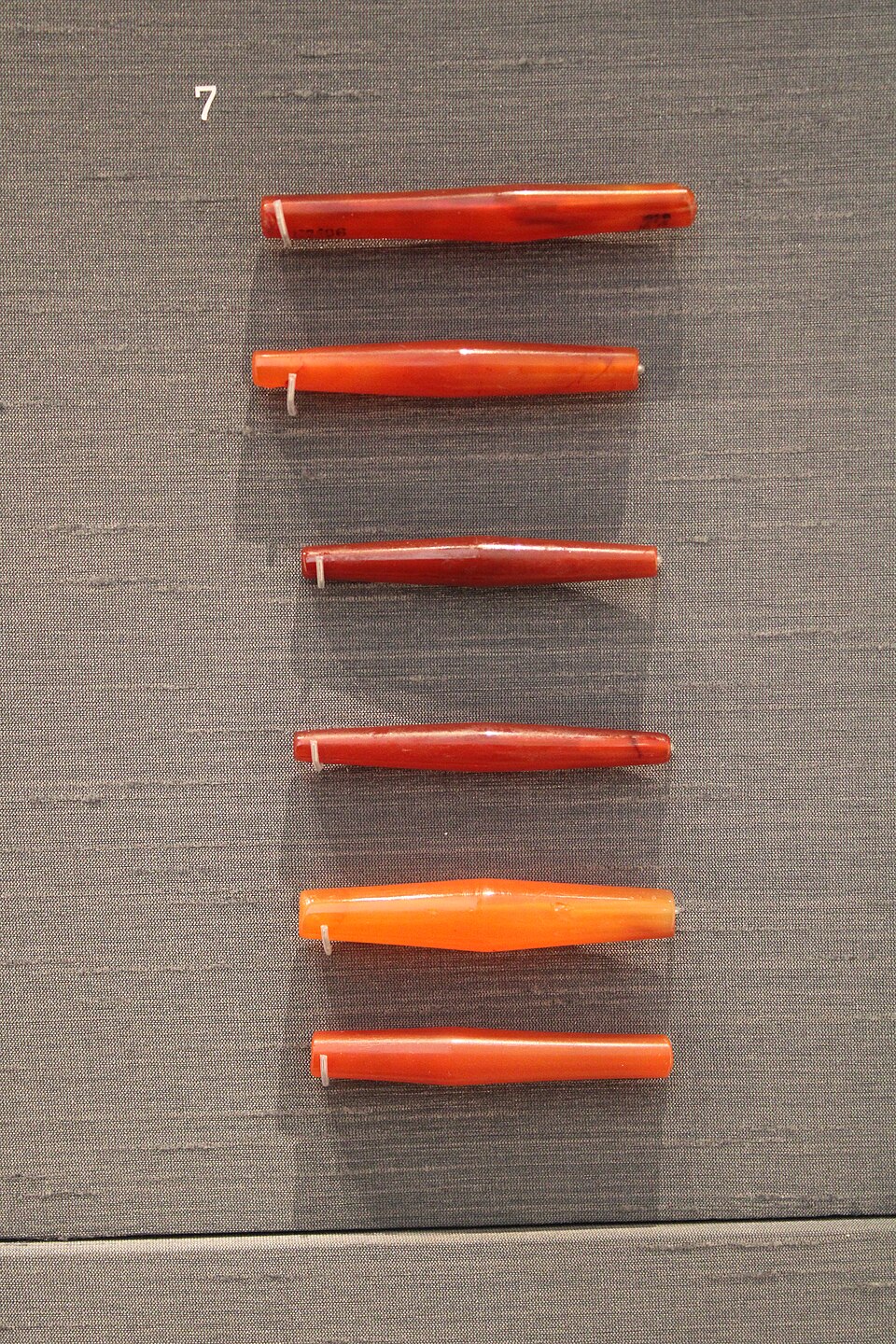
Recognising a Harappan site. Archaeologists call a site Harappan only when many typical artefacts occur together. These include thick red pottery with black painting, square steatite seals, standard cubical chert weights, bricks in the ratio 4:2:1, terracotta toy carts and triangular cakes, steatite microbeads, long carnelian beads and long chert blades. Together they form an archaeological culture.
One object is not enough. At Kayatha in Madhya Pradesh, Harappan-type beads were found carefully kept in a pot. But the rest of the site was Chalcolithic, so Kayatha was not Harappan; the beads only show contact. Likewise, a vaguely similar object in eastern India does not prove the civilisation reached there.
Uniform but not identical. Early archaeologists like Stuart Piggott saw Harappan products as standardised and uniform. Later research found regional variations, for example in pottery and religious practice. Yet the wide spread of certain artefact types still needs explaining, and that question leads to the debate on the Harappan state.
Town planning: citadel, grid and drains
Built to a plan. Planned streets, drains and housing blocks show that the big Harappan towns did not grow haphazardly out of villages. They were laid out first and people moved in later. Decisions about layout went beyond single households, which implies some authority.
Citadel and lower town. At Mohenjodaro, Harappa and Kalibangan, the town has two parts. A higher, smaller mound to the west, called the citadel, held large special buildings. A larger lower town to the east held most homes, and the two parts may have been walled separately.
Why separate them? The citadel's large non-residential buildings suggest administrative or ritual functions. Separating them may also have kept certain people and activities apart from the rest of the town. Fortification excluded outsiders and helped those inside control trade and movement.
Streets and houses. Main streets ran roughly north-south and east-west, crossing at right angles and dividing the town into blocks. House doors usually opened onto side lanes, not the main street. Bigger houses had rooms around a courtyard, with private wells, kitchens and bathing platforms, and the courtyard was hidden from the entrance for privacy.
Rich and poor. Houses ranged from single-room units to large multi-room homes. Near the Harappa granary were rows of small quarters, often read as workers' barracks. Large and small houses stood side by side in Mohenjodaro's lower town, so wealth was mixed rather than strictly zoned.
Drains and sanitation. Every house drain flowed into covered street drains of brick. Manholes and removable slabs at intervals allowed cleaning. This shows remarkable concern for sanitation, and its regular maintenance needed organised labour.
Bricks. Most buildings used burnt bricks in the standard ratio 4:2:1 (length, width, thickness). The same ratio across distant sites shows standardisation. Firing millions of bricks required huge fuel and labour, again pointing to organised control.
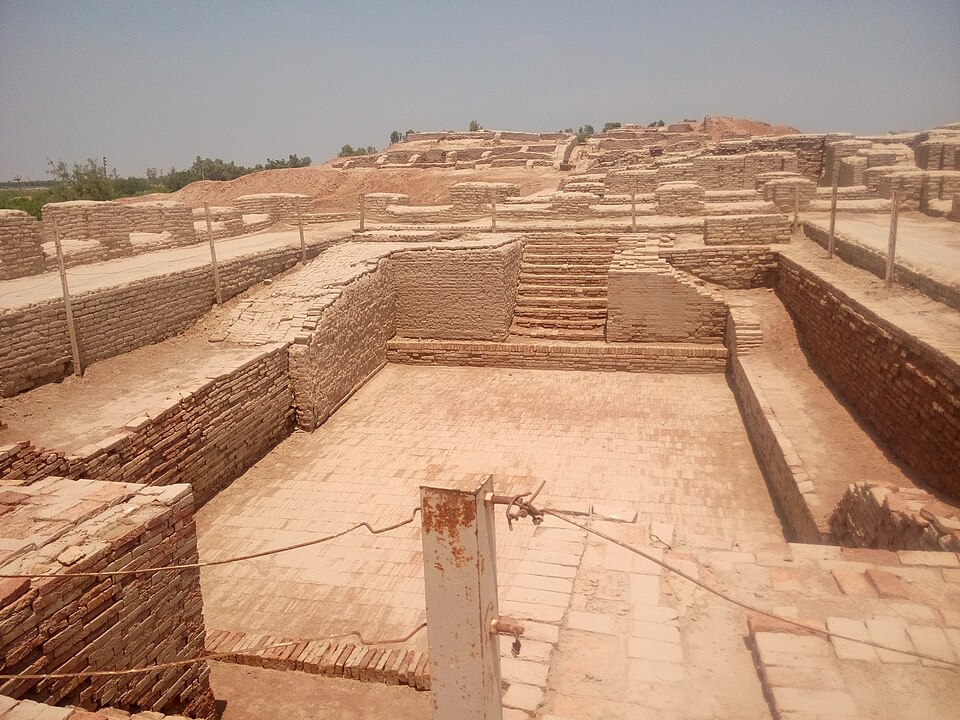
The Great Bath. On the Mohenjodaro citadel stands the Great Bath, a brick tank about 12 m by 7 m and 3 m deep, approached by steps from the north and south. Its floor was sealed with a layer of bitumen to stop seepage, and water came from a well in an adjoining room and drained away through a large drain. Rooms around it may have been for changing, and it was probably used for ritual bathing.
Granaries or storehouses? West of the Great Bath is a large building of brick blocks, traditionally called the granary. At Harappa, the 'Great Granary', two rows of six units on brick platforms, lies near rows of circular brick platforms used for threshing, with wheat and barley chaff. Some scholars caution that such buildings may also have stored goods and raw materials, not only grain.
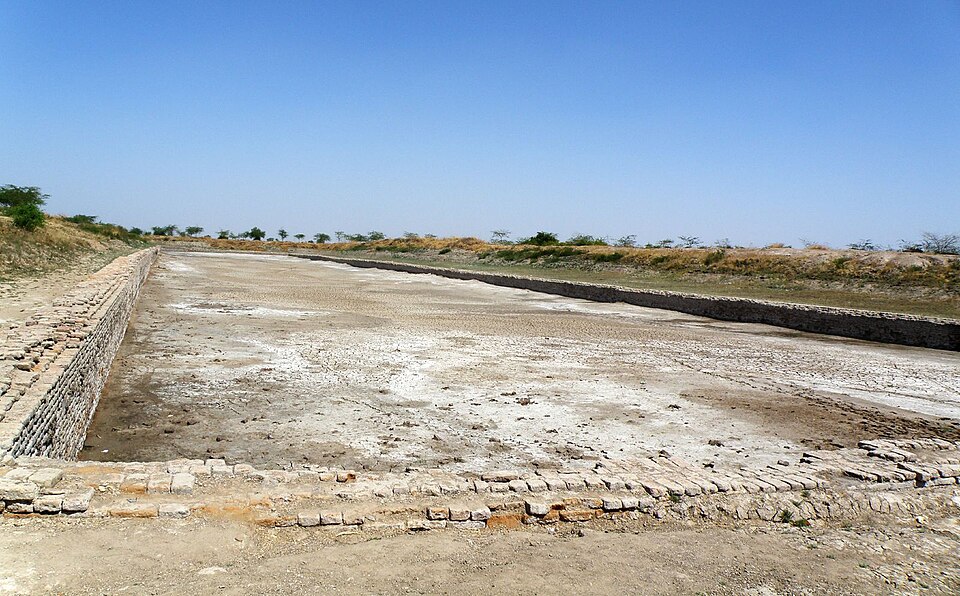
Lothal's dockyard. At Lothal in Gujarat, a large brick basin is identified as a dockyard for berthing ships and handling cargo. Sealings used on packed goods and a seal of Persian Gulf type were found there. Lothal was an important port and craft centre.
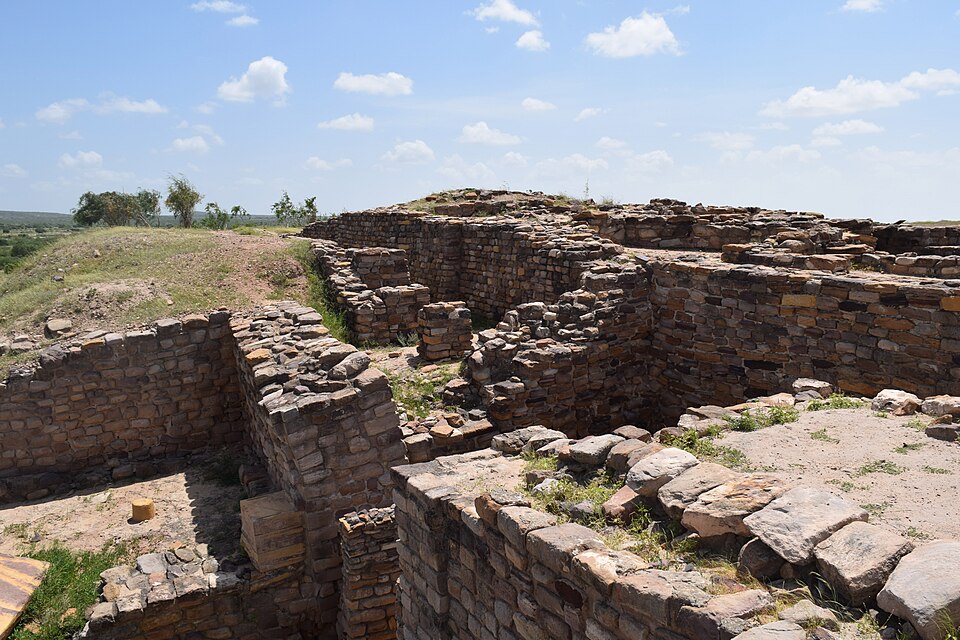
Regional variety. Not every site follows the same plan. Dholavira in Kutch made extensive use of stone, Lothal was a walled rectangle with no division into citadel and lower town, and Kalibangan used mud bricks. The older idea of Wheeler and Piggott that all towns shared one 'unity of conception' is now rejected: uniform ideas were adapted to local materials and needs.
Farming and herding: feeding the cities
The base of prosperity. Harappan prosperity rested on agriculture, crafts and trade, and farming came first. The fertile Indus alluvium, renewed by floods, produced a surplus. That surplus fed craftsmen, traders and administrators who did not grow their own food.
The plough. Few farm tools survive, but the ploughed field at Kalibangan, from the early phase, proves plough cultivation. A terracotta model of a plough comes from Banawali in Haryana. Oxen pulled ploughs and carts.
Two seasons. The Harappans grew a wide range of crops, which may have been their real innovation. Winter crops included wheat, barley, gram, lentil, linseed and mustard, and summer crops included millets, sesamum and cotton. Peas and dates were also known.
Rice and cotton. Rice husks have been found at Lothal and Rangpur in Gujarat, and rice also at Harappa and other sites. Rice may have reached the Harappans through contact with farming cultures to their east. Cotton was important; a piece of woven cloth was found at Mohenjodaro.
Water. Irrigation was small-scale, from wells and channels drawing river water, and lift irrigation was practised. A canal has been reported near Shortughai in Afghanistan. There is no evidence of large state-run canals.
Animals. Cattle, buffalo, sheep and goat were kept: oxen for traction, cows for milk, sheep for wool and meat, and goats for meat. Herders moving with their flocks were an important part of the economy, and manure helped the fields. Fish and wild game were also eaten.
Why herding mattered. In a region where drought or blight could wipe out a harvest, pastoralism was a useful safety net. Mobile herders also linked villages and towns. Unfortunately, their camps leave few traces, so we know little about them.
Villages and cities. Villages lay in very different ecological zones, so they varied as much as towns. Granaries in the cities suggest that grain was collected from villages and stored. Whether as tax, tribute or exchange, the countryside fed the city.
Crafts: specialists and standard goods
What specialisation means. In villages, people farmed and practised crafts in spare time. With cities came craftspeople who stopped growing their own food and exchanged their products for food and raw materials. Rich and powerful groups created demand for fine goods and supplied distant raw materials.
Shell bangles. Shell was cut into bangles, ladles and cups using bronze saws. Heaps of waste and half-finished pieces at small sites like Nageswar (Gujarat) and Balakot (Makran coast) show production far beyond local needs. These bangles reached sites from Harappa to Shortughai, and even Mesopotamia.
Chert blades. Long chert blades were mass-produced at factory sites in the Rohri hills of Sind. They have been found at sites as far apart as Balakot and Shortughai. This points to a trans-regional economy that made everyday goods at central places.
Beads. Bead-making was a major craft using carnelian, agate, jasper, lapis lazuli, steatite, gold and silver. Long barrel-shaped carnelian beads, up to 12 cm long, were probably drilled with bronze drills, and etched carnelian beads had designs on their surface. Chanhudaro and Lothal had bead-makers' workshops, and Mohenjodaro had workshops for carnelian and lapis.
Chanhudaro, a craft town. At Chanhudaro in Sind, archaeologists found evidence for making stone weights, seals, shell bangles, steatite and carnelian beads. Weights made at Chanhudaro were used at Mohenjodaro. Such specialised towns fed the big cities.
Metals. The Harappans used copper, bronze, gold and silver, but not iron for tools. Copper-bronze tools included axes, chisels, saws, knives, fish-hooks, razors and spearheads, and many of their weapons were simple. Silver vessels, gold beads, wire and pendants were also made.
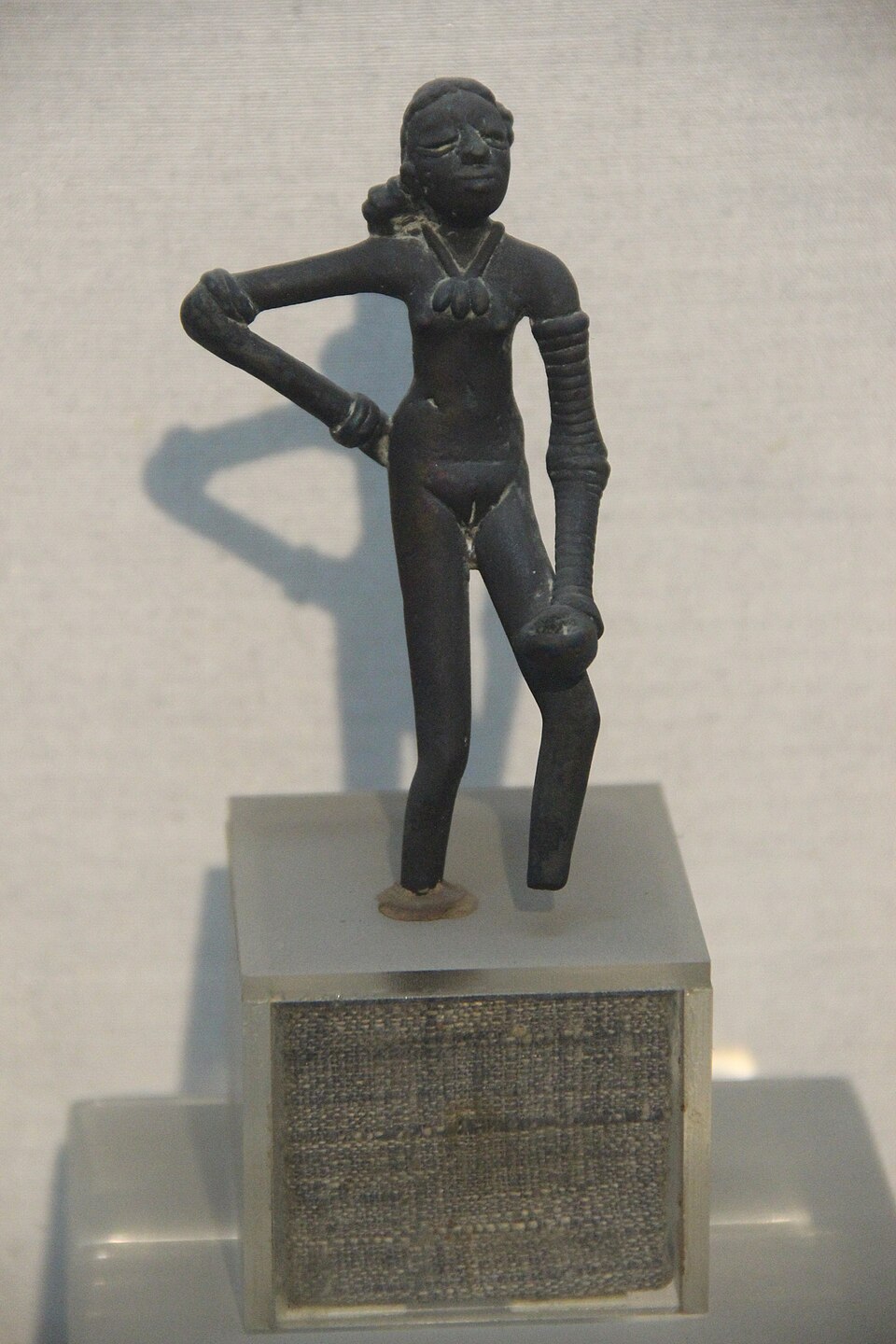
The dancing girl. The most famous bronze is the 'dancing girl' from Mohenjodaro, a slender figure with one arm on her hip and the other covered with bangles. It was made by the lost-wax method: a wax model is coated in clay, heated so the wax melts out, and the space filled with molten metal. This needed high skill.
Pottery and terracotta. Wheel-made red pottery carried black paintings of lines, pipal leaves, fish, birds and animals. Terracotta toy carts, animals and figurines were common. Seals of steatite were carved with animals and script, as discussed in the next chapter.
Goods for all. The range of products suggests that craftspeople made goods for ordinary people as well as the rich. Even small sites like Allahdino used copper widely. But the finest items, of gold, lapis and long carnelian, were for a small elite.
Trade: from Khetri to Mesopotamia
Why trade was needed. Bronze needs copper and tin, which are found only in a few places. Cities also used a wide range of stones, shells and metals not found locally. So the Harappans built wide networks of exchange inside and outside their region.
Sources inside the subcontinent. Copper came mainly from Khetri in Rajasthan, where Chalcolithic communities supplied it. Gold may have come from Kolar in Karnataka or Himalayan river sands, and silver perhaps from Rajasthan's Zawar mines or from Mesopotamia. Agate, chalcedony and carnelian came from Gujarat, shell from the coasts, and timber like deodar floated down the Ravi from the Himalayas.
Planted outposts. The Harappans did not just buy from others; they founded settlements at key sources. Shortughai, near the lapis lazuli mines of Badakshan in Afghanistan, was set up to obtain lapis and pan gold. Sutkagendor, on the bare Makran coast, served as an anchorage for ships sailing to the Persian Gulf.
New routes. Before the cities, Mehrgarh, Mundigak and Shahr-i-Sokhta were in contact with one another through the Bolan-Kandahar route. In the urban phase this contact stopped, and the Harappan elite set up its own channels. Harappa itself lay where routes from the upper Indus, the north-west highlands and Rajasthan met.
Mesopotamia. Mesopotamian texts mention trade with Dilmun, Magan and Meluhha. Scholars identify Meluhha with the Harappan region, Magan with the Makran coast and Dilmun with Bahrain. Mesopotamian kings boasted that ships from Meluhha brought ivory, gold, carnelian and lapis lazuli.
Evidence on both sides. About two dozen Harappan seals have been found at Mesopotamian cities like Ur and Susa, along with etched carnelian beads, shell and dice. A seal of Persian Gulf type was found at Lothal. Trade passed largely through Oman and Bahrain.
What came back? Mesopotamia probably sent garments, wool, perfumes, leather goods and silver. Apart from silver, these were perishable, which is why they rarely survive at Harappan sites. The trade was therefore one-sided only in the evidence, not necessarily in reality.
Who ran it? Long-distance exchange may not have been 'trade' in the modern sense alone. Some of it may have been expeditions to obtain raw materials, or gifts and embassies between rulers. Such contacts may even have made people bilingual.
A state behind the economy? The same weights, seals and script across the whole region, craft towns making goods for distant cities, and the founding of outposts all suggest an authority organising production and exchange. The Harappans had no coins and probably no markets as we know them. Control of labour, for drains, bricks, storage and expeditions, may have mattered more than taxes.
Quick revision
- 1826 Charles Masson saw Harappa; 1920-22 excavations: Harappa (Ravi) by Daya Ram Sahni, Mohenjodaro (Indus) by R.D. Banerji; John Marshall announced it.
- Early Harappan roughly 3300-2600 BC (Amri-Nal, Kot Diji, Sothi-Siswal, Damb Sadaat); Mature 2600-1900 BC.
- Extremes: Sutkagendor (west), Alamgirpur (east), Manda (north), Daimabad (south); outlier Shortughai (Afghanistan).
- Sites: Mohenjodaro, Chanhudaro (Sind); Harappa (Punjab); Kalibangan (Rajasthan); Banawali, Rakhigarhi (Haryana); Lothal, Dholavira (Gujarat).
- Hallmarks: red pottery with black paint, square steatite seals, cubical chert weights, 4:2:1 bricks.
- City debate: Allchins/Kenoyer (incipient urbanism), Possehl (short transition), Ratnagar (break). Hakra: 37 → 3 old sites, 80 new.
- Mohenjodaro population about 35,000; most sites 6 ha or less; Ganweriwala as big as Harappa.
- Citadel west, lower town east; grid streets; doors on lanes; covered drains with manholes.
- Great Bath: steps north and south, bitumen floor. Granaries (debated). Lothal dockyard.
- Plough: Kalibangan ploughed field, Banawali plough model. Rice at Lothal, Rangpur; cotton cloth at Mohenjodaro; canal near Shortughai.
- Crafts: shell at Nageswar, Balakot; chert from Rohri; weights, seals, beads at Chanhudaro; dancing girl (lost-wax). No iron tools.
- Sources: copper Khetri; lapis Badakshan; gold Kolar/Himalayas; silver Zawar/Mesopotamia.
- Meluhha = Harappan region; Magan = Makran; Dilmun = Bahrain. Seals at Ur, Susa; Gulf seal at Lothal. No coins.