

UKPSC PCS (Upper) · Module 57 · Mains depth · 20 min
Who runs global environmental action: UNEP, IPCC, IPBES, IUCN, the funds and India-led alliances
What UKPSC PCS (Upper) asks from this chapter
Syllabus lines this chapter covers:
- Prelims Paper I: General Studies · Ecology and environment, agriculture and crops, natural resources, renewable and non-renewable energy, biodiversity, pollution, global warming and climate change, remote sensing and GIS, weather forecasting.
UKPSC PCS (Upper) has asked 1 question from this chapter (2025); 4 from its whole module.
Read at full depth: basics, the standard layer and the Mains analysis.
Start from zero: the world's environment offices
A treaty is a promise on paper. To turn it into action, someone has to collect the science, keep the countries talking, raise money and help poor countries do the work. That is the job of the global environmental bodies.
It helps to sort them into three kinds. Some are science bodies, which tell governments what is happening and why, such as the IPCC for climate and IPBES for nature. Some are policy bodies, such as UNEP and IUCN, which set agendas and run programmes. Others are money bodies, such as the GEF and the Green Climate Fund, which pay for projects.
Since 2015 a fourth group has grown: alliances led or co-led by India, such as the International Solar Alliance. They show India moving from a country that receives rules to one that helps make them.
This chapter explains what each body does, why it was set up, and where and when it began. Exams ask most about their founders, headquarters, functions and India's role, so those are marked clearly.
UNEP: the UN's voice for the environment
What and when. The United Nations Environment Programme (UNEP) was created by the UN General Assembly on 15 December 1972, as the main follow-up to the Stockholm Conference. It is headquartered in Nairobi, Kenya. The story of its birth is told in the chapter on Stockholm, Rio and the SDGs.
What it does. UNEP is a programme, not a specialised agency, so it has no power to enforce rules. Its role is to watch the state of the environment, bring countries together and help them build treaties and policies. The 1985 Vienna Convention for the protection of the ozone layer, for example, was agreed under its auspices.
How it changed in 2012. At first only some countries sat on UNEP's governing council. Rio+20 in 2012 decided to give UNEP universal membership. Its governing body is now the UN Environment Assembly (UNEA), where all UN member states meet, and it was UNEA that launched the plastics treaty talks in 2022.
India and UNEP. In 2018, UNEP named Prime Minister Narendra Modi and President Emmanuel Macron Champions of the Earth in the Policy Leadership category, recognising, among other steps, their work on the International Solar Alliance.
The science bodies: IPCC and IPBES
Why governments needed a science panel. In the 1980s, scientists warned that the Earth was warming, but governments heard many voices and did not know whom to trust. They needed a single body that would weigh all the evidence fairly and give answers that every government could accept. The answer was the Intergovernmental Panel on Climate Change (IPCC).
What and when. The IPCC was set up in 1988 by UNEP and the World Meteorological Organization (WMO). Its secretariat is in Geneva. It does not carry out its own research; instead, thousands of volunteer scientists assess the published science and write reports.
How it works. The work is split among three Working Groups. Working Group I covers the physical science of climate change. Working Group II covers impacts, adaptation and vulnerability, and Working Group III covers mitigation. A Task Force on National Greenhouse Gas Inventories helps countries count their emissions.
Why its reports carry weight. Each report has a Summary for Policymakers that governments approve line by line, so no country can later say it rejects the findings. That is why IPCC numbers, such as the 1.5 °C pathways, shape climate negotiations. The IPCC shared the 2007 Nobel Peace Prize with Al Gore, and its seventh assessment cycle began in July 2023.
IPBES: the IPCC for nature. Biodiversity had no equivalent panel until IPBES (Intergovernmental Science-Policy Platform on Biodiversity and Ecosystem Services) was established in April 2012. Its secretariat is in Bonn, Germany. Its 2019 Global Assessment found that around 1 million animal and plant species are threatened with extinction, a figure that shaped the 2030 biodiversity targets.
IUCN: governments and NGOs in one union
What makes IUCN unusual. Most international bodies have only governments as members. The International Union for Conservation of Nature (IUCN) brings together governments and civil society organisations in one union. It has more than 1,600 member organisations.
When and where. IUCN was founded on 5 October 1948 at Fontainebleau, France, making it older than the UN's environment work by more than two decades. Its headquarters is in Gland, Switzerland. Its members meet every few years at the World Conservation Congress, which met in Abu Dhabi in October 2025.
What it does. IUCN is best known for the Red List of Threatened Species, which sorts species by their risk of extinction, explained in the chapter on threats to biodiversity.
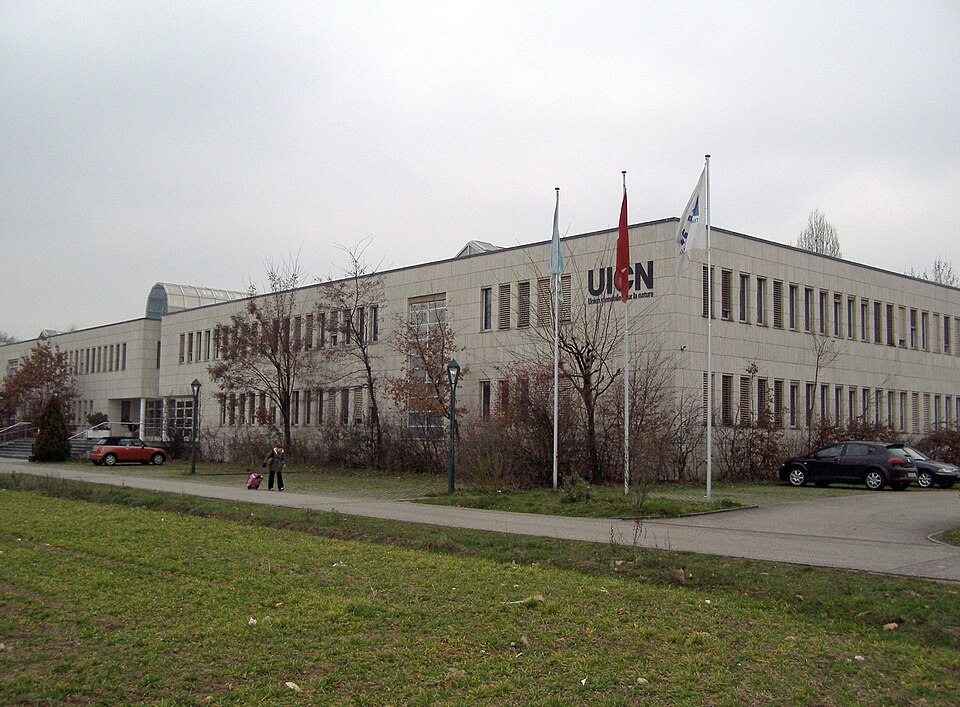
Why it matters. IUCN has no power to make laws, but its science is used in treaties and in national lists. When a species moves to a higher threat category on the Red List, it often triggers stronger protection in law and in CITES listings.
Paying for the planet: GEF and the Green Climate Fund
Why money bodies are needed. Developing countries agreed to environmental treaties on one condition: that rich countries would help pay the extra cost of greener choices. Without money, a poor country will choose the cheaper, dirtier option. So the treaties needed funds to channel finance.
The Global Environment Facility (GEF). The GEF began as a pilot agreed in 1990 by 27 countries, which ran from 1991, even before the Rio Summit. The World Bank acted as trustee and administrator. It was restructured in 1994 into a permanent body open to all countries.
The GEF is special because it serves several conventions at once. It funds projects under the biodiversity, climate, desertification, POPs and mercury conventions. Its money is raised in rounds called replenishments, in which donor countries pledge funds for the next few years.
The Green Climate Fund (GCF). The GCF was set up under the climate convention and is headquartered in Songdo, Republic of Korea, as explained in the chapter on climate summits. It is an operating entity of the financial mechanism of the UNFCCC and plays a key role in implementing the Paris Agreement. It funds both mitigation and adaptation in developing countries.
The bigger money question. These funds are small compared with the need. The new climate finance goal and the loss and damage fund, discussed in the chapter on mitigation and adaptation, show that the fight over who pays is far from over.
India-led alliances: from rule-taker to rule-maker
Why India started building alliances. For decades India's role in environmental talks was mainly defensive: it insisted on equity and on the duty of rich countries. Since 2015 India has also offered solutions of its own, built as international alliances. They let India lead on issues where it has experience and where developing countries share a need.
International Solar Alliance (ISA). The ISA was launched by India and France at COP21 in Paris in 2015 to promote solar energy in countries rich in sunshine. It became a treaty-based international organisation on 6 December 2017. At its seventh Assembly in November 2024, it had 103 member countries and 17 more signatories.
Coalition for Disaster Resilient Infrastructure (CDRI). Every flood or cyclone destroys roads, power lines and hospitals that took years to build. CDRI is a partnership of countries and organisations to make infrastructure resilient to disasters and climate change. It is headquartered in India, and the Union Cabinet approved its headquarters agreement.
International Big Cat Alliance (IBCA). India launched IBCA in 2023, at the 50-year mark of Project Tiger, to protect the world's big cats such as tigers, lions, leopards and cheetahs. It has since become a treaty-based body. It builds on India's own experience described in the chapter on species programmes.
Global Biofuel Alliance and LeadIT. The Global Biofuel Alliance was launched at the G20 Summit in New Delhi in September 2023 to promote sustainable biofuels. LeadIT (Leadership Group for Industry Transition) is an India-Sweden initiative that helps heavy industries such as steel and cement cut emissions; the two countries launched its second phase at COP28.
Mains lens: three live debates on global environmental bodies
1. Does the world need a stronger environment authority? UNEP was created in 1972 as a programme, not as a specialised agency like the WHO. It can gather data, convene countries and help write treaties, but it cannot enforce them, and its budget depends largely on voluntary money. Since 2012 every UN member sits in its assembly, which made it more representative but not more powerful.
One side argues for upgrading it into a full World Environment Organisation with its own rules and dispute settlement. The other side warns that countries guard their sovereignty, and that a new body would mean another layer of meetings without solving the money problem. A balanced answer says that UNEP's strength lies in science, coordination and convening, and that it needs steady funding more than a new title.
2. Can science bodies stay neutral? The IPCC does not do its own research. It assesses published studies and its summaries are approved line by line by governments. This gives its reports great authority, because every government has signed off on them.
Critics say that the same approval process can water down strong findings, and that most authors and studies still come from rich countries. Supporters say that the line-by-line approval is exactly what makes governments accept the science. In Mains, show that the IPCC turned climate change from a scientific debate into an agreed fact, and that IPBES was created in 2012 to do the same for biodiversity, while noting the need for more voices from the Global South.
3. Is India now a rule-maker? For a long time India's environmental diplomacy was defensive: it argued for equity and resisted targets that could slow its growth. Since 2015 India has also started bodies of its own, such as the International Solar Alliance with France, a coalition for disaster-resilient infrastructure, a big cat alliance and a biofuel alliance. This marks a shift from only reacting to rules towards shaping them.
Supporters see this as leadership that also serves India's energy and diplomatic interests. Critics ask whether these alliances deliver projects on the ground or remain mostly diplomatic platforms. A balanced answer praises the shift and judges each alliance by its results, finance and membership growth, such as the solar alliance's 103 members by 2024.
Why it matters: Treaties need institutions to collect data, find money and keep countries talking. Mains questions test whether you know what each body can and cannot do, so always state its limits along with its role.
Mains lens: two kinds of questions and how to answer them
Type 1: "Compare the roles" (institutions). Example: "Compare the roles of the Global Environment Facility and the Green Climate Fund. Why does environmental finance remain inadequate?"
- Intro: Note that both are funds that help developing countries meet their treaty commitments.
- Body, the GEF: Explain that it began as a pilot in 1991 with the World Bank as trustee, was restructured in 1994 and funds projects for several conventions.
- Body, the GCF: Explain that it is an operating entity of the UNFCCC's financial mechanism, focused on climate and the Paris Agreement.
- Body, why money falls short: Point out that contributions are voluntary, that needs keep rising with every disaster and that much finance comes as loans rather than grants.
- Conclusion: Conclude that funds exist, but that predictable, grant-based money on a larger scale is what makes treaties fair.
Type 2: "Discuss with examples" (India's role). Example: "India's environmental diplomacy has moved from defence to leadership. Discuss with examples."
- Intro: Explain that India long argued for equity and differentiated responsibilities in climate talks.
- Body, the defence years: Show how India insisted that rich countries act first and provide finance and technology.
- Body, the leadership turn: Give the International Solar Alliance, launched with France at COP21 in 2015 and treaty-based from 2017, the disaster-resilient infrastructure coalition based in India, the big cat alliance of 2023 and the biofuel alliance launched at the 2023 G20 summit in New Delhi.
- Body, a balanced view: Note that equity remains India's core position, so leadership has been added to defence, not swapped for it.
- Conclusion: Conclude that India now helps write the agenda, and that the test ahead is delivery on the ground.
Linking across papers. This chapter feeds GS-II (international institutions and India's foreign policy) and GS-III (climate finance, energy and conservation). India-led alliances are also useful examples in Essay answers on global leadership.
Mains practice: six questions, six angles
These are practice questions we have written, not past papers. Past questions for each exam are in this module's PYQ panel.
| Angle | Question | How to approach |
|---|---|---|
| Institutions | Is UNEP strong enough to be the world's environmental authority? Should it become a specialised agency? | Explain its 1972 origin, programme status and the 2012 universal membership. Weigh its convening power against weak enforcement and funding. |
| Science | How has the IPCC shaped global climate policy? Discuss its strengths and criticisms. | Cover its assessment model, three Working Groups and the line-by-line approved summaries. Discuss slowness and the gap between science and action. |
| Finance | Compare the roles of the GEF and the Green Climate Fund. Why does environmental finance remain inadequate? | Contrast multi-convention GEF with climate-only GCF. Then discuss pledges versus delivery, access problems and the new finance goal. |
| India's role | "India's environmental diplomacy has moved from defence to leadership." Discuss with examples. | Contrast the equity-first stance with the ISA, CDRI, IBCA, the biofuel alliance and LeadIT. End with what still limits India's influence. |
| Energy | Evaluate the International Solar Alliance as a tool of South-South cooperation. | Give its origin with France at COP21, treaty status from 2017 and membership. Weigh its promise against finance and manufacturing limits. |
| Nature | Why was IPBES needed when the IPCC already existed? How does it link science to biodiversity policy? | Explain the gap in nature science, its 2012 creation and the 2019 finding on 1 million species. Link it to the 2030 biodiversity targets. |
How to use this table: each answer should first explain the what, then give the why from this chapter, and end with a way forward.
Quick revision
- UNEP: created 15 Dec 1972, HQ Nairobi; a programme; universal membership after Rio+20; governing body UNEA; Champions of the Earth 2018: Modi and Macron (Policy Leadership).
- IPCC: 1988, by UNEP + WMO; no own research; WG I science, WG II impacts and adaptation, WG III mitigation, TFI; secretariat Geneva; Nobel 2007 with Al Gore; AR7 cycle from July 2023.
- IPBES: April 2012, Bonn; 2019: about 1 million species threatened.
- IUCN: 5 Oct 1948, Fontainebleau; HQ Gland; 1,600+ members (governments + NGOs); Red List; Congress Abu Dhabi, Oct 2025.
- GEF: pilot 1990–91 (before Rio), World Bank trustee, restructured 1994; serves several conventions.
- GCF: UNFCCC financial mechanism; key for Paris; HQ Songdo.
- ISA: India + France, COP21 (2015); treaty-based 6 Dec 2017; 103 members + 17 signatories (Nov 2024).
- CDRI (HQ India), IBCA (2023, Project Tiger at 50, treaty-based), Global Biofuel Alliance (G20 New Delhi, Sept 2023), LeadIT (India + Sweden, phase II at COP28).
UKPSC PCS (Upper) questions from this chapter
Which of the following statements is/are correct about Global Environment Facility (GEF) ? 1. Pilot GEF was agreed to setup in 1990. 2. UNDP, UNEP and the World Bank were the initial partners in implementing GEF projects. 3. India is both donor and a recipient of GEF.
- (a) Only 2
- (b) 2 and 3
- (c) 1 and 2
- (d) All of the above statements
Show answer
(d) All of the above statements · our answer; official key awaited