

UKPSC PCS (Upper) · Module 32 · Mains depth · 19 min
Making of the Constitution
What UKPSC PCS (Upper) asks from this chapter
Syllabus lines this chapter covers:
- Prelims Paper I: General Studies · Indian Polity (national): parliamentary system, coalition politics, regionalism, casteism, communalism, terrorism, welfare of SC/ST/OBC and minorities, gender politics, electoral reforms, governance, national integration, LPG reforms, civil society, Lokpal and Lokayukta.
- Prelims Paper I: General Studies · Constitution of India: constitutional development, Constituent Assembly, Preamble, basic features, Fundamental Rights and Duties, DPSP, amendments, federal and parliamentary system, parliamentary committees, Election Commission, CAG, Supreme Court and High Courts.
- Prelims Paper I: General Studies · Current events of State, National and International importance, plus general knowledge: nations, space events, books and authors, scientists, awards, defence, national symbols, protocol, dances, music, languages, world heritage, important days and sports.
- Mains Paper 4: General Studies II (governance, constitution, polity, social justice, IR) · Indian Constitution- historical underpinnings, evolution, features, amendments, significant provisions and basic structure.
- Mains Paper 4: General Studies II (governance, constitution, polity, social justice, IR) · Comparison of the Indian constitutional scheme with that of other countries.
2 UKPSC PCS (Upper) questions in our bank come from this module (The Constitution).
Read at full depth: basics, the standard layer and the Mains analysis.
Start from zero: how does a big group write rules together?
Suppose your whole class of forty wants to plan a picnic. If all forty try to write the plan at once, nothing gets done. So what do good classes do?
- They agree on what they want: "a fun day, safe for everyone, within budget." That is the goal.
- They form small teams: one for food, one for transport, one for games. Each team studies its part.
- One small group writes the full plan from all the teams' ideas.
- The whole class reads the plan, suggests changes, argues, and finally votes to accept it.
India did almost exactly this in 1946–49, only the "picnic" was a whole new country and the "class" was the Constituent Assembly: a group of a few hundred people from every region, religion and community.
- The goal was set by the Objectives Resolution.
- The small teams were the Assembly's committees.
- The writing team was the Drafting Committee, led by Dr B. R. Ambedkar.
- The whole class debating and voting was the Assembly itself, sitting for nearly three years.
Keep this picture in mind. Every fact in this chapter fits one of these four steps.
The Assembly is born
By 1946 it was clear that British rule was ending. India needed its own rulebook, written by Indians. Under a plan drawn up by the Cabinet Mission (1946), a Constituent Assembly was set up. It was formed on 6 December 1946 and first met on 9 December 1946 in New Delhi.
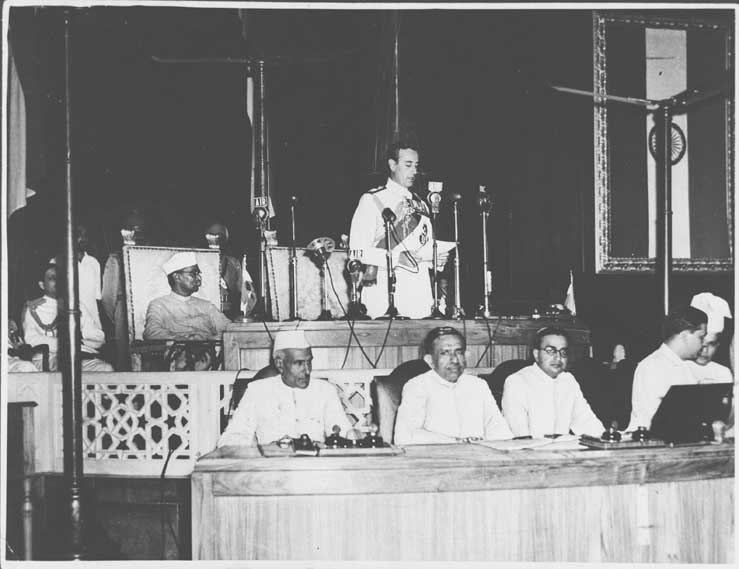
That first meeting was attended by 205 members, including 9 women. Because the Assembly had no President yet, the senior-most member, Dr Sachchidananda Sinha, chaired it.
Two days later, on 11 December 1946, the Assembly elected Dr Rajendra Prasad as its President. He led the Assembly through the whole journey and later became the first President of India.
Who sat in the Assembly, and how they got there
How members were chosen. The Assembly was not elected directly by all adult Indians. The members for the British provinces were chosen by indirect election: the members of the Provincial Legislative Assemblies (themselves elected in 1946 on a limited franchise) voted for them. The princely States were represented too. Think of a school council chosen by class monitors instead of by every student.
The seat plan. Seats were planned as:
- 292 for the provinces,
- 93 for the Indian (princely) States,
- 4 for the Chief Commissioners' Provinces,
- 389 in all.
After Partition. In 1947 the country was divided, and members from areas that went to Pakistan left. The Constitution we have was finally drafted by 299 delegates from different castes, regions, religions and genders.
The largest groups. As on 31 December 1947, the United Provinces (today's Uttar Pradesh) had 55 members, Madras had 49 and Bihar had 36. These were among the largest provincial groups.
Setting the goal: the Objectives Resolution
Before writing a single Article, the Assembly agreed on what the Constitution was for. On 13 December 1946, only four days after the first sitting, Jawaharlal Nehru moved the Objectives Resolution. Think of it as the mission statement a company agrees on before it writes its rules.
The Resolution gave the philosophy and guiding principles for framing the Constitution. Its main ideas were: India would be an independent sovereign republic; all power would come from the people; and every citizen would be guaranteed justice, liberty and equality, with safeguards for minorities and backward groups.
Later, the Resolution took the form of the Preamble. That is why the Preamble you studied reads like a short version of it: "We, the people", "sovereign", "justice, liberty, equality".
The small teams: committees
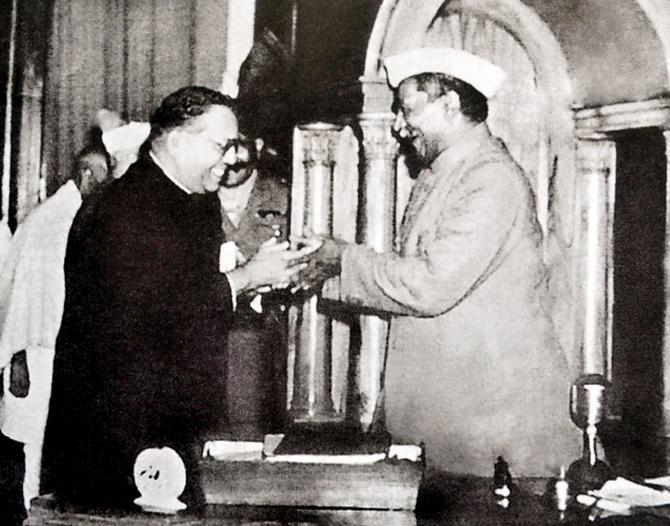
A few hundred people cannot study every subject together, so the Assembly split the work. It had eight major committees on different subjects, plus several smaller ones that ran the Assembly's own business. Here are committees and chairmen named on the Lok Sabha's page:
| Committee | Chairman |
|---|---|
| Rules of Procedure | Rajendra Prasad |
| Steering Committee | Rajendra Prasad |
| Finance and Staff | Rajendra Prasad |
| Ad hoc Committee on the National Flag | Rajendra Prasad |
| Credentials | Alladi Krishnaswami Ayyar |
| House Committee | B. Pattabhi Sitaramayya |
| Order of Business | K. M. Munshi |
| Functions of the Constituent Assembly | G. V. Mavalankar |
The most important committee was the Drafting Committee, set up on 29 August 1947 with Dr B. R. Ambedkar as chairman. Its job was to take the decisions and reports of all the other committees and turn them into one Draft Constitution, Article by Article. That is why Dr Ambedkar is often called the chief architect of the Constitution.
The whole class debates: from draft to final text
Once the draft was ready, the real argument began. A Constitution is not passed in one vote. The Assembly went through it in readings: first a general look at the whole draft, then a clause-by-clause debate (the second reading), and finally a vote on the settled text (the third reading).
The second reading ran from 15 November 1948 to 17 October 1949. During it, members proposed 7,653 amendments, and 2,473 of them were actually discussed in the Assembly. Those numbers show how seriously every word was argued over.
The time it took:
- 2 years, 11 months and 17 days in all;
- 11 sessions, with sittings on 165 days;
- 114 of those days went only to the Draft Constitution.
Learning from the world. The framers studied the constitutions of about 60 countries. They did not copy any one of them; they picked ideas that suited India and changed them to fit Indian needs. Which idea came from which country is listed in Salient features of the Constitution.
A flag before a Constitution
The Assembly did more than write the Constitution. Even before independence, at its meeting on 22 July 1947, it adopted the National Flag. On 15 August 1947, that flag became the official flag of the Dominion of India.
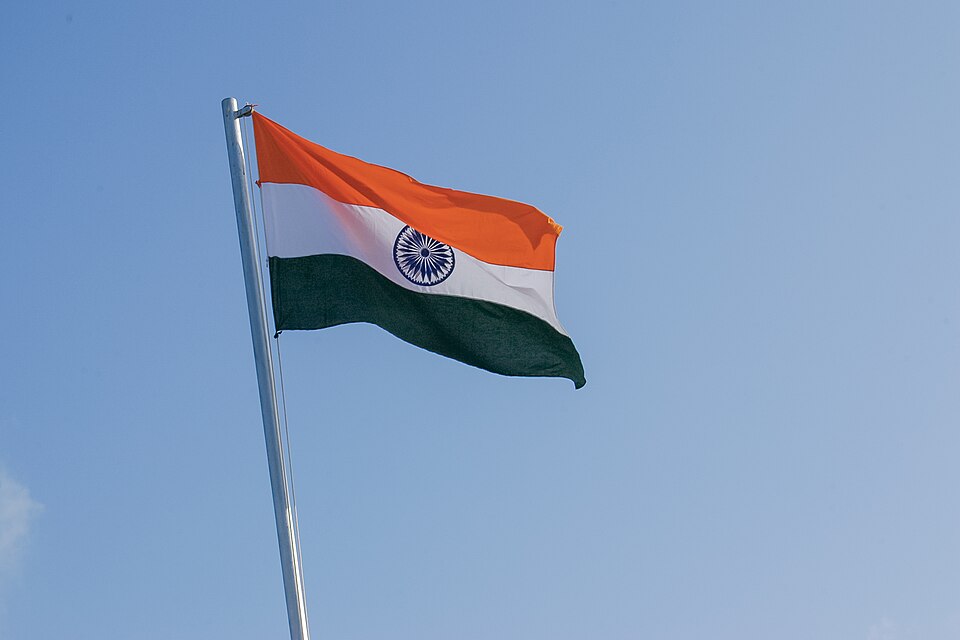
The flag is a tricolour of saffron, white and green, with the Ashoka Chakra, a 24-spoke wheel in navy blue, at the centre. The ad hoc Committee on the National Flag, chaired by Rajendra Prasad, handled this work.
Why does this matter for Polity? It shows that the Assembly was not only a drafting body; it was the place where the new nation made its first symbolic choices.
The finishing line: adopted, signed, in force
26 November 1949: adopted. At the end of the third reading, Dr Ambedkar moved the final motion: "the Constitution as settled by the Assembly be passed." It was carried, and the Constitution was adopted on 26 November 1949. Since 2015, this day is observed as Constitution Day.
Some Articles started at once. Under Article 394, a few provisions, such as those on citizenship and elections, came into force immediately on 26 November 1949, so that the country could prepare for the new system.
24 January 1950: signed. At the Assembly's last meeting, the members signed the Constitution.
26 January 1950: in force. The rest of the Constitution came into force, India became a Republic, and we celebrate this day as Republic Day. The date was chosen to honour 26 January 1930, when Purna Swaraj Day was observed.
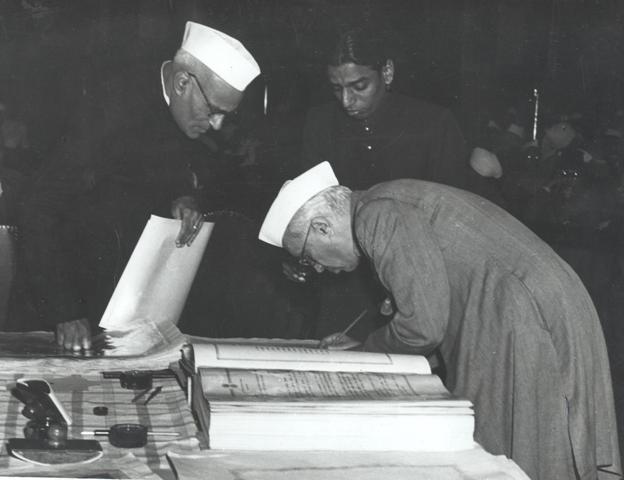
How big was it? The original Constitution had 395 Articles, 22 Parts and 8 Schedules. Amendments have added more since then; today there are 12 Schedules.
Memory trick: November is when the book was finished; January is when the country started living by it.
Why it was done this way, and what it changed
Knowing the dates is not enough. A good answer also explains why each step was taken and what difference it made. This table puts the main decisions side by side.
| Decision | Why it was needed | What it changed |
|---|---|---|
| An Assembly of Indians (1946) | Earlier laws like the 1935 Act were made in London; India wanted to write its own rules | The Constitution was made by Indians, not handed down by a foreign power |
| Indirect election through Provincial Assemblies | A fresh nationwide vote in 1946 was not practical; the Cabinet Mission scheme used existing bodies | Quick start, but a lasting debate about how representative the Assembly was |
| Objectives Resolution first (13 Dec 1946) | The Assembly needed an agreed goal before writing details | It became the base of the Preamble and guided every later debate |
| Work through committees | Hundreds of members could not draft every clause together | Experts drafted; the full House debated and decided |
| Long, open debate (7,653 amendments proposed) | A text for a diverse country had to hear many voices | Wider acceptance; many compromises were built into the text |
| Flag adopted before the Constitution (22 Jul 1947) | Independence on 15 Aug 1947 needed a national symbol at once | The new Dominion had its flag on day one |
| Some Articles in force on 26 Nov 1949 (Art 394) | Citizenship and elections had to be ready before the Republic began | A smooth handover on 26 January 1950 |
The big picture. Each choice traded speed against perfect representation. The framers chose to start quickly with the bodies they had, then made up for it with a long, open debate. That is why the Assembly's method is criticised, while its result is widely accepted.
Why it still matters today. The way a constitution is made shapes how far people trust it. Because the Indian Constitution was argued over openly, clause by clause, courts and citizens still read the Constituent Assembly Debates to understand what a provision was meant to do.
Mains lens: was an indirectly elected body legitimate?
A common question: "The Constituent Assembly was not a truly representative body." Critically examine.
The case against:
- Members for the provinces were chosen indirectly, by Provincial Legislative Assemblies elected on a limited franchise. Most adult Indians had no direct vote.
- The scheme was designed under the Cabinet Mission plan, by a colonial process.
- Representatives of the princely States were not chosen by the people of those States in the same way.
The case for:
- It included members from every region, religion, caste and gender: the 299 who finished the work came from very different backgrounds.
- The process was open and long: 11 sessions, 165 days, 114 days on the draft, 7,653 amendments proposed and 2,473 discussed. Many voices shaped the text.
- The ideals it set (Objectives Resolution, then the Preamble) placed power in "We, the people", and it gave universal adult suffrage from the very first election.
- The test of time: the Constitution has been accepted and worked through every general election since 1950.
Conclusion: the Assembly's method of selection was limited by its time, but its legitimacy came from how openly it deliberated, how widely it represented India's diversity, and how the people have accepted its work ever since.
Mains lens: "a borrowed Constitution"?
Critics have called the Constitution a "bag of borrowings" because many ideas came from other countries and a large part of the administrative detail came from the Government of India Act, 1935.
How to answer:
- Accept the fact: the framers did study the constitutions of about 60 countries and used the 1935 Act as a base for the machinery of government.
- Give Dr Ambedkar's reply: he said the charge of producing a blind copy rested on an inadequate study of the draft, and he made no apology for using the 1935 Act, because there was no point in inventing new machinery when a working one existed.
- Show the Indian design: borrowed parts were changed to fit India: for example, a federal system with a strong Centre, Fundamental Rights with reasonable restrictions, Directive Principles for a welfare state, and universal adult suffrage from day one.
- Conclude: borrowing tools is not the same as borrowing a purpose. The bricks came from many places, but the blueprint was Indian, set by the Objectives Resolution and the Preamble.
Mains practice: more questions, different angles
UPSC rarely asks the same question twice, but it keeps coming back to the same themes. Practise these with a 150-word answer each. The points give you a skeleton; fill it with facts from this chapter.
1. Analytical: "The Objectives Resolution was the soul of the Constitution." Explain.
- Explain what the Resolution said, its philosophy and guiding principles, and when it was moved: Nehru moved it on 13 December 1946.
- Show how its ideas later became the Preamble.
- Show how later debates in the Assembly kept returning to it.
- Conclude that the goal was fixed before the rules were written.
2. Process: Why did the Constituent Assembly take almost three years? Was the delay justified?
- Give the time taken: 2 years, 11 months and 17 days, spread over 11 sessions and 165 days of sittings.
- Explain that Partition, the princely States and the work of many committees slowed the process.
- Show that 7,653 amendments were proposed and 2,473 discussed, so the delay was the cost of wide consultation.
- Conclude that the process was slow, but it produced a durable text.
3. Comparative: How did the making of India's Constitution differ from the Government of India Act 1935?
- Point out that the 1935 Act was passed by the British Parliament, and Indians had no final say in it.
- Contrast this with 1946 to 1949, when an Assembly of Indians made the Constitution and debated it openly.
- Admit that the 1935 Act still supplied much of the administrative machinery.
- Conclude that some tools stayed the same, but the source of authority was new: "We, the people".
4. Current relevance: Why do courts still refer to the Constituent Assembly Debates?
- Explain that the debates show the purpose behind a provision.
- Show that they are useful when the text is unclear or a new situation arises.
- Note their limit: the Constitution is a living document, so its meaning can grow over time.
- Conclude that the debates guide interpretation, but they do not freeze it.
Quick revision
- The Assembly was formed on 6 December 1946 and first met on 9 December 1946, with 205 members including 9 women, under the chair of Sachchidananda Sinha. Rajendra Prasad was elected President on 11 December 1946, and Nehru moved the Objectives Resolution on 13 December 1946.
- The National Flag was adopted on 22 July 1947, and the Drafting Committee was set up on 29 August 1947 with Ambedkar as chairman.
- The second reading ran from 15 November 1948 to 17 October 1949; in it 7,653 amendments were proposed and 2,473 were discussed.
- The Constitution was adopted on 26 November 1949 (marked as Constitution Day since 2015), signed on 24 January 1950 and brought into force on 26 January 1950 (Republic Day).
- 389 seats were planned (292 + 93 + 4), but only 299 members remained after Partition. On 31 December 1947 the largest groups were the United Provinces (55), Madras (49) and Bihar (36).
- The work took 2 years, 11 months and 17 days, with 11 sessions and 165 days of sittings, 114 of them on the draft; about 60 constitutions were studied.
- The original Constitution had 395 Articles, 22 Parts and 8 Schedules; today it has 12 Schedules.