

UKPSC RO / ARO · Module 67 · standard depth · 12 min
Gateway temples: Pandyas, Vijayanagara and the Nayakas
What UKPSC RO / ARO asks from this chapter
Syllabus lines this chapter covers:
- Mains Paper 1: General Studies (objective, 200 questions) · History and culture of India and Uttarakhand
UKPSC RO / ARO questions from this module are being sorted into our bank.
Cut to standard depth for UKPSC RO / ARO. 6 deeper paragraphs are in the full chapter.
Start from zero: when the gate became taller than the god's house
Walk into a big south Indian temple town like Madurai or Srirangam. The first thing you see, from kilometres away, is not the tower over the god. It is a huge, colourful gateway tower, the gopuram.
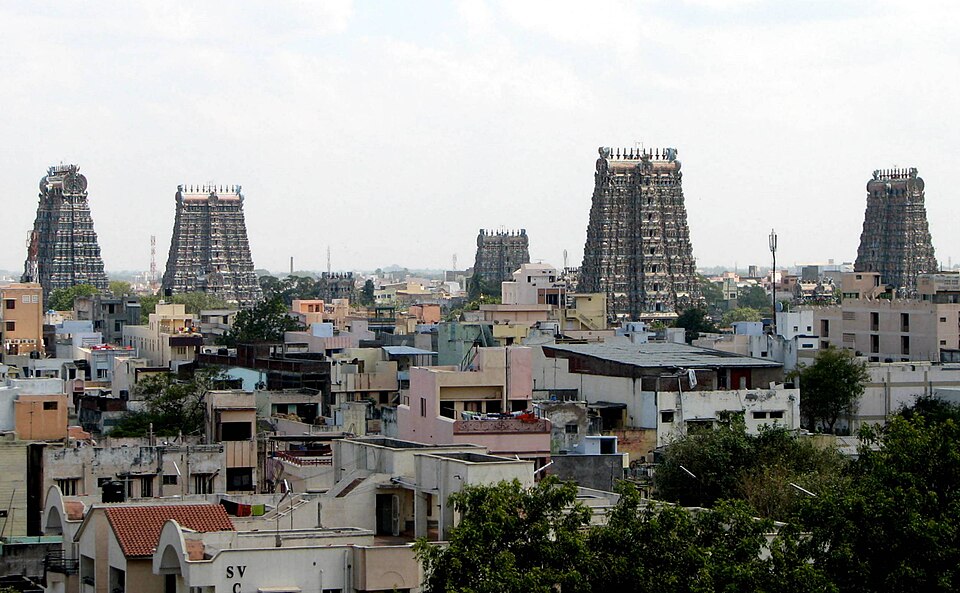
Now remember Thanjavur from the Chola chapter. There, the vimana over the sanctum was the tallest thing in sight. Somewhere between the 12th and the 16th century, the balance flipped: the gateways grew and the sanctum tower shrank by comparison.
This chapter tells the story of that flip. It begins with the Pandyas of Madurai, moves to the Vijayanagara empire at Hampi, and ends with the Nayakas and their temple cities. Each new ruler added walls, gates and halls around old temples, so the temple grew outward like rings in a tree.
Keep one idea in mind: in this age, the temple became a city in itself, with streets, markets, halls and festivals inside its walls.
The Pandyas: rock temples in the deep south
Learning from the Pallavas. The Pandyas ruled the far south of Tamil Nadu, around Madurai. From the end of the 7th century, inspired by the Pallavas, they began cutting rock temples. Pandya caves are found at many sites, including Tirupparankunram, Anamalai, Kudumiyamalai and Sittannavasal.
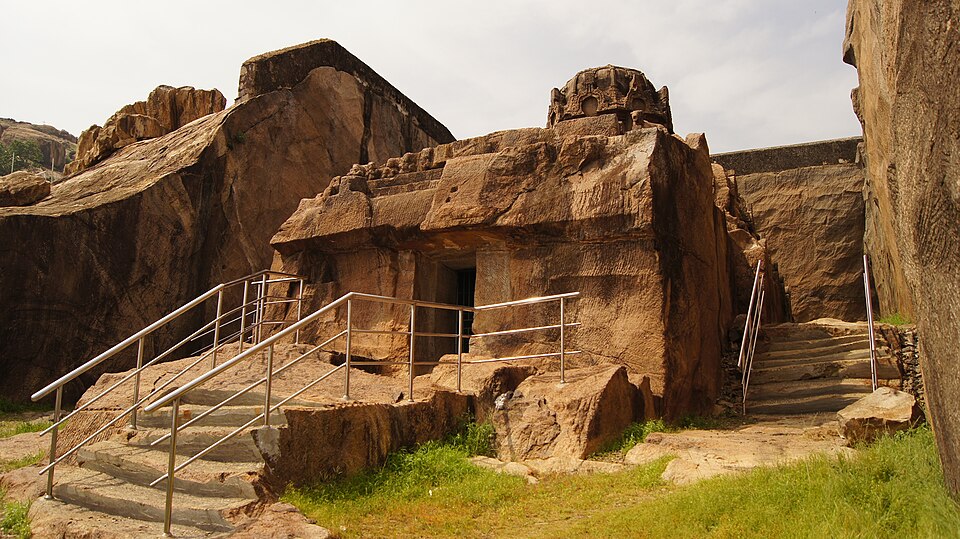
Their own touches. Pandya caves look like Pallava ones, with a sanctum and a pillared hall in front. But there are differences. The deity is carved in the sanctum itself, the capitals are cushion-shaped, and the brackets are plain, where Pallava ones are ornate. Some have a rock-cut linga and Nandi, an idea taken from the Chalukyas.
Kalugumalai. The most famous Pandya monument is the Vettuvan Koil at Kalugumalai (8th century). It is a monolithic temple cut into a hill, like a small cousin of the Kailasa at Ellora. Because it was left unfinished, it proves that carvers worked from the top downwards: the roof is complete, but the base is still rough rock.
Why it matters. Kalugumalai is a perfect picture question: it shows the method of monolithic carving. It also links to the rock-cut chapter, where you met the same top-down method at Ellora.
The gateway age begins
Walls and gates. From the 12th century, south Indian temples changed their focus. They were fortified with up to three concentric square walls, one inside another. Each wall had gates on all four sides.
From watch-tower to gopuram. The gate-houses on these walls began as watch-towers. Over time, they grew into gopurams, shaped like an oblong pyramid with its broad side parallel to the wall. The outer gopurams became taller than the central shikhara over the god.
A new name. Historians often call this the Pandyan style, after the Pandya kings who ruled Madurai in this period. Its most famous example is the temple at Madurai. But the idea spread across the south and was carried further by Vijayanagara and the Nayakas.
Why gateways? There are three good reasons. First, rich temples needed protection, and walls with gates provided it. Second, a new king could add a new outer wall and gopuram cheaply and quickly, instead of rebuilding an old, sacred sanctum. Third, a tall gopuram announced the temple to the whole town and to pilgrims arriving from far away.
Why it matters. This is a common Mains theme: "Why did gopurams overshadow vimanas?" Give the three reasons: defence, royal patronage that added rather than rebuilt, and visibility.
Vijayanagara: a city of granite
The empire. The Vijayanagara empire was founded around 1336, with its capital at Hampi on the Tungabhadra river in Karnataka. It reached its peak under Krishnadeva Raya (1509-1530). After its defeat at the Battle of Talikota in 1565, the city was pillaged for six months and abandoned.
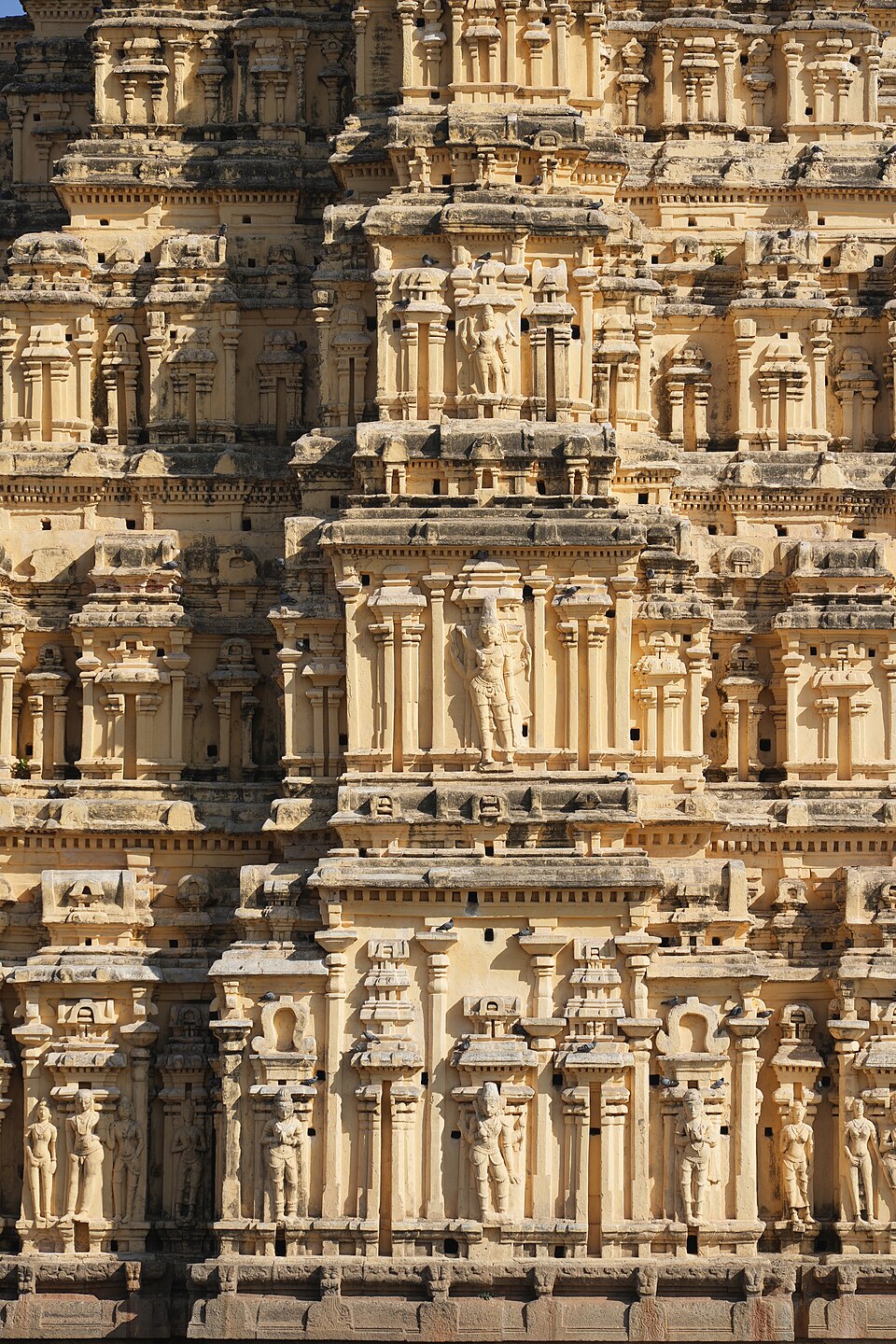
A city that survives. Hampi is the only pre-modern Hindu capital with extensive remains above ground. Its walled city covered about 16 sq km, with waterworks, the elephant stables and the Lotus Mahal. The builders used hard granite, burnt brick and lime mortar, mostly in post-and-lintel construction.
The temple plan. Vijayanagara temples have concentric rectangular prakaras, with a gopuram in the middle of each side. Their tall gateways, called raya-gopurams, rise 7 to 11 storeys. UNESCO notes that the raya gopura was first introduced in temples attributed to Krishnadeva Raya.
Halls everywhere. Inside the walls, there are many pillared mandapas for different rituals. The most special is the kalyana-mandapa, a pillared hall where the god's divine marriage is celebrated each year. Building went on for about 200 years, so the complexes grew in layers.
Why it matters. Hampi is a World Heritage Site and a favourite Prelims topic. Remember granite, raya-gopuram, kalyana-mandapa, Krishnadeva Raya, Talikota 1565.
Hampi's temples and the Vijayanagara pillar
Three great temples. At Hampi, the major temple complexes include the Virupaksha, the Hazara Rama, the Krishna, the Achyutaraya and the Vitthala. Of these, the Vitthala is called "the most exquisitely ornate structure" of the city.
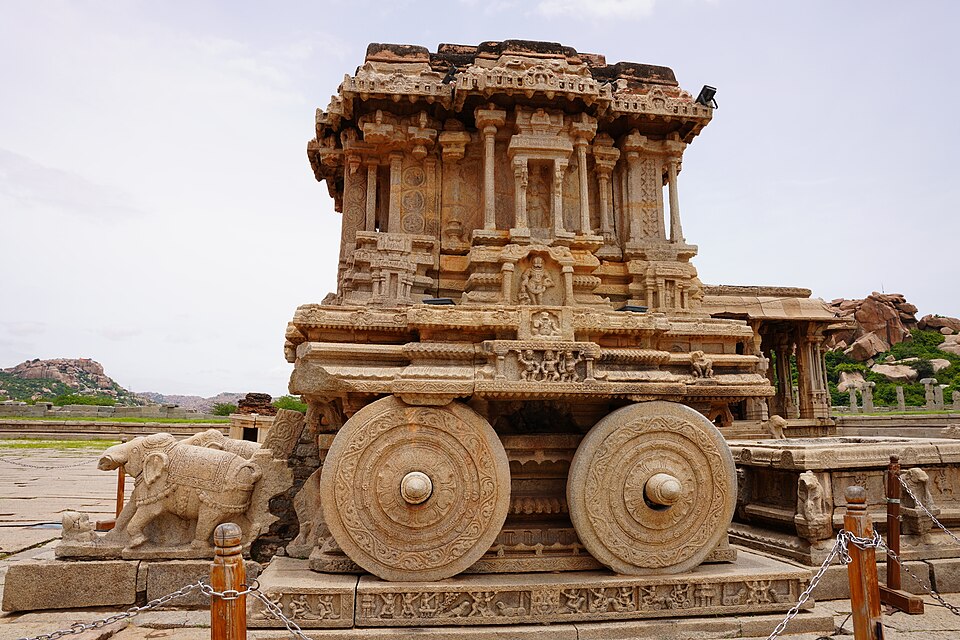
The Vitthala complex. The Vitthala has kalyana and utsava mandapas, three gopurams and a famous Garuda shrine shaped like a stone chariot. A long bazaar street runs from the temple, where goods were sold during festivals. The stone chariot is now one of India's best-known heritage images.
The Vijayanagara pillar. The pillars are the signature of this style. A central shaft carries an attached rearing yali, a mythical horse-lion, often with a rider. The bracket on top ends in an inverted lotus, and above it hang huge reverse-curve eaves, an idea from the Deccan.
A mixed style. Vijayanagara art blends three traditions: Dravida (Pallava, Chola, Pandya), Chalukya-Hoysala, and Deccani Indo-Islamic forms. For the first time in south India, figures of Ganga and Yamuna on their vahanas guard the gopuram entrances. This mix shows an empire open to many influences.
Why it matters. Questions often ask you to identify the stone chariot or the yali pillar. In Mains, the mixed style supports the theme of synthesis in Indian culture.
Extending old temples: Kanchipuram, Srirangam and Lepakshi
Adding, not replacing. Vijayanagara kings did not only build new temples. They extended old ones across the south with new walls, gopurams and halls. In 1509, Krishnadeva Raya added a nine-storeyed gopura to the Ekambaresvara temple at Kanchipuram.
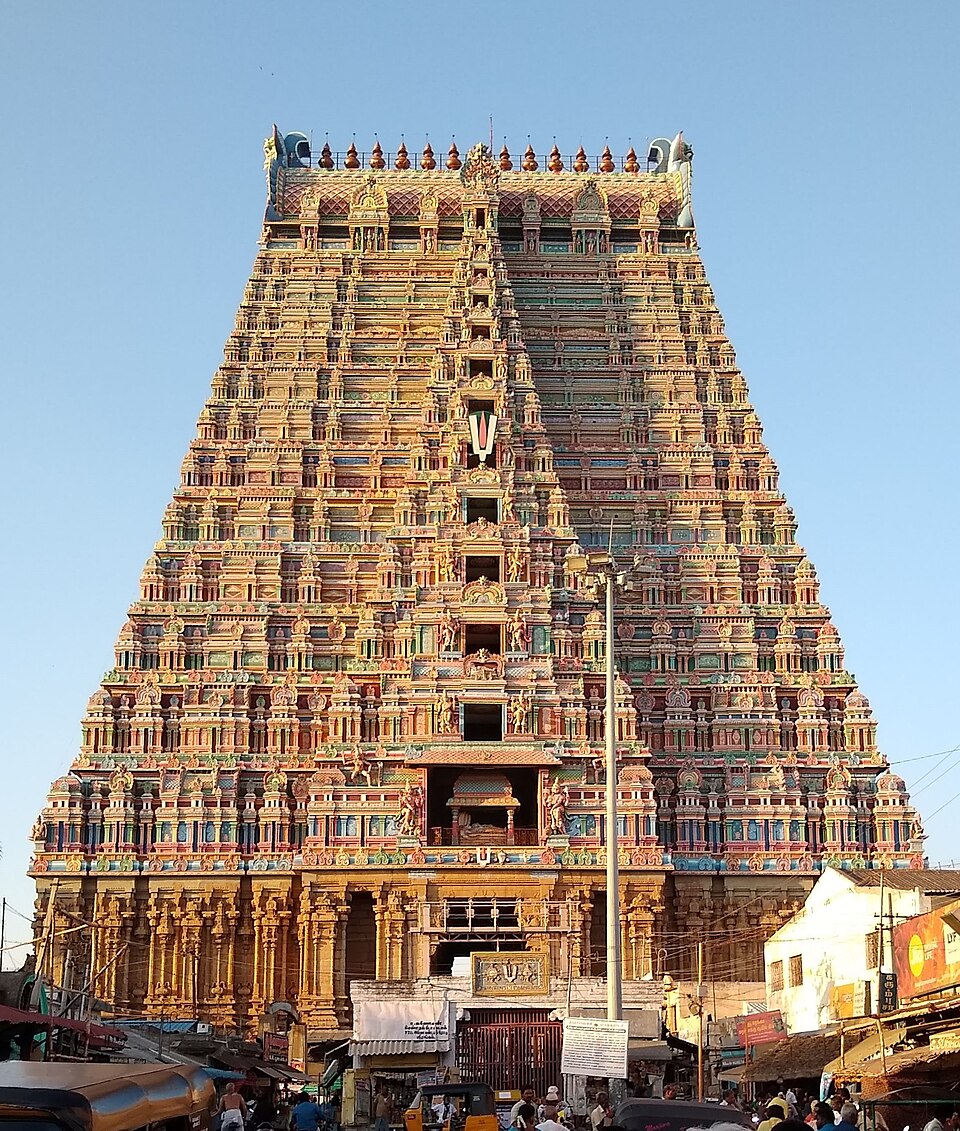
Srirangam. The Sri Ranganathaswamy temple at Srirangam, on an island in the Kaveri, is the grandest example of growth in rings. It covers 156 acres, with seven concentric prakarams, 21 gopurams, 50 sub-shrines and 9 sacred pools. Its Rajagopuram is about 72 m high, described as the second tallest temple tower in the world.
Many hands. Srirangam's builders included the Cholas, Pandyas, Hoysalas, Vijayanagara and the Nayakas. Its famous "thousand-pillar" hall actually has 953 granite pillars and belongs to the Vijayanagara period. Srirangam is on India's UNESCO Tentative List (2014).
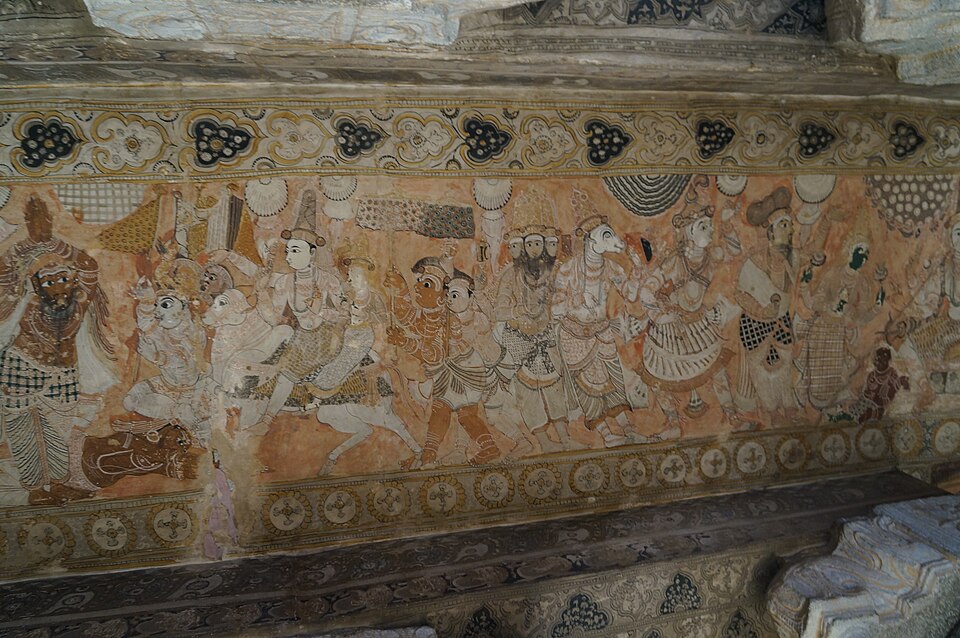
Lepakshi. The Veerabhadra temple at Lepakshi in Andhra Pradesh was built mostly in the reign of Achyutaraya, Krishnadeva Raya's successor. It has a huge monolithic granite Nandi facing a Naga-linga. Its dance-hall ceiling carries some of the finest Vijayanagara murals, painted in the fresco-secco technique, on dry plaster.
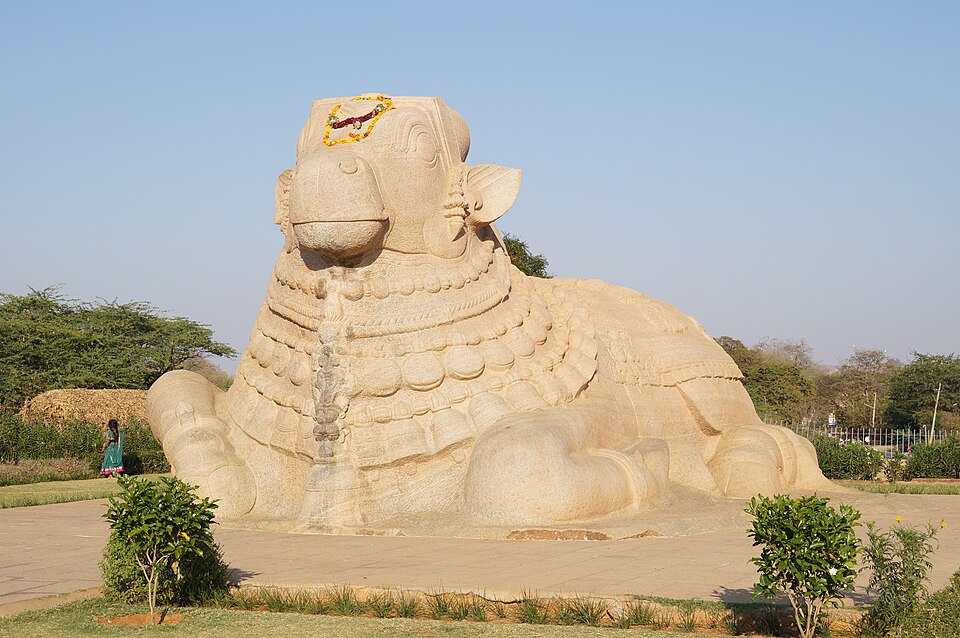
Why it matters. These three sites show how a temple became a multi-generation project. They also give you a painting link: Lepakshi murals are often asked in questions on south Indian painting.
The Nayakas and today's temple cities
After Vijayanagara. After 1565, the Nayakas, who had served the empire as governors, ruled on their own in the Tamil country. They carried the gateway style to its peak. Their temples have the tallest gopurams and the longest halls.
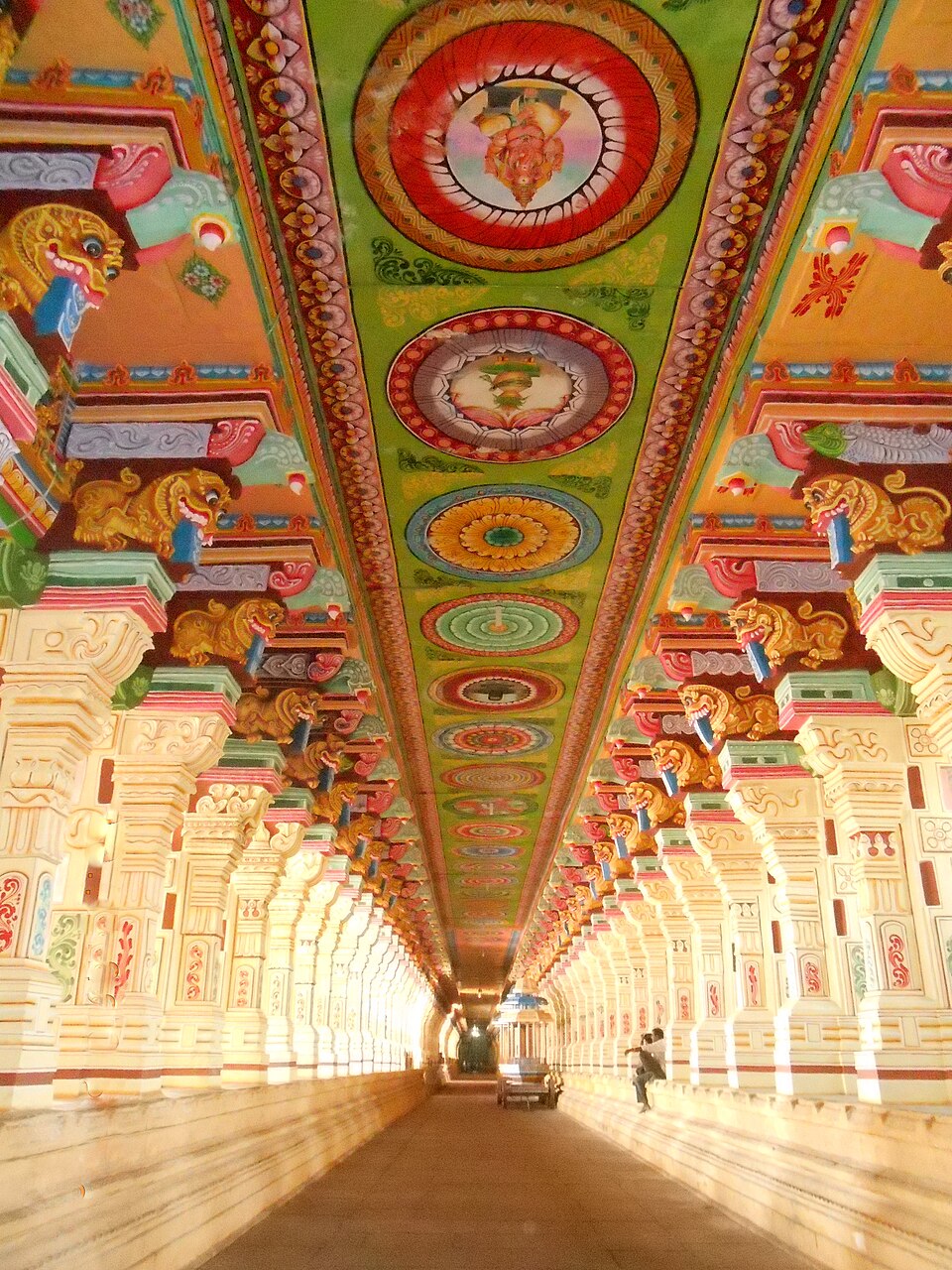
Hundred pillars and long corridors. Hundred-pillared mandapas belong to the late Vijayanagara and Nayaka period of the 16th century. Temples such as Madurai and Rameshvaram have long corridors lined with pillars carved with animals. Srirangam's Nayaka-period Sesharayar mandapam has about 40 piers of leaping animals.
Why did the south keep so many temples? The south was relatively free from repeated invasions, so thousands of temples survived and stayed in worship. That is why living temple towns like Madurai, Srirangam and Kanchipuram still function today.
Heritage pressures. At Hampi, UNESCO notes threats from commercial farming, new roads, shops near the Virupaksha and the asphalting of an ancient pathway. At living temples, renovation for worship can clash with conservation. Balancing faith, tourism and protection is the main challenge.
Why it matters. The Nayaka period gives you the final stage of the Dravida story, and Hampi's threats give you a heritage management angle for Mains.
Quick revision
- Pandya rock temples from the late 7th century; Vettuvan Koil, Kalugumalai (8th century), unfinished, cut top-down.
- From the 12th century: up to three concentric walls; gopurams (oblong pyramids) outgrow the vimana; Pandyan style, Madurai.
- Vijayanagara (1336-1565): Hampi, granite; peak under Krishnadeva Raya (1509-1530); Talikota 1565.
- Plan: concentric rectangular prakaras; raya-gopurams (7-11 storeys); many mandapas; kalyana-mandapa.
- Pillars with yalis; reverse-curve eaves; Ganga-Yamuna at gopuram entrances (first in the south).
- Vitthala: most ornate; stone chariot Garuda shrine; three gopurams.
- Kanchipuram: nine-storeyed gopura of 1509. Srirangam: 156 acres, 7 prakarams, 21 gopurams, Rajagopuram about 72 m, 953-pillar hall.
- Lepakshi: Achyutaraya, monolithic Nandi, fresco-secco murals.
- Nayakas: hundred-pillared halls, long corridors (Madurai, Rameshvaram).