

UKPSC RO / ARO · Module 66 · standard depth · 16 min
Stupas and early Buddhist relief art: Sanchi, Bharhut, Bodh Gaya, Amaravati and Nagarjunakonda
What UKPSC RO / ARO asks from this chapter
Syllabus lines this chapter covers:
- Mains Paper 1: General Studies (objective, 200 questions) · History and culture of India and Uttarakhand
1 UKPSC RO / ARO questions in our bank come from this module (Foundations and early art).
Cut to standard depth for UKPSC RO / ARO. 6 deeper paragraphs are in the full chapter.
Start from zero: walking around a hill of faith
Think of how people in your town show respect at a shrine. Many walk around it with the shrine on their right, often in silence or while chanting. This walk is called parikrama or pradakshina, and it is older than most of our temples.
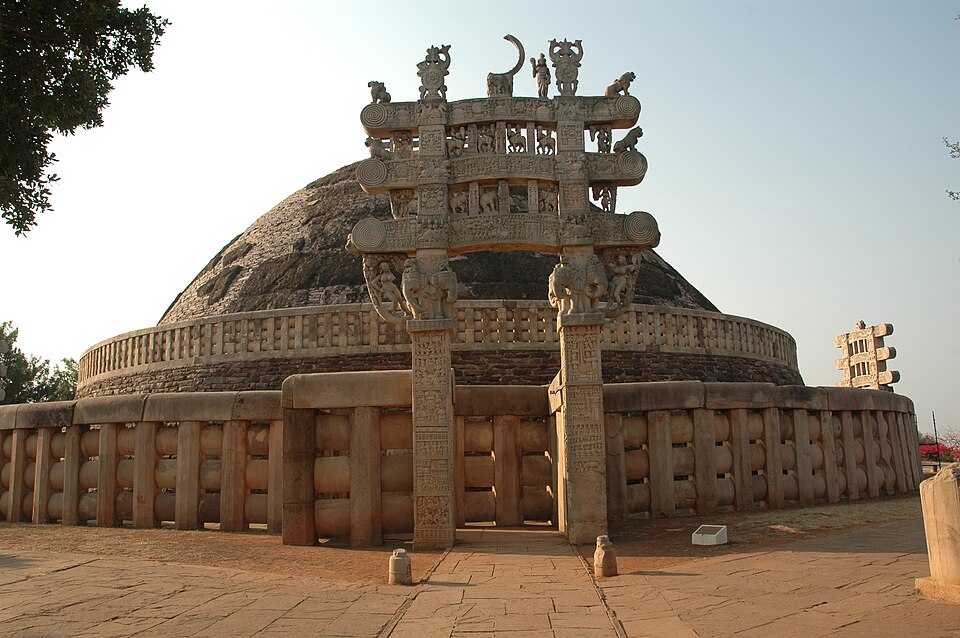
Over 2,000 years ago, Buddhists walked around a different kind of shrine. It was a large, solid, dome-shaped mound called a stupa, built over the remains (relics) of the Buddha or a great teacher. The early ones had no room inside and no image, only the mound, a railing and carved gateways.
Those railings and gateways became India's first great picture books in stone. They told the Buddha's life and his past lives to people who could not read. They also show us how people dressed, worked, travelled and prayed two thousand years ago.
This chapter explains what a stupa is and why it has this shape. It then takes you to the five great stupa sites, Sanchi, Bharhut, Bodh Gaya, Amaravati and Nagarjunakonda, and asks who paid for them and what their carvings mean.
Why stupas? From burial mound to Buddhist monument
An old idea, a new meaning. Raising a mound over the remains of an honoured person is a very old practice. Buddhists adopted it and gave it a new meaning. The word stupa comes from the root stu, which means to praise, so a stupa is a monument of praise.
The relics travel. After the Buddha's death, his remains were divided into eight parts and kept in different places. Ashoka dug up these relics and redistributed them, which led to many new stupas across his empire. Stupas were also raised at the four great places of the Buddha's life: Lumbini (birth), Bodh Gaya (enlightenment), Sarnath (first sermon) and Kushinagar (death).
From court to community. Ashoka's stupas were royal gifts, part of the Mauryan court art you read about in the Mauryan chapter. After the Mauryas, stupas were enlarged and decorated by a much wider circle of donors: merchants, guilds, artisans, monks, nuns, devotees and officials. Their names survive in hundreds of short donor inscriptions on railings and pillars.
Why it matters. This change from royal to popular patronage explains why post-Mauryan art spread so widely and looks so lively. It also tells historians about society: who had money, which crafts were organised in guilds and how many women made gifts. A question on post-Mauryan art is really also a question on post-Mauryan society.
The parts of a stupa and what they mean
The dome and its crown. The main body is a solid hemispherical dome called the anda, shaped like an upturned bowl. On its flat top sits the harmika, a small fenced box where the relic casket, often of gold or silver, was kept. From it rises a shaft, the yashti, carrying umbrellas (chhatra).
Three umbrellas. An umbrella in India was a sign of honour, held over kings and holy men. Stupas usually carry three discs, which are said to stand for respect, veneration and magnanimity. At first there was a single umbrella, and the number grew to three or more over time.
Two walks around the dome. A pradakshina patha (path for walking around) circles the base. When stupas were enlarged, a raised terrace called the medhi was added, which gave pilgrims a second, upper walk around the dome. A railing (vedika) fenced the sacred area, and four gateways (torana) stood at the four cardinal directions.
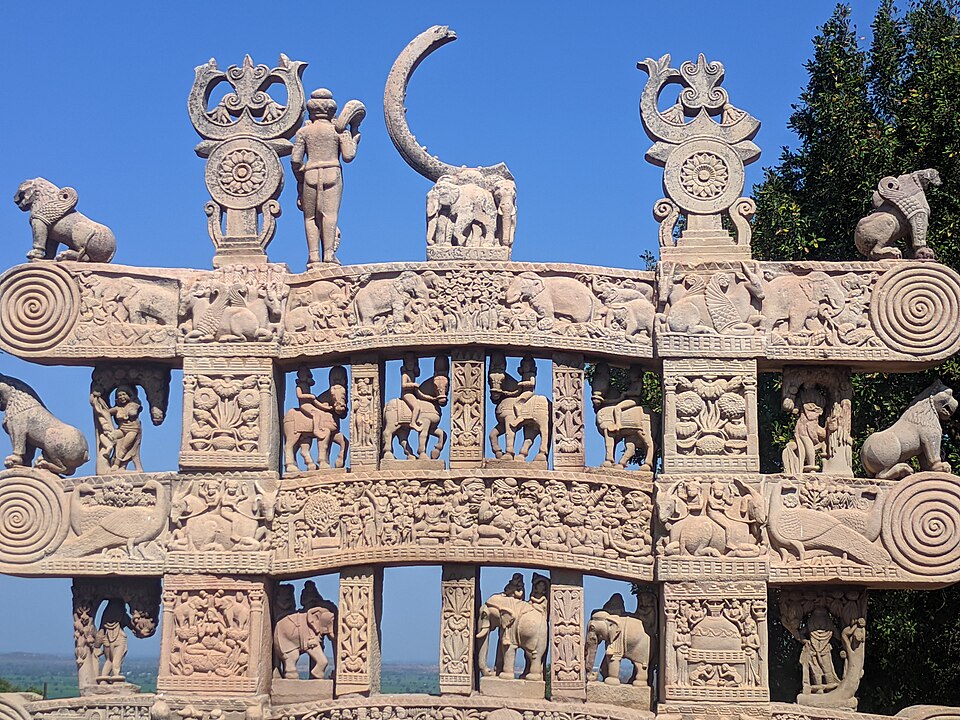
From wood to stone. The original stupa was of brick with a wooden railing. A base was added in the 1st century BC, and wooden railings and gates were later copied in stone. That is why a Sanchi gateway looks like carpentry: it has beams, posts and joints, all cut in stone.
Why it matters. Every part had a meaning. The dome holds the relic, the umbrellas honour it, the railing marks off sacred space and the walk turns worship into a journey around the Buddha's presence. Later Hindu and Jain temples kept the circumambulatory path and the idea of a sacred core, so the stupa shaped Indian temple design too.
A Buddha without a body: the language of symbols
A puzzle on the carvings. If you look closely at the earliest stupa carvings, you notice something strange. Crowds of people, animals and gods are shown worshipping, but the Buddha himself is missing. In his place you see a tree, an empty seat, footprints or a wheel.
Reading the symbols. Each symbol points to an event. The Bodhi tree or an empty seat (altar) under it means the enlightenment, the wheel means the first sermon, and the stupa means his final passing. Footprints show his presence, and a ladder recalls his descent from heaven in one well-known story.
Why no human image? Early followers saw the Buddha as a teacher who had gone beyond birth and death. Showing him as an ordinary body may have seemed wrong, so artists suggested him instead. This stage is often called aniconic, meaning "without images".
The change. From about the 1st century AD, artists began to show the Buddha in human form. This happened in Gandhara, Mathura and Amaravati, and it is explained in the chapter on sculpture schools. At Amaravati, you can even see one slab that was turned over and recarved so that the symbol was replaced by a human Buddha.
Why it matters. The move from symbol to image reflects a change in belief, as devotion grew and the Buddha came to be worshipped. It is one of the most asked themes in Buddhist art. Learn the symbols well, because examiners often describe a carving and ask you what it means.
Sanchi: one stupa, many centuries
Where. Sanchi stands on a hill in Madhya Pradesh, about 14 km from Vidisha. It has three main stupas with gateways, and it is the best-preserved early stupa site in India. It began with Ashoka, who built a brick stupa here around 250 BC.
Built in layers. Around 150 BC, under the Sungas, the stupa was nearly doubled in size and cased in stone. A stone railing and four gateways were added, along with the upper terrace, stairs, harmika and umbrellas. The gateways were richly ornamented in the Satavahana period, and four shrines were added at the entrances in the Gupta period.
Who carved the gateways? An inscription on the south gateway records it as a gift of King Satakarni. It also says that the carving was done by ivory workers. This explains the gateways' fine, crowded detail: they were made by craftsmen used to carving delicate ivory.
What the gateways show. The panels show the four great events of the Buddha's life: birth, enlightenment, the first sermon and the final passing. They also show Jataka stories, lotus plants and wish-fulfilling creepers. Some animals carry riders in heavy coats and boots, which shows the presence of foreigners in India at the time, and many scenes show the whole animal world worshipping the Buddha.
Later life. Stupa 3 held relics of Sariputra, one of the Buddha's leading disciples. The site was abandoned for about 600 years and was restored in the early 20th century. Today it is a World Heritage Site.
Why it matters. Sanchi shows that a monument grows over centuries as new patrons add to it. The ivory workers' inscription shows how crafts moved between materials, from ivory to stone. The foreign riders remind us that India was already part of a connected world of trade.
Bharhut and Bodh Gaya: railings that tell stories
Bharhut. Bharhut lies about 21 km south of Satna in Madhya Pradesh. The stupa itself is gone, and most of its carved railing and gateway now stand in the Indian Museum, Kolkata. It is one of the earliest great examples of narrative relief, telling stories in stone.
Wood copied in stone. At Bharhut, the stone gateways copy wooden gates, and the railing copies a post-and-rail fence with a heavy rounded coping on top. This shows again how builders carried timber habits into stone. It also shows how the railing was meant to fence a sacred space.
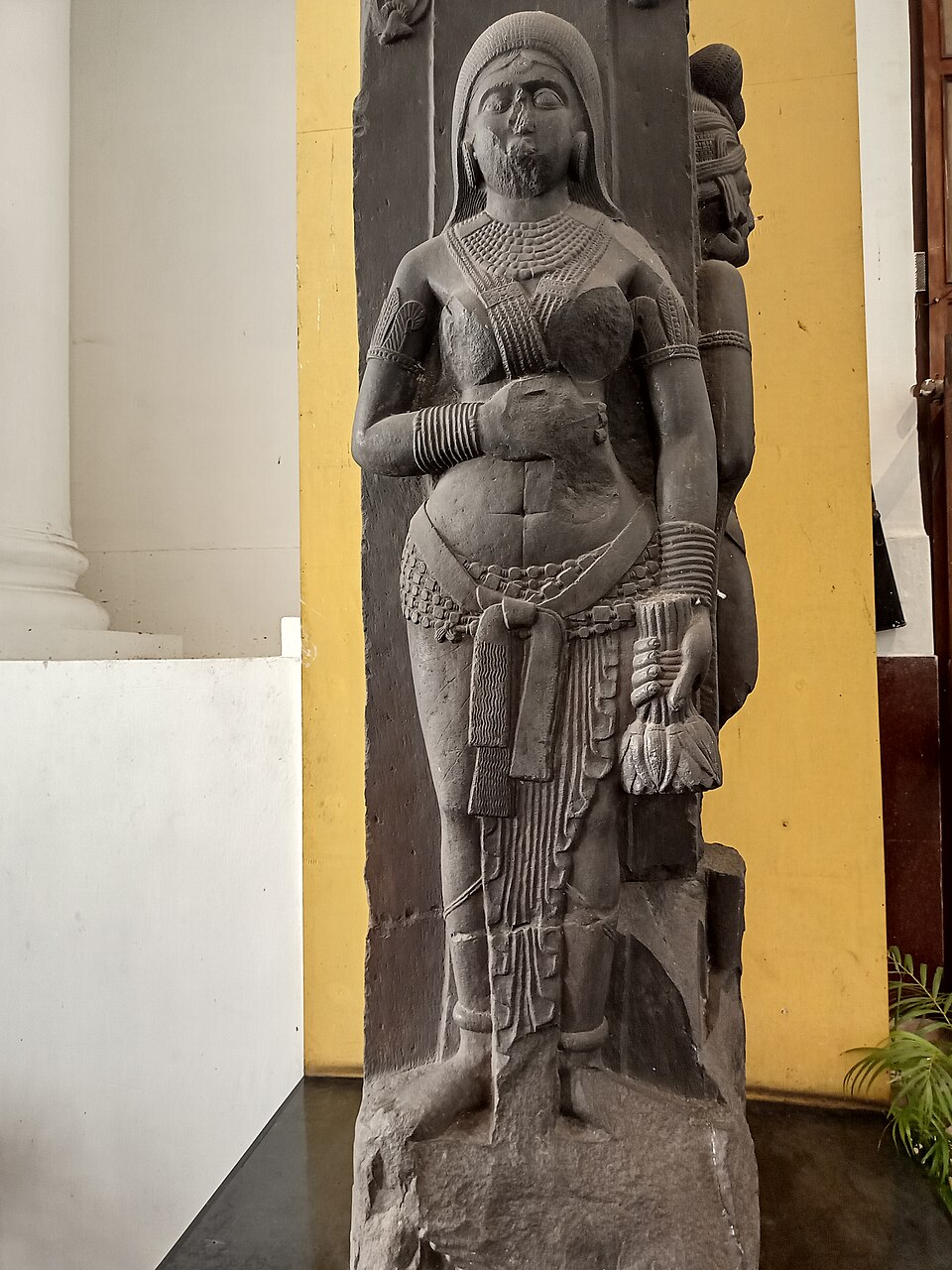
Figures with name tags. Bharhut's railing pillars carry life-size yakshas, yakshis and local deities, and many have inscriptions giving their names. These labels are precious, because they tell us exactly whom the carvers meant to show. They also prove that popular gods were brought into Buddhist sacred space as guardians.
Famous scenes. One panel shows the banker Anathapindika covering the ground with gold coins to buy the Jetavana garden at Shravasti for the Buddha. Others show the royal processions of Ajatashatru and Prasenjit going to meet him, and a figure of a Greek warrior. Round panels tell Jataka tales full of animals, boats, chariots and musical instruments.
Bodh Gaya. At Bodh Gaya, Ashoka built a Bodhi-manda, a platform at the spot of the enlightenment, but nothing original survives. A Sunga-period stone railing stands there, with Jataka scenes on its pillars. Its carvings include rows of animals, winged horses, centaurs and lotus medallions.
Why it matters. Bharhut's labelled figures and Bodh Gaya's railing show that early Buddhist art was rooted in local life. Yakshas, village scenes and animals sit beside the Buddha's story. The winged horses and Greek warrior also show ideas arriving from outside and being used freely.
Amaravati: the great stupa of the south
Where and how big. Amaravati is in Guntur district, Andhra Pradesh, beside the ancient city of Dhanyakataka on the Krishna river. Its stupa was the largest in Andhra, about 42 m across and 29 m high. Inscriptions call it the Mahachaitya, the great shrine.
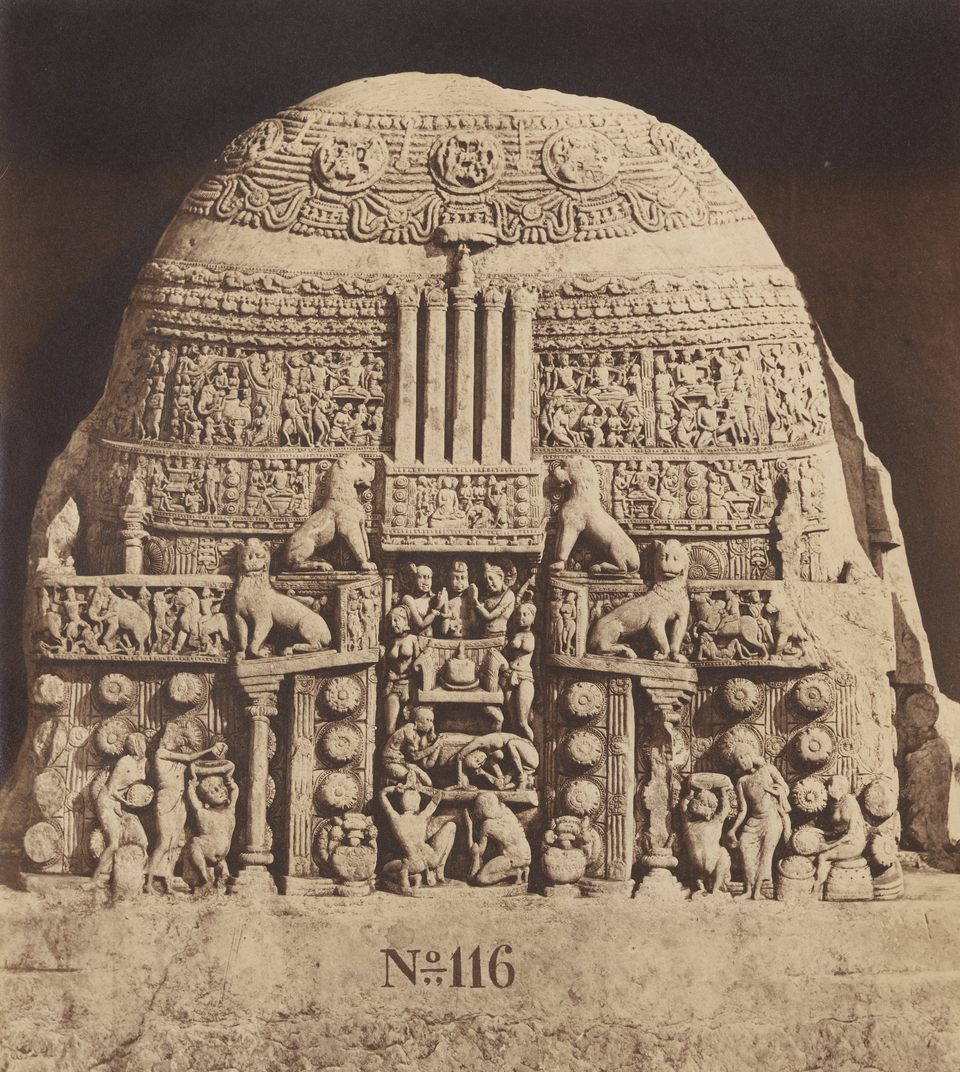
Built over a thousand years. An Ashokan edict found at the site shows that the stupa began in Mauryan times. It then went through five phases: Ashokan, post-Ashokan, Satavahana, Ikshvaku and Pallava. It was a centre of the Mahasanghika school, an early branch of Buddhism linked with the rise of Mahayana ideas.
Who paid. The stupa was built with help from the city chief and public donations. Amaravati was a rich trade town: archaeologists have found Mediterranean amphorae (storage jars), a rock-cut channel to the river and a wooden wharf. Roman trade brought wealth, and that wealth paid for the stupa.
Symbol to image on one slab. On Amaravati's carved panels, images of the Buddha appear beside the older symbols from about the 1st century AD. One famous drum slab, first carved around the 1st century BC, was later turned over and recarved to show the stupa with the Buddha in human form at its entrance. The same stone thus records the change in belief.
Roman touches. Around 70 CE, some Amaravati reliefs borrowed Roman picture conventions. In one panel of Queen Maya's dream, she sleeps with her arms over her head in a pose taken from a Roman model. Yet the style remained so Indian that the foreign borrowing is easy to miss.
Why it matters. Amaravati shows that the south was a major creative centre, linked by sea to the Roman world. Its carvers worked in a fine white limestone, often called "Amaravati marbles". Their slender, lively figures are studied further in the sculpture schools chapter.
Nagarjunakonda and the stupas of the north-west
A stupa built like a wheel. At Nagarjunakonda, also in Andhra, builders used a clever method. They made two concentric circular walls and joined them with walls like the spokes of a wheel. The gaps were then filled with mud, stone and brick, which made a big stupa (about 30 m across) strong but cheaper to build.
Ayaka platforms. Andhra stupas had four rectangular projections at the cardinal points, called ayaka platforms. Each carried five pillars, called ayaka pillars. The panels here show scenes such as the Buddha entering his mother's womb as a white elephant, and his birth under a flowering tree.
The north-west. In the far north-west, stupas grew under the Kushanas. Kanishka built a great stupa at Shah-ji-ki-Dheri near Peshawar, which was found in 1908 and which the Chinese pilgrim Fa-hien had described. At Taxila, the Dharmarajika (Chir Tope) stupa was excavated by Sir John Marshall.
Why it matters. The same basic stupa idea was built in different ways in different regions, using local materials and local skills. Artisans also moved between sites, which explains why so many common features appear across India. This is a good example of shared ideas with regional variety.
Quick revision
- The word stupa comes from stu, to praise, and the Buddha's relics were divided into eight parts and later redistributed by Ashoka.
- The parts of a stupa are the anda, harmika, yashti, chhatra, medhi, pradakshina patha, vedika and torana.
- Early art shows the Buddha only through symbols: tree, seat, footprints, wheel, stupa and ladder.
- Sanchi, near Vidisha, grew from Ashoka's brick stupa to Sunga stone casing, Satavahana gateways and Gupta shrines.
- Sanchi's south gateway was a gift of King Satakarni and was carved by ivory workers.
- Bharhut, near Satna, has labelled yakshas and yakshis, the Jetavana scene and a Greek warrior, and its remains are in the Indian Museum, Kolkata.
- Amaravati, in Guntur district, had Andhra's largest stupa, five building phases and links with Roman trade.
- Nagarjunakonda stupas used a wheel-and-spoke plan with ayaka platforms and pillars.
- Post-Mauryan art had a wider social base of merchants, guilds and devotees.