UPSC CAPF AC · Module 35 · standard depth · 13 min
Climate treaties and India's targets: why they look the way they do
What UPSC CAPF AC asks from this chapter
Syllabus lines this chapter covers:
Paper I: General Ability and Intelligence · General Science The questions will be set to test general awareness, scientific temper, comprehension and appreciation of scientific phenomena of everyday observation including new areas of importance like Information Technology, Biotechnology, Environmental Science.
UPSC CAPF AC questions from this module are being sorted into our bank.
Cut to standard depth for UPSC CAPF AC. 16 deeper paragraphs are in the full chapter.
Start from zero: why the world needs climate treaties
Imagine a village with one shared pond. Every family throws a little waste into it. No single family's waste ruins the pond, but together they do.
From science to treaties: 1958 to 2070
No family wants to stop alone, because then it pays the cost while others enjoy the benefit. The only way out is for the whole village to sit together and agree on rules. The atmosphere is the world's shared pond, and the climate treaties are the village meeting.
The UNFCCC (1992). The United Nations Framework Convention on Climate Change was adopted in New York on 9 May 1992, opened for signature at the Rio Earth Summit in June 1992, and entered into force on 21 March 1994. Its objective (Article 2) is to stabilise greenhouse gas concentrations "at a level that would prevent dangerous anthropogenic interference with the climate system". Countries that have joined it meet every year at the Conference of the Parties (COP).
Three climate treaties compared
The fairness principle: CBDR-RC. Article 3(1) says countries should act on the basis of equity and according to their "common but differentiated responsibilities and respective capabilities". In simple words: everyone shares the job of protecting the climate (common), but those who caused more of the problem and have more money and technology should do more (differentiated). This principle is central to India's position.
Kyoto Protocol (1997). Adopted on 11 December 1997 and in force from 16 February 2005, it set binding emission cuts for developed countries only (the first period was 2008–2012), for a basket of six gases (CO2, methane, nitrous oxide, HFCs, PFCs and SF6), with a second period (2013–2020) added by the Doha Amendment.
India's climate commitments
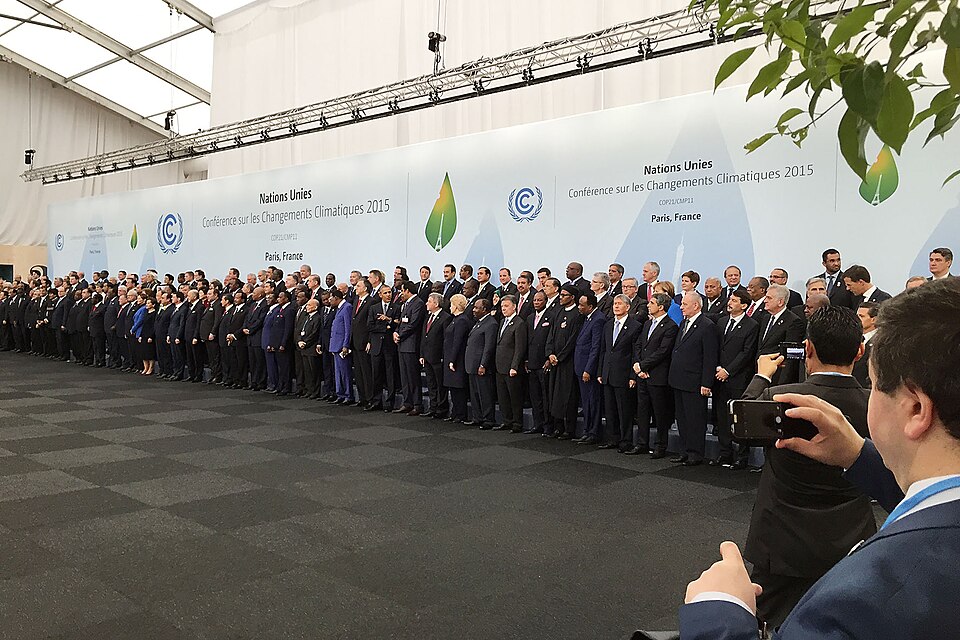
Paris Agreement (2015). Adopted at COP21 on 12 December 2015 and in force from 4 November 2016. Its goal is to hold the rise in global average temperature well below 2 °C above pre-industrial levels and to pursue efforts to limit it to 1.5 °C.
Unlike Kyoto, every country sets its own targets, called Nationally Determined Contributions (NDCs), and each country must send a new NDC every five years (Article 4.9); a global stocktake checks collective progress, first in 2023 and then every five years (Article 14.2). The full story of the COPs is in the chapter on the UNFCCC, Kyoto and Paris.
Intensity and net zero, explained
Why was each step needed? The story behind the treaties.
Why a treaty at all? By the late 1980s, the Keeling Curve and climate science had shown that the rise was real and global. The IPCC was set up in 1988 to give governments one shared, neutral assessment of the science. No country could fix a shared atmosphere alone, so the problem needed a shared rule book.
Why a "framework" in 1992? Countries agreed on the goal and the principles first, because they could not yet agree on numbers. A framework convention works like a constitution: it sets the purpose and the institutions, and the detailed rules come later through protocols and COP decisions.
Why did Kyoto bind only the rich countries? The developed countries had released most of the gases since the Industrial Revolution and had the money to change. Following CBDR, Kyoto gave them binding targets and left developing countries without them. Implication: fast-growing emitters had no targets, and some major developed countries stayed out or left later, so Kyoto covered a shrinking share of global emissions.
Why did Paris change the method? Instead of handing out targets from the top, Paris asks every country to set its own NDC and to raise it every five years. Implication: almost every country joined, but the targets are national choices. Success depends on transparency, peer pressure and the global stocktake, not on penalties.
India's commitments.
At COP26 in Glasgow (1 November 2021), India announced it would reach net zero by 2070, along with 500 GW of non-fossil energy capacity by 2030, as part of five commitments called the Panchamrit.
India's updated NDC (August 2022) commits to: reduce the emissions intensity of GDP by 45% by 2030 from the 2005 level; get about 50% of installed electric power capacity from non-fossil sources by 2030; create an additional carbon sink of 2.5 to 3 billion tonnes of CO2 equivalent through more forest and tree cover by 2030; and promote a mass movement for LIFE, "Lifestyle for Environment".
Two ideas to keep straight. "Emissions intensity" means emissions per unit of GDP, not total emissions. India's total emissions can still grow while each rupee of GDP becomes cleaner. "Net zero" means the gases a country releases are balanced by the gases it removes (through forests or technology); it does not mean zero emissions.
Why this matters. Prelims regularly asks about years, COP numbers, the 1.5/2 °C goals and India's NDC numbers. Mains asks you to evaluate whether these targets are fair and enough, so let us first see what climate change means for India and then turn to the Mains debates.
What it means for India: where it hurts, and why our targets look the way they do
So far we have asked what the greenhouse effect is and how the world responded. A UPSC aspirant must also ask: what does it mean for India, and why has India chosen the path it has?
Where climate change hits India
Where does it hurt? Start from the map of India. Think of India as five different homes under one roof, each feeling the heat in its own way.
The Himalaya. Glaciers act like a water bank: they store snow in winter and release water in summer, when the plains need it most. As they shrink, rivers such as the Ganga and the Brahmaputra may first carry more water and floods, and later less water in the dry season.
The plains and farms. More than half of India's farms depend on rain. A monsoon that arrives late, stops for weeks and then pours all at once is harder for a farmer than a monsoon that is simply weak. Heat at the grain-filling stage can also shrink the wheat harvest.
The coasts. India has a long coastline, low deltas such as the Sundarbans and big coastal cities. A higher sea makes storm surges reach further inland and pushes salt water into farms and wells.
The cities. Concrete and asphalt soak up heat by day and release it at night, so cities stay hotter than villages around them. More heatwave days mean more heatstroke, lost working hours and higher electricity demand for cooling.
The poorest households. A farmer with no irrigation or a worker who labours outdoors has the least protection. This is why climate change is also a question of poverty and equity, not only of science.
What does the global science say? The IPCC's AR6 report finds that hot extremes, including heatwaves, have become more frequent and more intense across most land regions since the 1950s, and that human-induced climate change is the main driver. Its impacts report adds that roughly 3.3 to 3.6 billion people live in contexts that are highly vulnerable to climate change. A large share of them live in South Asia, which is why this chapter matters so much for India.
Why are India's targets written the way they are? Each choice has a reason:
Why an intensity target and not a cap on total emissions? India's per-person energy use is still low and millions still need electricity, cooking gas and jobs. An intensity target lets the economy grow while each rupee of GDP becomes cleaner.
Why India's targets look this way
Why net zero by 2070, and not 2050 like many rich countries? India began industrialising much later, and its historical share of emissions is small. A later date gives time to build clean energy without stopping development.
Why a target for non-fossil capacity? Electricity is the biggest source of India's CO2, and solar and wind have become cheap. Shifting new power capacity to clean sources is the fastest lever India controls.
Why a forest sink target? Forests absorb CO2 and also protect soil, water and wildlife. One action gives several benefits, which is why it suits a developing country.
Why LiFE? Technology alone cannot solve the problem if consumption keeps rising without limit. LiFE asks citizens to save energy, water and food, and it carries India's traditional idea of careful use into climate policy.
Implications for governance (Mains angle). Climate change touches almost every ministry: agriculture, water, power, health, urban development and disaster management. It therefore needs coordination between the Centre and the States, money for adaptation, and local plans for districts that face floods, droughts or heat.
Latest numbers (refreshed yearly)
Targets are revised every few years, so they are kept in one place and refreshed with the date and source.
The Paris five-year cycle
India's targets: the 2030 targets come from the updated NDC (August 2022), and net zero by 2070 was announced at COP26 (2021).
Paris cycle: every Party sends a new NDC every five years, and the first global stocktake took place in 2023.
Quick revision
IPCC set up in 1988 by UNEP and WMO. Kyoto: adopted 11 Dec 1997, in force 16 Feb 2005, binds only developed countries.
UNFCCC: 1992 (Rio), in force 21 March 1994; CBDR-RC in Article 3(1). Paris: COP21, 2015; well below 2 °C, pursue 1.5 °C.
India: net zero 2070; NDC 2022: 45% intensity cut, 50% non-fossil capacity, 2.5 to 3 billion tonne sink by 2030; LiFE.
Exam-style questions on this chapter. Pick an answer to see the explanation. 0 of 9 answered
The principle of 'common but differentiated responsibilities and respective capabilities' is written in which instrument?
Consider the following statements about the Paris Agreement: 1. It aims to hold warming well below 2 °C and pursue efforts to limit it to 1.5 °C. 2. Each Party communicates a nationally determined contribution every five years. 3. Binding emission cuts apply only to developed countries. Which are correct?
Under its updated NDC (2022), India aims to reduce the emissions intensity of its GDP by 45% by 2030 compared with which year?
The United Nations Framework Convention on Climate Change entered into force on:
Consider the following statements about the Kyoto Protocol: 1. It was adopted on 11 December 1997. 2. It entered into force on 16 February 2005. 3. It set binding emission targets for developing countries as well. Which of the statements given above are correct?
Under the UNFCCC, 'Annex I Parties' are:
Under the Paris Agreement, countries report their actions and progress through the:
Assertion (A): India argues that developed countries should lead in cutting emissions. Reason (R): At COP26, India stated that it has about 17% of the world's population but its responsibility for emissions has been only about 5%.
According to the IPCC (2022), about how many people live in contexts that are highly vulnerable to climate change?
Previous year questions
Previous year questions for UPSC CSE will appear here once each one is checked word for word against the official question paper.
Frequently asked questions
What does CBDR-RC mean?
Common but differentiated responsibilities and respective capabilities: all countries must act, but rich countries that emitted more should do more.
What is the Paris Agreement temperature goal?
To keep warming well below 2 °C above pre-industrial levels and pursue efforts to limit it to 1.5 °C.
What share of India's power capacity is to be non-fossil by 2030?
About 50 percent of cumulative installed electric power capacity, under the updated NDC of 2022.