

UPSC CDS · Module 13 · standard depth · 13 min
Minerals, rocks and the rock cycle
What UPSC CDS asks from this chapter
Syllabus lines this chapter covers:
- General Knowledge (all academies) · The paper will also include questions on History of India and Geography of a nature which candidate should be able to answer without special study.
UPSC CDS questions from this module are being sorted into our bank.
Cut to standard depth for UPSC CDS. 11 deeper paragraphs are in the full chapter.
Start from zero: what is the ground made of?
Pick up a handful of soil, a pebble from a river and a piece of building stone. They look different, but all of them come from rocks, and every rock is made of tiny natural crystals called minerals. Rocks are the raw material of every hill, plain and coast.
Think of minerals as the letters of an alphabet and rocks as words. A few letters combine in different ways to make thousands of words. In the same way, a small number of common minerals combine to make the great variety of rocks we see.
Rocks are not permanent. A mountain of granite can slowly crumble into sand, the sand can harden into sandstone, and deep heat can turn that sandstone into a new rock. This endless recycling is called the rock cycle.
Why it matters. Rocks decide how landforms look, how fast they erode, which soils form, where groundwater collects and where minerals and fuels are found. Builders, farmers and planners all depend on knowing the rock beneath them.
Elements and minerals of the crust
A mineral is a natural, inorganic substance with a definite chemical composition and an orderly internal structure of atoms, which often shows as crystals. Common salt, quartz and mica are minerals. A rock is a solid mass of one or more minerals; granite, for example, is mostly quartz, feldspar and mica.
Only a few chemical elements make up almost the entire crust. By weight, oxygen forms about 46% and silicon about 28%, followed by aluminium, iron, calcium, sodium, potassium and magnesium. Together these eight elements make up about 99% of the crust, so most minerals are combinations of oxygen and silicon with metals, called silicates.
The most common mineral group is feldspar, which makes up roughly half of the crust and is used in ceramics and glass. Quartz, made of silica, is hard and resistant, so it forms most sand. Mica splits into thin sheets and is used in electrical insulation, while pyroxene, amphibole and olivine are dark, heavy minerals common in basalt and mantle rocks.
Minerals are identified by physical properties such as hardness, lustre (shine), colour, streak (colour of the powder), cleavage (splitting along flat planes) and density. Some minerals, such as metallic ores of iron, copper and aluminium, are mined; others, such as coal and petroleum, are not true minerals in the strict sense because they are organic, but they are still called mineral fuels.
Why it matters. The dominance of silicon and oxygen explains why sand, clay and glass are everywhere. Knowing which minerals are rare explains their economic and strategic value, a theme that returns in India's mineral resources and in critical-mineral policy.
Igneous rocks: born from fire
Igneous rocks (from the Latin ignis, fire) form when molten rock cools and hardens. Molten rock underground is magma; when it reaches the surface it is called lava. Because all other rocks can ultimately be traced back to them, igneous rocks are called primary or parent rocks.
Where the magma cools decides the rock's texture. Intrusive (plutonic) rocks cool slowly deep underground, so crystals have time to grow large; granite is the classic example. Extrusive (volcanic) rocks cool quickly at the surface, so crystals stay tiny; basalt is the classic example. Magma that cools at middle depths in cracks forms dykes and sills, a theme of volcanic landforms.
Igneous rocks are also grouped by silica content. Acidic rocks, with more than about 65% silica, such as granite, are light in colour and density. Basic rocks such as basalt have less silica and more iron and magnesium, so they are darker and heavier; ultrabasic rocks such as peridotite have even less silica, and intermediate rocks such as diorite lie in between.
Igneous rocks are generally hard, crystalline and without layers or fossils. They often resist erosion and stand out as hills and plateaus. The Deccan Traps are a vast spread of basalt formed by lava flows, while granite forms many old hills and tors across the Peninsula.
Igneous rocks also store clues about the deep Earth. Basalt erupted at mid-ocean ridges forms the floor of all the oceans, so oceanic crust is basaltic and fairly young, while continental crust is richer in granite-like rocks and much older. Iron-bearing minerals in cooling lava line up with the Earth's magnetic field, and this frozen record later helped prove that the sea floor spreads.
Why it matters. Granite and basalt are among the most-used building and road stones. Basalt weathers into fertile black soil, and many metal ores are found in or near igneous rocks. The silica difference also explains why some volcanoes are explosive and others quiet.
Sedimentary rocks: pages of Earth's history
Rocks exposed at the surface are slowly broken down by weather, and the pieces are carried by rivers, wind, ice and waves. When these sediments settle, usually in water, they pile up in layers. Over time, the weight of upper layers squeezes the lower ones, and natural cements bind the grains; this hardening is called lithification.
Sedimentary rocks are grouped by how their material gathered. Mechanically formed rocks are made of fragments: sandstone from sand, conglomerate from rounded pebbles, shale from mud and clay, and loess from wind-blown dust. Chemically formed rocks precipitate from water, such as rock salt, gypsum and some limestone. Organically formed rocks come from living things, such as coal from plant remains, and chalk and some limestone from shells.
Sedimentary rocks have layers (strata) separated by bedding planes, and they often contain fossils. They are usually softer and more porous than igneous rocks, so they can hold water, oil and natural gas in their pores. They cover about three-quarters of the land surface, yet form only a thin skin making up about 5% of the crust by volume.
Because each layer was laid down after the one below, sedimentary rocks are like the pages of a history book. Fossils and layers tell geologists about past climates, seas and life, which is how the geological time scale was built.
How do oil and gas form? Tiny marine plants and animals settle on the sea floor, get buried in mud, and over millions of years heat and pressure turn their remains into oil and gas. These fluids move upward through porous rocks such as sandstone until they are trapped beneath an impermeable layer such as shale, forming the reservoirs that companies drill into. Coal forms in a similar way from thick layers of plant matter buried in ancient swamps.
Why it matters. Almost all coal, oil and natural gas, and much of the world's groundwater, lie in sedimentary rocks. Limestone is the raw material of cement, and sandstone has built monuments across India. Fossils in these rocks also record past climate change.
Metamorphic rocks: changed without melting
Metamorphic means "changed form". When igneous or sedimentary rocks are buried deep, squeezed between colliding plates or baked by nearby magma, their minerals recrystallise and rearrange without melting. The result is a new, usually harder and denser rock.
There are two main settings. In contact (thermal) metamorphism, hot magma bakes the rocks around it, mainly through heat. In regional (dynamic) metamorphism, huge areas are changed by both heat and great pressure during mountain building, as in the core of the Himalaya.
Under pressure, minerals often line up in parallel bands or sheets, giving a foliated texture. Slate, which splits into thin sheets, schist, which glitters with mica, and gneiss, with light and dark bands, are foliated rocks. Rocks made mainly of one mineral, such as marble and quartzite, recrystallise without bands and are non-foliated.
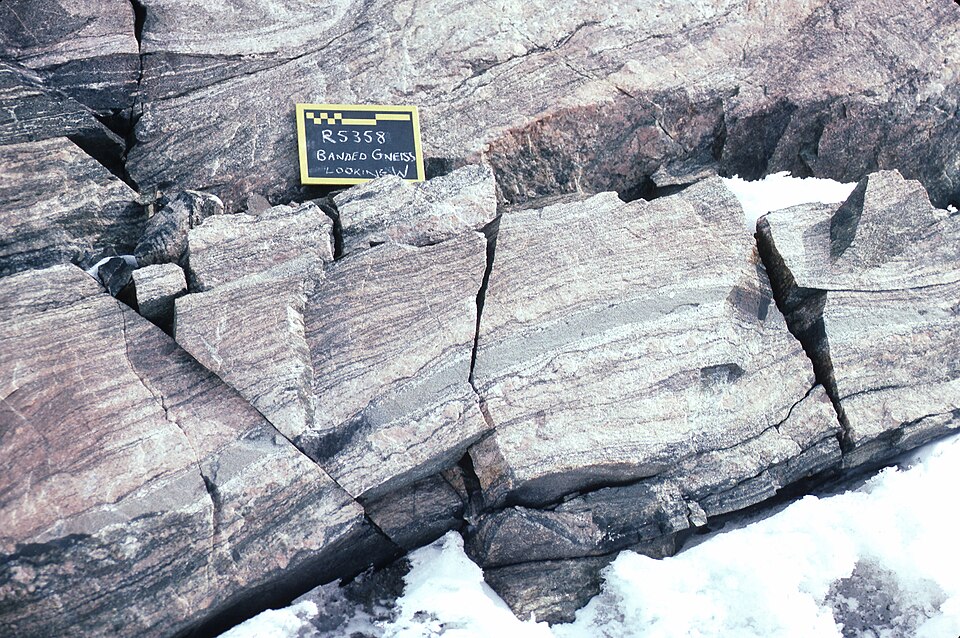
Some parent–child pairs appear in every exam: shale → slate, limestone → marble, sandstone → quartzite and granite → gneiss. Coal can also be transformed by pressure into higher-grade coal and finally graphite.
Why it matters. Marble and slate are valued building materials, and many ore deposits are concentrated during metamorphism. Metamorphic rocks also reveal past mountain building, since they mark zones where plates once collided.
The rock cycle and India's rocks
The three rock types are linked in a never-ending loop called the rock cycle. Magma cools into igneous rock; weathering breaks it into sediments that become sedimentary rock; heat and pressure turn either into metamorphic rock; and deep melting returns any rock to magma.
The cycle has many shortcuts. An igneous rock can be metamorphosed directly without becoming sediment, and a metamorphic rock can be raised to the surface and eroded into sediment. The cycle is driven by two energy sources: the Sun, which powers weathering, rain and rivers, and the Earth's internal heat, which drives melting, plate movement and mountain building.
India shows the whole cycle. The ancient gneisses and granites of the Peninsula are among the oldest rocks of the country. Lava flows built the basaltic Deccan Traps, while the Vindhyan sandstones and limestones and the coal-bearing Gondwana rocks are sedimentary. Rivers from the Himalaya are now carrying sediments to build the plains and deltas, the start of future sedimentary rocks.
The rock cycle also works on human timescales in small ways. Riverbeds are refilled with sand each monsoon, but only slowly, and when sand is mined faster than rivers can replace it, channels deepen, banks collapse and groundwater levels fall. Recycling construction waste and using manufactured sand from crushed rock are ways to ease this pressure.
Why it matters. The rock cycle connects geology to everyday resources. It shows why mining, quarrying and sand extraction remove materials that take millions of years to form, which is why riverbed sand and building stone must be managed carefully.
Quick revision
- Mineral: natural, inorganic, definite composition, orderly structure. Rock: aggregate of minerals.
- Crust by weight: O about 46%, Si about 28%, then Al, Fe, Ca, Na, K, Mg (eight elements about 99%). Feldspar is the commonest mineral.
- Igneous (primary): intrusive granite (big crystals), extrusive basalt (fine crystals); acidic over 65% silica, ultrabasic under 45%.
- Sedimentary: layers, bedding planes, fossils; mechanical (sandstone, shale), chemical (rock salt, gypsum), organic (coal, chalk). About 75% of land surface, about 5% of crust volume.
- Metamorphic: changed by heat and pressure without melting; foliated (slate, schist, gneiss), non-foliated (marble, quartzite).
- Pairs: shale → slate, limestone → marble, sandstone → quartzite, granite → gneiss.
- Rock cycle driven by the Sun and the Earth's internal heat.