

UPSC CDS · Module 35 · standard depth · 14 min
The Quad and the Indo-Pacific
What UPSC CDS asks from this chapter
Syllabus lines this chapter covers:
- General Knowledge (all academies) · General Knowledge including knowledge of current events and of such matters of everyday observation and experience in their scientific aspects as may be expected of an educated person who has not made a special study of any scientific subject.
UPSC CDS questions from this module are being sorted into our bank.
Cut to standard depth for UPSC CDS. 7 deeper paragraphs are in the full chapter.
Start from zero: four friends and two oceans
Imagine four neighbours who live around a busy shared road. None of them owns the road, but all of them use it every day. If one powerful neighbour started putting up barriers, everyone would suffer. So the four agree to keep the road open, help each other in emergencies and share what they see.
The Indo-Pacific is that shared road. It is the huge ocean space that links the Indian Ocean and the Pacific Ocean, through which a large share of the world's trade and energy moves. The Quad is a group of four democracies that use these waters: India, Australia, Japan and the United States.
The Quad is not a military alliance. Its members do not promise to defend one another, and they work on practical things such as disaster relief, vaccines, technology, clean energy and maritime awareness. This matters for India, which values its strategic autonomy and does not join military blocs.
This chapter first explains how the Quad began and grew, then what it does. It then explains India's own idea of the Indo-Pacific and how India balances the Quad with its other ties.
Why it matters. Exams test the Quad through its origin, its key dates and its initiatives, so learning the timeline and the four pillars pays off.
How the Quad began and grew
Born in a disaster. The Quad came together during the 2004 Indian Ocean tsunami, when India, Australia, Japan and the United States coordinated relief for affected countries. Working together in a crisis showed that the four could act quickly as a team. This origin in humanitarian relief, not war, still shapes the Quad's identity.
A first meeting, then a long pause. The first meeting of Quad officials took place in May 2007 on the sidelines of the ASEAN Regional Forum in the Philippines. After that, the group went quiet. It was revived only in November 2017, when officials met in Manila on the margins of the East Asia Summit after a gap of ten years.
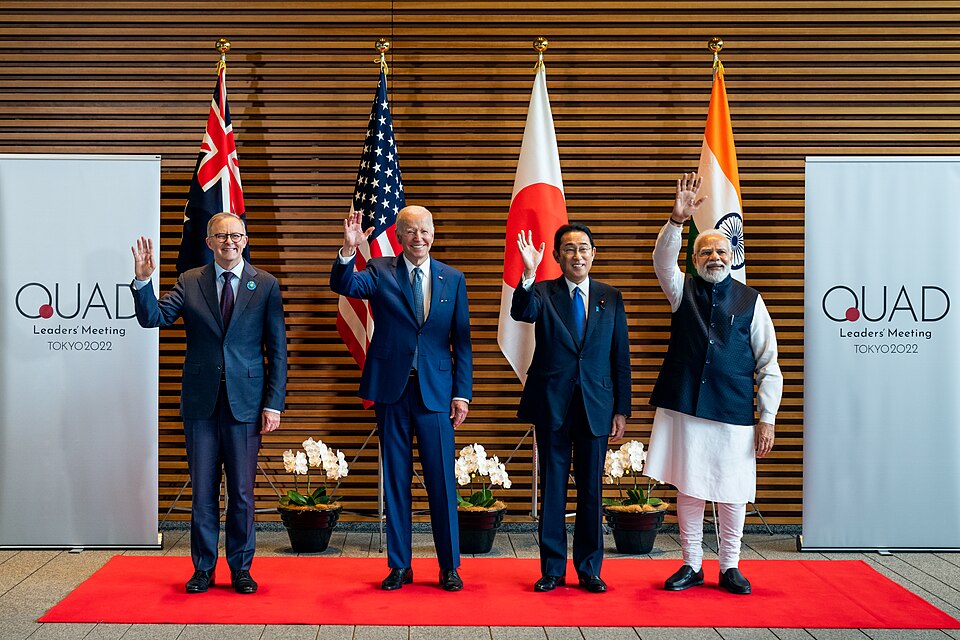
Moving up the ladder. In September 2019, Quad foreign ministers met for the first time, on the margins of the UN General Assembly in New York. In 2021, the Quad was raised to the level of leaders. The first Quad Leaders' Summit was held in virtual format on 12 March 2021, and it issued a joint statement called 'The Spirit of the Quad'.
Summits so far. Six leaders' summits have been held, two of them virtual. In-person summits took place in Washington (2021), Tokyo (2022), Hiroshima (2023) and Wilmington, USA (21 September 2024). Foreign ministers have met eleven times, most recently in New Delhi on 26 May 2026, where they announced a Quad Critical Minerals Initiative Framework and a statement on energy security.
A name with a message. The group is formally called the 'Quad', not the 'Quadrilateral Security Dialogue'. The choice signals that it is a broad partnership for public goods, not a security pact. India in particular stresses this, because it wants the Quad to be seen as a force for good rather than a bloc against any country.
Why it matters. The long gap between 2007 and 2017 shows that the Quad grew only when the four countries' worries about the region came together. Its rise to leader level in 2021 marked it as a serious and lasting grouping.
What the Quad actually does
Four pillars. The Quad organises its work under four pillars: maritime and transnational security; economic prosperity and security; critical and emerging technologies; and humanitarian assistance and disaster response. Its work focuses on three sub-regions: South-East Asia, the Indian Ocean Region and the Pacific Islands.
Watching the seas. In 2022, the Quad announced the Indo-Pacific Partnership for Maritime Domain Awareness (IPMDA). It gives partners near-real-time, low-cost information about what is happening at sea, such as illegal fishing. The programme reaches partners through the Pacific Islands Forum Fisheries Agency, South-East Asia and the Information Fusion Centre-Indian Ocean Region at Gurugram.
Training and coast guards. At Wilmington in 2024, leaders announced MAITRI, the Maritime Initiative for Training in the Indo-Pacific, to help partners use these tools to monitor their waters and enforce their laws. India was to host the first MAITRI workshop in 2025. The coast guards of the four countries also planned a first-ever Quad-at-Sea Ship Observer Mission in 2025.
Health and disasters. In 2021 and 2022, the Quad delivered more than 400 million COVID-19 vaccine doses to Indo-Pacific countries. In 2024, it launched the Quad Cancer Moonshot, starting with cervical cancer, and an Indo-Pacific Logistics Network pilot to share airlift capacity for faster disaster relief.
Technology and supply chains. The Quad works on semiconductors, undersea cables, ports and digital public infrastructure. In 2024, leaders adopted principles for digital public infrastructure, an area where India's experience with such platforms is widely noticed. In 2026, foreign ministers added a framework on critical minerals.
Why it matters. These projects deliver public goods to smaller countries in the region. By offering help rather than demands, the Quad builds trust and shows smaller states that they have choices beyond any single big power.
India's own idea of the Indo-Pacific
Where the idea came from. In 2007, Japanese Prime Minister Shinzo Abe spoke in India's Parliament about the 'Confluence of the Two Seas', linking the Indian and Pacific Oceans. Over the next decade, many countries began to treat the two oceans as one strategic space. India gave this idea its own shape.
The Shangri La speech. On 1 June 2018, Prime Minister Modi set out India's vision at the Shangri La Dialogue in Singapore. India calls for a free, open and inclusive Indo-Pacific based on respect for sovereignty and territorial integrity, peaceful settlement of disputes and adherence to international law. It supports freedom of navigation and overflight for all, and its vision rests on ASEAN centrality.
Why 'inclusive' matters. India's idea is not aimed at any country. By stressing inclusiveness and ASEAN's central place, India signals that the Indo-Pacific should be open to all who respect the rules. This keeps India's approach different from a containment strategy.
From words to work. In April 2019, the Ministry of External Affairs set up a new Indo-Pacific Division to turn this vision into policy. On 4 November 2019, at the East Asia Summit in Bangkok, India launched the Indo-Pacific Oceans Initiative (IPOI).
The seven pillars of IPOI. The IPOI is an open initiative built on seven pillars: maritime security; maritime ecology; maritime resources; capacity building and resource sharing; disaster risk reduction and management; science, technology and academic cooperation; and trade connectivity and maritime transport. Partners can choose the pillars that suit them. Japan's Free and Open Indo-Pacific vision fits closely with it, and South Korea joined the IPOI in 2026.
Why it matters. The IPOI lets India lead in the Indo-Pacific on its own terms, using cooperation on oceans rather than military pacts. It complements the Quad while reaching countries that may not wish to join a four-nation group.
What the Quad stands for, and what it does not
A region free from coercion. In the Wilmington Declaration of 2024, Quad leaders said they seek a region where no country dominates and no country is dominated. They opposed any unilateral action to change the status quo by force or coercion. They also stressed respect for sovereignty, territorial integrity and the peaceful settlement of disputes.
The law of the sea. The leaders stressed adherence to international law, particularly the UN Convention on the Law of the Sea (UNCLOS), for dealing with maritime claims. They expressed serious concern about the situation in the East and South China Seas, including the militarisation of disputed features. Such statements show the shared worry that drives the Quad, even though the group avoids naming a target.
Respect for regional groupings. The Quad repeatedly says it supports ASEAN centrality and unity, the Pacific Islands Forum and the Indian Ocean Rim Association (IORA). This reassures smaller countries that the Quad will not replace their own institutions. It also matches India's own emphasis on inclusiveness.
What the Quad is not. The Quad is a partnership built on practical cooperation, not a treaty with a promise of mutual defence. Each member also keeps its own ties with other powers. For India, this flexible format allows close cooperation with the United States, Japan and Australia while it continues to work with Russia, engage China and lead the Global South.
Why it matters. The Quad's careful language lets it address real concerns about coercion at sea without turning into a military bloc. This balance is exactly what allows India to take part fully.
When, where and why: the Quad and the Indo-Pacific at a glance
This table puts the main milestones in order so you can see how the idea and the grouping grew together.
| When | What | Why it matters |
|---|---|---|
| 2004 | Tsunami relief coordination | Genesis of the Quad |
| May 2007 | First Quad officials' meeting | Early start, then a pause |
| 2007 | Abe's 'Confluence of the Two Seas' speech | Indo-Pacific idea |
| Nov 2017 | Officials meet in Manila | Revival after ten years |
| 1 Jun 2018 | Shangri La Dialogue speech | India's Indo-Pacific vision |
| Sep 2019 | First Quad foreign ministers' meeting | Ministerial level |
| 4 Nov 2019 | IPOI launched at East Asia Summit | Seven-pillar initiative |
| 12 Mar 2021 | First leaders' summit (virtual) | Leader level |
| 21 Sep 2024 | Wilmington Declaration | MAITRI, Cancer Moonshot |
Read across each row: a date, an event and the reason it matters. Notice how the idea of the Indo-Pacific and the Quad grew side by side.
Quick revision
- The Quad brings together India, Australia, Japan and the US; it came together during the 2004 tsunami and is formally called the 'Quad'.
- Officials first met in May 2007, met again in Manila in November 2017 after ten years, and foreign ministers first met in September 2019.
- The first leaders' summit was virtual on 12 March 2021; the sixth was at Wilmington on 21 September 2024.
- The four pillars are maritime security, economic security, critical technologies and disaster response; focus areas are South-East Asia, the Indian Ocean and the Pacific Islands.
- IPMDA (2022) shares maritime data and reaches the IFC-IOR at Gurugram; MAITRI (2024) trains partners.
- Wilmington launched the Cancer Moonshot, a coast guard observer mission and a logistics network; the Quad gave over 400 million vaccine doses.
- India's Indo-Pacific vision was set out at the Shangri La Dialogue on 1 June 2018, based on ASEAN centrality and inclusiveness.
- The IPOI was launched at the East Asia Summit in Bangkok on 4 November 2019 with seven pillars.
- The Quad seeks a region where no country dominates and none is dominated, and backs UNCLOS, ASEAN, the Pacific Islands Forum and IORA.