

UPSC CSE · Module 15 · Mains depth · 14 min
Miniature painting II: Rajasthani, Pahari and Deccani
What UPSC CSE asks from this chapter
Syllabus lines this chapter covers:
- Prelims Paper I: General Studies · History of India and Indian National Movement.
- Mains Paper II: General Studies I (Heritage, culture, history, geography, society) · Indian culture will cover the salient aspects of Art Forms, literature and Architecture from ancient to modern times.
UPSC CSE questions from this module are being sorted into our bank.
Read at full depth: basics, the standard layer and the Mains analysis.
Start from zero: after the Mughal court
In the previous chapter, we saw how the Mughal atelier created a new style. But painting in India was never only a Mughal story. Rajput kings in Rajasthan, small hill states in the Himalayas and sultans in the Deccan all kept painters. Each court developed its own style.
Why so many styles? Each court had its own religion, poetry, landscape and taste. When imperial patronage weakened under Aurangzeb, many Mughal-trained painters moved to these courts. They mixed Mughal skill with local traditions, and regional painting bloomed.
Three big families. In this chapter, we study three families of style. They are Rajasthani painting of the Rajput courts, Pahari ("of the hills") painting of the Himalayan states, and Deccani painting of the southern sultanates. At the end, we also meet the later court styles of Tanjore and Mysore.
The key idea. These paintings are small, but they carry big things: love poetry, music, seasons and devotion. They connect with music (through Ragamala) and with dance (through the moods of the nayika). This makes them a favourite area for exam questions.
Rajasthani painting: roots, themes and colours
Older roots. The scholar Ananda Coomaraswamy showed that Rajasthani painting grew from pre-Mughal traditions, such as the western Indian style you met in the last chapter. It reached maturity in the 16th century and its full flowering around 1600. Later, Mughal contact added finer modelling and portraiture.
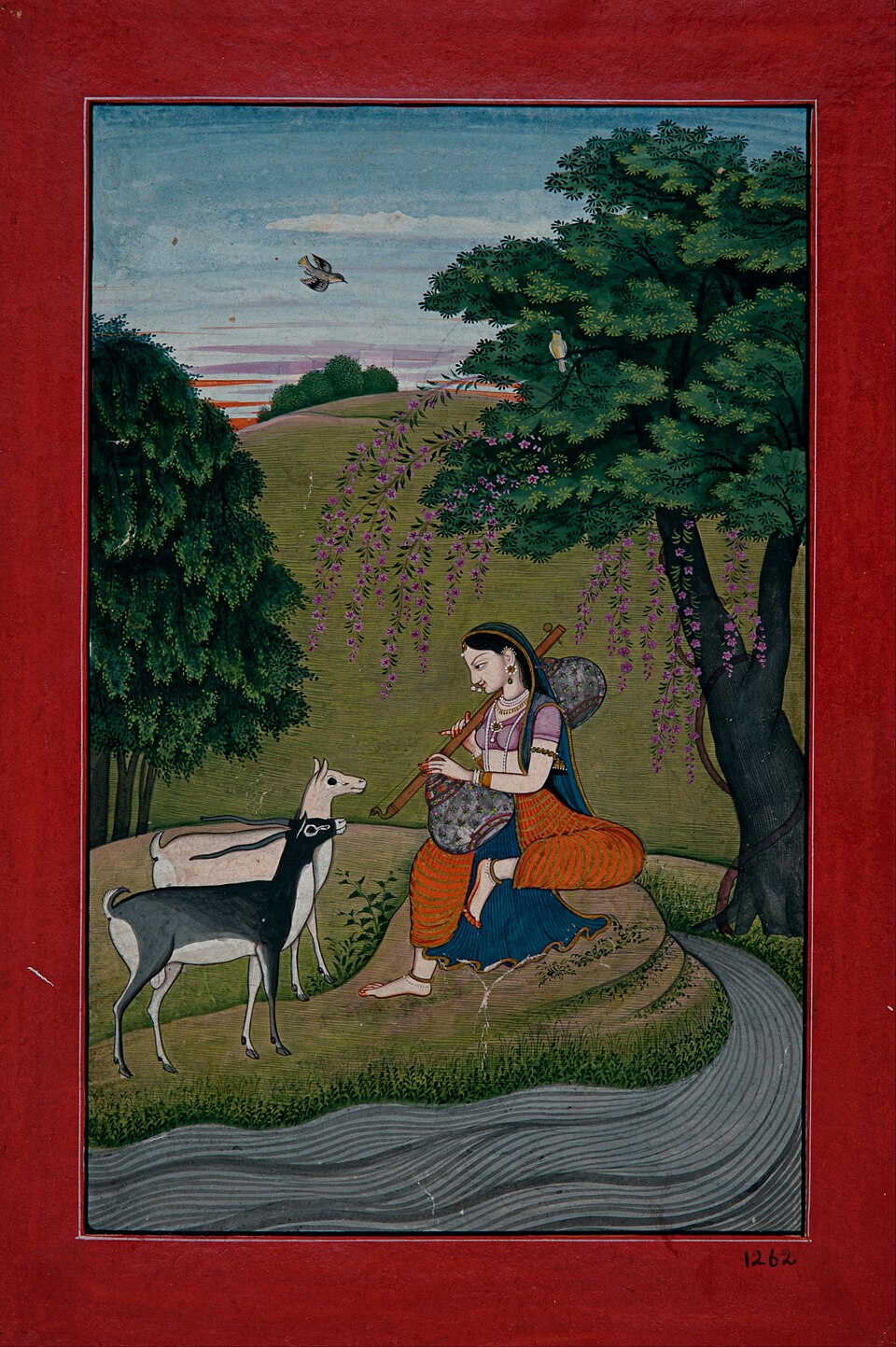
Nature at the centre. Nature is a main theme in Rajasthani painting. Trees, foliage, birds, rivers full of lotuses and rain falling from blue clouds fill the pictures. Nature is not just a background: it mirrors the feelings of the people in the scene.
Intense colours. Colours are bold and glowing: deep blue clouds, golden lightning and emerald foliage. In the 17th century, painters often divided a picture into compartments to tell several moments of a story. This makes the pages look lively and rhythmic.
Favourite themes. Painters loved stories of Krishna, the Gita Govinda of Jayadeva and the love poetry of the nayika and nayaka. Ragamala paintings gave each musical mode (raga or ragini) a picture, and Baramasa paintings showed the twelve months. Hunting scenes and portraits of rulers were also common.
The Rajasthani schools: Mewar, Bundi, Kota, Kishangarh and others
Mewar. Mewar, with its capital at Udaipur, is one of the oldest Rajasthani schools. Its earliest dated group of paintings is by Nisar Din in 1606. Sahib Din worked there from 1627 to 1648, and under Jagat Singh I (1628–52) a series on the types of heroines (Nayakabheda) was painted.
Bundi and Kota. Bundi had two high phases, around 1620–35 and 1680–1700. In the 18th century, Bundi painting became known for its feminine grace. Neighbouring Kota also developed its own school.
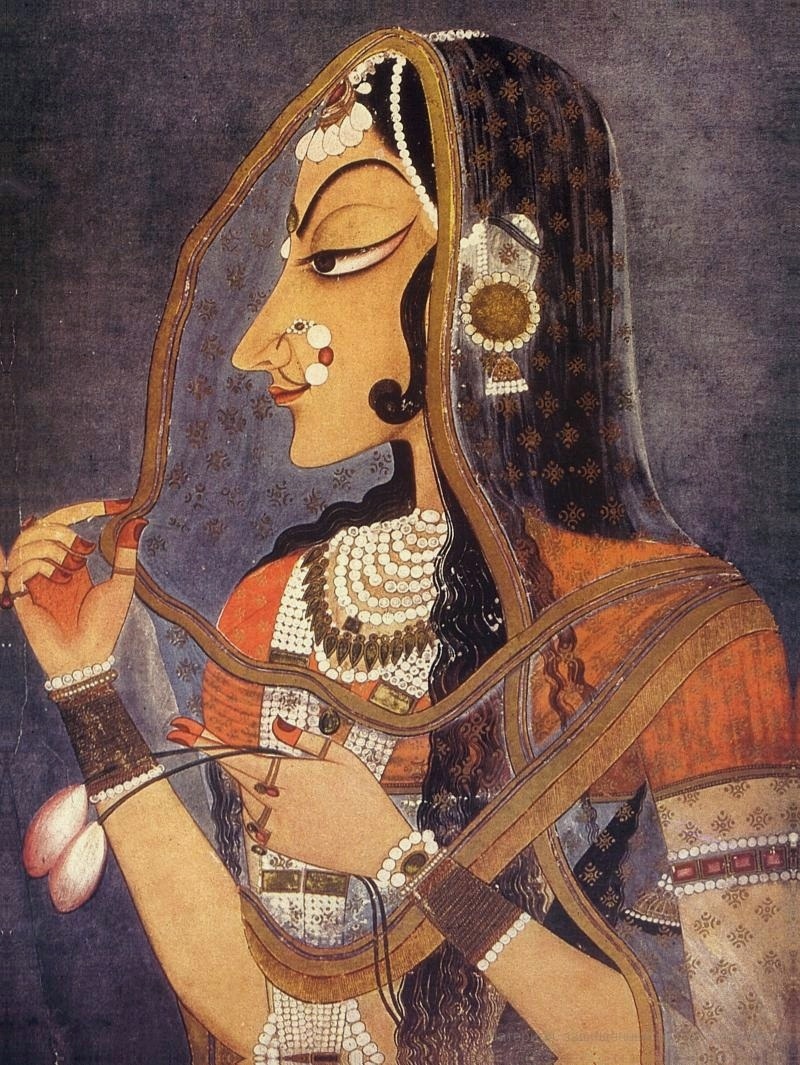
Kishangarh. The small state of Kishangarh produced one of the most famous styles. Its ruler Sawant Singh (1699–1764), a poet who wrote as Nagari Das, was devoted to Radha and Krishna. His painter Nihal Chand created a Radha with a sharp nose, long almond-shaped eyes, arched brows and a slender neck; the best-known example is Bani Thani, often called "India's Mona Lisa".
Malwa and others. Malwa in central India, Pratapgarh and later Jaipur also had schools. Todi Ragini, showing a lady with a veena and deer, is one of the best-known Ragamala subjects in Rajasthani painting. Each school shares the Rajasthani love of colour but has its own face types and moods.
| School | Key features | Names to remember |
|---|---|---|
| Mewar (Udaipur) | Oldest dated group; bold colours; Nayakabheda | Nisar Din (1606), Sahib Din, Jagat Singh I |
| Bundi | Feminine grace, lush nature | High phases 1620–35, 1680–1700 |
| Kishangarh | Elongated eyes, arched brows; Radha-Krishna | Sawant Singh (Nagari Das), Nihal Chand, Bani Thani |
| Malwa, Pratapgarh, Kota | Ragamala, regional faces | Todi Ragini (Ragamala) |
Pahari painting and the Basohli style
Painting in the hills. Pahari means "of the hills". This painting flourished in the small hill states of Himachal Pradesh, Jammu and Tehri-Garhwal, from about 1675 to 1823. Centres included Basohli, Mankot, Guler, Jammu, Kangra, Mandi, Chamba, Bilaspur, Kulu and Garhwal.
Why in the hills? The hill rajas were connected by marriage and trade, and their courts were safe from the wars of the plains. When Mughal patronage declined, trained painters found new homes here. Families of painters moved from one hill court to another, carrying their style with them.
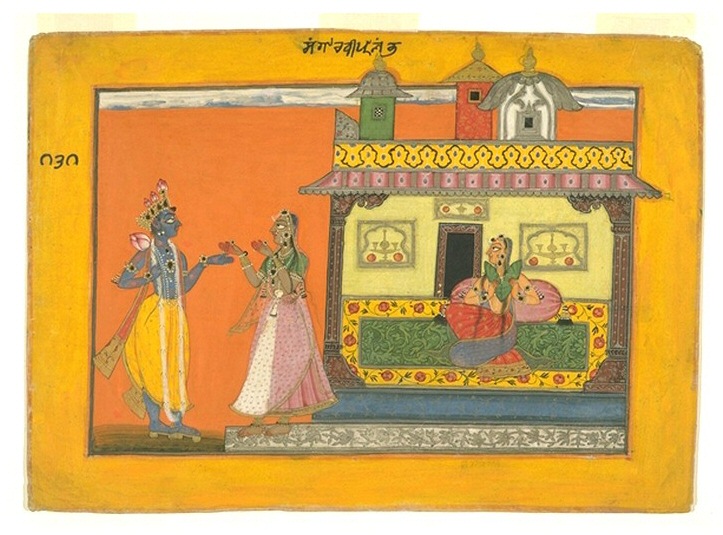
Basohli: bold and fiery. The earliest major Pahari style is Basohli, of the late 17th and 18th centuries, under patrons such as Kirpal Pal. Its paintings have bold, glowing colours, flat backgrounds of yellow or red and figures with large, staring eyes. The effect is strong and intense rather than soft.
Basohli works. A famous work is the Rasamanjari (a text on lovers and heroines) painted by Devidas in 1694–95. Basohli painters also illustrated the Bhagavata Purana. Over time, the fiery Basohli style gave way to the softer styles of Guler and Kangra.
Guler, Kangra and Chamba: the lyrical hills
A family of painters. The softer phase of Pahari painting is linked with one family. Pandit Seu and his sons Manaku and Nainsukh are among the greatest Pahari painters. Later painters such as Purkhu and Fattu carried the tradition forward.
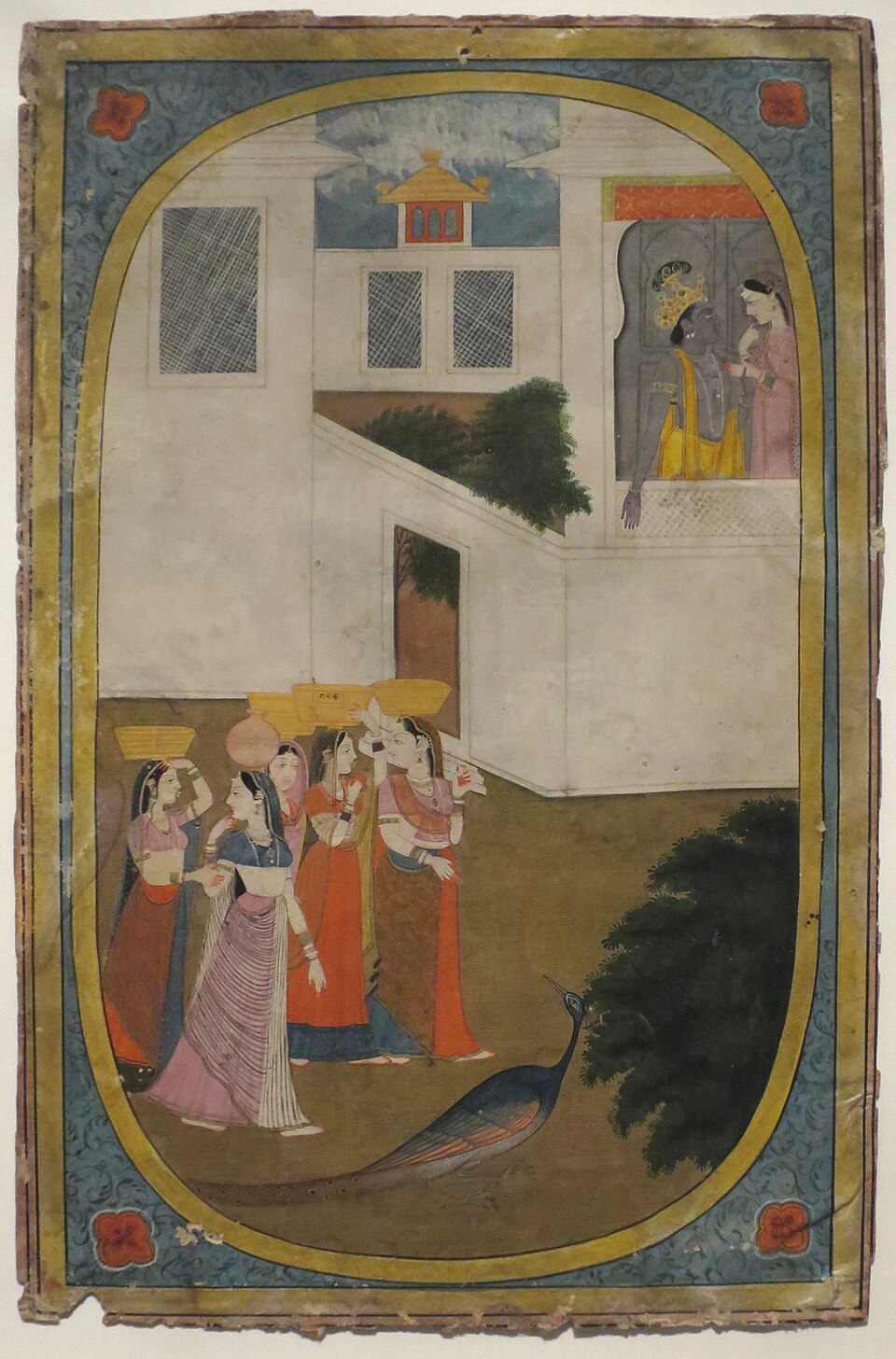
Kangra at its height. Kangra painting reached its peak under Raja Sansar Chand. Its figures are graceful, its lines delicate and its colours soft, with cool greens and gentle light. Painters used fine wasli paper (layers of paper pasted together), brushes of squirrel hair and touches of gold and silver.
Themes of love and seasons. Kangra painters loved Radha and Krishna, the Gita Govinda and the Baramasa. A Baramasa painting called "The Rains" (around 1800) follows the poet Keshavdas. Lovers, clouds, lightning and dancing peacocks show the longing of the rainy season.
Chamba and others. Chamba also produced fine series, and other hill states such as Mandi and Garhwal had their own flavours. A useful contrast for exams: Basohli is bold and intense, Kangra is soft and lyrical. Both show how one region could hold very different moods.
Deccani painting: the sultanates of the south
An independent school. In the Deccan, the sultanates of Ahmadnagar, Bijapur and Golconda developed their own painting from the late 15th century. This school is older than the Mughal school and grew independently of it. It reached its peak in the 17th century.
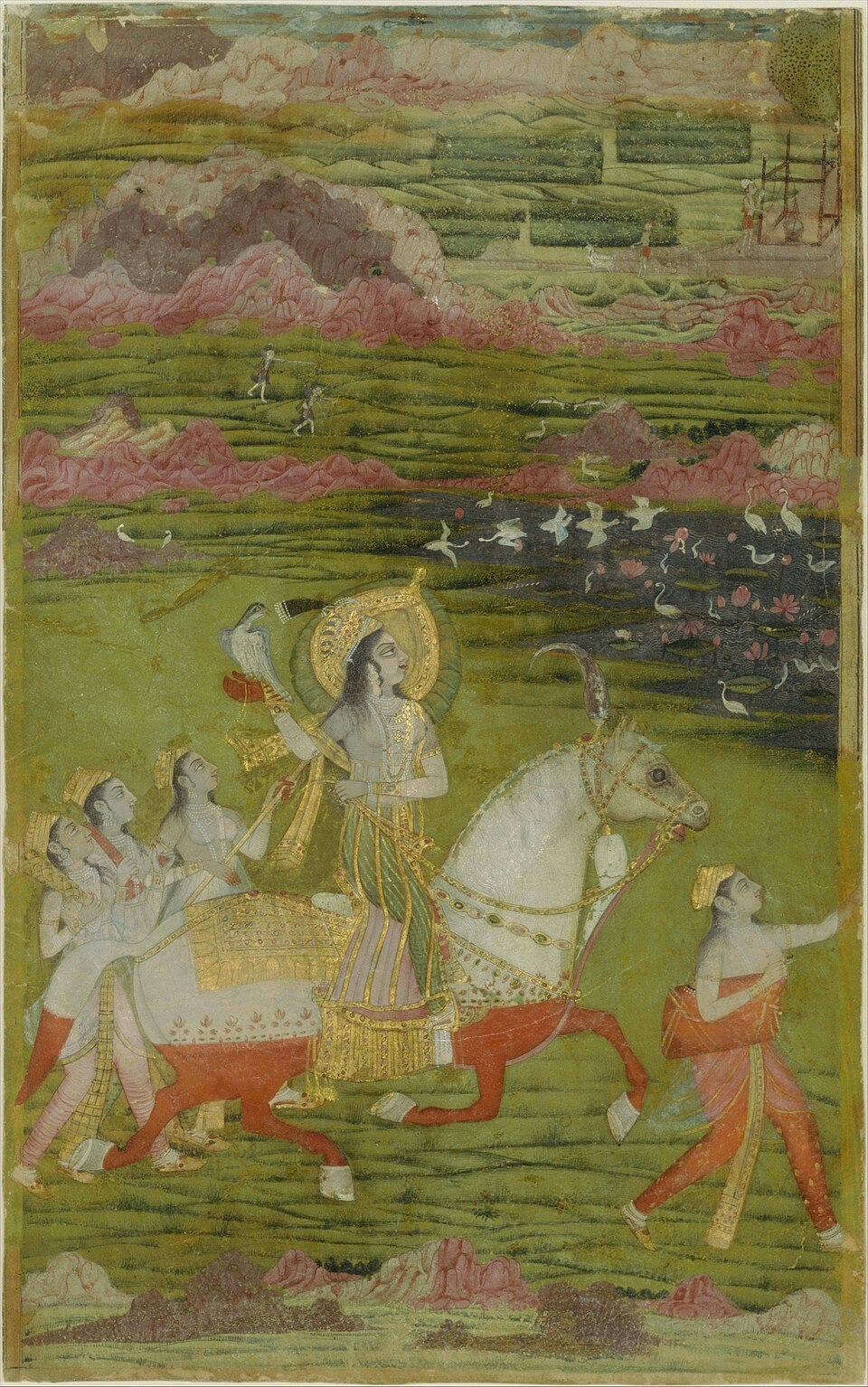
Early works. The earliest known Deccani manuscript is the Ta'rif-i Husain Shahi of Ahmadnagar (1565–69). The Nujum-ul-Ulum ("Stars of the Sciences"), made at Bijapur in 1570 under Ali Adil Shah, has 876 miniatures. A famous single painting shows Chand Bibi hawking.
Ibrahim Adil Shah II. Ibrahim Adil Shah II of Bijapur (1580–1627) was himself a painter and calligrapher. Ragamala paintings reached a peak in Ahmadnagar and Bijapur under him. At Golconda, Abdullah Qutb Shah (1626–72) had grand processions painted, and in the 18th century the style continued at Hyderabad under the Asaf Jahis.
What makes it Deccani. Deccani painting has a rich palette with much white and gold. Important figures are drawn larger than others (hierarchical scale), women wear plaque necklaces, and girdles and stoles swirl around the body. Persian, Turkish and local Indian elements blend into a dreamy, luxurious style.
Tanjore and Mysore: later southern court styles
Tanjore painting. In Thanjavur, painting grew under the Nayakas and then the Marathas (1676–1855). Tanjore paintings are usually of Hindu gods, especially Krishna, painted on wooden boards. Their special feature is a raised surface made with gesso (a chalk paste), covered with gold foil and set with gems or glass stones.
Why they glitter. These paintings were made for worship in homes and temples. The gold and stones catch the light of oil lamps, making the deity seem to shine. This devotional purpose explains the rich, frontal and decorative style.
Mysore painting. In Mysore, painting flourished under the Wodeyar kings. Mysore painting also uses gesso, but more lightly than Tanjore, with softer colours. A famous text, the Sritattvanidhi, compiled under Mummadi Krishnaraja Wodeyar, gives detailed rules and pictures for drawing deities.
Why they matter today. Tanjore and Mysore painting are living crafts, still practised by artists in Tamil Nadu and Karnataka. They link court painting with the folk and craft traditions of the next chapter. They are also a good example of how art serves devotion.
| Region | Style family | Signature feature |
|---|---|---|
| Rajasthan | Rajasthani | Bold colour, nature, Ragamala, Krishna |
| Himalayan hills | Pahari: Basohli, Kangra | Basohli bold; Kangra soft and lyrical |
| Deccan | Deccani | White and gold, swirling dress, pre-Mughal |
| Tamil Nadu | Tanjore | Gesso relief, gold foil, gems |
| Karnataka | Mysore | Light gesso, Sritattvanidhi |
Mains lens: practice questions
Debate: borrowed or home-grown? One view treats regional painting as a provincial echo of Mughal art. The better view sees two streams meeting: older local traditions (western Indian, early Rajput, Deccani) and Mughal techniques brought by migrating painters. The Deccan shows the strongest proof, since its school is older than the Mughal one.
Art as a record of society. These paintings show court life, dress, festivals, music and the devotion of the Bhakti movement. They tell us about the tastes of patrons and the movement of artist families. Used carefully, they are a historical source as well as art.
These are practice questions written by us, not past papers. Past questions from your exam appear in the PYQ panel.
| Angle | Question | Key points to cover |
|---|---|---|
| Comparison | Compare the Rajasthani and Pahari schools of painting. | Region, period; colour (bold vs Basohli bold, Kangra soft); themes Krishna, Ragamala, Baramasa; patrons; painter families. |
| Synthesis | Regional schools were a meeting of local traditions and Mughal technique. Examine. | Pre-Mughal roots; Aurangzeb and migration; Kishangarh, Kangra; Deccan older than Mughal. |
| Integration | How did miniature painting connect poetry, music and devotion? | Gita Govinda, Rasamanjari, Keshavdas; Ragamala; Baramasa; Bhakti; Nagari Das. |
| Heritage | Suggest ways to keep traditional painting styles alive. | Tanjore and Mysore as living crafts; museums, digitisation; training; GI and markets. |
Answer plan for the comparison question. Open by placing both schools on a map and a timeline. In the body, compare patrons, themes, colour and line, giving one named work for each (Bani Thani, the Basohli Rasamanjari, a Kangra Gita Govinda). Conclude that both shared Krishna devotion but expressed it in different moods.
Quick revision
- Why regional styles: local traditions + Mughal-trained painters who migrated when patronage fell under Aurangzeb.
- Rajasthani: pre-Mughal roots, full flowering ~1600; nature, intense colour, compartments; Krishna, Gita Govinda, Ragamala, Baramasa.
- Mewar: Nisar Din 1606, Sahib Din, Jagat Singh I. Bundi: feminine grace. Kishangarh: Sawant Singh (Nagari Das), Nihal Chand, Bani Thani. Also Kota, Malwa, Pratapgarh, Jaipur; Todi Ragini.
- Pahari (HP, Jammu, Tehri-Garhwal, ~1675–1823): Basohli (Kirpal Pal; bold colour, staring eyes; Devidas Rasamanjari 1694–95) → Guler, Kangra (Sansar Chand; soft, lyrical; wasli, squirrel-hair brushes); Chamba.
- Painters: Pandit Seu → Manaku, Nainsukh; Purkhu, Fattu.
- Deccani (Ahmadnagar, Bijapur, Golconda; older than Mughal; peak 17th c): Ta'rif-i Husain Shahi; Nujum-ul-Ulum 1570 (876); Ibrahim Adil Shah II; Chand Bibi hawking; white and gold.
- Tanjore: Nayakas, Marathas; gesso, gold foil, gems. Mysore: Wodeyars; light gesso; Sritattvanidhi.