

UPSC IES / ISS · Module 35 · standard depth · 17 min
Money: from barter to money supply (M1 to M4)
What UPSC IES / ISS asks from this chapter
Syllabus lines this chapter covers:
- IES: General Economics II · Theory of employment, Output, Inflation, Money and Finance
- IES: Indian Economics · Money and Banking
UPSC IES / ISS questions from this module are being sorted into our bank.
Cut to standard depth for UPSC IES / ISS. 7 deeper paragraphs are in the full chapter.
Start from zero: life without money
Imagine a village with no money at all. A potter wants rice. The rice farmer does not want pots; he wants shoes. The cobbler wants pots but has no rice.
Trading goods directly for goods is called barter. Barter works only when two people happen to want exactly what the other has. Economists call this the double coincidence of wants, and it is rare.
Barter has other problems too. How many pots is one goat worth? You cannot split a goat to pay for half a sack of rice. And rice stored for next year may rot.
Money solves all of these. Everyone accepts it, so the potter sells pots for money and uses the money to buy rice. This chapter explains what money does, what counts as money in India today, and how the RBI measures the total money supply.
What money does: its functions
The principal role of money is to make exchange easy, but it serves other purposes as well.
- Medium of exchange. This is money's first and foremost role. You sell your labour or goods for money, and use money to buy what you need. Barter's double coincidence problem disappears.
- Unit of account. Money gives a common measure of value. A shirt costs ₹500 and a book ₹250, so you know at once that the shirt is worth two books.
- Store of value. You can keep money today and spend it next month or next year. Unlike rice, it does not rot.
Why this matters: each function depends on trust. If prices rise very fast, money loses value quickly, and people stop using it as a store of value. That is one reason why controlling inflation (see Inflation: meaning, causes and types) protects money itself.
What counts as money in India
Currency. Notes and coins are the most visible form of money. In India, the RBI issues currency notes, and they are fiat money. This means they have value because the law makes them acceptable for payment, not because the paper itself is valuable.
Bank deposits. Most money today is not cash. When you pay by cheque, debit card or a phone payment app, you move money from one bank account to another. So the balance in your bank account is money too.
High-powered money. The currency issued by the central bank can be held by the public or by banks. This money is called high-powered money, reserve money or the monetary base. It is "high-powered" because banks use it as the base on which they create loans and deposits.
Why this matters: when we talk of "how much money is in the economy", we must count bank deposits, not just cash. That is why there are several measures of money supply.
Measuring money supply: M1, M2, M3 and M4
Money supply is the total stock of money held by the public at a point in time. The RBI has used four measures of it, from the most liquid to the least liquid. Liquid means how quickly something can be used to pay.
| Measure | What it includes | Type |
|---|---|---|
| M1 | Currency with the public + net demand deposits of commercial banks | Narrow money |
| M2 | M1 + savings deposits with Post Office savings banks | Narrow money |
| M3 | M1 + net time deposits of commercial banks | Broad money |
| M4 | M3 + total deposits with Post Office savings organisations (excluding NSCs) | Broad money |
Reading the table. Demand deposits are savings and current account balances you can withdraw any time. Time deposits are fixed deposits, which you lock in for a period. The word "net" means that only the public's deposits are counted, not deposits of one bank with another.
Narrow and broad money. M1 and M2 are narrow money, and M3 and M4 are broad money. The measures fall in liquidity from M1 to M4. M3 is the most commonly used measure of money supply.
Latest data. The RBI releases data on reserve money and money supply every fortnight. The latest release, dated 11 November 2026, covers the fortnight ended 31 October 2026.
How banks multiply money
Banks do not keep all deposits as cash. They keep a part as reserves and lend out the rest. The loan is spent, and the money comes back into some bank as a new deposit. Then that bank lends out a part of it again.
A simple example. Suppose banks must keep 20% of deposits as reserves. You deposit ₹100. The bank keeps ₹20 and lends ₹80.
The ₹80 is spent and deposited in another bank, which keeps ₹16 and lends ₹64. This goes on, and in the end reserves of ₹100 create deposits of 5 × 100 = ₹500.
The money multiplier. The ratio of total money supply to high-powered money is the money multiplier. In this simple example, with a 20% reserve ratio, it is 1 ÷ 0.20 = 5. If the reserve ratio rises, banks can lend less, and the multiplier falls.
The brakes. The legal reserve requirement limits how much credit banks can create. In India these brakes are the CRR and SLR, which the RBI sets (see The RBI and monetary policy: repo rate, CRR, SLR and the MPC). Real-life multipliers are smaller than 5, because people also keep some cash at home.
Who makes money, and why a paper note has value
Start with a simple puzzle. A ₹500 note costs only a few rupees to print, yet a shopkeeper gives you ₹500 worth of goods for it. The paper itself is almost worthless, so the value must come from somewhere else. It comes from the law and from trust.
The law makes it acceptable. Under Section 22 of the RBI Act, 1934, the Reserve Bank alone can issue banknotes in India. Under Section 26, every banknote is legal tender, which means it must be accepted in payment for the amount written on it. So no one can refuse a genuine note for a debt. Coins and ₹1 notes are the exception, because the Government of India issues them under the Coinage Act, 2011.
Trust makes it valuable. Money whose value rests on the law and on trust, rather than on the metal in it, is called fiat money. Gold coins once carried their own value, but a modern note does not. It keeps its value only as long as people believe it will buy the same things tomorrow. That is why a central bank that lets prices race ahead slowly destroys the very money it issues.
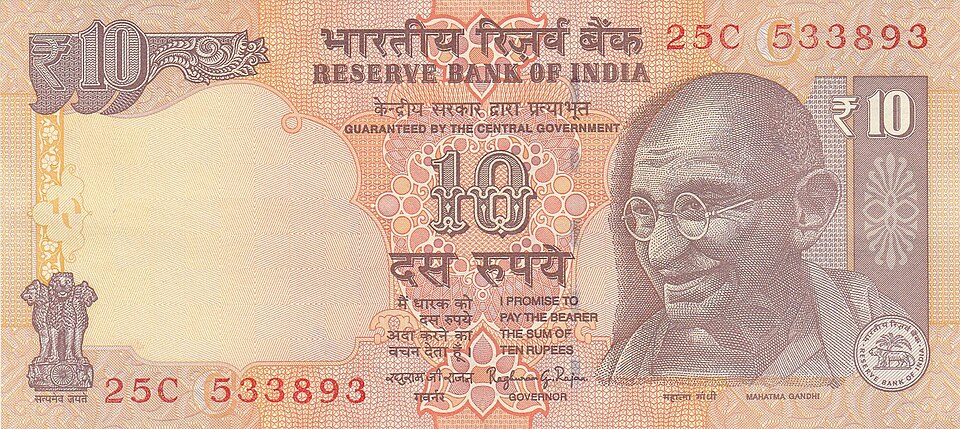
What stands behind the note? Under Section 33 of the RBI Act, the notes the RBI issues are backed by assets such as gold coin, gold bullion and foreign securities. These assets do not mean you can swap a note for gold. They show that the issuer holds real assets against its promise.
Which notes exist? The highest note ever printed was the ₹10000 note of 1938. The ₹2000 note came in November 2016 under Section 24(1) of the RBI Act. It has since been withdrawn from circulation, but it still remains legal tender, which is a useful exam trap.
Demonetisation 2016: what it teaches about money
What happened. On 8 November 2016, the legal tender status of the ₹500 and ₹1000 notes issued till that day was withdrawn. These old notes were called Specified Bank Notes. People had to deposit or exchange them at banks within a fixed window, after which they stopped being money.
Why it was done. The RBI explained that high denomination notes had been misused for hoarding black money and by terrorists. It also pointed out that fake notes were being used for illegal activities. Taking the big notes out of use was meant to hit all three at once.
What it teaches. Demonetisation shows plainly that a note is money only because the law says so. On 8 November an old ₹1000 note could buy groceries, but the next day the same paper could not, because Section 26's legal tender cover had been removed. So the value of fiat money rests on the issuer's word, which is why that word must be used carefully.
The debate it opened. Supporters argue that it pushed people towards bank accounts and digital payments and made hidden cash harder to keep. Critics argue that a sudden cash shortage hurt daily-wage workers, farmers and small traders, who run mostly on cash. A balanced Mains answer states the aims, weighs both sides, and then judges the policy by its results rather than its intentions.
How hard each rupee works: velocity and the quantity of money
Start with one note. On Monday a farmer pays ₹100 to a tailor, on Tuesday the tailor pays it to a grocer, and on Wednesday the grocer pays it to a farm worker. The same note has paid for ₹300 of goods in three days. How many times a rupee changes hands in a period is called the velocity of money.
The quantity equation. Economists link money and spending in one simple identity: M × V = P × T. Here M is the stock of money, V is its velocity, P is the price level and T is the volume of goods and services traded. The left side is the money spent, and the right side is the value of what was bought, so the two must be equal.
What it predicts. Suppose velocity and real output change slowly. Then if the money stock grows much faster than output, the extra money can only push up P, the price level. This is the old quantity theory of money, and it is the reason central banks once watched money growth so closely.
Where it breaks down. The theory works only if velocity is steady. But when people switch to UPI, keep more savings in banks or hold cash during a crisis, velocity shifts in ways that are hard to predict. That is exactly why the RBI moved away from targeting money supply towards targeting inflation directly, as the next section explains.
A worked example. Suppose M is ₹100 lakh crore and V is 2, so spending is ₹200 lakh crore. If M rises by 10% while V and real output stay the same, prices must rise by about 10%. But if output also grows 6%, prices rise by only about 4%, which shows why money growth should roughly match growth in output.
Why we measure money in four ways: when, where and why
The problem: money is not one thing. Notes in your pocket can be spent at once. A savings deposit takes a trip to the bank or a click. A fixed deposit is locked for months. If the RBI wants to know how much "spending power" is in the economy, it has to decide which of these to count.
The answer: a ladder of measures. M1 counts the most liquid money: currency with the public and demand deposits. M3 adds time deposits, which people can turn into spending more slowly. That is why M1 and M2 are called narrow money and M3 and M4 broad money, in decreasing order of liquidity. M3 is the most commonly used measure of money supply.
Why reserve money matters most to the RBI. Currency and banks' deposits with the RBI form high-powered money. Banks lend many times over on this base (see Banks: how they work, how they create money, and the types of banks), so a small change in reserve money can move M3 a lot. This is why CRR and other tools that change reserves are so powerful.
Why the RBI once targeted money and then stopped. From 1985 to 1998 the RBI aimed at the growth of money supply, because it believed money and prices moved together in a steady way. After the 1991 reforms that link became unstable, so the RBI moved to watching many indicators and then, from 2016, to targeting inflation directly (see Inflation: meaning, causes and types). Money supply is still watched, but as one signal among many.
Implication. Rapid growth of broad money can warn of future inflation or of a credit boom, and very slow growth can warn of weak demand. That is why the RBI publishes money supply data every fortnight.
Quick revision
- Barter works only when each side wants what the other has, a double coincidence of wants, and money removes that need.
- Money's main function is to be a medium of exchange, and it also serves as a unit of account and a store of value.
- High-powered money, also called reserve money or the monetary base, is the currency issued by the central bank and held by the public or by banks.
- M1 is currency with the public plus the net demand deposits of banks.
- M2 is M1 plus savings deposits with Post Office savings banks.
- M3 is M1 plus the net time deposits of banks, and it is the measure used most often.
- M4 is M3 plus all Post Office savings deposits, leaving out National Savings Certificates.
- M1 and M2 are called narrow money, M3 and M4 are called broad money, and liquidity falls as we move from M1 to M4.
- The money multiplier is money supply divided by high-powered money, so with a 20% reserve ratio, ₹100 of reserves can support ₹500 of money.
- Under Section 22 of the RBI Act only the RBI issues banknotes, under Section 26 every note is legal tender, and coins and ₹1 notes come from the government under the Coinage Act, 2011.
- A modern note is fiat money, so its value rests on the law and on trust, and Section 33 requires assets such as gold and foreign securities to stand behind it.
- Demonetisation on 8 November 2016 removed the legal tender status of old ₹500 and ₹1000 notes, while the ₹2000 note was only withdrawn from circulation and is still legal tender.
- The quantity equation M × V = P × T shows that money growing much faster than output pushes up prices, but only if velocity stays steady.
Common confusions and exam traps:
- M2 adds Post Office savings deposits to M1, not bank time deposits; M3 adds bank time deposits to M1, not to M2.
- Demand deposits can be withdrawn any time; time deposits are for a fixed period.
- A higher reserve ratio means a smaller multiplier.