

UPSC IES / ISS · Module 45 · standard depth · 14 min
Genetic engineering: recombinant DNA, PCR and CRISPR
What UPSC IES / ISS asks from this chapter
Syllabus lines this chapter covers:
- General Studies (IES and ISS) · General knowledge including knowledge of current events and of such matters of everyday observation and experience in their scientific aspects as may be expected of an educated person who has not made a special study of any scientific subject.
UPSC IES / ISS questions from this module are being sorted into our bank.
Cut to standard depth for UPSC IES / ISS. 8 deeper paragraphs are in the full chapter.
Start from zero: editing the recipe book
In the last chapter, Heredity, DNA and genes, we saw that DNA is a recipe book written in four letters. For thousands of years, people could change living things only slowly, by choosing the best plants and animals to breed. They could not open the book and change a single line.
Genetic engineering changes that. It means directly cutting, copying, moving or changing genes in a living thing. A gene from one organism can even be placed into another, so that a bacterium, for example, makes human insulin.
Three tools made this possible, and each one built on the last:
- Recombinant DNA technology cuts a gene out and pastes it into a new home.
- PCR makes millions of copies of a chosen piece of DNA quickly.
- CRISPR edits genes at an exact spot, like changing one word in a book.
This chapter explains each tool step by step, then looks at how India uses and regulates them. Later chapters apply these tools to crops and to medicine.
Recombinant DNA: cut, paste and copy
Why it was needed. Before the 1970s, medicines like insulin for diabetics came from the organs of slaughtered animals. Supply was limited, and animal insulin sometimes caused reactions. Scientists wanted living cells that would make pure human proteins in large amounts.
What recombinant DNA means. "Recombinant" means recombined. Recombinant DNA (rDNA) is DNA made by joining pieces from two different sources, such as a human gene and a bacterial carrier. The first rDNA molecule was made in 1972 by Paul Berg, Herbert Boyer, Annie Chang and Stanley Cohen in the USA.
The five basic steps.
- Cut the wanted gene out of the donor DNA using a restriction enzyme.
- Cut a carrier, called a vector, with the same enzyme, so the ends match.
- Join the gene and the vector; their matching ends stick together.
- Seal the join with the enzyme DNA ligase, a step called ligation.
- Insert the recombinant DNA into a host cell, usually a bacterium, which multiplies and copies the gene with it.
Vectors: the delivery vans. A vector carries the new gene into the host and helps it copy there. The most common vector is a plasmid, a small ring of DNA found in bacteria, separate from their main chromosome. Viruses that infect bacteria (such as phage lambda) and larger hybrid carriers called cosmids are also used.
What it produced. This method lets bacteria or yeast act as tiny factories. Hormones such as insulin, vaccines and other medicines are now made this way. It also opened the door to genetically modified crops, which GM crops and biosafety covers.
Restriction enzymes: the molecular scissors
Every cut-and-paste job needs a good pair of scissors. In genetic engineering, those scissors are restriction enzymes. They were found in bacteria, which use them to chop up the DNA of invading viruses.
What they do. A restriction enzyme reads along DNA and cuts it only where it finds a particular short sequence, called its recognition site. Because the cut is always at the same place, scientists can cut out exactly the gene they want. The discovery of these enzymes earned Werner Arber, Daniel Nathans and Hamilton Smith the 1978 Nobel Prize in Physiology or Medicine.
How they are named. Each enzyme is named after the bacterium it comes from. Take EcoRI:
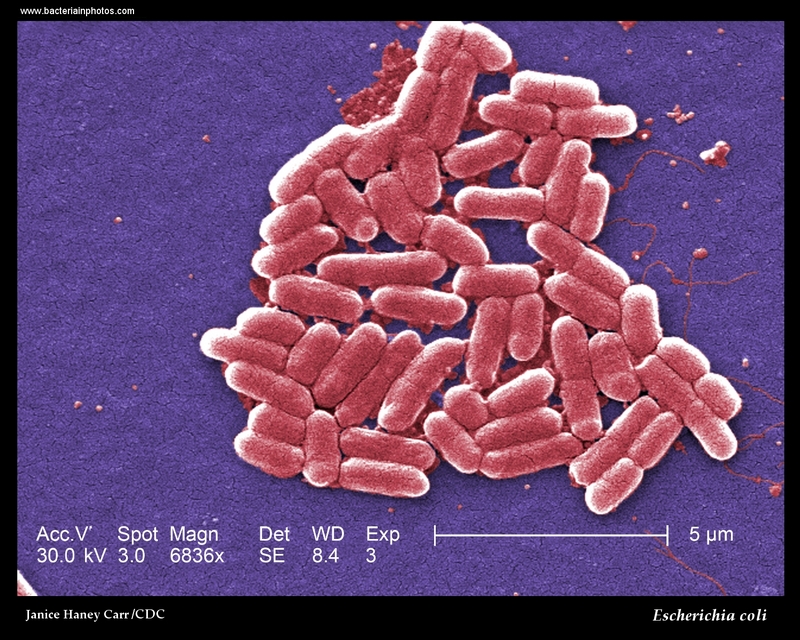
- E stands for the genus Escherichia;
- co stands for the species coli;
- R stands for the strain RY13;
- I means it was the first such enzyme found in that bacterium.
Sticky and blunt ends. Some enzymes cut the two strands at slightly different points, leaving short single-stranded tails called sticky ends. These tails easily pair with matching tails from another DNA cut by the same enzyme, which makes joining easy. Other enzymes cut straight across, leaving blunt ends, which are much harder to join.
PCR: a photocopier for DNA
Cutting and pasting genes needs enough DNA to work with. But a crime scene, a drop of blood or a single virus may give only a few DNA molecules. Scientists needed a way to make many copies quickly, without growing bacteria.
What PCR is. The polymerase chain reaction (PCR) makes millions of copies of one chosen piece of DNA in a few hours. Kary Mullis received the 1993 Nobel Prize in Chemistry for inventing it. It works like a photocopier that copies only the page you mark.
The three repeating steps.
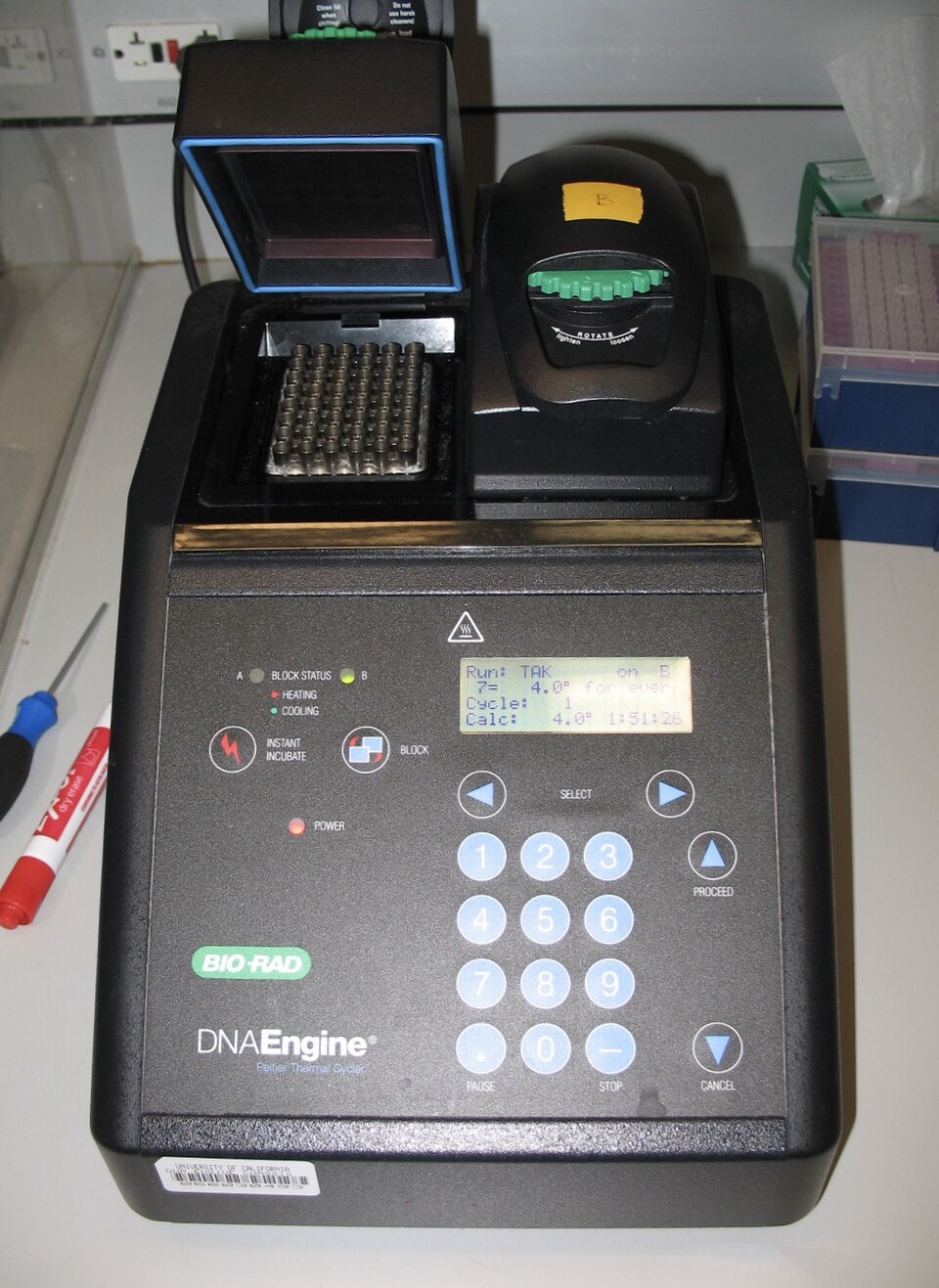
- Separate: the DNA is heated so its two strands come apart.
- Bind: the mix is cooled so that short starter pieces called primers stick to each end of the chosen region.
- Build: an enzyme, DNA polymerase, builds a new strand starting from each primer.
Why the copies explode. Each cycle doubles the number of copies: 1 becomes 2, 2 become 4, 4 become 8, and so on. After a few dozen cycles, one molecule becomes many millions. The machine that runs these cycles is a simple heater and cooler.
Where PCR is used.
- Disease testing: the RT-PCR tests widely used during COVID-19 detected the virus's genetic material in this way.
- Forensics: DNA fingerprinting from tiny samples of blood or hair.
- Research: making enough DNA for cloning and sequencing.
- Farming and food: checking whether a crop or food contains GM material.
CRISPR: editing a single word
Recombinant DNA adds whole genes, but it cannot easily fix one wrong letter at an exact place. For that, scientists needed a precise editing tool. CRISPR-Cas9 became that tool, and it changed biology in a few short years.
Where it came from. Like restriction enzymes, CRISPR was found in bacteria, which use it as an immune system to remember and cut the DNA of viruses that attacked them before. Scientists learned to reprogramme this natural system to cut any DNA they choose. Emmanuelle Charpentier and Jennifer Doudna received the 2020 Nobel Prize in Chemistry "for the development of a method for genome editing".
How it works, in two parts.
- A guide RNA acts like a GPS: it matches and finds one exact address in the genome.
- The Cas9 enzyme acts like scissors: it cuts the DNA at that address.
After the cut, the cell repairs the break itself. Scientists use this repair to switch a gene off, to make a small change, or to insert a new piece of DNA.
Three levels of editing (SDN). Regulators group edits by site-directed nuclease (SDN) type:
- SDN-1: the cut is repaired with small random changes, usually switching a gene off, and no foreign DNA is added.
- SDN-2: a small template guides a precise small change, again without adding a foreign gene.
- SDN-3: a whole new gene is inserted, which makes the result similar to a GM organism.
Why SDN-1 and SDN-2 matter. Because SDN-1 and SDN-2 add no foreign DNA, the result can be the same as a natural mutation. India has approved SDN-1 and SDN-2 genome editing under its biosafety regulations for general crops, which allows faster development than for GM crops.
India's first genome-edited rice. On 4 May 2025, India announced its first genome-edited rice varieties, made with CRISPR-Cas:
- DRR Dhan 100 (Kamala) from ICAR-IIRR, Hyderabad, based on the popular variety Samba Mahsuri;
- Pusa DST Rice 1 from ICAR-IARI, New Delhi, based on MTU 1010.
These are reported to give about 19% more yield and about 20% lower greenhouse gas emissions. Kamala also matures about 20 days earlier, saving water. Budget 2023-24 provided ₹500 crore for genome editing in crops.
Rules: how India regulates genetic engineering
Powerful tools need careful rules. A GM organism released by mistake could spread in nature, and a badly tested gene therapy could harm patients. So India regulates genetic engineering at every stage, from the lab to the field and the clinic.
The legal base. India's rules for genetically engineered organisms are the Rules of 1989, made under the Environment (Protection) Act, 1986. They cover making, using, importing, storing and releasing genetically engineered organisms. Placing the rules under an environment law shows that the main worry is safety for nature and people.
Who decides what. The Genetic Engineering Appraisal Committee (GEAC), under the Ministry of Environment, Forest and Climate Change, decides on releasing GM crops into the environment. Its role is explained in detail in GM crops and biosafety.
Gene therapy in humans. Treatments that change patients' genes follow the National Guidelines for Gene Therapy Product Development and Clinical Trials (2019), issued by ICMR, CDSCO and DBT. These set rules for testing safety step by step before a therapy can be widely used.
Why genome editing got lighter rules. SDN-1 and SDN-2 edits add no foreign gene, so they can be no different from natural mutations. India therefore approved them under its biosafety regulations with lighter checks than full GM crops, while SDN-3, which adds a new gene, is not part of this approval.
What genetic engineering changes, and the worries
We have studied three tools and India's rules. UPSC answers need to weigh their promise against their risks. Here are the main points.
1. Medicine. Recombinant DNA gave cheap insulin, vaccines and other medicines. PCR made fast disease testing possible, as the COVID-19 period showed. CRISPR opens the way to fixing faulty genes behind inherited diseases.
2. Farming. Genome editing can create crops that tolerate drought, salt and pests faster than traditional breeding. India's genome-edited rice shows how this could raise yields while saving water.
3. Ethical worries. Editing human embryos could pass changes to future generations, which raises deep moral questions. There are also fears of "designer babies" and of new inequalities if only the rich can afford such treatments.
4. Safety and trust. Edits can sometimes happen at the wrong spot in the genome. Clear rules, careful testing and honest public information are needed so that people trust these products.
Previous years' questions
This section shows the real past questions on this chapter for the exam you have chosen. Each question is copied word for word from the official paper, with the year and paper, so that you can see how the topic is actually asked.
Questions are being collected from the official UPSC and BPSC papers. They will appear here once each one is checked against the original paper.
Quick revision
- rDNA joins DNA from two sources; the first molecule was made in 1972. Its steps are cut, cut the vector, join, seal with ligase, and insert into a host.
- Restriction enzymes cut at recognition sites (Nobel 1978). In EcoRI, R is the strain.
- Sticky ends join easily, and blunt ends do not.
- Vectors include plasmids, phage lambda and cosmids.
- PCR copies DNA through separate, bind primers and build cycles, doubling each time (Mullis, Nobel 1993).
- CRISPR-Cas9 uses a guide RNA and Cas9 scissors (Nobel 2020, Charpentier and Doudna). SDN-1 and SDN-2 add no foreign DNA.
- India's first genome-edited rice came on 4 May 2025: DRR Dhan 100 (Kamala) and Pusa DST Rice 1. The rules are the 1989 Rules under EPA 1986, plus the 2019 gene therapy guidelines.