Orbits: where satellites go and how they get there
What UPSC IFoS asks from this chapter
Syllabus lines this chapter covers:
Prelims Paper I: General Studies · General Science.
UPSC IFoS questions from this module are being sorted into our bank.
Cut to standard depth for UPSC IFoS. 9 deeper paragraphs are in the full chapter.
Start from zero: why doesn't a satellite fall down?
A rocket's job ends once it has carried its satellite high above the Earth. It then lets the satellite go and falls away, as you saw in how a rocket works. So why doesn't the satellite simply fall back down?
Every throw comes down
Think of throwing a ball. Throw it gently and it lands near your feet. Throw it harder and it lands farther away.
A cricket fielder's throw from the boundary flies a long way before it comes down. It always comes down in the end, because the Earth's gravity pulls everything towards its centre.
The surprising answer is that a satellite never stops falling either. It moves sideways so fast that it keeps missing the ground, and that path is called an orbit.
This chapter builds that idea step by step. By the end you will know why some satellites sit 600 km up and others 36,000 km up. You will also see why a mission to the Sun first circles the Earth many times.
What is an orbit? Falling around the Earth
Remember the ball you threw with a gentle and a hard push? Now imagine you are standing on a mountain so tall that it rises above the air, so nothing slows the ball down. You throw the ball sideways.
Throw harder and harder: from falling to orbiting
Throw it gently: it curves down and hits the ground near the mountain.
Throw it harder: it travels much farther before it lands.
Throw it really hard: the Earth is round, so its surface curves away below the ball. If the ball is fast enough, the ground curves away as fast as the ball falls, and the ball comes all the way round to the mountain.
That never-ending fall is an orbit. In scientific words, an orbit is the curved path that an object in space follows around another object because of gravity. Gravity has not switched off up there. Gravity is the very thing that bends the satellite's path into a circle; without it, the satellite would fly off in a straight line.
How fast is "really hard"? A satellite in Low Earth Orbit moves at about 7.8 km/s. That is 7.8 kilometres every second, fast enough to cross India from Kanyakumari to Kashmir in under 7 minutes. At that speed, the satellite goes once around the whole Earth in about 90 minutes.
Why satellites stay above the air
Why must it be above the air? Air rubs against anything that moves through it and slows it down (this is air drag; you feel it when you put your hand out of a moving bus). A slowed satellite falls lower, meets thicker air, and slows even more, until it burns up. So satellites generally do not fly below about 180 km.
Types of orbits: the right height for the right job
Now we know what an orbit is, but not every orbit is the same.
Orbits by height, to scale
Think of floors in a tall building. A shop on the ground floor sees every passer-by up close. A water tank on the roof sees the whole colony. Satellites are the same: the height and tilt of an orbit decide what a satellite can do. There is one more rule to remember: the higher the orbit, the slower the satellite moves and the longer one round takes.
1. Low Earth Orbit (LEO): close and quick. LEO lies below about 2,000 km. Satellites here move at about 7.8 km/s and circle Earth in about 90 minutes.
Being close, they take sharp pictures and need less power to talk to the ground. Space stations and many Earth-observation satellites live here.
2. Polar and sun-synchronous orbits: the scanners. A polar orbit passes over the North and South Poles at an inclination of 90°. Polar orbits are typically 200 to 1,000 km high.
While the satellite goes round from pole to pole, the Earth turns beneath it, so each pass covers a new strip. Over days, it sees the whole planet, like peeling an orange in strips.
Polar, sun-synchronous, geostationary
A sun-synchronous orbit (SSO) is a special near-polar orbit, usually 600 to 800 km high. Its plane slowly turns so that it keeps the same angle to the Sun all year. Result: the satellite crosses any place at the same local time every day, say 10:30 a.m.
That gives the same lighting in every photo, so changes in crops, forests or floods can be compared fairly. This is why India's remote-sensing satellites use SSO, and why PSLV's payload figure is given for a "sun-synchronous polar orbit of 600 km".
3. Medium Earth Orbit (MEO): the in-between. MEO is the wide band between LEO and GEO. Navigation satellites commonly use this band.
4. Geostationary orbit (GEO): the one that seems to stand still. At 35,786 km above the equator, a satellite moving west to east takes 23 h 56 min 4 s for one round. That is exactly the time Earth takes to spin once (one sidereal day). So the satellite and the ground below turn together, and from Earth it seems fixed in the sky.
A dish antenna on your roof can point at it and never move. That is why TV broadcasting, many communication satellites and weather satellites that watch a whole hemisphere use GEO. Up there, a satellite moves at only about 3 km/s, much slower than in LEO.
L1: a parking spot to watch the Sun
5. Transfer orbits: the shortcut. No rocket takes a satellite straight to 35,786 km in a circle. Instead, it puts the satellite into a long oval called a geostationary transfer orbit (GTO), low at one end and high at the other.
GTO works like a shortcut. The satellite then fires its own engine at the high point to turn the oval into a circle. For LVM3, a typical GTO is 180 × 36,000 km.
6. Lagrange points: parking spots between Sun and Earth. Between two big bodies like the Sun and Earth, there are five points where their pulls balance in a special way, so a spacecraft can stay in step with Earth as both go round the Sun. They are called L1 to L5.
L1 lies between Earth and the Sun, and L2 lies on the far side of Earth; both are about 1.5 million km from Earth. From L1, a spacecraft can watch the Sun all the time, with Earth never blocking the view. India's Aditya-L1 is placed in a halo orbit (a loop) around L1.
Orbit
Height
Speed and time per round
Typical use
LEO
below about 2,000 km
about 7.8 km/s, about 90 min
Earth observation, space stations
Polar / SSO
200–1,000 km; SSO 600–800 km
(part of LEO)
Mapping, crops, forests, disasters
MEO
between LEO and GEO
slower than LEO
Navigation
GEO
35,786 km, over the equator
about 3 km/s, 23 h 56 min 4 s
TV, communication, weather
GTO
oval, about 180 × 36,000 km
changing
Route to GEO
Sun-Earth L1
about 1.5 million km
moves round the Sun with Earth
Watching the Sun (Aditya-L1)
Climbing step by step: how missions use orbits
We have seen the orbits. So how does a mission actually reach the one it needs?
Climbing step by step: parking orbit to destination
A rocket gives its passenger one big throw. After that, the spacecraft climbs the rest of the way with its own small engine, little by little, like a boy on a swing who pumps a little at the lowest point of each swing to go higher each time. Firing the engine at the closest point of an oval orbit stretches the far end higher.
Do it again and again, and the oval grows until the spacecraft can break away. This saves a lot of fuel compared with flying straight. Two Indian missions show this clearly.
Aditya-L1: four months to its orbit
Aditya-L1 (to watch the Sun):
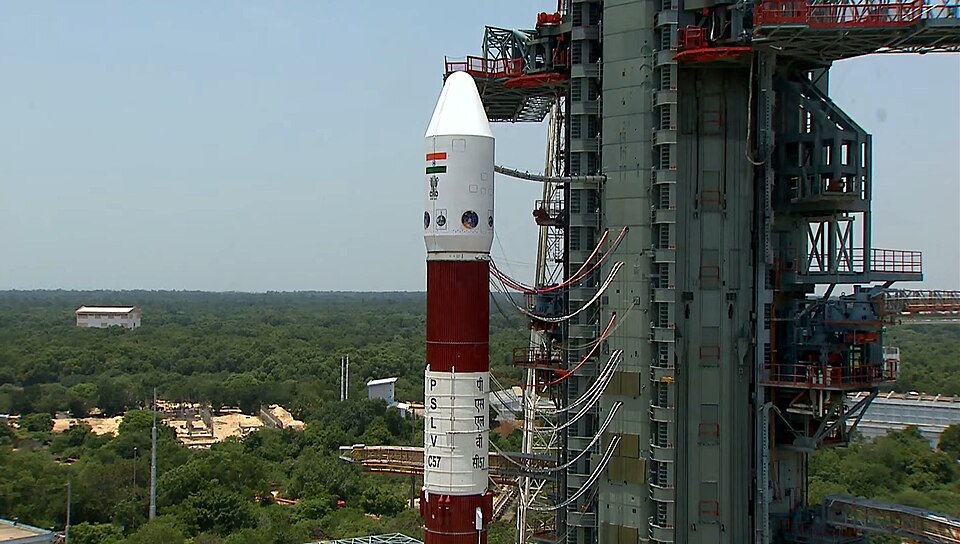
2 September 2023: PSLV-C57 lifted off from the Second Launch Pad of Satish Dhawan Space Centre (SDSC), Sriharikota, and put Aditya-L1 into an elliptical orbit of about 235 × 19,500 km around Earth.
In Earth orbit: ISRO made five engine burns. The fifth, called the trans-L1 injection, sent the spacecraft out towards L1.
Cruise: about 110 days of travel.
6 January 2024:halo-orbit insertion around L1, about 1.5 million km away. One round of this halo orbit takes about 178 Earth days (177.86 days, to be exact).
The heavier LVM3 (flight LVM3 M4) launched it from SDSC SHAR, Sriharikota, into an elliptic parking orbit of about 170 × 36,500 km.
After raising its orbit around Earth, it headed out to the Moon.
On 5 August 2023, its engine fired backwards (a retro-burn) for 1,835 seconds at the point closest to the Moon (perilune). This braking let the Moon's gravity capture it, in an orbit of 164 × 18,074 km.
Its propulsion module then carried the lander and rover down to a 100 km lunar orbit, ready for landing.
Why not just use a bigger rocket and fly straight? Because every extra kilogram of fuel needs even more fuel to lift it. Using a modest rocket plus clever orbit-raising is cheaper. The trade-off is time: Aditya-L1 took about four months to reach its orbit.
Why direction and destination change what a rocket can carry
The same rocket can carry very different loads, depending on where it is going. Two things decide this: the direction of launch and the height of the destination.
Earth's spin helps a rocket going east
Earth gives a free push to rockets going east. The Earth spins from west to east. Anything standing on it, including a rocket on the launch pad, is already moving eastward with the ground, and fastest at the equator. This is why launches are usually made near the equator. There, Earth's rotation gives a large part of the speed needed for orbit as a "free ride".
A rocket launched east keeps this bonus. A rocket going to a polar orbit flies north or south, so it cannot use this free ride. That is one reason why the same rocket can lift more to an eastward orbit than to a polar one.
Higher destination, smaller load
Higher destination = smaller load. Compare these figures for India's rockets:
GSLV Mk II: 6,000 kg to LEO, but only 2,250 kg to GTO.
LVM3: 8,000 kg to LEO (600 km), but 4,000 kg to GTO.
PSLV: 1,750 kg to a 600 km sun-synchronous orbit, 1,425 kg to a sub-GTO.
Why does the load fall so much? Getting to GTO needs much more speed than circling at 600 km. More speed means more propellant per kilogram of satellite, so less room is left for the satellite itself. This is the same as a bus that can carry 50 passengers to the next town but only 30 up a steep hill road.
Match the rocket to the job
Practical lesson for exams: match the rocket to the job.
Earth-observation satellite to SSO → PSLV.
Communication satellite to GTO, up to about 2 tonnes → GSLV Mk II.
Heavy communication satellite, Moon mission, or human flight → LVM3.
Small satellite to LEO on short notice → SSLV.
What the right orbit changes: the implications
Knowing what an orbit is, is only half the story. UPSC also asks so what? Here are the main ways in which the right orbit changes life on the ground.
Five ways reaching space changes life
1. Daily life. GEO satellites carry TV and communication signals across the whole country, so a dish on a village roof gets the same channel as one in Delhi. Weather satellites in GEO watch a whole hemisphere without a break, which helps track cyclones. Sun-synchronous satellites photograph the same field at the same time of day, so crop health, floods and forest loss can be compared fairly.
2. Science. Aditya-L1 watches the Sun from L1, and Chandrayaan-3 went to the Moon. Without launchers that can reach GTO-like orbits and then climb further, these missions would have needed foreign rockets.
3. New problems. More launches mean more objects left in orbit: spent upper stages, covers and dead satellites. In LEO, these stay for years before air drag pulls them down, and they can hit working satellites. So every space-faring country must now plan how to remove or lower old stages after use.
The one-line takeaway: each orbit is a tool. The height and tilt we choose decide what a satellite can do for people on the ground.
Previous years' questions
This section shows the real past questions on this chapter for the exam you have chosen. Each question is copied word for word from the official paper, with the year and paper, so that you can see how the topic is actually asked.
Questions are being collected from the official UPSC and BPSC papers. They will appear here once each one is checked against the original paper.
Quick revision
One-page revision card
An orbit is a never-ending fall around Earth. LEO lies below about 2,000 km, where a satellite moves at about 7.8 km/s and goes round in about 90 minutes.
SSO lies 600–800 km up, near the poles, and passes over each place at the same local time. GEO lies 35,786 km above the equator, where a satellite moves west to east at about 3 km/s and takes 23 h 56 min 4 s per round.
GTO is the oval route to GEO. L1 is about 1.5 million km away, and Aditya-L1 circles it in a halo orbit (launched by PSLV-C57 on 2 Sep 2023, halo insertion on 6 Jan 2024).
Launching east from near the equator gets a free ride from Earth's spin. A launch to a polar orbit does not get this boost.
Exam-style questions on this chapter. Pick an answer to see the explanation. 0 of 9 answered
A satellite stays in orbit mainly because:
In low Earth orbit, a satellite goes round the Earth about once every:
Consider the following statements:
1. A geostationary satellite lies about 35,786 km above the equator.
2. A geostationary satellite moves from east to west.
3. A geostationary satellite takes 23 h 56 min 4 s for one orbit.
Which of the statements given above is/are correct?
Earth-observation satellites are often put in a sun-synchronous orbit because such a satellite:
A geostationary transfer orbit (GTO) is:
Aditya-L1 is placed in:
Assertion (A): Rockets going to most orbits are launched eastwards from places near the equator.
Reason (R): Earth's west-to-east spin gives an eastward-launched rocket extra speed for free, and the effect is largest near the equator.
How does a satellite's speed change as its orbit gets higher?
How many engine burns did Aditya-L1 make in Earth orbit, counting the final trans-L1 injection?
Mains answer practice
Write your answer first, then open the points a good answer should cover.
Explain how sun-synchronous and geostationary orbits serve different needs. Add one problem that crowded orbits create. (150 words)
Show answer points
A sun-synchronous orbit lies 600–800 km up and passes over each place at the same local time.
That makes it suited to Earth observation: crops, floods and forest loss can be compared fairly.
A geostationary orbit lies 35,786 km above the equator, and a satellite there seems to stand still.
That suits TV, communication and non-stop weather watch, including cyclones.
Crowded orbits collect spent stages and dead satellites as debris, so old stages must be lowered or removed after use.
Previous year questions
Previous year questions for UPSC CSE will appear here once each one is checked word for word against the official question paper.
Frequently asked questions
What is a geostationary orbit?
An orbit 35,786 km above the equator where a satellite circles once per sidereal day, so it seems to stay over one spot.
What is a sun-synchronous orbit?
A near-polar orbit, usually 600–800 km high, that passes over each place at the same local time, which suits Earth-imaging satellites.
Where is Aditya-L1 placed?
In a halo orbit around the Sun–Earth L1 point, about 1.5 million km from Earth, reached on 6 January 2024.
Why are rockets launched eastward near the equator?
Earth's rotation gives a free boost in speed there, which saves fuel.