

UPSC NDA & NA · Module 11 · basic depth · 10 min
The Deccan laboratory: Aihole, Badami, Pattadakal and Ellora
What UPSC NDA & NA asks from this chapter
Syllabus lines this chapter covers:
- Paper II, Part B: General Knowledge · A broad survey of Indian History, with emphasis on Culture and Civilisation.
UPSC NDA & NA questions from this module are being sorted into our bank.
Cut to basic depth for UPSC NDA & NA. 17 deeper paragraphs are in the full chapter.
Start from zero: a laboratory of temples
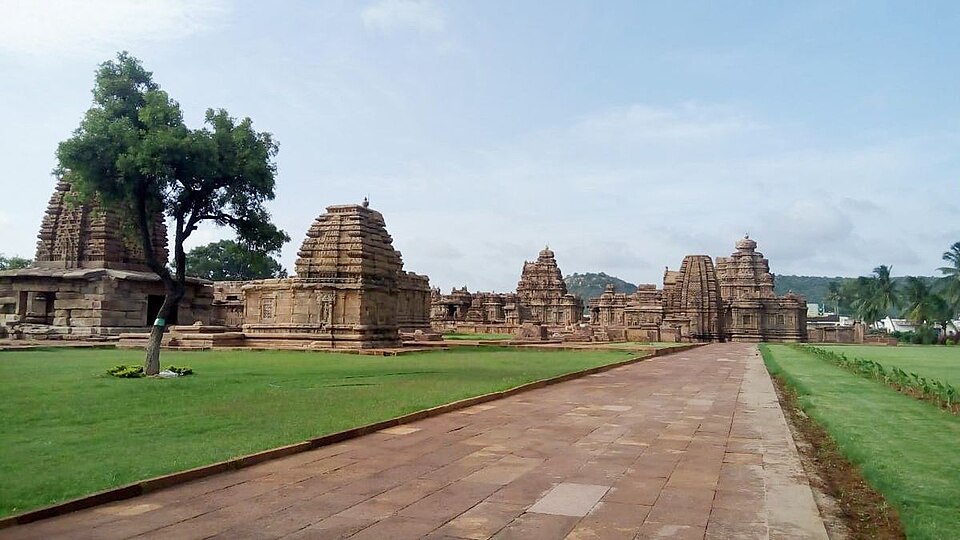
Imagine a school where students try every possible design before deciding which one works best. In the 6th to 8th centuries, three small towns in northern Karnataka became such a school for temple builders: Aihole, Badami and Pattadakal, along the Malaprabha river.
Here the Early Chalukyas built dozens of temples in local sandstone. Some look like northern temples, some like southern ones, and some like neither. UNESCO's Tentative List calls the area the "cradle of temple architecture", with 16 types of free-standing temple and 4 types of rock-cut shrine.
Then, in the 8th century, the Rashtrakutas replaced the Chalukyas and carved one of the world's greatest monuments: the Kailasa at Ellora. It is a whole temple cut out of a hill.
This chapter explains why the Deccan became a meeting ground of north and south, and why exam writers use the word Vesara for its mixed style.
Aihole: the first experiments
The first capital. Aihole was the first Chalukya capital, and Badami the second. Its temples and caves include some of the earliest Chalukya experiments. Many are simple and heavy, because builders were still learning how to roof a stone shrine.
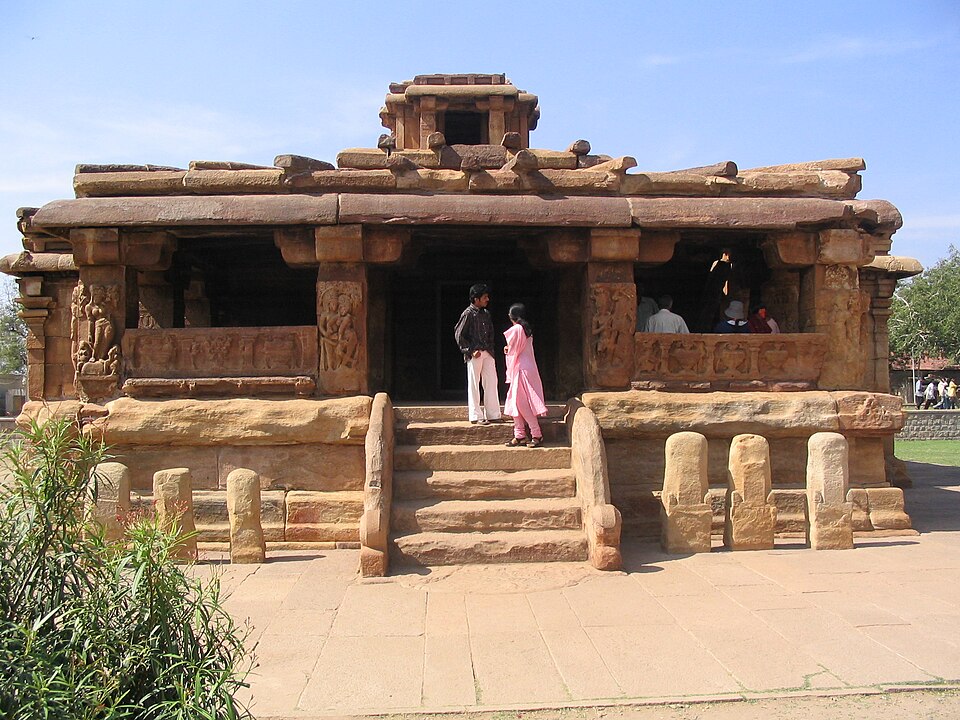
The Ladkhan temple. One of the earliest is the Ladkhan temple. It looks like a village hall of stone, with a sloping slab roof and jali (stone lattice) windows. On its roof sits a small shrine, which scholars see as the first attempt at a turret, an early step towards the shikhara.
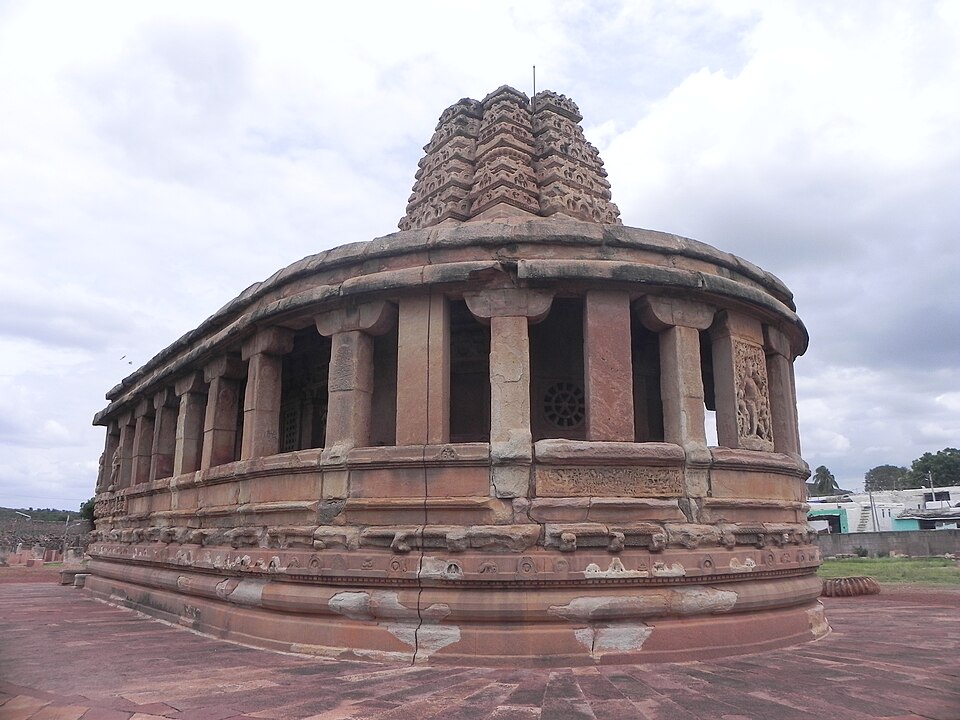
The Durga temple. The Durga temple (about 550) is the most famous building at Aihole. It is apsidal, rounded at the back like a Buddhist chaitya hall, and stands on a high base. An open pillared verandah runs right round it, serving as the path for circumambulation.
Why so experimental? The Chalukyas sat between the north and the south. Their builders knew both traditions and also older Buddhist forms. University texts say their temples were "neither true Nagara nor true Dravida nor true Vesara", meaning they were testing ideas, not following one rulebook.
Why it matters. Aihole is the classic example of experimentation in Indian temple history. Remember the Ladkhan (turret) and the Durga temple (apsidal, verandah).
Pattadakal: north and south on one riverbank
A royal stage. When the Pallavas held Badami from 642 to 655, Pattadakal briefly served as a capital. In the 7th and 8th centuries, it became the showpiece of Chalukya architecture.
Two styles side by side. Pattadakal has eight Shiva temples, plus the Papanatha and a Jain temple. Some, like the Galaganatha and Kashi Vishveshvara, have curved Nagara towers with an amalaka. Others, like the Sangameshvara and Mallikarjuna, have stepped Dravida vimanas. The Papanatha mixes features of both.
Dated buildings. Several temples can be dated closely. The Sangameshvara belongs to about 696-733, and the Mallikarjuna to 733-744. This dating lets scholars watch styles change within a few decades.
World Heritage. Pattadakal was inscribed as a World Heritage Site in 1987. UNESCO values it as a harmonious blend of the Nagara and Dravida temple forms. It is one of the best places in India to compare the two styles on one site.
Why it matters. Pattadakal is the standard answer to "where can you see Nagara and Dravida temples side by side?" It is also a perfect example for a Mains answer on regional synthesis.
The Virupaksha: a queen's victory temple
Built for a victory. In 731, the Chalukya king Vikramaditya II defeated the Pallavas and entered Kanchipuram. To commemorate this victory, his queen Lokamahadevi built the Virupaksha temple at Pattadakal, around 740. It is called the masterpiece of Chalukya art.
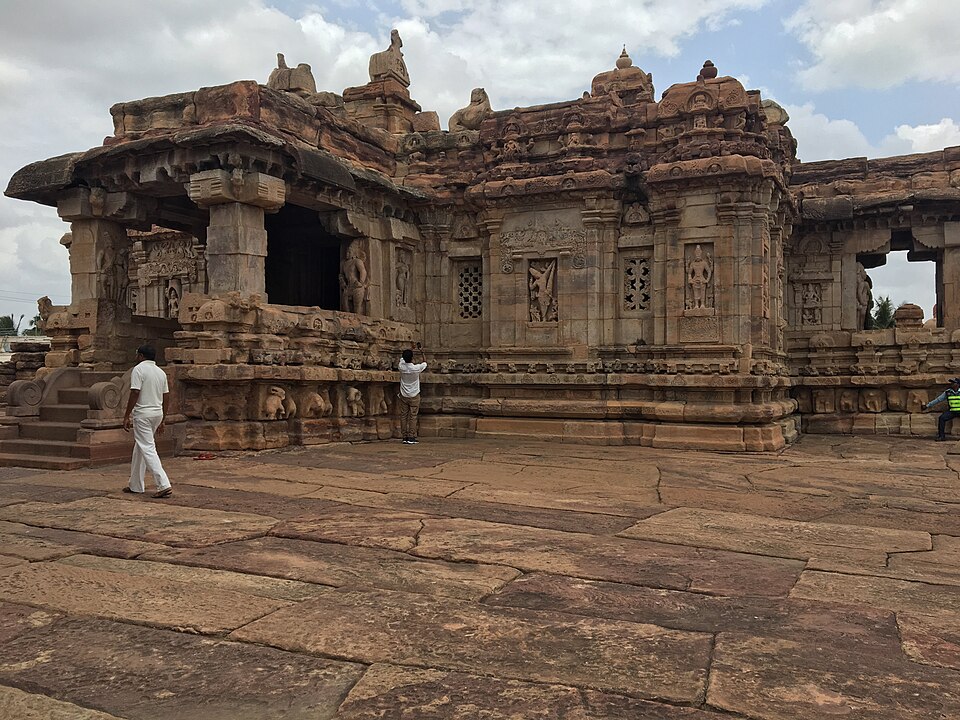
Borrowed from the enemy. The Virupaksha was likely built by workmen from Kanchipuram, imitating Rajasimha's Kailasanatha, which you met in the Pallava chapter. Like it, the Virupaksha has a Dravida vimana, a pillared hall, an enclosure wall with a gateway, and a separate Nandi pavilion.
Built to last. The temple is built without mortar, its stones fitted together by careful cutting. It is the only ancient temple at Pattadakal still in worship.
Why copy a rival's temple? Taking a rival's style was a way of claiming his prestige. The Virupaksha says, in stone, that the Chalukyas had conquered Kanchi and could build as grandly as the Pallavas. Art here is part of political competition.
Why it matters. The Virupaksha links two chapters: Kanchipuram and Pattadakal. It is the clearest example of cultural borrowing through war, a strong point for Mains.
The Rashtrakutas and the Kailasa at Ellora
New masters of the Deccan. In the mid-8th century, the Rashtrakutas overthrew the Chalukyas. Their greatest monument is not built at all: it is carved. The Kailasa temple (Cave 16) at Ellora in Maharashtra was cut in the mid-8th century under the Rashtrakuta king Krishna I.
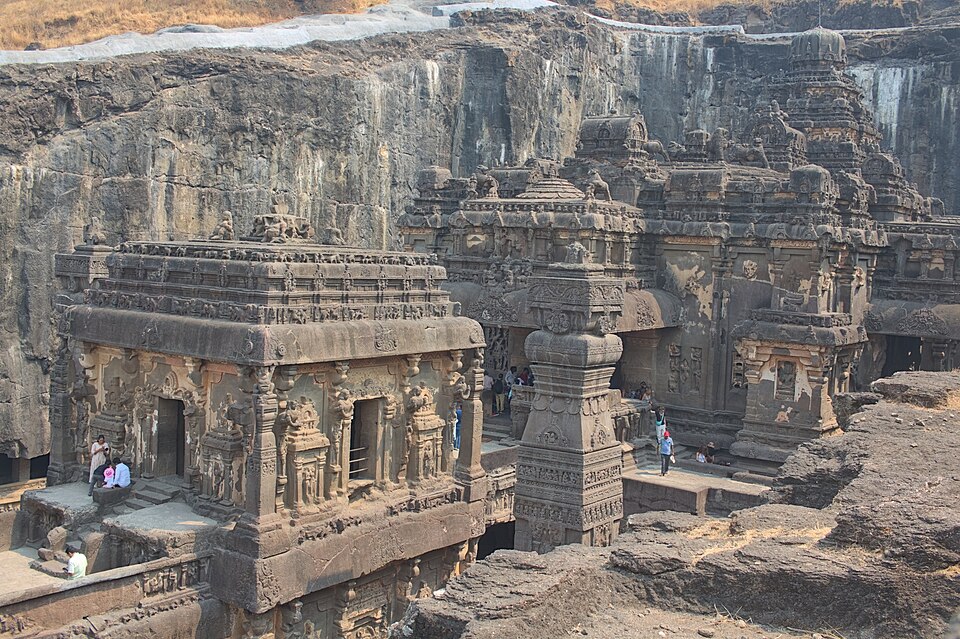
A temple cut from a hill. The carvers dug deep trenches into a sloping hill of rock, leaving a huge block in the middle. They then shaped this block from the top downward into a complete temple, with its tower, halls and pillars. It is the largest monolith at Ellora.
A copy of the south. The Kailasa follows the Dravida plan, with a storeyed vimana, much like the Virupaksha at Pattadakal and the Kailasanatha at Kanchipuram. Its famous sculpture of Ravana shaking Mount Kailasa gives the temple its name. Its ceilings once carried paintings.
Ellora as a whole. Ellora has 34 caves: Buddhist (1-12), Brahmanical (13-29) and Jain (30-34), cut between the 5th and 12th centuries. Three faiths worked side by side on one hill. UNESCO lists seepage, cracking and visitor pressure as threats.
Why it matters. The Kailasa is a top favourite in both Prelims and Mains. Remember: Rashtrakuta, Krishna I, monolith, top-down, Dravida plan. It is the Deccan's final, grandest experiment.
What does 'Vesara' mean? Two answers
The exam meaning: a hybrid. In most exam books, Vesara means the Deccan hybrid style that mixes Nagara and Dravida features. It is linked with the Chalukyas of Badami and Kalyani and with the Hoysalas, whom you will meet in the next chapter. Pattadakal, where both styles stand together, is often given as its starting point.
A second meaning: apsidal. One university text uses Vesara differently. It says the prototype of Vesara is the Buddhist chaitya hall of the Western Ghats, and its key trait is the apsidal plan, rounded at the back. Its examples include Chezarla in Andhra Pradesh, the Durga temple at Aihole, the Sahadeva and Draupadi rathas at Mamallapuram and the Kerala temples of Trikkandiyur and Tiruvannur.
Why two meanings? The old texts on architecture use Vesara loosely, and modern scholars read them differently. Some emphasise plan (apsidal), others mixture (Nagara plus Dravida). Both readings point to the Deccan's role as a meeting ground.
What to write. In an exam, use the hybrid meaning unless the question asks about apsidal temples. In Mains, you can show depth by mentioning both readings in one or two lines.
Why it matters. "Vesara" appears in many Prelims questions. Knowing both meanings protects you from tricky options.
Quick revision
- Early Chalukyas (mid-6th to mid-8th century): Aihole (first capital), Badami, Pattadakal on the Malaprabha; sandstone.
- "Cradle of temple architecture": 16 free-standing and 4 rock-cut types.
- Aihole: Ladkhan (sloping roof, jali, first turret); Durga temple (about 550, apsidal, verandah).
- Badami: four caves (one Jain; Cave 3 of 578); Upper Shivalaya (sandhara); Malegitti (Dravida); Bhutnatha group.
- Pattadakal (World Heritage 1987): Nagara (Galaganatha, Kashi Vishveshvara), Dravida (Sangameshvara, Mallikarjuna, Virupaksha), mixed (Papanatha).
- Virupaksha (about 740): Queen Lokamahadevi, Vikramaditya II's victory, Kanchi workmen, no mortar, still in worship.
- Kailasa, Ellora (Cave 16): Rashtrakuta Krishna I, mid-8th century, monolith, top-down.
- Vesara: exam meaning = hybrid; second meaning = apsidal (Chezarla, Durga temple).