

Module 1 · 13 min read · Free chapter
Origin and evolution of the Earth and the geological time scale
Early theories said the solar system came from one star (Kant and Laplace's nebular hypothesis) or from two stars (the planetesimal and tidal ideas). Today a revised nebular theory is accepted: the Sun and planets formed together from a spinning cloud of gas and dust about 4.6 billion years ago. Earth's history is divided into eons, eras, periods and epochs.
Start from zero: a planet with a history
The Earth under your feet was not always like this. About 4.6 billion years ago, it did not exist; there was only a spinning cloud of gas and dust around a young Sun. Over hundreds of millions of years, that cloud became a hot ball of molten rock, then a planet with a crust, air, oceans and, finally, life.
Nobody watched this happen, so how do we know? Scientists study meteorites, which are leftover building blocks of the solar system, the oldest rocks on Earth, the Moon's surface, and other planets. They also observe young stars elsewhere in the galaxy, which are surrounded by discs of dust in which planets seem to be forming.
Ideas about the Earth's origin have changed many times as new evidence appeared. Studying this history teaches us not only facts but also how science works: theories are proposed, tested and replaced by better ones.
Why it matters. The Earth's history explains why its layers, rocks, minerals, oceans and air are arranged as they are. It also shows that the planet's conditions have changed greatly over time, which helps us understand present-day climate change in a long-term frame.
Early theories: one star or two?
Early scientific ideas about the origin of the solar system fall into two groups. Monistic theories say that the Sun and planets came from one body. Dualistic theories say that two stars were involved, usually a passing star that disturbed the Sun.
The German philosopher Immanuel Kant proposed in 1755 that the solar system formed from a cloud of scattered matter that began to rotate and collapse. In 1796, the French mathematician Pierre-Simon Laplace refined this into the nebular hypothesis. He imagined a hot, slowly rotating nebula that cooled and shrank; as it spun faster, it threw off rings of matter from its equator, and these rings condensed into planets, while the centre became the Sun.
The nebular idea explained why the planets all revolve in one direction and nearly one plane. But it had problems. It could not explain why the Sun, which holds almost all the mass, spins so slowly while the planets carry most of the solar system's angular momentum (spin).
Dualistic theories tried to solve this. Chamberlin and Moulton proposed the planetesimal hypothesis: a passing star pulled matter out of the Sun, which cooled into small solid bodies, planetesimals, that joined to form planets. James Jeans, in 1919, proposed the tidal hypothesis, later modified by Harold Jeffreys: a passing star raised a huge cigar-shaped filament from the Sun, which broke into planets, the biggest in the middle.
Later ideas included the supernova hypothesis of Hoyle and Lyttleton (1946) and the Cepheid hypothesis of the Indian scientist A.C. Banerjee (1942). These theories were all rejected in time, mainly because close encounters between stars are extremely rare and hot material torn from the Sun would scatter rather than form planets.
Why it matters. These theories show how science improves by testing ideas against evidence. Exams frequently ask which scientist proposed which hypothesis, and Mains answers can use them to show the shift from speculation to evidence-based models.
The modern view: born from a disc
Today, scientists accept a revised nebular theory. It keeps Kant's and Laplace's core idea, that the Sun and planets formed together from one rotating cloud, but explains the details with modern physics and observations of young stars.
About 4.6 billion years ago, a cloud of gas and dust collapsed, perhaps triggered by a nearby exploding star. Most matter fell to the centre to form the Sun, and the rest flattened into a spinning disc. In the disc, dust grains stuck together into pebbles, then into kilometre-sized bodies called planetesimals, which collided and merged into protoplanets.
Near the hot young Sun, only rock and metal could stay solid, so the inner planets became small and rocky. Further out, where it was cold, ices could also condense, so the outer planets grew large enough to pull in huge amounts of hydrogen and helium gas. Then a strong solar wind blew the remaining gas out of the inner solar system.
The young Earth was hit by countless bodies, and the heat of these impacts, of radioactive decay and of gravitational compression melted much of it. Heavier materials, mainly iron and nickel, sank to the centre, while lighter materials rose. This sorting, called differentiation, produced the core, mantle and crust. A giant collision with a Mars-sized body is thought to have thrown off debris that formed the Moon.
How do we know the Earth's age? Meteorites, the untouched leftovers of the solar nebula, give ages of about 4.6 billion years by radioactive dating, and Moon rocks brought back by astronauts agree. The oldest known mineral grains on Earth are a little over 4 billion years old, because the planet's active surface has recycled most of its earliest crust.
Why it matters. Differentiation explains why the Earth has an iron core that generates the magnetic field and a light crust rich in useful minerals. The same process explains why heavy metals such as gold are rare at the surface. Understanding planet formation also guides the search for Earth-like planets around other stars.
Air, oceans and the first life
The early Earth's first atmosphere was mainly hydrogen and helium, the same light gases as the solar nebula. This primordial atmosphere was soon stripped away by the solar wind and the planet's heat.
A second atmosphere formed from inside the Earth. As the planet cooled, gases trapped in its rocks escaped through cracks and volcanoes. This process, called degassing, released mainly water vapour, carbon dioxide and nitrogen, with very little oxygen.
As the Earth cooled further, the water vapour condensed into clouds and fell as rain for an immensely long time. The rain filled the low basins of the crust and formed the oceans, and the oceans dissolved much of the carbon dioxide from the air.
Life is thought to have begun in the oceans, perhaps around 3.8 billion years ago. Some early life forms, such as blue-green algae (cyanobacteria), used sunlight to make food by photosynthesis, releasing oxygen. Over hundreds of millions of years, this oxygen built up in the oceans and then the air, and part of it formed the ozone layer, which made life on land possible.
Why did the Earth keep its air and water when some neighbours did not? Its gravity is strong enough to hold gases, and its distance from the Sun lets water stay liquid. Its magnetic field, produced by the iron core, also shields the atmosphere from the solar wind. Mars, smaller and with a weak magnetic field, lost most of its air and surface water, while Venus, closer to the Sun, built a thick carbon dioxide atmosphere with a runaway greenhouse effect.
Why it matters. The air we breathe was made by living things, so life and the atmosphere evolved together. This shows how deeply the biosphere shapes the planet, and why changes by humans today, such as adding carbon dioxide, can shift the climate. It is also why oceans and forests are vital carbon sinks.
The geological time scale
Earth's 4.6-billion-year history is too long to grasp in years, so geologists divide it into units: eons, eras, periods and epochs. The boundaries are usually marked by big changes in life, seen in fossils, such as the appearance of new groups or mass extinctions.
The first and by far the longest span is the Precambrian, covering almost nine-tenths of Earth's history. It saw the formation of the crust, oceans and first simple life, mostly single-celled. The oldest rocks of the Indian Peninsula belong to this time.
The Palaeozoic era ("ancient life") saw an explosion of complex life in the seas, followed by fish, the first land plants, amphibians and great swamp forests, which later became coal. The Mesozoic era ("middle life") was the age of reptiles, when dinosaurs ruled; it ended about 66 million years ago with a mass extinction, probably caused by an asteroid impact, with the huge Deccan lava eruptions happening around the same time.
The Cenozoic era ("new life") is the age of mammals. During it, the Himalaya rose, the modern continents took shape, and grasslands spread. Modern humans appeared only in the last few hundred thousand years, a tiny fraction of the whole.
How do geologists date rocks? Lower layers are generally older than upper ones, and fossils show the relative order of rock layers across the world. For actual ages in years, scientists use radioactive dating, measuring how much of a radioactive element has decayed, which works like a natural clock.
Why it matters. The time scale shows how recent and brief human history is, and how life has recovered from past mass extinctions only over millions of years. Some scientists now speak of a new human-dominated phase, the "Anthropocene", because of our impact on climate and life. The time scale also guides the search for minerals, since coal, oil and ores formed in particular eras.
India in Earth's long story
India's land records much of this long history. The old crystalline rocks of the Peninsula date from the Precambrian, when the crust was young. Coal-bearing rocks of the Damodar and Godavari valleys formed in the swamps of the late Palaeozoic and early Mesozoic.
Near the end of the Mesozoic, as India drifted north, huge lava flows built the Deccan Traps. Fossils of dinosaurs and their eggs have been found in Gujarat and Madhya Pradesh, and the Narmada valley has yielded fossils of early humans and animals from much later times.
In the Cenozoic, India collided with Asia, raising the Himalaya, and rivers began building the Northern Plains. This recent and continuing activity explains why the Himalaya are young, steep and earthquake-prone, while the Peninsula is old and stable.
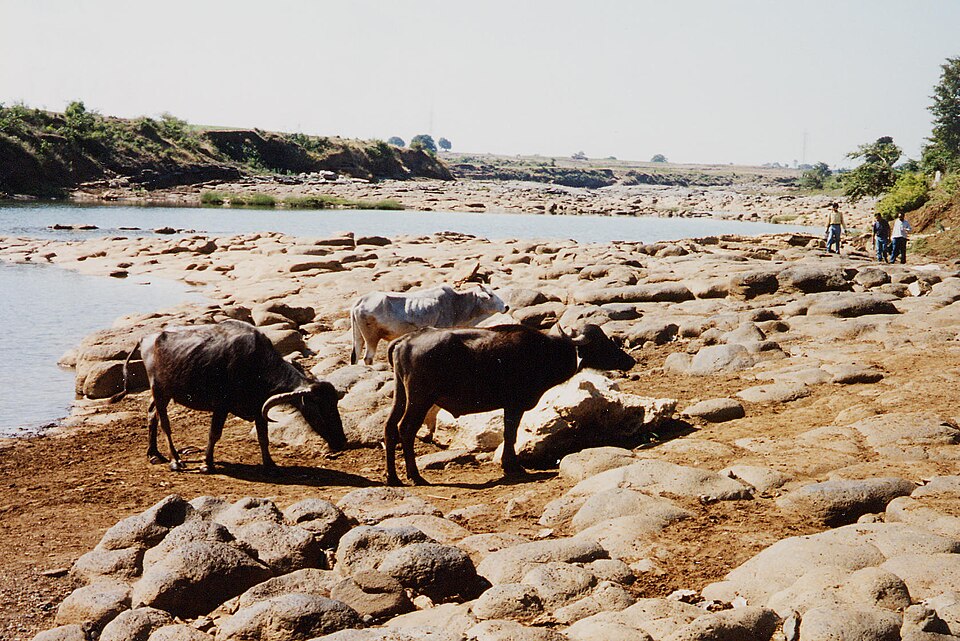
Why it matters. India's rocks are a natural museum of Earth's history, valuable for science, education and tourism. Fossil sites and geological heritage need protection from mining and construction. The same history explains where India's coal, minerals and fertile plains are found.
Mains lens: what, why, where and so what
This chapter appears in GS Paper I (physical geography) and connects to environment and science in GS Paper III. Here are four angles.
1. How science corrects itself. The move from Kant and Laplace through tidal theories to the modern nebular theory shows how evidence replaces speculation. Answers can trace this progression briefly.
2. Differentiation and resources. The sorting of the young Earth explains the layered interior, the magnetic field and the minerals of the crust. Answers can link this to why some minerals are rare.
3. Life shapes the planet. Photosynthesis built the oxygen atmosphere and ozone layer. Answers on climate change can use this long view to show how the biosphere and atmosphere are linked.
4. Deep time and the present. Mass extinctions and the Anthropocene idea frame today's biodiversity loss. Answers can use the time scale to argue for conservation.
Mains lens: practice questions and answer plans
Now turn this understanding into written answers. The four questions below are written in the UPSC style, but they are our own practice questions, not previous-year questions. The real previous-year questions of your exam appear in the "Previous year questions" box once we have matched them with the official papers.
Q1. "Critically examine the nebular hypothesis of the origin of the solar system." (150 words)
- Explain Kant's and Laplace's idea.
- Give its strengths (common direction and plane).
- Give its weakness (angular momentum).
- End with the revised modern nebular theory.
Q2. "Describe the stages in the evolution of the Earth's atmosphere." (150 words)
- Cover the loss of the primordial atmosphere.
- Then degassing and volcanoes.
- Then photosynthesis and the ozone layer.
Q3. "How did the Earth's interior become layered? What are the consequences of this layering?" (250 words)
- Introduction: Describe the hot, molten early Earth.
- Body: Explain differentiation into core, mantle and crust; then give consequences (magnetic field, plate movements, mineral distribution).
- Conclusion: Link to habitability.
Q4. "What is the geological time scale? Explain its significance for understanding the present." (150 words)
- Give eons and eras with key life events.
- Mention dating methods.
- End with mass extinctions and the Anthropocene.
Useful keywords: monistic, dualistic, Kant, Laplace, nebular hypothesis, planetesimal, Chamberlin–Moulton, tidal hypothesis, Jeans–Jeffreys, angular momentum, solar nebula, protoplanet, differentiation, degassing, photosynthesis, ozone, Precambrian, Palaeozoic, Mesozoic, Cenozoic, radioactive dating, Anthropocene.
Quick revision
- Monistic (one star): Kant 1755, Laplace 1796 nebular hypothesis. Dualistic (two stars): Chamberlin–Moulton planetesimal; Jeans (1919)–Jeffreys tidal.
- Others: Hoyle–Lyttleton supernova (1946); A.C. Banerjee Cepheid (1942).
- Accepted now: revised nebular theory: dust → planetesimals → protoplanets.
- Differentiation → core (iron, nickel), mantle, crust; Moon from a giant impact.
- Atmosphere: primordial H–He lost → degassing (water vapour, CO₂, N₂) → photosynthesis adds O₂ → ozone.
- Oceans from condensed vapour; life began in the oceans.
- Time scale: Precambrian → Palaeozoic → Mesozoic (dinosaurs, end about 66 million years ago) → Cenozoic (mammals, Himalaya, humans).