

Module 4 · 12 min read · Free chapter
ಭಾರತದಲ್ಲಿ ಹವಾಮಾನ ಕ್ರಮ: NAPCC, missions, LiFE ಮತ್ತು carbon markets.
India's National Action Plan on Climate Change of 2008 launched eight national missions, from solar and energy efficiency to water, Himalayas and green India; a ninth on health was added later. States have their own climate action plans. At COP26 India announced the Panchamrit pledges, Mission LiFE asks people to adopt sustainable lifestyles, and new carbon and green credit schemes create markets for cutting emissions.
Start from zero: a family budget for the climate
Think of a family that wants to save money while still paying for school fees and medicines. It cannot simply stop spending. Instead it makes a plan: cheaper electricity, less waste, a little saved every month, and some insurance against a bad year.
India faces a similar problem with climate change. It must grow, create jobs and lift millions out of poverty, which needs more energy. At the same time it is one of the countries most exposed to heat, floods and a changing monsoon. Its climate policy therefore tries to grow and protect at the same time.
At home, this policy rests on a few pillars. The National Action Plan on Climate Change of 2008 and its missions set the direction. State action plans take it to every region. International promises such as the Panchamrit set targets, and new tools such as Mission LiFE, a carbon market and green credits try to change how people and firms behave.
This chapter explains each pillar: what it is, why it was created, how it works, and what it has achieved. India's international negotiating position is explained in the chapter on climate treaties and India's targets.
The NAPCC: India's climate plan of 2008
India released its National Action Plan on Climate Change (NAPCC) on 30 June 2008. At that time India had no binding emission targets under the climate treaty. Yet it chose to draw up a national plan, both to protect its people from impacts and to show that a developing country could act.
The key idea of the NAPCC is co-benefits. It looks for measures that serve India's development goals, such as cheaper energy, water security and better farming, and that also help fight climate change. This made climate action an ally of growth rather than its enemy.
The plan works through eight national missions:
- National Solar Mission: expand solar power.
- National Mission for Enhanced Energy Efficiency: save energy in industry and appliances.
- National Mission on Sustainable Habitat: greener buildings, transport and waste management in cities.
- National Water Mission: conserve water and use it more efficiently.
- National Mission for Sustaining the Himalayan Ecosystem: protect glaciers, forests and communities in the mountains.
- National Mission for a Green India: increase forest and tree cover and improve degraded forests.
- National Mission for Sustainable Agriculture: make farming more climate-resilient.
- National Mission on Strategic Knowledge for Climate Change: build research and data.
The plan has grown since. The NAPCC now has nine components, the ninth being the National Programme on Climate Change and Human Health, which brings the health risks of a warming climate, such as heat and disease, into the plan.
Why missions? Each mission gives one ministry clear ownership of one area. This avoids the problem of "everyone's job is no one's job" in a cross-cutting issue like climate change.
Taking the plan to the states, and funding adaptation
Climate impacts are local. A coastal state worries about cyclones and salinity, a Himalayan state about glaciers and landslides, and a dry state about drought. A single national plan cannot see all these differences.
So, as a second step after the NAPCC, every state was asked to prepare a State Action Plan on Climate Change (SAPCC). These plans extend the NAPCC to state and local levels and are aligned with the national missions. As of 2025, thirty-four States and Union Territories had prepared their plans.
Money for adaptation is a constant problem, because adaptation brings local benefits but few direct returns. In 2015, the Centre set up the National Adaptation Fund on Climate Change (NAFCC) to support adaptation projects in states that are especially vulnerable. Such projects include water conservation, climate-resilient farming and coastal protection.
Why this matters. Federalism shapes climate action in India. Agriculture, water and land are mostly state subjects, so national goals succeed only if states act. State plans and dedicated funds are the bridge between the two.
Panchamrit and the clean-energy shift
At COP26 in Glasgow on 1 November 2021, India announced five commitments, called the Panchamrit (five nectars):
- 500 GW of non-fossil energy capacity by 2030.
- 50% of energy requirements from renewable energy by 2030.
- A cut of one billion tonnes in total projected carbon emissions till 2030.
- A 45% reduction in the carbon intensity of the economy by 2030.
- Net zero by 2070.
Some of these were later written into India's updated Nationally Determined Contribution (NDC) of 2022, where the intensity cut is measured against 2005 levels. Carbon intensity means emissions per unit of GDP. Cutting intensity lets the economy grow while each rupee of output produces less carbon.
Progress so far. The biggest change is in electricity. By 30 June 2025, non-fossil sources, such as solar, wind, hydro and nuclear, made up 50.08% of India's installed power capacity (242.78 GW of 484.82 GW). This met the NDC goal of 50% non-fossil capacity five years ahead of 2030.
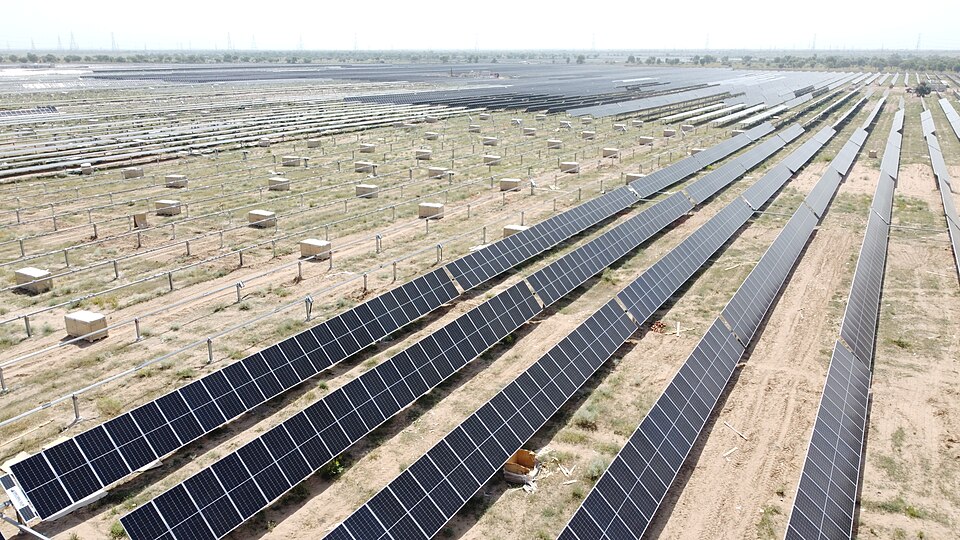
Installed capacity is not the same as generation. Solar panels do not produce power at night, and wind varies with the season, so their share of actual electricity produced is lower than their share of capacity. Storage, grid upgrades and flexible demand are therefore the next challenge.
Mission LiFE: changing how we live
Most climate policy targets power plants, factories and vehicles. But the demand for all of these comes from how people live: what they buy, how they travel, and how much they waste. Mission LiFE focuses on this demand side.
LiFE (Lifestyle for Environment) was launched on 20 October 2022 at the Statue of Unity in Ekta Nagar, Gujarat, in the presence of UN Secretary-General António Guterres. It calls on individuals and communities to replace mindless and wasteful consumption with mindful and deliberate use. Simple examples are switching off unused lights and appliances, saving water, cutting single-use plastic, eating local and seasonal food, and repairing instead of throwing away.
Why LiFE? Technology alone cannot solve the problem if consumption keeps rising without limit. Many small choices, made by over a billion people, add up to large savings in energy and resources. LiFE also draws on Indian traditions of thrift and reuse, which gives it cultural roots.
The criticism. Some argue that personal choices matter far less than the decisions of governments and large firms. The best answer is that LiFE is a complement, not a substitute: behaviour change works best when policy makes the green choice the easy and cheap one.
Carbon credits and green credits: India's new markets
India has also begun using markets to reward cleaner behaviour. Two schemes, both from 2023, are often confused, so it helps to study them side by side.
The Carbon Credit Trading Scheme (CCTS), 2023 was notified on 28 June 2023 under the Energy Conservation Act, 2001, as amended in 2022. It creates an Indian carbon market. The Bureau of Energy Efficiency (BEE) administers the scheme, and the Grid Controller of India acts as the registry that records credits.
The logic is the same as in any carbon market. Entities that do better than their emission targets earn credits, which they can sell to those who fall short. This rewards the cheapest cuts first and puts a price on carbon in the Indian economy.
The Green Credit Programme works differently. The Green Credit Rules, 2023 were notified on 12 October 2023 under the Environment (Protection) Act, 1986, with the Indian Council of Forestry Research and Education (ICFRE) as administrator. It rewards positive environmental actions, such as tree planting and water conservation, with tradable green credits.
India took the idea abroad as well. At COP28 on 1 December 2023, India co-hosted with the UAE the Global Green Credit Initiative, inviting other countries to adopt similar approaches.
The debate. Supporters see both schemes as a way to bring private money into climate action. Critics warn that credits must reflect real, additional and lasting benefits, and that tree-planting credits must not replace the protection of existing natural forests.
Mains lens: judging India's domestic climate action
Mains questions ask you to evaluate, not just list. Show what each policy does, then judge it with evidence. Four arguments help.
1. Development first, with co-benefits. The NAPCC was built on co-benefits, and Panchamrit uses intensity targets and a 2070 net zero date. Explain that this reflects India's low per-capita emissions and its development needs, and that it is consistent with common but differentiated responsibilities.
2. Real progress in power. The 50% non-fossil capacity milestone in 2025, five years early, is strong evidence. Balance it with the gap between capacity and generation, the continued role of coal, and the need for storage and grid investment.
3. Implementation runs through the states. Thirty-four state plans exist, but many depend on central funds, and adaptation money is limited. A good answer suggests stronger state capacity, dedicated finance and better data.
4. New tools need integrity. LiFE, CCTS and green credits widen the toolbox from supply to demand and from rules to markets. Their success depends on credible measurement, real additionality and protection of natural forests, so mention safeguards.
Mains ಅಭ್ಯಾಸ: ಆರು ಪ್ರಶ್ನೆಗಳು, ಆರು ದೃಷ್ಟಿಕೋನಗಳು
These are practice questions written by us, not past papers. Past questions from each exam appear in the PYQ panel of this module.
| Angle | Question | Key points to cover |
|---|---|---|
| Policy | Critically evaluate the National Action Plan on Climate Change and its missions. | Cover the 2008 plan, co-benefits, the eight missions and the ninth health programme. Then judge uneven progress across missions, funding and coordination. |
| Federalism | What role do states play in India's climate action? Discuss with reference to SAPCCs. | Explain why impacts are local and why agriculture, water and land are state subjects. Then give the 34 plans, the NAFCC (2015) and capacity gaps. |
| Energy | India reached 50% non-fossil installed capacity in 2025. What are the remaining challenges in its energy transition? | Give the figures and Panchamrit targets, then explain capacity versus generation, storage, grid integration, coal dependence and just transition for coal regions. |
| Behaviour | "Mission LiFE shifts the focus of climate action from supply to demand." Discuss. | Explain the 2022 launch and mindful use, then give examples and the cultural link. Balance with the criticism and argue for policy support. |
| Markets | Compare the Carbon Credit Trading Scheme and the Green Credit Programme. What safeguards do they need? | Give the laws, dates, administrators and purposes of each. Then discuss measurement, additionality, permanence and protection of natural forests. |
| Way forward | How can India reconcile its development needs with its commitment to net zero by 2070? | Use co-benefits, intensity targets and the clean-power record. Then suggest finance, technology, green jobs, adaptation and state capacity. |
How to use this table: each answer should first explain the what, then give the why from this chapter, and end with a way forward.
Quick revision
- NAPCC: released 30 June 2008, built on co-benefits; eight missions (Solar, Energy Efficiency, Sustainable Habitat, Water, Himalayan Ecosystem, Green India, Sustainable Agriculture, Strategic Knowledge); now nine, with the Climate Change and Human Health programme.
- SAPCCs: prepared by 34 States/UTs; NAFCC (2015) funds adaptation.
- Panchamrit (COP26, 1 Nov 2021): 500 GW non-fossil, 50% energy from renewables, −1 billion tonnes to 2030, −45% carbon intensity (from 2005), net zero 2070.
- 50.08% non-fossil installed capacity on 30 June 2025 (242.78 of 484.82 GW), five years ahead of 2030.
- Mission LiFE: 20 Oct 2022, Ekta Nagar, Gujarat, with UN Secretary-General Guterres; mindful use over wasteful consumption.
- CCTS: 28 June 2023, Energy Conservation Act (amended 2022), BEE administrator, Grid Controller of India registry.
- Green Credit Rules: 12 Oct 2023, Environment (Protection) Act, ICFRE administrator; Global Green Credit Initiative co-hosted with the UAE at COP28.