

KPSC KAS · Module 47 · Mains depth · 23 min
ವಾಯು ಮಾಲಿನ್ಯ: ಮಾಲಿನ್ಯಕಾರಕಗಳು, smog, acid rain, AQI ಮತ್ತು ಶುದ್ಧ ಗಾಳಿಗಾಗಿ ಕ್ರಮಗಳು.
What KPSC KAS asks from this chapter
Syllabus lines this chapter covers:
- Paper II: General Studies · Environment and ecology.
- GS 3 · Environment and ecology.
KPSC KAS has asked 1 question from this chapter (2020); 5 from its whole module.
Read at full depth: basics, the standard layer and the Mains analysis.
Start from zero: the air you cannot see
Every day, an adult breathes in far more air by weight than the food and water they consume. We can live for days without food, but only for minutes without oxygen. So the quality of air matters more directly to our health than almost anything else.
Clean, dry air is about 78% nitrogen, 21% oxygen, around 0.04% carbon dioxide and small amounts of other gases. When human activity adds gases, particles or energy that change this mix and harm life, we call it air pollution. Much of it is invisible until it becomes a grey haze over a city.
In north Indian cities each winter, smoke from vehicles, factories, construction dust and crop burning hangs low for days. Schools close, flights are delayed and hospitals fill with people who cannot breathe. This is not only an environmental problem but a public health emergency.
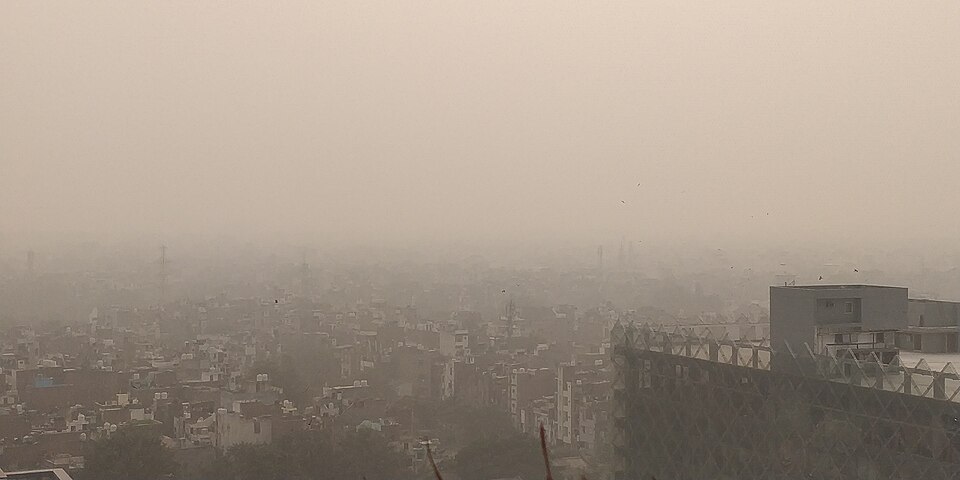
This chapter explains what pollutants are, the main air pollutants and their effects, and how smog, inversion and acid rain form. It then covers indoor air, how India measures air quality, what the government is doing, and the lessons of the Bhopal gas tragedy.
What makes something a pollutant
The definition. Pollution is any undesirable change in the physical, chemical or biological features of air, water or soil that harms living things. The agent that causes it is a pollutant. Even a normal part of the air, such as carbon dioxide, becomes a pollutant when its amount rises beyond a safe threshold.
Not only substances. A pollutant can also be a form of energy, such as heat, sound or radiation. This is why noise and thermal pollution are counted alongside smoke and sewage.
Degradable or not. Biodegradable pollutants, such as sewage, paper and garden waste, are broken down by bacteria into simple substances. They become a problem only when they arrive faster than nature can break them down. Non-biodegradable pollutants, such as plastics, pesticides like DDT, heavy metals and nuclear waste, stay unchanged for a very long time.
Where they come from. A point source is a single, fixed outlet, such as a factory chimney or a drain pipe. A non-point source is spread over a wide area, such as runoff from farms or construction sites. Point sources are easier to measure and control.
Primary and secondary. Primary pollutants, such as sulphur dioxide, nitrogen oxides, carbon monoxide and soot, are released directly. Secondary pollutants form in the air when primary pollutants react with each other or with normal air, often helped by sunlight. Ground-level ozone, sulphuric acid and peroxyacetyl nitrate (PAN) are examples.
The main air pollutants and what they do
Particulate matter. Tiny solid and liquid particles hang in the air from fuel burning, construction, mining, stone crushing and fires. The nose filters larger particles, but those smaller than 10 micrometres (PM10), called respirable suspended particulate matter, enter the airways. Particles smaller than 2.5 micrometres (PM2.5) go deep into the lungs and are the most harmful for health.
Carbon monoxide. Carbon monoxide (CO) comes from the incomplete burning of fuel, as in vehicles and stoves in closed rooms. It binds to haemoglobin in blood far more readily than oxygen. This starves the body of oxygen and can cause death by suffocation.
Sulphur dioxide. Sulphur dioxide (SO2) comes from burning sulphur-containing coal and oil, and from smelting metal ores. It damages the lungs and corrodes metals and paint. It is also a major precursor of acid rain.
Nitrogen oxides. Nitrogen oxides (NOx) form when fuel burns at high temperature, as in vehicle engines and power plants. They irritate the eyes and lungs and help form smog, ozone and nitric acid. Vehicles are a major source in cities.
Hydrocarbons and lead. Volatile organic compounds, such as benzene, evaporate from fuel tanks, paints and solvents, and some can cause cancer. Lead from leaded petrol once polluted city air, but the shift to unleaded petrol sharply cut lead levels in India. Cleaner low-sulphur fuel has similarly helped reduce sulphur dioxide.
Ground-level ozone. High in the stratosphere, ozone shields us from ultraviolet rays, as explained in the chapter on the ozone layer. Near the ground, the same gas is a powerful oxidant that damages crops, fabrics and lungs. So ozone is "good up high, bad nearby".
Smog, inversion and acid rain
Smog. The word comes from smoke plus fog. Photochemical smog forms when nitrogen oxides and hydrocarbons, mostly from vehicles, react in sunlight. It produces ozone and PAN, causing a brown haze and burning eyes, and is worst in crowded cities with still air.
Temperature inversion. Normally air gets cooler as you go higher, so warm polluted air near the ground rises and spreads out. In an inversion, a layer of warm air sits above cooler air near the ground and acts like a lid. Pollutants are trapped close to where people breathe, which is why winter nights and mornings bring the worst air in north India.
Acid rain. Sulphur dioxide and nitrogen oxides from power plants, smelters and vehicles react with water and oxygen in the air to form sulphuric and nitric acids. These come down as wet deposition in rain, snow, fog or dew, or as dry deposition of acidic particles. The broader term for both is acid precipitation.
The damage. Acid rain makes lakes and soils acidic, which can release toxic metals that harm plants and fish. It damages forests and corrodes steel, paint, cement, limestone and marble. The fear that factory smoke could yellow the marble of the Taj Mahal is one reason courts restricted industries around it.
Why it crosses borders. Tall chimneys send gases high into the air, where winds carry them hundreds of kilometres. So one region's emissions can fall as acid rain on another. This makes air pollution a regional problem, not just a local one.
The air inside our homes
Why indoor air matters. Most people spend most of their time indoors, at home, in school or at work. Yet indoor air can be more polluted than the air outside. In poor homes, cooking on wood, dung or coal in a closed kitchen fills the room with smoke every day.
Common indoor pollutants. Formaldehyde escapes from particleboard, foam and furniture. Radon, a radioactive gas, can seep in from soil and building materials such as stone and concrete. Asbestos fibres from old insulation and fireproofing can damage the lungs.
Other sources. Paints, adhesives, solvents and cosmetics release volatile organic compounds. Tobacco smoke adds many harmful substances at once. Damp homes can also harbour moulds and allergens.
Why it matters for policy. Indoor smoke from cooking fuel falls hardest on women and young children who spend long hours near the stove. This is one reason why giving clean cooking gas to poor households is treated as both a health and an environmental measure. Better ventilation is a simple but powerful fix.
How India measures air quality
Standards: the safe limits. To judge whether air is clean, a country needs limits for each pollutant. India notified its National Ambient Air Quality Standards (NAAQS) for 12 pollutants in 2009. "Ambient" means the outdoor air that people breathe, as opposed to the gas leaving a chimney.
The problem with many numbers. Twelve separate readings are hard for ordinary people to understand. A parent wants to know one thing: is it safe for my child to play outside today? This is why an index was needed.
The Air Quality Index. India launched the National Air Quality Index (AQI) on 17 October 2014. It turns pollutant readings into one number and one colour. It considers eight pollutants: PM10, PM2.5, NO2, SO2, CO, O3, NH3 and lead (Pb).
Six categories. The AQI has six categories: Good, Satisfactory, Moderately polluted, Poor, Very Poor and Severe. Each comes with a colour and health advice, so people can decide whether to go out. Cities with monitoring stations publish the AQI daily.
Why it matters. The AQI turned air pollution from an expert topic into daily news. It also lets the government trigger emergency steps when air crosses set levels. Its weakness is that many smaller towns still have few or no monitoring stations.
Fighting dirty air: NCAP, CAQM and GRAP
A national programme. The National Clean Air Programme (NCAP), launched in 2019, asks cities with persistently poor air to make and carry out their own clean-air plans. Under it, about ₹9,650 crore was released to 131 cities from 2019-20 to 2023-24. Cities are judged on how much they reduce particulate pollution, with money linked to results, as explained in the chapter on pollution laws.
A special body for Delhi-NCR. Delhi's air is shaped by sources across several states, including crop burning, power plants and traffic. Parliament therefore passed the Commission for Air Quality Management in National Capital Region and Adjoining Areas Act, 2021. It created a statutory commission that can coordinate and direct action across Delhi and neighbouring states.
Graded steps: GRAP. The Graded Response Action Plan (GRAP) lists emergency steps that switch on as the AQI worsens. It has four stages: Stage I at Poor (AQI 201-300), Stage II at Very Poor (301-400), Stage III at Severe (401-450) and Stage IV at Severe+ (above 450). Measures grow stricter at each stage, from dust control and stopping open burning to curbs on construction and on certain vehicles.
Why graded steps. Acting only in a crisis is too late, but permanent bans are costly. A graded plan matches the strength of the response to the level of danger, and everyone knows in advance what will happen. Its limit is that it treats symptoms; lasting change needs cleaner fuel, transport and farming.
Case study: the Bhopal gas tragedy
The plant. Union Carbide set up a pesticide formulation unit in Bhopal in 1969. In 1979 it began producing methyl isocyanate (MIC), a highly toxic chemical used to make pesticides. The plant stood close to crowded neighbourhoods.
The night of the leak. On the night of 2 December 1984, water carrying catalytic material entered MIC storage tank 610. In the early hours of 3 December, about forty tonnes of toxic gas escaped and spread across the sleeping city. No alarm sounded, and there was no evacuation plan.
The human cost. The leak lasted less than an hour but killed thousands of people, and many more were seriously injured. MIC burns on contact and attacks the eyes, throat and lungs. Medical studies later found lung damage, depression and anxiety among survivors, more illness among exposed children, and higher rates of miscarriage among exposed women.
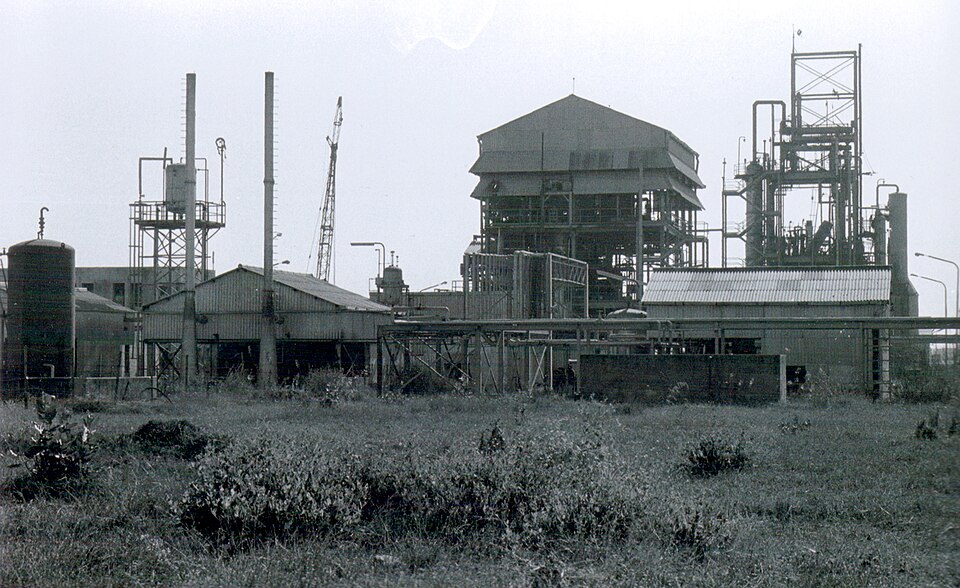
What changed. The tragedy exposed how weak the laws on hazardous industry were. It led directly to the Environment (Protection) Act, 1986 and to new rules on hazardous chemicals and accident insurance. It also shaped the idea that dangerous industries must bear full responsibility for the harm they cause.
The lessons. Hazardous plants must not sit next to homes, and safety systems must be maintained, not just installed. Communities need warning systems and drills. Justice for victims took decades, showing that compensation and clean-up must be planned before disaster, not after.
Mains lens: three live debates on clean air
1. City problem or airshed problem? Most clean-air plans are drawn city by city, because cities have budgets, officers and monitoring stations. But smoke from brick kilns, power plants, vehicles on highways and burning fields travels tens of kilometres, and winter inversions hold it over a whole region. So a city can do everything right and still breathe dirty air made elsewhere.
One side says that city plans are the only practical unit, because someone must be answerable for results. The other side says that air must be managed by airshed, the whole area that shares the same air, with States working together. A balanced answer keeps city plans for local sources but adds a regional body with real powers. That is why a statutory commission was created for Delhi-NCR and its neighbouring States in 2021, instead of leaving the job to Delhi alone.
2. Emergency steps or year-round change? The Graded Response Action Plan switches on bans on construction, diesel generators and some vehicles when the AQI crosses set levels. Supporters say these steps save lives on the worst days. Critics say that they arrive after the air is already bad, and that they hit daily-wage workers hardest when sites shut.
A balanced view treats emergency steps as a seatbelt, not a cure. The cure is year-round work: cleaner fuel in homes and industry, public transport, paved roads, and paying farmers for alternatives to burning stubble. In Mains, praise the graded plan for speed, then argue that it works only on top of steady, all-season action.
3. Health or growth? Some argue that a developing country cannot afford strict limits on industry and vehicles, because jobs and cheap energy come first. The other side points out that dirty air itself costs the economy through illness, lost workdays and early deaths. Clean air is therefore part of growth, not its enemy.
The strongest answers use the chapter's science here. Fine particles (PM2.5) go deep into the lungs, so the cost falls on the health of workers, children and the elderly. Framing air pollution as a public health issue moves it from the environment ministry's desk to the whole government, including health, transport, energy and agriculture.
Why it matters: Mains rarely asks "what is smog". It asks who should act, how fast and at whose cost. Each debate above gives you both sides plus a middle path, which is exactly what "critically examine" and "discuss" questions reward.
Mains lens: two kinds of questions and how to answer them
Type 1: "Why does it happen?" (science plus policy). Example: "Why does air quality in north Indian cities worsen sharply every winter?"
- Intro: Open by saying that winter pollution is a mix of more emissions and weather that stops them from spreading.
- Body, the weather: Explain that cold, calm nights create a temperature inversion, in which a warm lid of air traps smoke near the ground.
- Body, the sources: List vehicles, road and construction dust, industry, brick kilns, household fuel and stubble burning, and note that their share changes from week to week.
- Body, the response: Mention the AQI for warning people, the graded plan for bad days and the regional commission for joint action.
- Conclusion: Conclude that the weather cannot be changed, so the only lasting answer is to cut emissions all year.
Type 2: "Evaluate the institution or programme." Example: "Evaluate India's institutional response to air pollution."
- Intro: Note that India has standards for 12 pollutants, an index that reports eight of them in six colours, and a national clean-air programme for cities.
- Body, strengths: Show that the AQI made pollution visible to ordinary people, that money now reaches cities, and that a statutory body can make several States act together.
- Body, gaps: Point out that monitoring is thin in small towns and villages, that indoor smoke from cooking fuel gets less attention, and that rules are weakly enforced on small polluters.
- Body, a lesson from Bhopal: Add that industrial safety, alarms and evacuation plans are part of clean air too.
- Conclusion: Conclude that India has built the tools, and that the next step is enforcement, wider monitoring and regional action.
Linking across papers. Use this chapter in GS-III (environment and disaster management), GS-II (health and governance) and the Essay paper (development and the environment). The Bhopal case also fits GS-IV questions on corporate responsibility.
Mains ಅಭ್ಯಾಸ: ಆರು ಪ್ರಶ್ನೆಗಳು, ಆರು ದೃಷ್ಟಿಕೋನಗಳು
These are practice questions we have written, not past papers. Past questions for each exam are in this module's PYQ panel.
| Angle | Question | How to approach |
|---|---|---|
| Science | Why does air quality in north Indian cities worsen sharply in winter? | Explain inversion, calm winds and the sources: vehicles, dust, industry and crop burning. End with seasonal and permanent solutions. |
| Health | "Air pollution is a public health emergency, not just an environmental issue." Discuss. | Explain PM2.5, CO and ozone effects and indoor smoke. Link to productivity and suggest health-based targets. |
| Governance | Evaluate the role of the Commission for Air Quality Management in tackling air pollution in Delhi-NCR. | Explain why a cross-state body was needed and how GRAP works. Weigh coordination gains against weak enforcement on farms and roads. |
| Measurement | How has the Air Quality Index changed public engagement with air pollution? What are its limits? | Explain NAAQS, the eight AQI pollutants and six categories. Discuss sparse monitoring in small towns and suggest low-cost sensors. |
| Disaster | What lessons does the Bhopal gas tragedy hold for industrial safety in India today? | Describe what went wrong and the laws that followed. Suggest siting rules, maintenance, community warning and quick compensation. |
| Regional | "Air pollution does not respect administrative boundaries." Examine with reference to acid rain and airsheds. | Explain long-range transport of SO2 and NOx and acid deposition. Argue for airshed-level planning and cooperation between states. |
How to use this table: each answer should first explain the what, then give the why from this chapter, and end with a way forward.
Quick revision
- Pollutant: substance or energy beyond a threshold; primary (SO2, NOx, CO, soot) vs secondary (ground ozone, H2SO4, PAN); point vs non-point sources.
- PM10 = respirable particles; PM2.5 goes deep into lungs; CO binds haemoglobin; SO2, NOx → acid rain.
- Photochemical smog: NOx + hydrocarbons + sunlight; inversion: warm air above cool air traps pollutants.
- Acid precipitation: wet + dry deposition; damages lakes, soils, forests, marble.
- Indoor: formaldehyde (furniture), radon (soil, stone), asbestos, cooking smoke.
- NAAQS 2009: 12 pollutants. AQI (17 Oct 2014): 8 pollutants, 6 categories.
- NCAP: ~₹9,650 crore to 131 cities (2019-20 to 2023-24). CAQM Act 2021 for Delhi-NCR. GRAP: 4 stages from Poor (201-300) to Severe+ (>450).
- Bhopal (2-3 Dec 1984): MIC from tank 610; led to the EPA 1986.
KPSC KAS questions from this chapter
Consider the following statements regarding SAFAR system inaugurated recently : A. It is a very advanced air quality and weather forecast system. B. It was developed indigenously by Indian Institute of Tropical Meteorology, Pune. C. It will not measure sun’s UV-Index. Which of the above statement/s is/are correct ? Choose the correct answer from the options given below :
- (a) A only
- (b) A and C only
- (c) A and B only
- (d) A, B and C
Show answer
(c) A and B only