

KPSC KAS · Module 51 · Mains depth · 22 min
ಸುಸ್ಥಿರ ಅಭಿವೃದ್ಧಿ: carrying capacity, footprints ಮತ್ತು circular economy
What KPSC KAS asks from this chapter
Syllabus lines this chapter covers:
- Paper II: General Studies · Environment and ecology.
- GS 3 · Environment and ecology.
KPSC KAS has asked 1 question from this chapter (2014); 11 from its whole module.
Read at full depth: basics, the standard layer and the Mains analysis.
Start from zero: the farmer and the well
Imagine a village well that fills up with about a hundred buckets of rain water each year. If the village draws eighty buckets a year, the well lasts forever. If it draws a hundred and fifty, the well still gives water for some years, but one summer it runs dry.
That simple story is the whole idea of sustainable development. A resource can be used forever only if we take no more than nature can replace, and dump no more waste than nature can absorb. The second, faster path looks like progress in the short run, but it borrows from the future.
The world economy today behaves like a village drawing too many buckets. Forests, fish, groundwater and clean air are being used faster than they can recover. At the same time, millions of people still need more food, homes, electricity and jobs.
This chapter explains what sustainable development means and why it was needed. It covers carrying capacity and absorptive capacity, the forces that push us beyond them, and tools such as the ecological footprint, green accounting and the circular economy. It ends with what these ideas mean for India's development choices.
What sustainable development means
The definition. The best-known definition comes from the Brundtland Report of 1987. It defines sustainable development as development that meets the needs of the present generation without compromising the ability of future generations to meet their own needs. The story of that report and the summits around it is told in the chapter on Stockholm, Rio and the SDGs.
Two key ideas inside it. The first is needs, especially the basic needs of the world's poor, which must come first. The second is limits: technology and social organisation decide how far the environment can meet present and future needs. Sustainable development is therefore not "no growth"; it is growth of the right kind.
The three pillars. Sustainable development is usually shown as three overlapping goals: economic growth, social equity and environmental protection. A project that earns money but poisons a river fails the test. A conservation plan that throws poor families off their land also fails it.
A stronger picture: nested circles. Many ecologists prefer to show the economy inside society, and society inside the environment. In this view, the economy cannot be traded off freely against nature, because it depends completely on it. This idea leads to the debate on weak and strong sustainability explained later.
Carrying capacity and absorptive capacity
Carrying capacity. Carrying capacity is the maximum number of individuals that an ecosystem can support without degrading its natural resources and functions. The idea comes from population ecology, where numbers level off near this ceiling, as explained in the chapter on populations and communities. If demand goes beyond it, the environment degrades and its ability to support life falls.
Absorptive capacity. The environment also works as a sink. Absorptive capacity is its ability to absorb and neutralise pollution and waste. Rivers can clean small amounts of sewage and soils can break down some waste, but beyond a limit, pollution piles up.
Two kinds of human carrying capacity. For humans, the limit depends on technology, culture and consumption. The biophysical carrying capacity is the maximum population the planet's resources can support at a given level of technology. The social carrying capacity is lower, because it also requires a decent standard of living, basic rights and a fair distribution of resources.
Why the social limit matters. The Earth might feed a very large population on the edge of hunger, but such a world would be unstable and unjust. A socially sustainable limit must meet basic needs of food, water and space, and allow health, education and well-being. Unequal distribution itself can cause conflict and instability.
What pushes us beyond the limits
Two pressures, two worlds. The environmental crisis has two main drivers. In many developing countries, a growing population needs more water, land, food and fuel. In the developed world, high consumption and production standards use huge amounts of resources and create large amounts of waste per person.
Why both matter. It is tempting to blame only population, but a rich person's consumption can use many times the resources of a poor person. Fossil fuels, plastics and consumer goods in rich countries drive much of climate change and pollution. Equally, rising numbers in poor regions can strain local forests, soils and water.
A simple way to think: I = P × A × T. Ecologists often write environmental Impact as the product of Population, Affluence (consumption per person) and Technology (impact per unit of consumption). The equation shows that impact can be cut through any of the three. Cleaner technology can let a richer, larger population live with less damage.
What happens when limits are crossed. Overuse of resources and waste beyond absorptive capacity lead to water scarcity, loss of biodiversity, soil erosion and more severe floods and droughts. Climate change, worsened by unsustainable patterns, adds economic and social shocks. These effects hit the poor first and hardest, as discussed in the chapter on environmental ethics and justice.
Natural capital: weak and strong sustainability
Nature as capital. Economists sometimes call forests, fish stocks, soils, water and a stable climate natural capital. Like money in a bank, it gives a yearly "interest", such as timber, fish and clean water. Living sustainably means living on the interest without eating into the capital.
Weak sustainability. The weak view says that what matters is the total stock of capital, natural plus man-made. If we cut a forest but build a school or a factory of greater value, the total has not fallen. In this view, nature can be substituted by machines, buildings and skills.
Strong sustainability. The strong view says that some natural capital is critical and cannot be replaced. No factory can replace the ozone layer, a stable climate or a species once it is extinct. So these must be protected for their own sake, whatever the money value of the alternative.
Why the debate matters for policy. Under weak sustainability, cutting a forest for a highway may pass if compensatory plantation is done elsewhere. Under strong sustainability, an old-growth forest or a key wildlife corridor might be off-limits altogether. Many debates on forest diversion and development projects in India are, at heart, this debate; the forest rules are explained in the chapter on forest laws.
Measuring sustainability: footprints and green accounting
Ecological footprint. The ecological footprint estimates how much biologically productive land and water a person, city or country needs to produce what it consumes and absorb its waste, mainly its carbon dioxide. It is compared with biocapacity, the productive area actually available. When the footprint is larger than the biocapacity, the population is living beyond its means, an "ecological deficit".
Carbon and water footprints. A carbon footprint counts the greenhouse gases released by an activity, product or person. A water footprint counts the fresh water used, including the "hidden" water used to grow food and make goods. These tools help people and firms see the environmental cost of their choices.
Why GDP misleads. Gross Domestic Product counts the value of goods and services, but it ignores the loss of natural capital. If a country cuts all its forests and sells the timber, its GDP rises this year, even though its wealth has fallen. Clean-up after a disaster also adds to GDP, though nothing has really been gained.
Green GDP and green accounting. Green accounting tries to correct this by subtracting the depletion of natural resources and the cost of environmental damage from national income. The result, sometimes called green GDP, gives a truer picture of whether growth is sustainable. The difficulty lies in putting a fair money value on things like a clean river or a species.
The circular economy: closing the loop
The linear economy. Most modern economies follow a linear path: take raw materials, make products, use them and throw them away. This model assumes endless resources and endless space for waste. Both assumptions are false, as overflowing landfills and depleted mines show.
The circular idea. A circular economy tries to keep materials in use for as long as possible. Products are designed to last, to be repaired, reused and finally recycled, so that waste from one process becomes raw material for another. This copies nature, where the waste of one organism is food for another, as in the nutrient cycles explained in the chapter on biogeochemical cycles.
Why it helps. A circular economy cuts the demand for new mining and logging, lowers pollution and reduces the waste that ends up in rivers and landfills. It also saves energy, since recycling many materials uses less energy than making them new. It can create jobs in repair, collection and recycling, much of it in the informal sector in India.
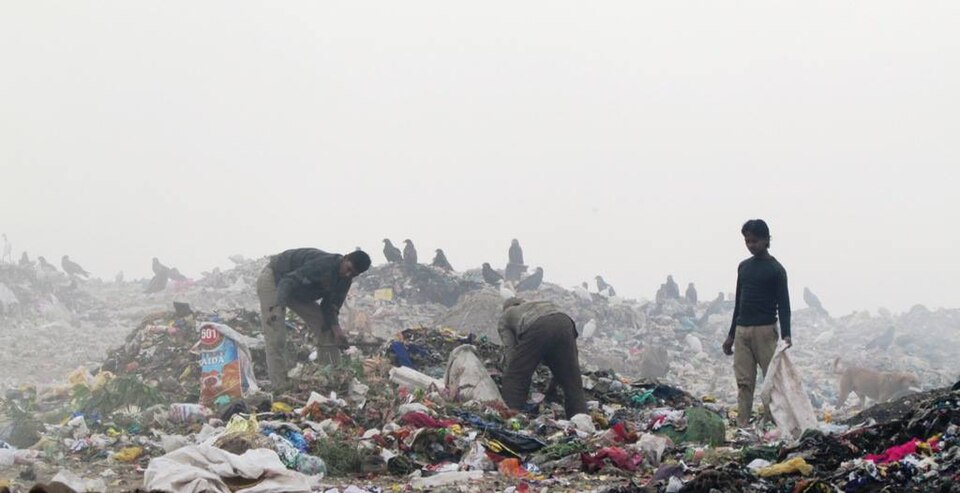
How India is moving towards it. Extended Producer Responsibility (EPR) makes producers responsible for collecting and recycling what they sell. India now has EPR rules for plastic packaging, e-waste and batteries, explained in the chapter on solid waste and plastic and the chapter on special wastes. Waste-to-energy, compost from wet waste and recycled construction debris are other circular steps.
Sustainable development and India
India's dilemma. India must lift hundreds of millions of people out of poverty, build homes, roads and power plants, and create jobs. It must do this while protecting forests, rivers and air that its people depend on directly. Unlike rich countries that grew first and cleaned up later, India is trying to do both at once.
Decoupling. The key idea is decoupling: growing the economy while using fewer resources and causing less pollution per unit of output. Renewable energy, energy efficiency, public transport and better farming all help decouple. India's energy shift is explained in the chapter on clean energy.
Lifestyles matter. India's mission for environment-friendly lifestyles asks people to cut waste and use resources mindfully, and its green credit system rewards actions such as tree planting; both are explained in the chapter on India's climate missions. India's per-person resource use and emissions are still far below those of rich countries. This gives India a moral argument for fair sharing of the remaining global "environmental space".
Linking to global goals. The Sustainable Development Goals turn these ideas into 17 targets for 2030, from ending poverty to protecting oceans and forests. Progress depends on joining up policies, so that a road, a dam or a farm subsidy is judged on all three pillars together. The planetary limits that frame all this are described in the chapter on environmental ethics and justice.
Mains lens: three live debates on sustainable development
1. Too many people or too much consumption? One view says that the environmental crisis is driven mainly by growing populations in developing countries, which need more land, water, food and fuel. Another view says that the bigger driver is the high consumption and production of rich countries, where each person uses many times more energy and materials. Both pressures are real, which is why the debate never fully ends.
A strong answer avoids blaming one side. It shows that a child born in a rich country may leave a far larger footprint than a child born in a poor one, but also that rising numbers in poor regions put pressure on local forests, soil and water. So the solution needs both: lower waste and consumption in rich societies, and education, health and decent jobs that slow population growth and raise living standards in poorer ones.
2. Weak or strong sustainability? Weak sustainability says that natural capital, such as forests, can be replaced by human-made capital, such as roads and factories, as long as total wealth does not fall. Strong sustainability says that some natural assets, like a river system, a rainforest or a stable climate, cannot be replaced at any price. The difference matters when a government decides whether to clear a forest for a mine or a highway.
Supporters of weak sustainability argue that poor countries must be free to turn some natural wealth into schools, hospitals and jobs. Supporters of strong sustainability reply that once a critical ecosystem is gone, no amount of money can bring back its services. A balanced Mains answer uses weak sustainability for ordinary resources and strong sustainability for critical natural capital that has no substitute.
3. Is GDP the wrong scoreboard? GDP counts the timber sold from a cut forest as income, but it does not subtract the lost forest. It counts the money spent cleaning up a pollution disaster as growth. So a country can look richer while its real wealth in soil, water and forests is falling.
Some economists argue for green accounting, which adjusts national figures for the loss of natural capital and the cost of pollution. Others say that such numbers are hard to measure and may be ignored by policymakers. In Mains, argue that green accounts are needed alongside GDP, not instead of it, so that hidden losses become visible in budgets and plans.
Why it matters: Sustainable development is the umbrella idea for the whole environment paper. Every Mains question on growth versus nature, climate or waste can be anchored in these three debates.
Mains lens: two kinds of questions and how to answer them
Type 1: "Explain the concepts and their use" (theory for Mains). Example: "Explain carrying capacity and absorptive capacity. Why is social carrying capacity lower than biophysical carrying capacity?"
- Intro: Define carrying capacity as the largest number of organisms an ecosystem can support without damaging its resources.
- Body, absorptive capacity: Explain that it is the environment's ability to absorb waste and pollution, as when a river breaks down sewage.
- Body, the two kinds: Show that biophysical carrying capacity is the maximum population at a given technology, while social carrying capacity is lower because it allows for a decent life and fair sharing.
- Body, an Indian example: Use a crowded hill town or a city river to show what happens when either limit is crossed.
- Conclusion: Conclude that planning must aim at social carrying capacity, because survival alone is not development.
Type 2: "Discuss a quotation" (Essay and GS). Example: "The Earth provides enough to satisfy every man's needs, but not every man's greed."
- Intro: Explain that the line separates needs, which are limited, from greed, which has no limit.
- Body, the idea: Link it to the 1987 definition of sustainable development, which asks us to meet present needs without harming the ability of future generations to meet theirs.
- Body, the evidence: Show both pressures, rising demand in developing countries and high consumption in rich ones.
- Body, the solutions: Suggest a circular economy, producer responsibility for plastic, e-waste and batteries, and lifestyles that waste less.
- Conclusion: Conclude that sustainability is finally a question of values as much as of technology.
Linking across papers. This chapter is the base for GS-III (environment and economy), GS-IV (values of moderation and care for the future) and the Essay paper. Use its ideas to frame the introduction and conclusion of almost any environment answer.
Mains ಅಭ್ಯಾಸ: ಆರು ಪ್ರಶ್ನೆಗಳು, ಆರು ದೃಷ್ಟಿಕೋನಗಳು
ಇವು ನಾವು ಬರೆದ ಅಭ್ಯಾಸ ಪ್ರಶ್ನೆಗಳು, ಹಿಂದಿನ ವರ್ಷಗಳ ಪ್ರಶ್ನೆಪತ್ರಿಕೆಗಳಲ್ಲ. ಪ್ರತಿ ಪರೀಕ್ಷೆಯ ಹಿಂದಿನ ಪ್ರಶ್ನೆಗಳು ಈ ಮಾಡ್ಯೂಲ್ನ PYQ ಫಲಕದಲ್ಲಿವೆ.
| Angle | Question | How to approach |
|---|---|---|
| Concept | Explain the concepts of carrying capacity and absorptive capacity. Why is social carrying capacity lower than biophysical carrying capacity? | Define both with examples such as groundwater and rivers. Explain quality of life and fair distribution. |
| Economy | "GDP growth can hide the loss of national wealth." Discuss the case for green accounting in India. | Explain natural capital and depletion. Give the forest-cutting example, the valuation difficulty, and policy uses. |
| Debate | Distinguish between weak and strong sustainability. Which should guide decisions on diverting forest land? | Define substitutability and critical natural capital. Use compensatory plantation as an example and argue for a balance. |
| Industry | How can a circular economy help India manage its waste and resource needs? | Contrast linear and circular models. Use EPR rules, informal recyclers and construction debris, and note the challenges. |
| Equity | Is population growth or high consumption the bigger threat to sustainability? Argue with reference to I = P × A × T. | Explain each term. Compare per-person consumption in rich and poor countries, and stress technology and fair sharing. |
| Essay | "The Earth provides enough to satisfy every man's needs, but not every man's greed." | Use carrying capacity, consumption and footprints. Bring in decoupling, circular economy and lifestyles, and end with India's path. |
ಈ ಕೋಷ್ಟಕವನ್ನು ಹೇಗೆ ಬಳಸುವುದು: ಪ್ರತಿ ಉತ್ತರವು ಮೊದಲು ಏನು ಎಂದು ವಿವರಿಸಬೇಕು, ನಂತರ ಈ ಅಧ್ಯಾಯದಿಂದ ಏಕೆ ಎಂದು ನೀಡಬೇಕು, ಮತ್ತು ಮುಂದಿನ ದಾರಿ ಯೊಂದಿಗೆ ಕೊನೆಗೊಳ್ಳಬೇಕು.
Quick revision
- Brundtland (1987): meet present needs without compromising future generations; ideas of needs and limits; three pillars.
- Carrying capacity (resource supply) vs absorptive capacity (waste sink); social carrying capacity < biophysical.
- Crisis drivers: population growth (developing) + high consumption (developed); I = P × A × T.
- Weak sustainability (capital substitutable) vs strong (critical natural capital).
- Ecological footprint vs biocapacity; carbon and water footprints; green GDP subtracts depletion.
- Circular economy: reduce, reuse, repair, recycle; EPR for plastic, e-waste, batteries.
- Decoupling: growth with less resource use per unit of output.
KPSC KAS questions from this chapter
What are renewable and non-renewable resources. How are they depleted and protected.