

KPSC KAS · Module 77 · Mains depth · 16 min
Quantum technology
What KPSC KAS asks from this chapter
Syllabus lines this chapter covers:
- GS 3 · ಭಾರತದ ಅಭಿವೃದ್ಧಿಯಲ್ಲಿ ವಿಜ್ಞಾನ ಮತ್ತು ತಂತ್ರಜ್ಞಾನದ ಪಾತ್ರ; ಮಾಹಿತಿ ತಂತ್ರಜ್ಞಾನ.
3 KPSC KAS questions in our bank come from this module (ಮಾಹಿತಿ ಮತ್ತು ಸಂವಹನ ತಂತ್ರಜ್ಞಾನ).
Read at full depth: basics, the standard layer and the Mains analysis.
Start from zero: a strange world of the very small
Everything around you is made of atoms, and atoms are made of even smaller particles such as electrons. At this tiny scale, nature does not follow the everyday rules we see with balls, cars and planets. It follows the rules of quantum physics, which often seem strange.
Here is a simple picture. A coin lying on a table shows either heads or tails, never both. But a coin spinning in the air is, in a sense, a blur of both until you catch it. Tiny particles behave a bit like the spinning coin, and only "decide" when they are measured.
For about a hundred years, scientists have used quantum physics to explain how atoms work. It already lies behind lasers, transistors, LEDs and MRI scanners. What is new is that we can now control single particles and use their strange behaviour on purpose.
Quantum technology means building devices that use these quantum effects directly, to compute, communicate and measure in ways that ordinary devices cannot. This chapter explains the basic ideas, the four main uses, and India's National Quantum Mission.
Why quantum technology matters now, and when India acted
Why the world is racing. Quantum technology could change three areas at once. It may solve certain problems far faster than any supercomputer, it can make communication that cannot be secretly tapped, and it can build sensors of extreme precision. Countries see it as a strategic technology, much like nuclear or space technology once were.
Why it worries security experts. Most of today's online security, from banking to government messages, relies on maths problems that ordinary computers cannot solve in any useful time. A large enough quantum computer could solve some of them, which would break much of today's encryption. So countries must both build quantum tools and protect themselves from them.
Where India stands. India's research output is growing fast. Its quantum science and technology papers rose from 222 in 2019 to 596 in 2023, though China (889) and the USA (755) published more in 2023.
When India acted. The Union Cabinet approved the National Quantum Mission (NQM) on 19 April 2023, with an outlay of ₹6,003.65 crore for eight years. It is implemented by the Department of Science and Technology (DST). Every year, the world marks World Quantum Day on 14 April, an initiative begun in 2022.
The key ideas: qubits, superposition and entanglement
To understand quantum technology, you need only three ideas. Each one can be explained with an everyday picture, even though the real thing is stranger. Let us take them one at a time.
1. The qubit. An ordinary computer stores information in bits, each either 0 or 1, like a coin lying flat. A qubit (quantum bit) can be 0, 1, or a mix of both at the same time, like a spinning coin. Qubits can be made from tiny things such as single atoms, ions, particles of light or very cold electrical circuits.
2. Superposition. This "both at once" state is called superposition. Because each qubit can hold a mix, a group of qubits can represent a very large number of possibilities together. This is what could let quantum computers explore many options for certain problems at once.
3. Entanglement. Two qubits can be linked so that measuring one instantly tells you about the other, even if they are far apart. This is called entanglement. Think of a pair of gloves packed in two boxes and sent to two cities: opening one box and finding a left glove tells you the other is a right glove, though real entanglement is even stranger than this.
4. Measurement changes everything. When you measure a qubit, the spinning coin is caught, and it becomes a plain 0 or 1. This fragility is a problem for building computers, because heat and noise can "measure" qubits by accident. But it is also a gift for security, because anyone who secretly looks at a quantum message disturbs it.
Four uses: computing, communication, sensing and materials
With these ideas in hand, we can look at what quantum technology is actually used for. India's mission is organised around exactly four areas. Each one uses a different quantum effect.
1. Quantum computing. A quantum computer uses qubits in superposition and entanglement to solve certain problems much faster. These include designing new medicines and materials by simulating molecules, solving complex planning problems, and breaking some types of encryption. It will not replace ordinary computers for everyday tasks such as typing or video calls.
2. Quantum communication. This uses the fact that measuring a quantum signal disturbs it. If someone tries to tap the line, the two users can notice the errors and throw away the key. This makes communication that is secure because of the laws of physics, not just because a code is hard to break.
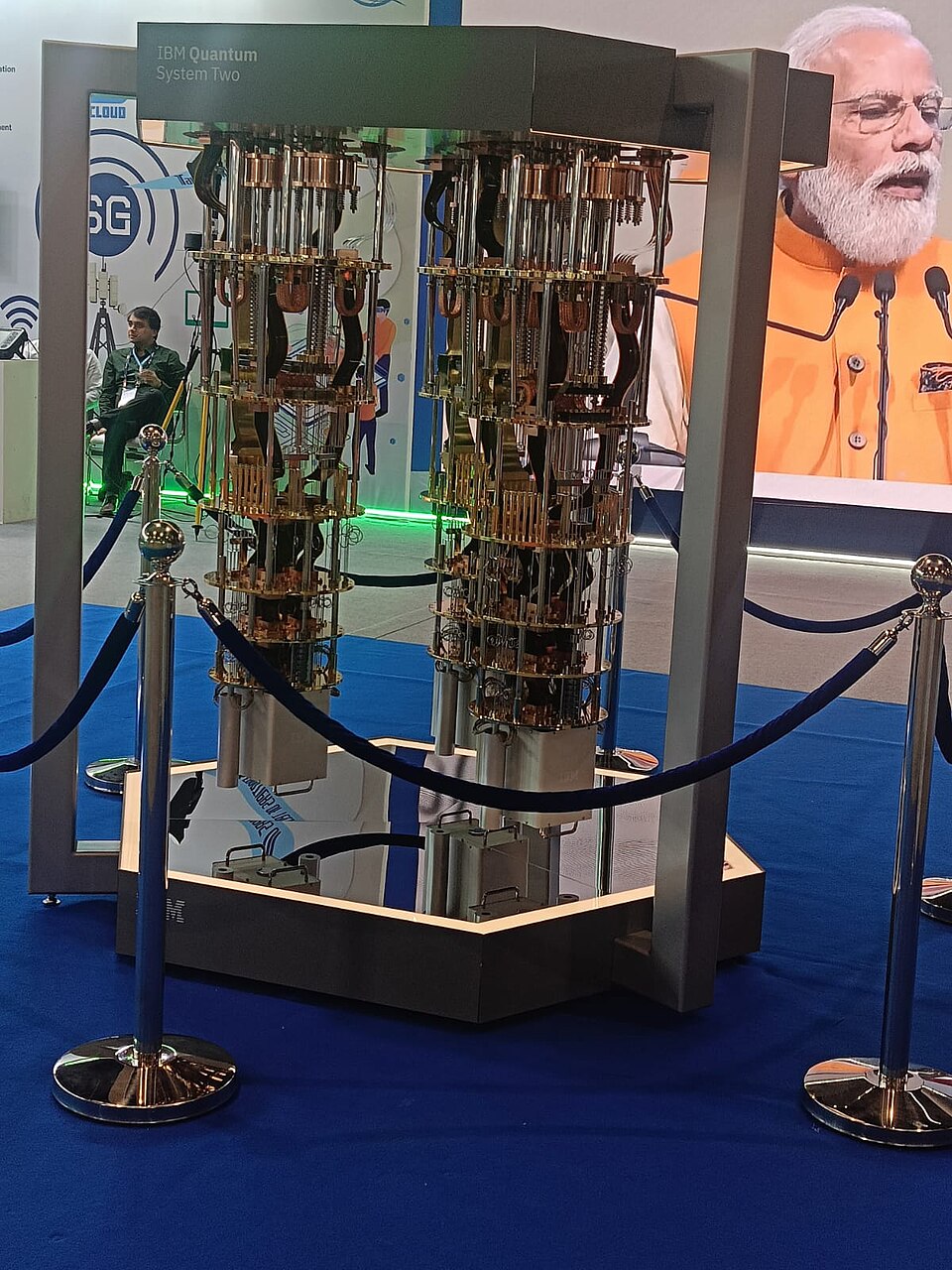
3. Quantum sensing and metrology. Quantum states are extremely sensitive to tiny changes in magnetic fields, gravity or time. This allows super-precise clocks, navigation that does not need satellites, and sensors to find minerals or study the brain. Metrology means the science of very exact measurement.
4. Quantum materials and devices. All of the above need special materials, such as superconductors and very pure crystals, and devices to make and control qubits. This area builds the hardware base on which the other three depend.
Keeping secrets safe: QKD and post-quantum cryptography
We saw that a large quantum computer could break much of today's encryption. So how do countries protect their banks, armies and governments? There are two answers, and India is working on both.
Answer 1: quantum key distribution (QKD). In QKD, the secret key that locks a message is sent using single particles of light. If a spy tries to read them, the particles are disturbed and the users notice. India aims to build a fibre-based QKD network and a country-wide free-space QKD network that uses a satellite as a trusted node, so that keys can travel long distances.
Answer 2: post-quantum cryptography (PQC). PQC does not use quantum physics at all. Instead, it uses new maths problems that even quantum computers are expected to find very hard. Because it runs on ordinary computers and networks, it is easier to roll out widely.
Who is working on it in India. DRDO works on quantum-resilient security, SETS under the Office of the Principal Scientific Adviser works on secure authentication, and C-DOT has worked on QKD, PQC and a quantum-secure video IP phone. India's cyber security agency, CERT-In, published a white paper on quantum cyber readiness in July 2025.
Why start now. An enemy could record encrypted data today and break it later once quantum computers are ready. This is often called "harvest now, decrypt later", and it is why sensitive systems need to move to quantum-safe methods well in advance.
India's National Quantum Mission
Now we can put the pieces together and look at India's plan. The National Quantum Mission (NQM) was approved on 19 April 2023, with ₹6,003.65 crore for eight years. Its aim is to build Indian strength in all four quantum areas, from research to products.
Who runs it. The mission is implemented by the Department of Science and Technology (DST). It was conceived by PM-STIAC, the Prime Minister's Science, Technology and Innovation Advisory Council.
- Its Mission Governing Board is chaired by Dr Ajai Chowdhry.
- Its Mission Technology Research Council is chaired by the Principal Scientific Adviser to the Government of India.
How it is organised. The mission has four Thematic Hubs (T-Hubs), matching the four uses we studied:
- Quantum Computing
- Quantum Communication
- Quantum Sensing and Metrology
- Quantum Materials and Devices
These hubs have 14 technical groups spread across 17 states and 2 UTs. The mission follows a hub-spoke-spike model, which links big centres of excellence (hubs) with consortium projects (spokes) and individual scientists' projects (spikes).
What the hubs do. Besides building technology, the hubs train people, help start-ups and industry, and build international partnerships. A call for pre-proposals to set up the T-Hubs was issued on 20 January 2024.
What quantum technology could change for India
We have seen the science and the mission. UPSC will also ask so what? Here are the likely gains and the real hurdles.
1. Security. Quantum-safe communication can protect defence, banking and government networks against future attacks. Being early also means India is not forced to depend on foreign security tools.
2. Science and industry. Quantum simulation could speed up the design of medicines, fertilisers, batteries and new materials. Precise sensors could help in mining, navigation and medical imaging.
3. The hurdles. Qubits are fragile and often need extremely cold conditions, so the equipment is costly and hard to build. India also needs many more trained scientists and engineers, and a supply of special materials and components.
4. A long race. Quantum technology will take years to mature, so results will not come overnight. Steady funding, international cooperation and links between labs and industry matter more than quick headlines.
Mains lens: one debate and three kinds of questions
GS-III asks about "awareness in the fields of IT, computers, nano-technology" and about developing new technology. On this chapter, a good answer explains the science simply and links it to security and self-reliance.
The questions in this section are practice questions written by us, not past papers.
Debate: should India spend heavily on quantum now?
- Yes: it is a strategic technology, and late entrants may depend on others for security tools.
- No: results are far away, and money could do more good in present needs such as health and education.
- Balanced view: fund it steadily as a long-term strategic bet, while focusing first on areas with near-term use such as quantum-safe security and sensing.
Question type 1: "Explain" (the concept question). Example: Explain superposition and entanglement, and how they are used in quantum technologies.
- Intro: Introduce qubits as the quantum version of bits.
- Body: Explain superposition (both at once), entanglement (linked results) and the effect of measurement, then link them to computing, QKD and sensing.
- Conclusion: Note that the same fragility that makes computing hard makes communication secure.
Question type 2: "Discuss" (the application question). Example: Discuss the objectives and structure of India's National Quantum Mission.
- Intro: Give the facts: approved 19 April 2023, ₹6,003.65 crore, 8 years, DST.
- Body: Explain the four T-Hubs, the hub-spoke-spike model, and the governance by a Mission Governing Board and the PSA-led research council.
- Conclusion: Link the mission to security, industry and research output.
Question type 3: "Critically examine" (the both-sides question). Example: "Quantum computing is a threat to cyber security." Critically examine.
- For the statement: a large quantum computer could break today's public-key encryption, and data stolen now could be decrypted later.
- Against: QKD and post-quantum cryptography can protect systems, and quantum tools can also strengthen security.
- Way forward: move critical systems to quantum-safe methods early, as CERT-In's 2025 white paper urges.
Useful keywords: qubit, superposition, entanglement, decoherence, quantum key distribution, post-quantum cryptography, quantum sensing, metrology, T-Hubs, hub-spoke-spike, harvest now decrypt later.
Previous years' questions
This section shows the real past questions on this chapter for the exam you have chosen. Each question is copied word for word from the official paper, with the year and paper, so that you can see how the topic is actually asked.
Questions are being collected from the official UPSC and BPSC papers. They will appear here once each one is checked against the original paper.
Quick revision
- A qubit can be 0, 1 or a superposition of both. Entanglement links qubits, and measurement turns a qubit into a plain 0 or 1.
- The four uses are computing (special hard problems), communication (secure by physics), sensing and metrology (super-precise measurement) and materials and devices (the hardware base).
- QKD shares keys using light particles, while PQC uses new maths on ordinary computers. India plans satellite-based and fibre-based QKD.
- The National Quantum Mission was approved on 19 Apr 2023, with ₹6,003.65 crore for 8 years, run by DST, and has four T-Hubs.
- India's quantum papers rose from 222 (2019) to 596 (2023). World Quantum Day is 14 April.