

Module 2 · 16 min read · Free chapter
விண்வெளிக் கொள்கை, private sector மற்றும் space debris
India opened space to private companies with reforms in 2020 and the Indian Space Policy 2023. IN-SPACe authorises private space activity, NSIL sells ISRO's technology, and ISRO focuses on research. In January 2025, SpaDeX made India the fourth country to dock two spacecraft. India also aims for debris-free space missions by 2030 to keep orbits safe.
Start from zero: who should do what in space?
Think of the Indian Railways. The government builds the tracks and runs the trains, but private companies make many coaches, parts and signals. Imagine if only one government body were allowed to do everything, from making a bolt to selling a ticket. Work would be slow, and many good ideas would never be tried.
For about fifty years, India's space programme worked somewhat like that, with ISRO doing almost everything itself. That made sense in the early days, when space was new, risky and expensive. But today the world uses space every day, for TV, maps, phones, weather, banking and farming, and the demand is far too large for one agency to meet.
So the question changed from "Can India reach space?" to "How can India earn from space, and use it well?" This chapter answers three parts of that question. Who is allowed to do what, how India learned to join spacecraft in orbit, and how to keep space clean and safe as it gets crowded.
A simple idea runs through all three parts: the space value chain. It is the full path from making parts and satellites, to launching them, to running them in orbit, to selling the services they give on the ground.
Why India opened space to private firms, and when
Why open up? The reasons are easy to see once you look at the numbers. A 2023 government presentation put the global space economy at about USD 360 billion, with India's share at only about 2%. India had world-class rockets and satellites, but a very small slice of the business.
There were other reasons too. ISRO's scientists were spending a lot of time on routine work, such as building standard satellites and launching them, which industry could do. Freeing ISRO from this work lets it focus on new and harder problems, such as human spaceflight and deep-space missions.
When did it happen?
- 2020: the government announced space sector reforms that opened space activities to non-government entities (NGEs), meaning private companies, start-ups and academic bodies.
- 2023: the Indian Space Policy 2023 was brought out. It allows NGEs to take part across the entire space value chain, from building satellites and rockets to running ground stations and selling services.
Where does it apply? The policy covers all of India's civil space activities. It sets out clear roles for the government bodies so that a private company knows whom to approach and what it is allowed to do.
Who does what: ISRO, IN-SPACe, NSIL and the Department of Space
Opening the door to private firms raises a practical question: who decides, who builds and who sells? The Space Policy 2023 answers this by giving each body a clear job. It helps to remember them as a team in which each member plays one position.
| Body | What it is | Main job under the policy |
|---|---|---|
| Department of Space (DOS) | Government department | Nodal department for the policy; sets rules, including for safe and sustainable operations |
| ISRO | Space agency | Research and development of new space technology |
| IN-SPACe | Autonomous single-window agency | Promotes, hand-holds, guides and authorises private space activity |
| NSIL | Public sector enterprise under DOS | Commercialises technology and platforms built with public money |
ISRO: the research engine. Under the policy, ISRO steps back from routine production and focuses on research and development of new technology. It can also share its facilities and know-how with industry.
IN-SPACe: the single window. A private company that wants to build a satellite, launch a rocket or use ISRO's facilities goes to IN-SPACe. It is an autonomous single window that promotes, hand-holds, guides and authorises non-government space activities. By early 2023, it had received more than 250 applications and signed more than 30 MoUs.
NSIL: the business arm. NewSpace India Limited (NSIL) is a public sector enterprise under the Department of Space. Its job is to commercialise the technology and platforms that were created with public money, so that the country earns from what it has already built.
DOS: the rule-maker. The Department of Space is the nodal department for implementing the policy. It also sets the framework for safe and sustainable space operations, which leads us to the problem of space debris later in this chapter.
What a bigger space economy could mean
Why should a student of governance care about market share? Because space is no longer only about prestige. It has become an industry that creates jobs, exports and services that ordinary people use every day.
Think about who uses space in a normal day. A farmer gets a weather warning, a truck driver follows a map, a bank confirms a payment using precise time signals, and a village school joins a class by satellite. Each of these is the last link in the space value chain.
India also has a lot of its own hardware in orbit to build on. By the end of 2025, India had launched 144 spacecraft, and 22 government satellites were working in low Earth orbit and 31 in geostationary orbit. Private firms can now build services on top of this, or launch their own satellites.
There is, however, a catch. More satellites, from India and every other country, mean more crowding in orbit. The same growth that creates business also creates risk, as the rest of this chapter shows.
SpaDeX: learning to join two spacecraft in orbit
Before we come to debris, let us look at a skill that India added recently, because it shapes the future of the whole programme. Docking means bringing two spacecraft together in orbit and joining them firmly. It sounds simple, but both craft are moving at several kilometres every second, so even a small error can cause a crash.
The mission. SpaDeX, the Space Docking Experiment, was launched on PSLV-C60 on 30 December 2024. It carried two spacecraft of about 220 kg each into a 470 km orbit inclined at 55°. After launch, the two craft first moved apart, and then one slowly approached the other in careful steps.
The result. The two spacecraft docked on 16 January 2025. With this, India became the fourth country in the world to achieve docking in space.
Why docking matters. Docking opens up kinds of missions that a single launch cannot do.
- Missions needing more than one launch: large spacecraft can be sent up in parts and joined in orbit.
- Servicing in orbit: a spacecraft could one day refuel or repair another.
- A space station: the Bharatiya Antariksh Station will need its modules, crews and supplies to dock again and again. You can read more about this in human spaceflight and the space station.
Space debris: the rubbish we leave in orbit
Now we come to the downside of a busy sky. Space debris means human-made objects in orbit that no longer do any useful work. It includes dead satellites, used rocket stages, and pieces from break-ups and collisions, down to tiny flakes of paint.
Why is a small piece dangerous? On Earth, a stone the size of a coin cannot do much harm. In orbit, the same piece moves at several kilometres every second, so it hits with the force of a bullet or worse. A satellite hit by even a small fragment can be damaged or destroyed.
Why does it get worse over time? When two objects collide, they break into many more pieces, and each piece can hit something else. So debris can grow by itself, like a chain reaction, unless countries are careful. Low Earth orbit, where most satellites work, is the most crowded and the most at risk.
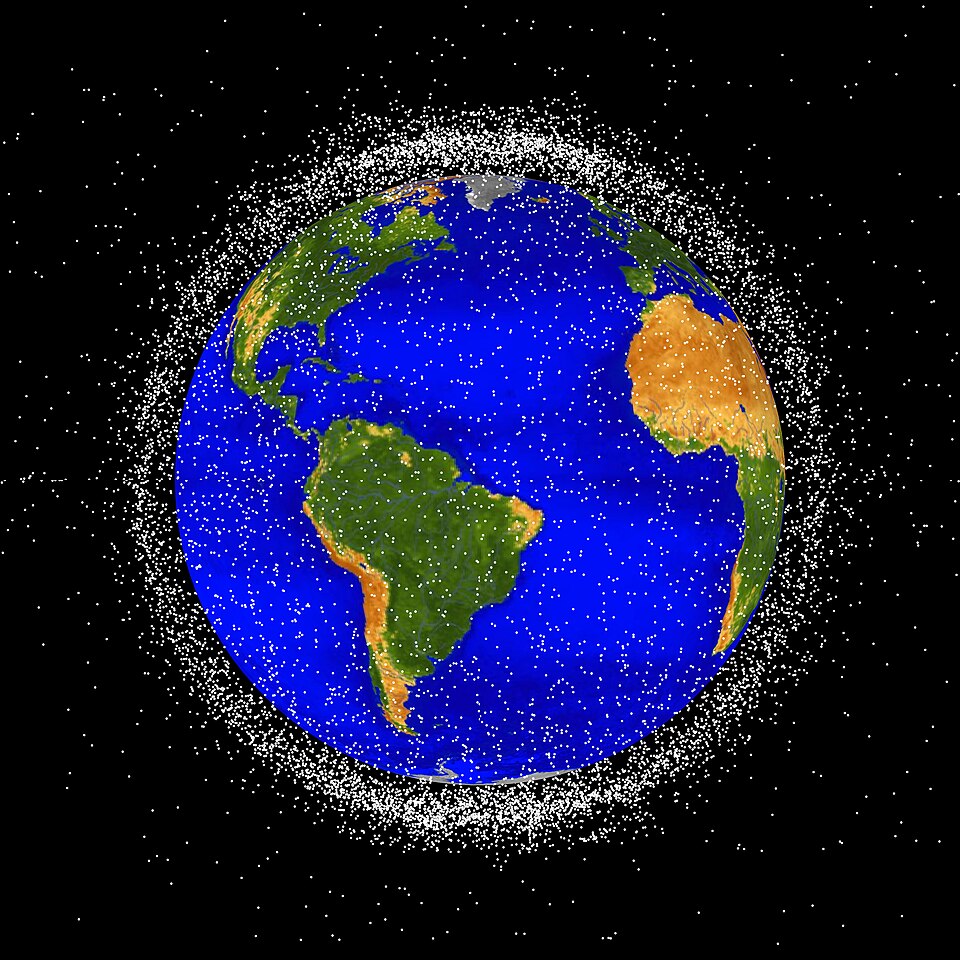
How fast is it growing? ISRO's Indian Space Situational Awareness Report 2025 says 4,651 new objects were added to space in 2025 alone. Launch failures add to the problem too. In 2025, PSLV-C61 had an anomaly in its third stage, and the EOS-09 satellite it carried was lost.
How India keeps its satellites safe and space clean
If debris is the problem, what can a country do about it? India's answer has two parts. First, protect your own satellites from what is already up there, and second, stop adding more junk in the future.
1. Watching the sky. ISRO's IS4OM (ISRO System for Safe and Sustainable Space Operations Management) is the nodal system for this work. It tracks objects in orbit and checks the risk they pose to Indian satellites. Every year, ISRO publishes what it found in the Indian Space Situational Awareness Report.
2. Moving out of the way. When tracking shows that a piece of debris will pass dangerously close, the satellite fires its small thrusters to shift its path slightly. This is called a collision avoidance manoeuvre (CAM). In 2025, ISRO carried out 4 such manoeuvres for satellites in geostationary orbit and 14 for satellites in low Earth orbit.
3. Not leaving junk behind. In 2024, at the 42nd meeting of the IADC (the Inter-Agency Space Debris Coordination Committee) held in Bengaluru, India declared the Debris Free Space Missions (DFSM) initiative. Its aim is that by 2030, the missions of all Indian space actors, government and private, leave no debris behind.
4. Rules for everyone. The Space Policy 2023 asks the Department of Space to set a framework for safe and sustainable operations, in line with international debris mitigation guidelines. As private firms launch more satellites, these rules will apply to them as well.
What these changes mean for India
We have seen the rules, the new docking skill and the debris problem. UPSC will also ask so what? Here is what these changes mean, on both the bright side and the risky side.
1. Growth and jobs. Opening the whole value chain lets start-ups and industry build satellites, rockets and services. This can raise India's small share of the global space economy and create skilled jobs.
2. A sharper ISRO. With routine work moving to industry, ISRO can put its talent into harder goals such as human flight, docking and deep-space missions. SpaDeX shows the kind of new capability this focus can produce.
3. New risks to manage. More private satellites mean more traffic and more chances of collisions. Clear rules, close tracking and the DFSM goal are needed so that growth does not ruin the orbits everyone depends on.
4. Clear roles, fewer delays. A single window like IN-SPACe saves private firms from chasing many offices. But it also needs to work quickly and fairly, because a slow approval system can hold back the very growth it is meant to support.
Mains lens: one debate and three kinds of questions
GS-III asks about "awareness in the field of space" and the role of science and technology in development. On this chapter, a good answer links policy, industry and safety rather than listing them separately.
The questions in this section are practice questions written by us, not past papers.
Debate: should the government keep space to itself?
- For a bigger private role: faster growth, more innovation, more jobs, and a freer ISRO that can focus on hard research.
- For caution: national security, the risk of profit-driven firms ignoring safety, and the danger of more debris.
- Balanced view: open the market, but keep strong rules through a clear regulator, and make debris-free missions a condition for everyone.
Question type 1: "Explain" (the concept question). Example: Explain the institutional framework created by the Indian Space Policy 2023.
- Intro: Say that the 2020 reforms and the 2023 policy opened the whole value chain to non-government entities.
- Body: Explain the roles of DOS as the nodal department, ISRO for R&D, IN-SPACe as the single window, and NSIL as the commercial arm.
- Conclusion: Note that clear roles help private firms know whom to approach.
Question type 2: "Discuss the significance" (the application question). Example: Discuss the significance of SpaDeX for India's future space missions.
- Intro: Give the facts: PSLV-C60 on 30 December 2024, docking on 16 January 2025, India the fourth country to dock.
- Body: Explain multi-launch missions, servicing in orbit, and building the Bharatiya Antariksh Station.
- Conclusion: Show how it links to human spaceflight and long-term goals.
Question type 3: "Critically examine" (the both-sides question). Example: "Space debris is the price of a growing space economy." Critically examine, with reference to India's response.
- For the statement: more launches add more objects (4,651 added in 2025), and collisions can create still more debris.
- Against: growth need not mean debris, if missions are designed to leave nothing behind.
- India's response: IS4OM tracking, collision avoidance manoeuvres (4 in GEO and 14 in LEO in 2025), DFSM by 2030 for all actors, and the policy's debris framework.
Useful keywords: space value chain, non-government entities, single window, commercialisation, docking, in-orbit servicing, space situational awareness, collision avoidance, debris mitigation, sustainable use of outer space.
Previous years' questions
This section shows the real past questions on this chapter for the exam you have chosen. Each question is copied word for word from the official paper, with the year and paper, so that you can see how the topic is actually asked.
Questions are being collected from the official UPSC and BPSC papers. They will appear here once each one is checked against the original paper.
Quick revision
- The 2020 reforms opened space to non-government entities, and the Indian Space Policy 2023 opened the entire value chain to them.
- DOS is the nodal department, ISRO focuses on R&D, IN-SPACe is the single window that promotes and authorises private firms, and NSIL is the commercial arm under DOS.
- In 2023, the global space economy was about USD 360 billion, and India's share was about 2%.
- SpaDeX was launched on PSLV-C60 on 30 Dec 2024, and its two craft docked on 16 Jan 2025. India became the fourth country to dock in space.
- Docking is needed for multi-launch missions, servicing in orbit and the Bharatiya Antariksh Station.
- 4,651 objects were added to space in 2025. ISRO did 4 CAMs in GEO and 14 in LEO, and DFSM aims for debris-free missions by all Indian actors by 2030.