

BPSC ASO · Module 12 · standard depth · 19 min
What are art, culture and heritage? How to read a monument
What BPSC ASO asks from this chapter
Syllabus lines this chapter covers:
- Preliminary: General Knowledge (General Studies 50, General Science and Mathematics 50, Mental Ability 50) · India and neighbouring countries: history of neighbouring countries, history of India, culture
- Mains Paper 2: General Knowledge (General Studies 50, General Science and Mathematics 50, Mental Ability 50) · India and neighbouring countries: history of neighbouring countries, history of India, culture
BPSC ASO questions from this module are being sorted into our bank.
Cut to standard depth for BPSC ASO. 6 deeper paragraphs are in the full chapter.
Start from zero: what is "culture"?
Think about what happens at a wedding in your family. Someone cooks a dish that only appears at weddings, and an aunt sings an old song that nobody wrote down. Everyone knows where to stand, what to wear and when to touch the elders' feet, although nobody handed out a rule book.
All of this is culture. It is the way a group of people lives, eats, dresses, speaks, prays, celebrates and makes beautiful things. We are not born knowing it, because we pick it up from our family and neighbours, and then we pass it on.
The word itself tells the story. The English word comes from the Latin cultus, which means tilling or refining, the way a farmer turns rough land into a field. The Sanskrit word sanskriti comes from the root kri, "to do", so culture is what people do to refine themselves and the world around them.
This chapter sets up the whole subject. Keep one question in mind as you read: why does a civil servant need to understand temples, songs and festivals at all?
The key ideas at a glance
This table gathers the words that this subject uses again and again. Each one is explained in the sections that follow.
| Term | What it means | Example |
|---|---|---|
| Culture | It is a whole way of life, with things we make and ideas we hold. | Food, dress, language, festivals and art are all culture. |
| Civilisation | It is the outer system of living: cities, tools, government and trade. | Harappan drains and granaries show a civilisation at work. |
| Heritage | It is the part of culture we inherit and choose to protect. | The Sanchi Stupa and the Taj Mahal are part of India's heritage. |
| Tangible heritage | These are things you can touch, such as buildings, sites and objects. | A temple, a fort and a bronze statue are tangible heritage. |
| Intangible heritage | These are living practices, such as songs, dances, rituals, knowledge and crafts. | A festival or a weaving skill is intangible heritage. |
| Constitution | Three Articles protect culture: 29(1), 49 and 51A(f). | Article 49 asks the State to protect monuments of national importance. |
Notice that the list moves from ideas (culture) to things (monuments) to law (the Constitution). That is also the order of this chapter.
Culture and civilisation: two different things
Two parts of culture. Culture has a material part, which is the objects we make, like dress, food, pots and buildings. It also has a non-material part, which is our ideas, ideals, beliefs and values. A temple is material, but the belief that makes people build it is non-material.
Prakriti, sanskriti, vikriti. Three Sanskrit words from the same root make the idea easy to picture. Prakriti is raw matter, like a lump of clay, and sanskriti is that clay refined into a painted pot. Vikriti is the same pot broken or spoilt, so culture is refinement and its loss is decay.
Civilisation is what we have; culture is what we are. People often use the two words as if they mean the same, but they do not. Civilisation is the outer system of living: better houses, roads, tools, trade and government that make nature serve human needs. Culture is the inner refinement of "head and heart", seen in art, music, values and the way we treat others.
A simple test. A rich person with a big house and car is "civilised" in the outer sense, but may still be rude and selfish. A poor farmer who sings, shares food with a stranger and respects others may be deeply "cultured". This is why an exam question on culture is never only about buildings.
Eight features of culture. Culture is learned, not inherited in the blood, and it is shared by a group rather than held by one person. It is cumulative, because each generation adds to it, and it changes, because some things are dropped as new ones are added. It is dynamic, it sets permissible patterns of behaviour, it forms one connected whole, and it holds up ideals that people try to live by.
Why it matters. If culture is learned and changing, then nobody's culture is "pure" or fixed. Indian culture has absorbed ideas from many peoples over thousands of years, and it is still changing in our own lifetime. That one idea will help you answer many Mains questions on identity, diversity and globalisation.
Heritage: what we choose to keep
From culture to heritage. Every generation learns from the one before, adds its own experience and drops what no longer helps. The part of this inheritance that people cherish, protect and keep alive is called cultural heritage. It is a source of pride, and it ties people together across time.
Two levels. Some heritage belongs to all humanity, such as the idea of zero or the practice of yoga. Some belongs to a nation, such as the Sanchi Stupa, the Qutub Minar, the Golden Temple or a church in Goa. Heritage also includes ideas: the work of Aryabhata and Bhaskaracharya in mathematics and astronomy, of Charaka and Sushruta in medicine, and of Patanjali in yoga.
Tangible and intangible. Tangible heritage can be touched: monuments, sites, sculptures and manuscripts. Intangible heritage lives in people: songs, dances, rituals, skills and knowledge. If the last weaver of a pattern dies without a student, that heritage dies too, even though no building falls.
The world's two big agreements. UNESCO adopted the World Heritage Convention on 16 November 1972 to protect sites of "outstanding universal value". India ratified it on 14 November 1977, and as read on 16 November 2026, India has 44 properties on the World Heritage List. Later, the 2003 Convention (adopted 17 October 2003) began to protect intangible heritage too.
The five domains of intangible heritage. The 2003 Convention lists five areas. They are oral traditions and expressions (including language), performing arts, social practices, rituals and festive events, knowledge and practices about nature and the universe, and traditional craftsmanship.
Why it matters. The idea of intangible heritage changed what the world counts as worth saving. Earlier, the focus was on grand stone buildings, which favoured rich kings and big empires. Now a village festival, a puppet show or a craft family counts as heritage too, and that brings ordinary people and their livelihoods into the story.
Culture in the Constitution
Why would a Constitution care about culture? India was born in 1947 out of a painful Partition, with hundreds of languages and many faiths. The makers of the Constitution knew that people feel safe only when their way of life is respected. So they wrote culture into three different parts of the Constitution, each giving a different kind of promise.
A right: Article 29(1). Under the Fundamental Rights, Article 29(1) says that any section of citizens with a distinct language, script or culture has the right to conserve it. This is a right that a court can enforce. A small language group, for example, can claim protection for its script.
A duty of the State: Article 49. Among the Directive Principles, Article 49 makes it the obligation of the State to protect every monument, place or object of artistic or historic interest that Parliament declares to be of national importance. It must be guarded from spoliation, disfigurement, destruction, removal, disposal or export. Directive Principles cannot be enforced in court, but they guide laws and policy.
A duty of every citizen: Article 51A(f). The Fundamental Duties, added later, ask every citizen "to value and preserve the rich heritage of our composite culture". The word composite is the key. It means Indian culture is made of many strands woven together, not owned by one group.
Why it matters. Notice the three-way design: a right for communities, a duty for the government and a duty for citizens. Protection of culture is therefore not only the job of the Archaeological Survey of India or the Ministry of Culture. When a citizen scratches a name on a monument, they break a constitutional duty, even if no court will punish them for that alone.
Why Indian art looks the way it does
Material decides what survives. For about a thousand years after the Harappan cities declined, very little Indian architecture survives. The reason is not that people stopped building. They built with mud, mud-brick, bamboo, timber and thatch, which rot away, so the record looks empty even though life was busy.
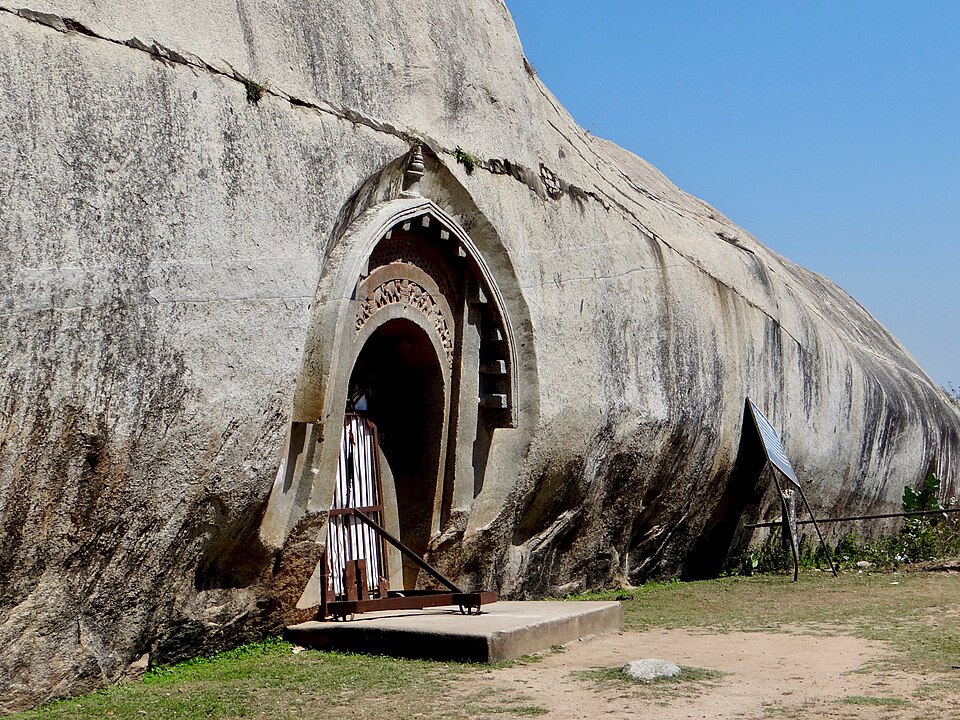
Wood remembered in stone. Around Ashoka's time, builders began to shift from wood to stone. The Lomas Rishi cave in the Barabar hills of Bihar, cut for the Ajivika sect in the 3rd century BC, shows this clearly. Its stone doorway copies a wooden hut, with bent roof-ends, beam-ends and a frieze of elephants, as if the carvers were remembering timber.
Many sources, one synthesis. Indian art grew from local traditions mixed with outside influences. After the Harappans came Hindu, Buddhist and Jain styles, and in the medieval period Persian ideas merged with Indian ones. Colonial rule then brought Western forms, which Indian builders also adapted.
Four forces that shape any art form. You can explain almost any style with four forces. Religion decides what is shown and why, patrons (kings, merchants, guilds, monasteries) decide what can be afforded, and material (stone, wood, clay, paper) decides what is possible. Contact through trade and conquest brings new ideas.
Why it matters. These forces turn memorising into understanding. A Prelims question may ask why Gandhara Buddhas look Greek, or why south Indian temples are built of granite, and the answer is almost always one of these four forces. In Mains, naming the force and giving one example makes your answer analytical instead of descriptive.
How to read a monument: five questions
Every chapter in this subject uses the same five questions. Practise them on any building, painting, dance or song you meet, even a small shrine near your home.
| Question | What to look for | Example: a cave-temple doorway |
|---|---|---|
| What do I see? | Look at the shape, material, decoration and figures. | A rock-cut arch is shaped like a wooden hut. |
| When and where? | Find the period, the region and the dynasty. | It dates from Ashoka's time and lies in the Barabar hills. |
| Why this shape? | Think of religion, material, climate and older traditions. | Carvers copied the timber huts they knew. |
| Who made and paid for it? | Look for the patron, the artisans and any inscription. | An inscription says it was made for the Ajivikas. |
| What does it mean today? | Check its protection, use, tourism and the threats it faces. | It is a protected site that shows how stone architecture began. |
Why it matters. Exam questions on art are rarely "name the builder". They are usually "identify the style from its features" or "explain why this form developed". The five questions train you for both, and they also give you a ready structure for a 150-word Mains answer.
Classical, folk and tribal: three streams that meet
Classical. A classical art follows a written grammar and needs long training under a teacher. It usually grew with the support of temples or courts. Its rules for movement, melody or proportion were set down in treatises, so a trained eye can judge whether it is done "correctly".
Folk. A folk art belongs to a village or region, is learned by watching and joining in, and is tied to seasons, harvests, weddings and festivals. Anyone in the community may take part. Its strength is freshness and local flavour, not fixed rules.
Tribal. A tribal art is rooted in a community's link with forest, land and spirits. Its paintings, songs and dances often record myths, hunts and the cycle of nature. It is usually collective, and its meaning is known fully only inside the community.
The streams keep borrowing. These are not sealed boxes. Many classical dances grew out of temple and folk forms, and folk painters now sell to city buyers. Bodies such as the Sangeet Natak Akademi, set up in 1953 as an autonomous body of the Ministry of Culture for music, dance and drama, try to support all three.
Why it matters. The label "classical" brings prestige, grants and stage space, so it is sometimes debated. A strong Mains answer avoids ranking the streams as "high" and "low". It shows how they feed each other and why folk and tribal forms need extra support to survive.
Why a civil servant must know culture
It is in the syllabus. The UPSC Mains GS Paper 1 syllabus asks for "salient aspects of art forms, literature and architecture from ancient to modern times". Prelims also asks a few questions every year on temples, dances, paintings, Buddhism and Jainism, and heritage lists. State PSCs ask the same, often with extra questions on their own folk arts.
It is part of the job. A district officer handles protected monuments near construction sites and runs the security for fairs and festivals that draw lakhs of people. They also support craft clusters and handloom weavers whose livelihoods depend on heritage skills. Tourism, temple administration and museum education all reach the officer's desk sooner or later.
It is a tool of diplomacy. Yoga, Buddhist sites, classical music and handicrafts are part of India's soft power, which means its ability to win friends through attraction rather than force. Officers in culture, tourism and foreign service use this every day.
It shapes social harmony. Respect for many cultures keeps a diverse country together. The Constitution asks citizens to value our composite culture for exactly this reason. An officer who understands why a festival or a dance matters to a community handles a dispute about it with more sense and less force.
Why it matters. Culture is therefore not a "soft" subject for memorising names. It connects to development, livelihoods, law and order, diplomacy and national unity. That link is what Mains examiners look for in your answers.
Quick revision
- Culture comes from the Latin cultus (tilling, refining), and sanskriti comes from the root kri (to do).
- Prakriti is raw matter, sanskriti is refined matter and vikriti is decayed matter.
- Culture has a material part (objects) and a non-material part (ideas, values).
- Civilisation is "what we have", while culture is "what we are".
- Culture is learned, shared, cumulative, changing and dynamic, and it sets ideal patterns of behaviour.
- Heritage is the part of culture we inherit and protect; it can be tangible or intangible.
- The World Heritage Convention dates from 16 November 1972, and India ratified it on 14 November 1977.
- The Intangible Cultural Heritage Convention dates from 17 October 2003 and has five domains.
- Article 29(1) is a right to conserve a distinct language, script or culture.
- Article 49 is the State's duty to protect monuments of national importance.
- Article 51A(f) is the citizen's duty to value and preserve our composite culture.
- The Lomas Rishi cave (Barabar hills, Ashoka's time, for the Ajivikas) copies a wooden hut in stone.
- The Sangeet Natak Akademi was set up in 1953.