

BPSC TRE 4.0 · Module 3 · standard depth · 22 min
After the Guptas: Harsha, the Chalukyas and the Pallavas
What BPSC TRE 4.0 asks from this chapter
Syllabus lines this chapter covers:
- Class 9 to 10 teacher · Part III subject: Social Science (history or geography, then geography, economics or political science).
- Class 11 to 12 teacher · Part III subject: History, Political Science, Geography, Economics, Sociology, Psychology or Philosophy.
BPSC TRE 4.0 questions from this module are being sorted into our bank.
Cut to standard depth for BPSC TRE 4.0. 9 deeper paragraphs are in the full chapter.
Start from zero: a world without one emperor
In the last chapter we saw the Gupta empire weaken and break up by the middle of the sixth century. No single family replaced it. Instead, India filled with regional kingdoms, each rooted in its own fertile valley and each fighting its neighbours.
Two stories stand out. In the north, Harsha of the Pushyabhuti family built a large kingdom from Kanauj in the seventh century. In the south, the Chalukyas of Badami and the Pallavas of Kanchi fought one another for more than a century, while the Pandyas of Madurai pressed from the far south.
Older books saw this as a sad age of decline after the 'Golden Age'. Historians now see it differently. This is when regional kingdoms, temple building in stone, local assemblies and the Dravidian temple style took shape, patterns that lasted for centuries.
Why study this? Exams ask about Harsha's sources, his clash with Pulakesin II, the Aihole inscription, the Pallava-Chalukya wars, the ur-sabha-nagaram assemblies and Pallava architecture. Mains asks why the south stayed divided and whether Harsha really was the 'last great Hindu emperor'.
The post-Gupta powers at a glance
| Power | Base | Key facts |
|---|---|---|
| Pushyabhutis (Harsha) | Thanesar, then Kanyakubja | Harsha from 606; checked on the Narmada; died 647 |
| Maukharis | Kanyakubja | Grahavarman married Rajyasri; throne passed to Harsha |
| Gaudas | Bengal | Sasanka, Harsha's rival, died about 637 |
| Maitrakas | Valabhi, Saurashtra | Dhruvasena II became Harsha's son-in-law |
| Chalukyas of Badami | North Karnataka | Pulakesin I (543-44), Pulakesin II; ended about 750 by Dantidurga |
| Eastern Chalukyas | Vengi, Krishna-Godavari delta | Founded by Vishnuvardhana, 631; ruled over 500 years |
| Pallavas | Kanchi (Tondaimandalam) | Simhavishnu, Mahendravarman I, Narasimhavarman I; ended early 10th century |
| Pandyas | Madurai, Vaigai valley | Revived by Kadungon; fought for the Kaveri delta |
The key idea. After the Guptas, power became regional. Each kingdom rested on a fertile agrarian core, gave land to brahmanas and temples, and depended on many subordinate rulers. Wars were mostly about controlling rich river valleys and the routes between them.
North India changes: camps, Kanauj and a debate
Many kingdoms. As Gupta authority faded, families that had been Gupta subordinates declared independence. These included the Maukharis of Kanyakubja, the later Guptas of Magadha, the Gaudas of Bengal, the Maitrakas of Valabhi in Saurashtra and the Pushyabhutis of Thaneswar. They fought each other constantly, and the samantas (subordinate rulers) who guarded outlying areas grew powerful.
Camps of victory. A new kind of political centre appeared. Inscriptions speak of jayaskandhavaras, 'camps of victory', set at strategic places on high ground or protected by hills and rivers, and linked by good routes. Kings issued land grants from these camps; Harsha's Banskhera and Madhuban plates were issued from two such camps.
Why Kanauj? Kanauj (Kanyakubja, also called Mahodaya) lay in the fertile Ganga-Yamuna doab on raised ground that could be easily fortified. It had a large farming hinterland from which land grants could be made in plenty, and so it attracted brahmanas, whose descendants were later honoured in courts across India. It was also well linked by routes to the east and the south.
Why did Harsha move there? Harsha's family had ruled from Thaneswar in Haryana. When he became king he chose Kanyakubja instead, perhaps because Thaneswar was closer to the north-west, from where the Hunas had been raiding since Skandagupta's time. A more central capital felt safer.
Did Pataliputra decline because trade decayed? Historian R. S. Sharma argued that trade declined after the Guptas, coins became scarce, and officials and soldiers had to be paid with land. For him, Pataliputra stood for the old order and Kanauj for the start of a feudal age. This connects to the debate on Gupta land grants that you met in the last chapter.
The critics' answer. Other historians reply that trade, towns and money did not decline everywhere. In south-eastern Bengal and western India trade flourished and gold and pure silver coins were plentiful, and regional trade continued on a large scale. So the decline of one city cannot prove an all-India decline.
Why it mattered later. Because Harsha made Kanyakubja his capital and his poet glorified it, the city became a symbol of royal power in the north. Later rulers kept trying to claim it, which led historians to speak of a 'Tripartite Struggle' for Kanauj among the Gurjara-Pratiharas, the Palas and the Rashtrakutas, a story for a later chapter.
Harsha: rise, wars and reputation
Two famous sources. Most of what we know about Harsha comes from two men he patronised. Banabhatta wrote the Harshacharita ('Life of Harsha'), the first formal charita kavya, a biographical poem with the patron as hero. The Chinese pilgrim Xuan Zang (Hiuen-Tsang) travelled in India from 629 to 645 and spent much time at Harsha's court.
Why read them carefully? Both writers had reasons to praise Harsha, and both present him as master of all north India. Bana portrays Harsha as just and loving toward his elder brother, partly to justify why the younger brother became king. Inscriptions of Harsha and of his rivals help us check their claims.
The family's rise. Banabhatta names Pushyabhuti as the founder of the line at Thaneswar. Harsha's own plates list earlier rulers, the first three titled only Maharaja, a sign they were not fully sovereign. The fourth, Prabhakaravardhana, took the title Maharajadhiraja and married his daughter Rajyasri to Grahavarman, the Maukhari king of Kanyakubja.
A crisis becomes an opportunity. Prabhakaravardhana faced Huna raids on the north-west and died suddenly. Then Devagupta of Malava and Sasanka of Gauda killed Grahavarman and seized Kanyakubja. Harsha's elder brother Rajyavardhana went to fight them but was killed in the enemy camp.
Two kingdoms in one hand. Harsha, who came to the throne in AD 606, rescued his widowed sister Rajyasri. Since the Maukharis had no heir, their ministers offered him the throne of Kanyakubja. Harsha now ruled both the Pushyabhuti and Maukhari lands and made Kanyakubja his capital.
The east. Harsha vowed revenge on Sasanka, but neither Bana nor Xuan Zang describes an actual battle between them. Xuan Zang says Sasanka cut down the Bodhi tree at Gaya some years before 637-38, so he must have held that region then. Harsha seems to have succeeded in the east only after Sasanka's death around 637, taking Odra and Kongada (Odisha) by 643.
The west. The Maitrakas of Valabhi had been Gupta vassals. Harsha overpowered their king and then made peace through marriage: Dhruvasena II married Harsha's daughter and became his ally. This drew Valabhi away from the influence of the Chalukya king Pulakesin II.
The clash on the Narmada. The Latas, Malavas and Gurjaras lay between Harsha's kingdom and that of Pulakesin II, and both kings wanted them. Pulakesin's Aihole inscription, composed by his poet Ravikirti, says Harsha's joy (harsha) melted away in fear when his elephants fell in battle. Xuan Zang also suggests that Harsha attacked but failed.
A title from a rival. Pulakesin's successors claim he became Paramesvara by defeating sakalottarapathesvara, 'the lord of the whole north', meaning Harsha. Historians note that court poets often praised a rival in order to make their own king's victory look greater. The Narmada remained Harsha's southern frontier.
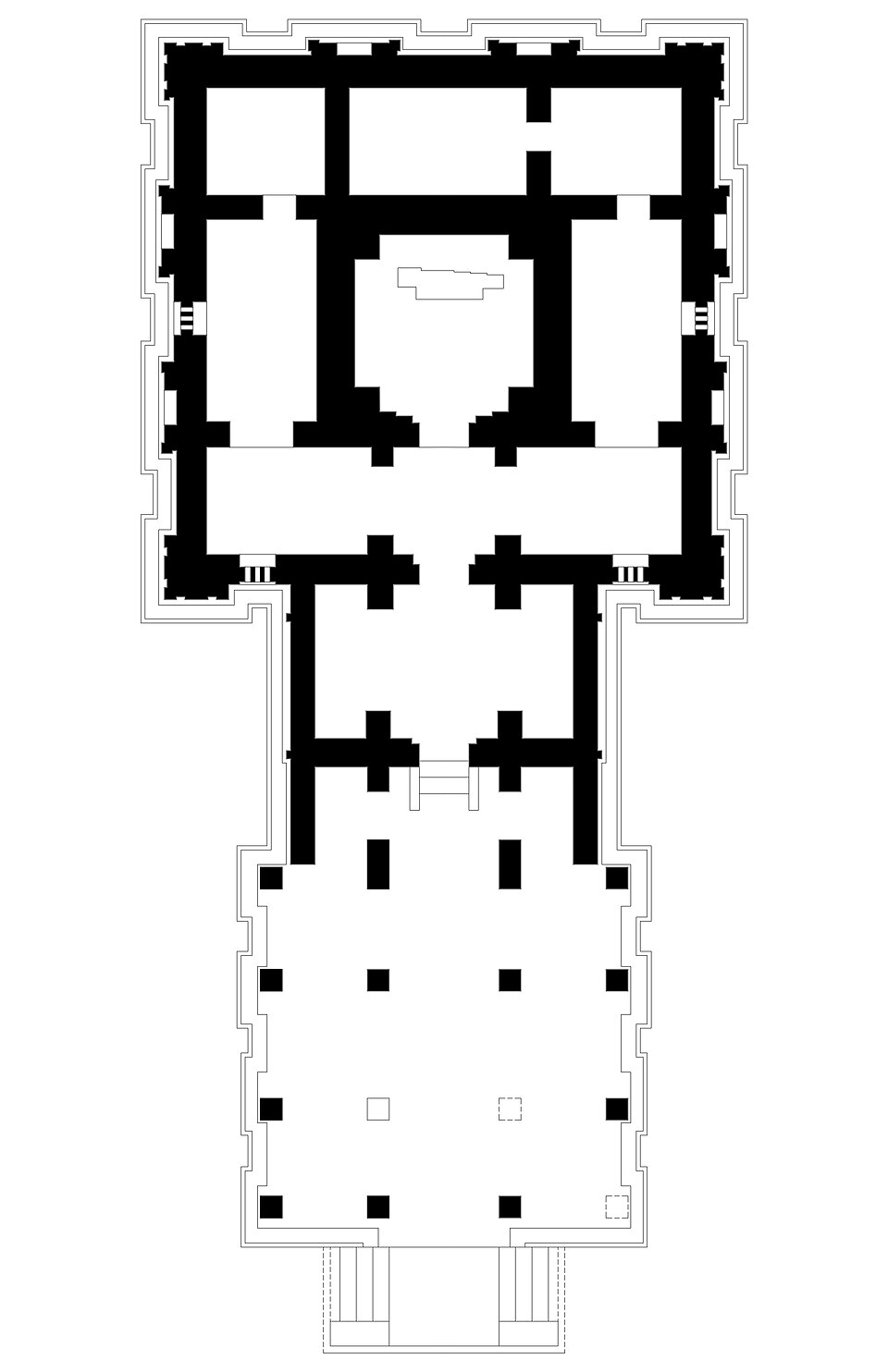
How large was his kingdom? Harsha held parts of present Uttar Pradesh, south Bihar and Odisha, and inherited Thanesar with parts of eastern Punjab and Rajasthan. Bhaskaravarman of Kamarupa was his subordinate ally, and he had influence over Jalandhar and perhaps Kashmir. This is much smaller than older historians imagined.
Harsha's religion. Xuan Zang presents Harsha as a Mahayana Buddhist who held a grand assembly at Kanyakubja and nearly emptied the treasury in gifts to Buddhists. Yet the same pilgrim says that at Prayaga Harsha worshipped the Buddha, Shiva and the Sun and gave to all faiths. Harsha's inscriptions call him a devotee of Shiva and record land grants to brahmanas.
The king as author. Three plays are credited to Harsha: Priyadarshika, Ratnavali and Nagananda. The first two begin with invocations to Brahmanical gods. This suggests that the Buddhist pilgrim may have presented Harsha as a greater patron of Buddhism than he was.
Government. Little is known of Harsha's administration, and most official titles continued from the Guptas. Xuan Zang says taxes were light, with the king taking one-sixth of the produce, and that Harsha toured his kingdom to learn about his people. He says officials were paid with land, though no such secular grants have survived; in 643 about 20 tributary rulers owed Harsha allegiance.
Era and end. The Harsha era, counted from AD 606, was still in use in Mathura and Kanauj when Alberuni visited in the eleventh century. A Chinese embassy came to Harsha's court in 643 and again in 647, but by then Harsha was dead and his throne had been seized. The usurper was defeated with help from Nepal and Assam and taken to China.
The Deccan and the south: from many kingdoms to three powers
Two regions, not one. Historians separate the Deccan (Maharashtra, north Karnataka and up to the Krishna-Godavari deltas) from south India (Tamil country and Kerala). Both had their own histories after the Satavahanas, whom you met in an earlier chapter. Together they are called 'southern India'.
After the Satavahanas. No single dynasty held the Deccan any longer. In northern Maharashtra the Abhiras founded a kingdom; their founder Isvarasena began an era in 248-49 that later became the Kalachuri-Chedi era. The Vakatakas soon dominated the Maharashtra plateau, and Pravarasena I alone among them took the title Samrat, performing Vedic sacrifices and giving land to brahmanas.
Karnataka. In the north Kanara coast, the Kadambas of Banavasi replaced an earlier line. Their founder Mayurasarman was a brahmana skilled in guerrilla war who forced the Pallavas to recognise him. After performing horse sacrifices he became Mayuravarman, the change from 'Sarman' to 'Varman' marking a move from brahmana to kshatriya status.
The east and south of the Deccan. In the fertile Krishna-Godavari delta, the Ikshvakus succeeded the Satavahanas from about 225, and the Vishnukundins brought stability from the mid-fifth century. In south Karnataka, the Western Gangas ruled Gangavadi for about 600 years. Its hills and modest farmland kept outsiders away, but its strategic position drew it into every southern war.
The Kalabhra interregnum. In the Tamil country, the history of the fourth to mid-sixth centuries is obscure. Hill groups called Kalabhras seem to have ended the rule of the old Chera, Chola and Pandya lines of the Sangam age. They are thought to have opposed Brahmanical institutions and favoured Buddhism and Jainism, and this period is called the 'Kalabhra interregnum'.
The Chalukyas of Badami. From the mid-sixth century, three powers dominated. Pulakesin I fortified the hill at Badami in 543-44 and performed a horse sacrifice. His successors absorbed the Kadambas and the Mauryas of Konkan, and Pulakesin II became paramount in the Deccan, receiving the submission of the Gangas and Alupas in the south and the Latas, Malavas and Gurjaras in the north.
A new branch in Vengi. Pulakesin II also defeated the Vishnukundins. The Krishna-Godavari delta, with almost a million acres of rich farmland, was too valuable to leave, so around 621 he sent his brother Vishnuvardhana to hold it. In 631 Vishnuvardhana founded his own line, the Eastern Chalukyas of Vengi, who ruled for more than 500 years.
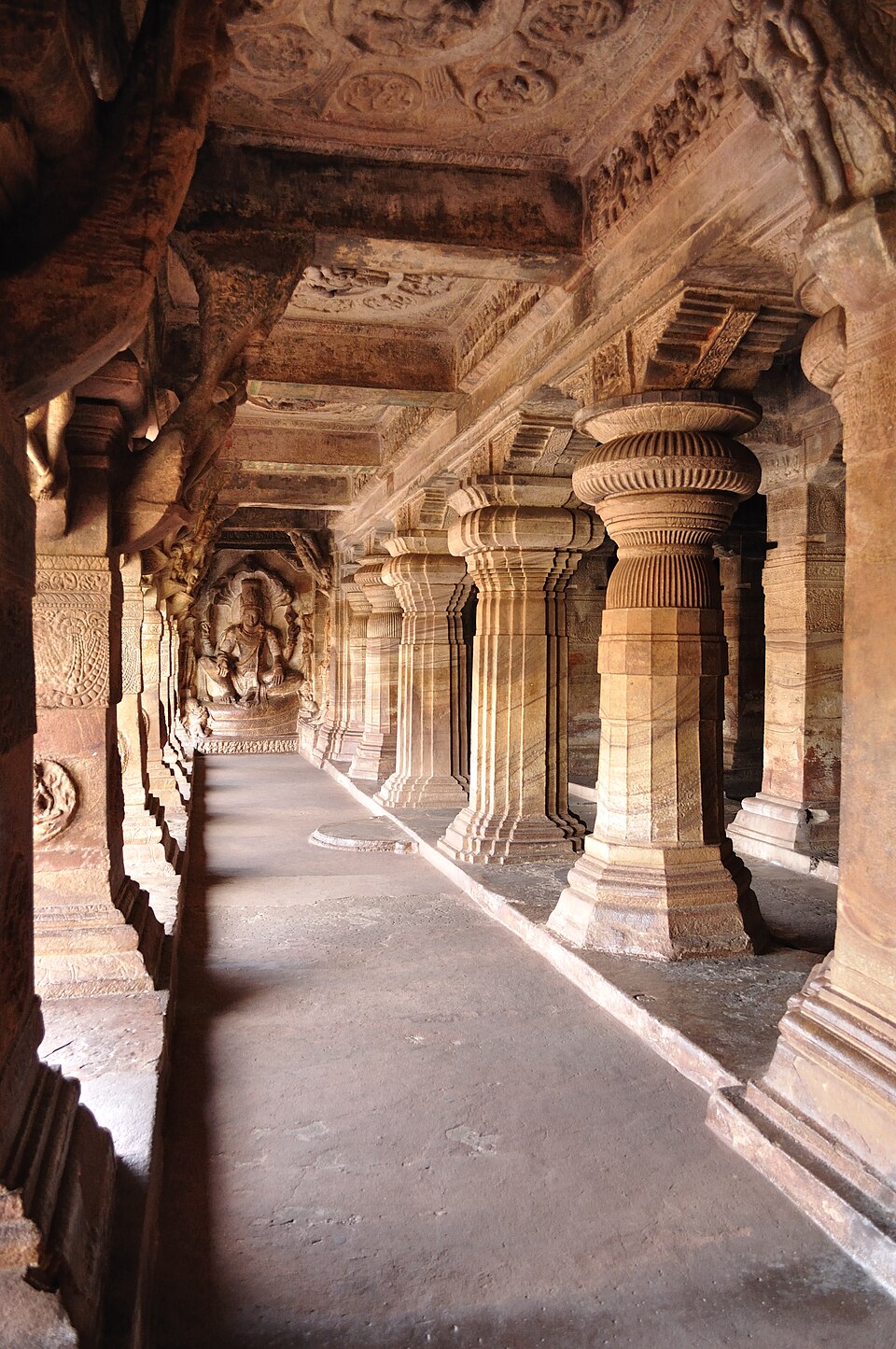
The Pallavas of Kanchi. Pallava rule was tied to the Kanchi region, or Tondaimandalam. Simhavishnu ended the Kalabhra interregnum there in the mid-sixth century and pushed south to the Kaveri delta, and Mahendravarman I extended the kingdom north to the Krishna. By the mid-seventh century the Pallavas had a powerful regional kingdom.
The Pandyas. The Pandyas reappeared with Kadungon, who suppressed the Kalabhras at the end of the sixth century. Their heartland was the Vaigai basin around Madurai. They kept trying to push north into the Kaveri delta and west into Kerala.
A century of wars: Chalukyas, Pallavas and Pandyas
The first blows. Hostilities began when Pulakesin II defeated Mahendravarman I and occupied the northern part of the Pallava kingdom. In another campaign he beat the Banas, allies of the Pallavas, and threatened Kanchi again. But Narasimhavarman I defeated him in several battles.
Badami captured. Narasimhavarman I then invaded the Chalukya kingdom, captured Badami and probably killed Pulakesin II; an inscription of his victory was carved on a rock at Badami. Pulakesin's son Vikramaditya I restored Chalukya power, drove out the Pallavas, allied with the Pandyas and raided Pallava land again and again. His successor Vikramaditya II is said to have overrun Kanchi three times.
Why always the Pallavas? The Pallavas were nearly always the target of attack. This was partly because they sat between the Chalukyas and the Pandyas, but mainly because they were the most prosperous. The Pallavas mostly fought to drive invaders out; Narasimhavarman's raid on Badami was a one-time act of retaliation.
The Pandya motive. The Pandyas' own Vaigai valley was relatively poor for farming. To become rich and strong they needed the fertile Kaveri delta, so they fought the Pallavas repeatedly for it. By the early ninth century they controlled it.
Small kings, big role. Lesser kings and chiefs joined these wars as subordinate allies of one side or the other. They shared in the plunder and sometimes gained new land, so together they were a real force. The unit prefers the neutral term 'subordinate ally' to 'feudatory', since we cannot be sure the European feudal relationship existed here.
Side effects. The wars created new kingdoms. Vikramaditya I rewarded his brother Jayasimhavarman with south Gujarat, starting the Chalukyas of Lata. Narasimhavarman I sheltered a Lankan prince, Maravarma, and sent two naval expeditions to put him on the throne at Anuradhapura, showing a growing southern interest in Sri Lanka.
Endings. Around AD 750 the Rashtrakuta feudatory Dantidurga defeated Kirtivarman II and ended Chalukya rule at Badami. The Pallavas weakened from the mid-eighth century, and their rule ended in the early tenth century when Aditya Chola I defeated Aparajita. The stage was set for the Rashtrakutas and the Cholas.
How the south was governed, and what it built
Kings and sacrifices. In theory the king was the source of all authority, with titles such as maharaja, bhattaraka and dharmamaharajadhiraja. Early kings performed Vedic sacrifices such as the horse sacrifice, vajapeya and rajasuya. These no longer had their old social meaning, but they declared a king's independence and right to rule, which is why Pulakesin I performed one to launch his dynasty.
Officials and taxes. The king was helped by ministers, the crown prince (yuvaraja) and officials of many ranks. The main tax was on land, one-sixth or more of the produce, plus smaller taxes on weavers, draught cattle and even marriage parties. Officials also kept order and judged civil and criminal cases.
Units of government. In the Deccan, kingdoms were divided into vishaya, ahara and rashtra, and from the eighth century into groups of villages in multiples of ten. In the Pallava kingdom the nadu became the lasting basic unit. The word nadu also meant arable land, in contrast to kadu, waste land, which shows how central farming was.
Growing farms. Kings worked to extend agriculture, the basis of their revenue. The Kadamba Mayurasarman is said to have brought new land under the plough by inviting brahmanas from afar, and a Pallava king gave away a thousand ploughs. Since southern farming depended on irrigation, the Pallavas built and maintained canals, tanks, lakes and large wells.
Local assemblies. A striking feature of Pallava government was the role of local bodies. There were associations of weavers, oil pressers, merchants (such as the Manigramam and the Five Hundred of Ayyavole), students, ascetics and temple priests. There were also three key territorial assemblies: the ur (village assembly of non-brahmanas), the sabha (assembly of a brahmana village) and the nagaram (where merchant interests dominated).
Why kings left them alone. Each assembly ran itself by custom, meeting yearly with a smaller executive body for daily work. This lightened the burden on government and made people responsible for solving local problems, which reduced opposition to the state. So the Pallava kings did not interfere with these bodies.
Brahmana settlements and committees. Kings strengthened their base by creating brahmadeya (grants to brahmanas) and devadana (grants to temples) settlements in the prosperous core of rice-growing land. In the late Pallava period the sabha began to work through committees, the variyam system, managing tanks, roads, charities, temples and irrigation rights. In the Chalukya Deccan, by contrast, local notables called mahajanas under a headman (gavunda) were closely supervised by officials.
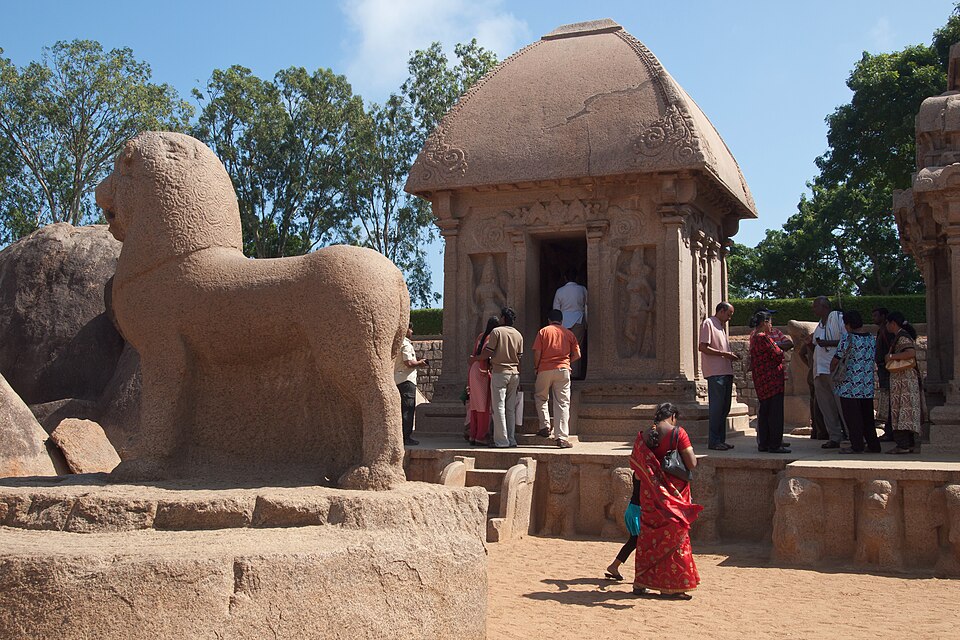
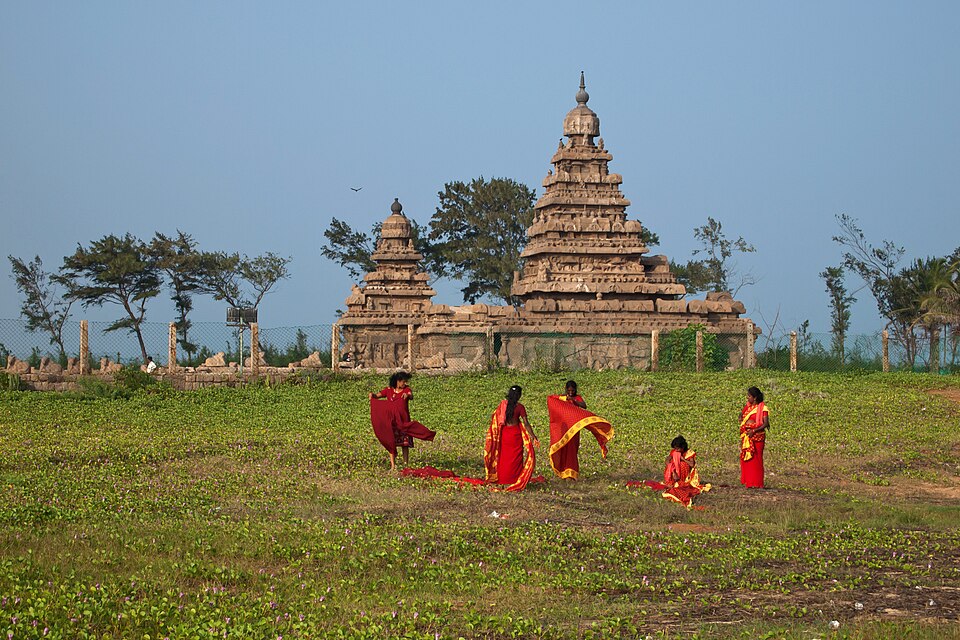
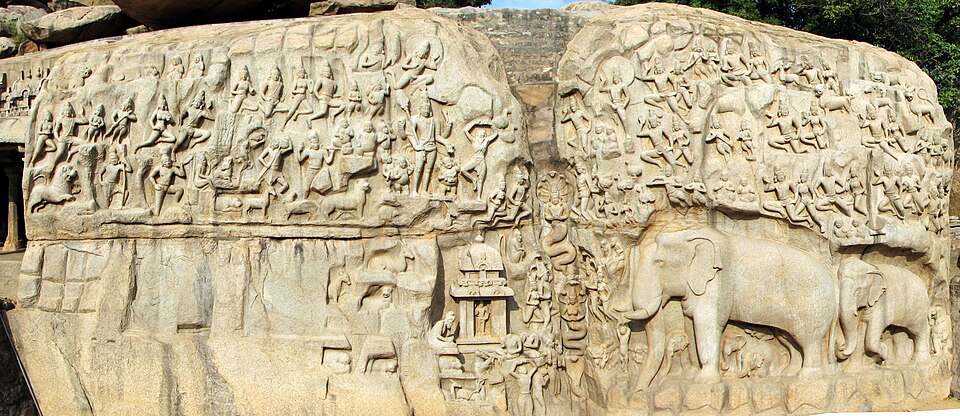
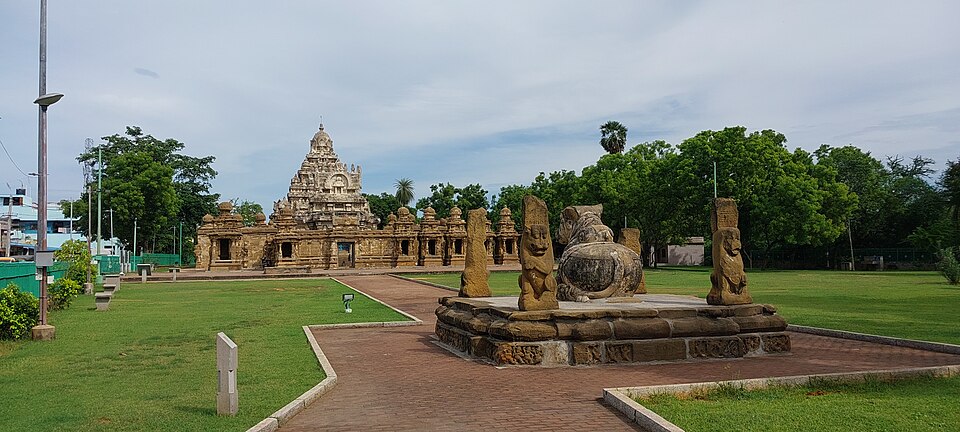
From caves to temples. The Pallavas are credited with starting the Dravidian style of temple architecture. It grew in stages named after rulers: the Mahendra style of plain rock-cut cave temples with heavy pillars under Mahendravarman I; the Mamalla style of Narasimhavarman I, with the monolithic rathas at Mamallapuram, of which the five Pancha Pandava rathas are best known; and later structural temples such as the Shore temple at Mamallapuram and the Kailasanatha temple at Kanchi. Great carved panels such as 'Arjuna's Penance' (the descent of the Ganga) at Mamallapuram also belong to this period; the Art and Culture course covers these in detail.
Quick revision
- Post-Gupta powers: Maukharis (Kanyakubja), later Guptas, Gaudas, Maitrakas (Valabhi), Pushyabhutis (Thaneswar); jayaskandhavaras = camps of victory.
- Kanauj rose: fortified high ground, agrarian hinterland, routes; Sharma's feudal decline view vs critics (trade in SE Bengal, western India).
- Pushyabhutis: Prabhakaravardhana (first Maharajadhiraja); Rajyasri married Maukhari Grahavarman; killed by Devagupta and Sasanka; Harsha from 606, capital Kanyakubja.
- Sources: Harshacharita (Bana, first charita kavya); Xuan Zang (629-645); Banskhera and Madhuban plates.
- Wars: east only after Sasanka's death (c. 637), Odra and Kongada by 643; Maitraka Dhruvasena II his son-in-law; stopped on Narmada by Pulakesin II (Aihole inscription, Ravikirti); sakalottarapathesvara.
- Religion: Mahayana in Xuan Zang; Shiva devotee in inscriptions; Prayaga gifts to all; plays Priyadarshika, Ratnavali, Nagananda; Harsha era 606; died 647.
- Deccan: Abhiras (era 248-49 = Kalachuri-Chedi), Vakatakas (Pravarasena I, Samrat), Kadambas (Mayurasarman to Mayuravarman), Ikshvakus, Vishnukundins, Western Gangas (Gangavadi); Kalabhra interregnum in Tamil country.
- Chalukyas: Pulakesin I fortified Badami 543-44; Pulakesin II; Vengi branch by Vishnuvardhana (631); Vikramaditya I, II (Kanchi thrice); Dantidurga ended them c. 750.
- Pallavas: Simhavishnu, Mahendravarman I, Narasimhavarman I (took Badami); ended by Aditya Chola I (Aparajita); Pandyas: Kadungon, Vaigai, fought for Kaveri delta.
- Polity: one-sixth+ land tax; nadu vs kadu; ur, sabha, nagaram; variyam committees; brahmadeya, devadana; Deccan mahajanas and gavunda. Art: Mahendra caves, Mamalla rathas, Shore temple, Kailasanatha.