

HPSC ADA & legal · Module 5 · standard depth · 19 min
The Vijayanagara and Bahmani kingdoms
What HPSC ADA & legal asks from this chapter
Syllabus lines this chapter covers:
- Screening test (general) · General studies (as for HPSC screening tests)
HPSC ADA & legal questions from this module are being sorted into our bank.
Cut to standard depth for HPSC ADA & legal. 9 deeper paragraphs are in the full chapter.
Start from zero: two powers of the Deccan
In the Tughlaq chapter we saw Muhammad Tughluq try to rule the Deccan directly, and the Bahmani kingdom break away in 1347. At about the same time, south of the Tungabhadra river, a new Hindu kingdom called Vijayanagara rose in 1336.
For the next two centuries these two powers fought again and again, over fertile river lands and over the ports that brought war-horses from Arabia. Neither could destroy the other for long. In the end the Bahmani kingdom broke into five Sultanates, and four of them joined to crush Vijayanagara at Talikota in 1565.
These kingdoms were not just armies. The Bahmanis built a cosmopolitan Deccani culture, and Vijayanagara created the nayaka and ayagar systems, great temple economies and one of the richest cities of its time.
Why study this? Exams ask about the founding, Mahmud Gawan, the Afaqi-Dakhni conflict, Krishnadeva Raya, Talikota, the nayankara and ayagar systems, and foreign travellers. Mains asks about the nature of the Vijayanagara state and why the Bahmani kingdom fell apart.
The two kingdoms at a glance
| Point | Bahmani | Vijayanagara |
|---|---|---|
| Founded | 1347, Hasan Gangu (Alauddin Hasan Bahman Shah) | 1336, Harihara and Bukka |
| Capitals | Gulbarga, then Bidar (1422) | Vijayanagara (Hampi) on the Tungabhadra |
| Greatest figure | Mahmud Gawan (minister) | Krishnadeva Raya (1509-29) |
| Key system | Atraf under tarafdars; land measurement | Nayankara and ayagar |
| Main weakness | Afaqi-Dakhni conflict | Powerful nayakas; dependence on imported horses |
| End | Split into five states by 1538 | Defeated at Talikota, 1565 |
The key idea. Both kingdoms grew out of the collapse of Delhi's rule in the south. Both were shaped by powerful nobles or chiefs, and both depended on horses brought by sea.
The Bahmani kingdom: rise, wars and factions
Delhi's Deccan. After conquering the Deccan, Muhammad Tughluq divided it into 23 provinces (iqlims), such as Marhat (Maharashtra), Telingana, Bidar, Kampili and Dwarasamudra, under a powerful viceroy. Each province was split into shiqs, and further into units of a thousand and a hundred villages. The amiran-i sadah, 'commanders of a hundred', acted as both military officers and revenue collectors and had direct links with local people.
Why control slipped. Delhi was far away, the terrain was difficult, and the viceroy and officers had wide powers. A rising at Gulbarga in 1327 was crushed, but Ma'bar and later Bidar also rebelled. By about 1344 the Deccan revenue had fallen sharply, and the Sultan put new 'upstart' officers over the region, which the amiran-i sadah resented.
The break in 1347. After the nobles of Gujarat rebelled in 1345, Muhammad Tughluq suspected the Deccan amirs too and ordered them to come to Broach. Fearing punishment, the amiran-i sadah declared themselves independent at Daulatabad and elected Ismail Shah as Sultan. Ismail soon stepped aside for Hasan Gangu, who took the title Alauddin Hasan Bahman Shah, and the Bahmani kingdom was founded in 1347.
First phase: Gulbarga (1347-1422). With its capital at Gulbarga, the kingdom expanded from Mandu in the north to Raichur in the south, and from Bhongir in the east to Dabhol and Goa in the west. Its main rivals were the rulers of Telingana and Vijayanagara. The war with Vijayanagara was not decisive, and the Tungabhadra doab stayed shared; Goa was lost to Vijayanagara in the late fourteenth century.
Second phase: Bidar (1422-1538). The capital moved to Bidar, a central and fertile site where the Marathi, Kannada and Telugu areas met. Warangal was annexed. The Bahmanis also fought Malwa and Gujarat, and allied with Khandesh against Gujarat.
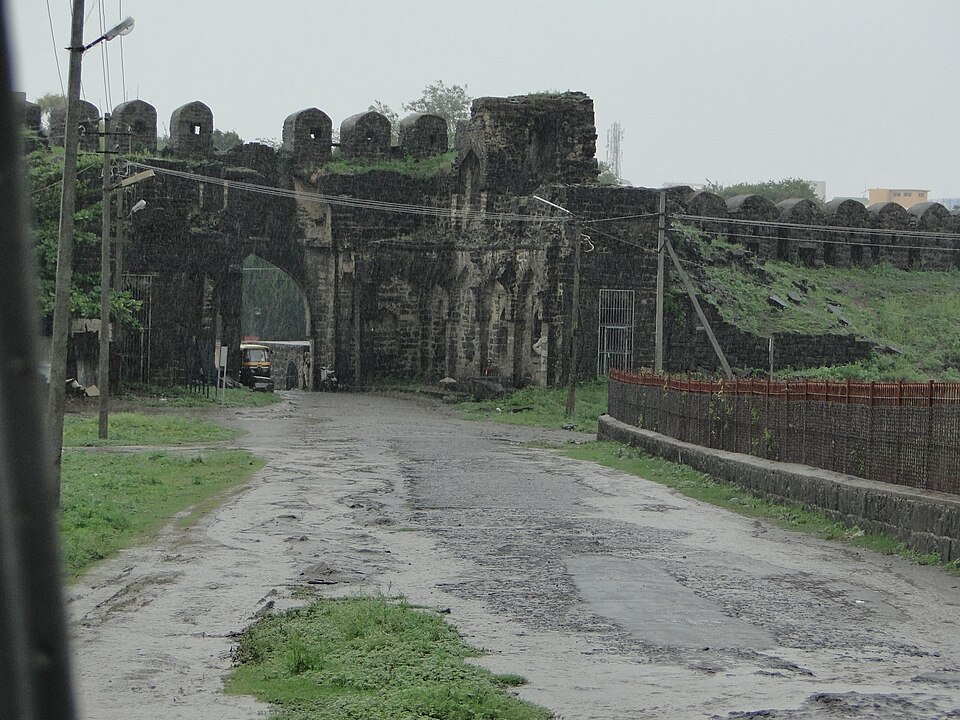
Old nobles and newcomers. From the late fourteenth century a new group entered the nobility: the Afaqis, meaning 'universal' people, also called gharibud diyar, 'strangers'. They came from Iran, Iraq and Transoxiana. The old Deccani nobles, the Dakhnis, resented them, and the Afaqis' rise to high posts set off a long struggle.
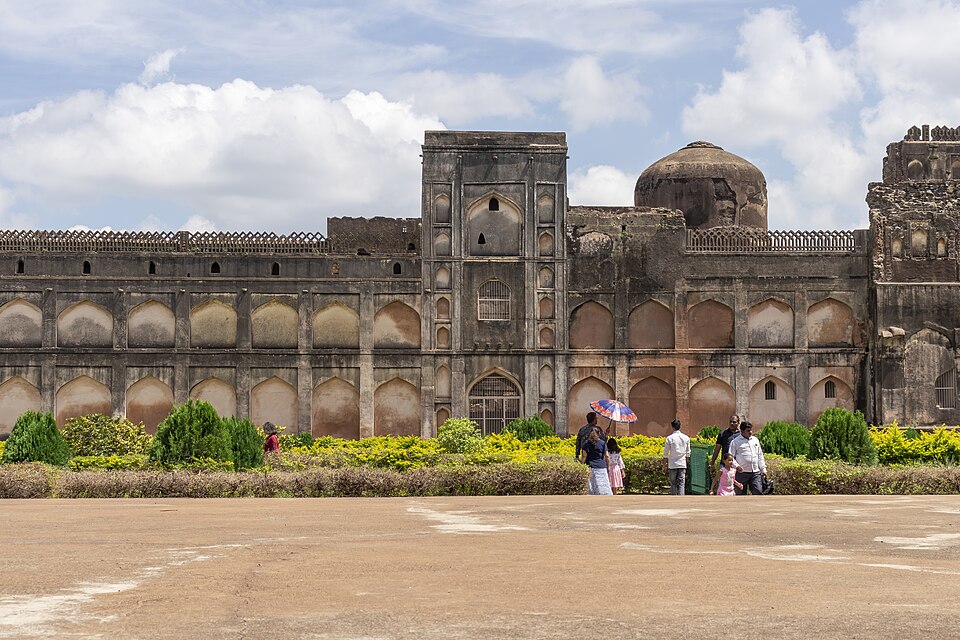
Kings take sides. Ahmad I (1422-36) gave the Afaqi Khalaf Hasan Basri the highest office, wakil-i sultanat, and the title malik-ut tujjar ('prince of merchants'), and raised a special force of Afaqi archers. In campaigns against Gujarat and Khandesh, the non-cooperation of one faction led to defeats. Each defeat deepened the quarrel.
Mahmud Gawan. The most famous Bahmani minister was Mahmud Gawan, an Afaqi who served as chief minister under Muhammad III (1463-82). He tried to balance the two factions, repulsed attacks from Orissa and Malwa, and extended Bahmani power from Orissa to Goa, conquering Hubli, Belgaum and Bagalkot. But a Dakhni conspiracy led to his murder.
Break-up. After Gawan's death, weak kings became puppets of one faction or another, and powerful nobles ran their provinces freely. In 1487 a plot against the king led to a three-day massacre of the Dakhnis. Ibrahim Adil Shah of Bijapur was the first to claim independence in 1537, and by 1538 the kingdom had split into Bijapur, Ahmadnagar, Golconda, Bidar and Berar.
Bahmani government, economy and culture
A Delhi-style state. The Bahmanis copied the Delhi Sultanate's administrative structure. The king was followed by the wakil, wazir, bakhshi and qazi, with a dabir (secretary), mufti, kotwal and muhtasib. Spies (munihians) were posted across the kingdom and, under Muhammad I, even at Delhi.
Provinces. Muhammad I divided the kingdom into four provinces (atraf), Daulatabad, Berar, Bidar and Gulbarga, each under a tarafdar. Gulbarga, the most important, was held by a trusted viceroy (mir naib). Some areas were kept under the Sultan's direct control (khassa-i Sultani).
The army. The amir-ul umara commanded the army of soldiers, cavalry and elephants, and the ruler kept bodyguards called khassakhel; Muhammad I had 4,000 of them. The Bahmani army used gunpowder, which gave it an advantage. The Italian Niccolo Conti mentions siege machines and bombarding engines.
Gawan's reforms. Earlier, tarafdars appointed all fort commanders in their province. Mahmud Gawan raised the provinces to eight and left only one fort under each tarafdar, placing the rest under central command. To check corruption, he paid officers at a fixed rate for every 500 troopers, and an officer who kept fewer men had to refund the difference.
Measuring land. Gawan also ordered systematic measurement of land and fixed the boundaries of villages and towns. This made the state's income known in advance and curbed corruption by nobles. In this, he was a forerunner of Todar Mal.
Trade. The Russian traveller Nikitin (in the Deccan 1469-74) describes the busy trade of Bidar in horses, cloth, silk and pepper, and the port of Dabul (Dabhol), linked to Indian and African ports. Horses came from Arabia, Khurasan and Turkestan, musk and fur from China. Trade was mostly in the hands of Hindu merchants.
A cosmopolitan society. The kingdom had Muslims and Hindus, Iranians, Transoxanians, Iraqis and Abyssinians (Habshis). People spoke Persian, Marathi, Dakhni (an early form of Urdu), Kannada and Telugu. Nikitin says nobles were 'extremely opulent', carried on silver beds with hundreds of attendants, while the common people were poor.
Sufis and syncretism. Bahmani rulers honoured Sufis of the Chishti, Qadiri and Shattari orders, and Bidar became a major Qadiri centre. The Chishti saint Gesu Daraz moved from Delhi to Gulbarga in 1402-3, though he later fell out with Sultan Feroz over the succession. Sultan Feroz (1397-1422) married a Vijayanagara princess, and at the urs at Gulbarga the head of the Lingayats performed rites in a Hindu manner.
Vijayanagara: rise, Krishnadeva Raya and Talikota
The founders. Harihara and Bukka had served the Kakatiyas of Warangal and, after Warangal fell to Delhi, the chief of Kampili. When Kampili too was conquered, they were taken to Delhi. Later the Sultan sent them back to govern the Kampili region.
Independence in 1336. In the south they came under the influence of the sage Vidyaranya. With his support they declared their independence and founded Vijayanagara, with Harihara as king, in 1336. Vidyaranya and his kinsmen served as their ministers.
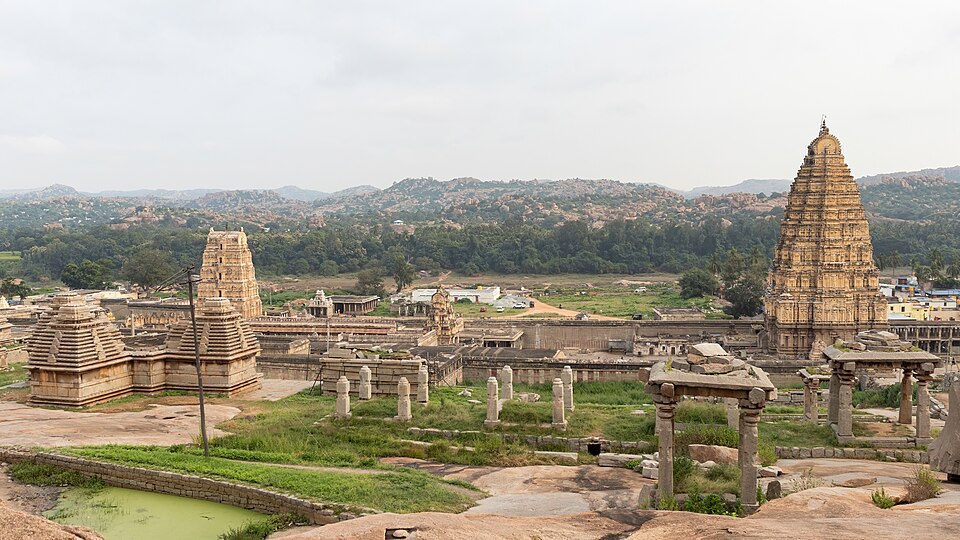
Four dynasties. Vijayanagara was ruled in turn by the Sangama, Saluva, Tuluva and Aravidu dynasties. The early Sangamas were Shaivas who added to the Virupaksha temple, the Saluvas were Vaishnavas, and the Tuluva king Krishnadeva Raya built a Krishna temple while giving grants to Shiva temples too.
The cockpit. The struggle was over the Krishna-Godavari delta, the Tungabhadra or Raichur doab and the Konkan, which was fertile and had access to the sea. The Bahmanis' alliance with the Velamas of Rajakonda kept Vijayanagara from pushing north, so it expanded east, west and south into the Tamil country. Other players were the Reddis of Kondavidu and the Gajapatis of Orissa.
Learning from defeat. In 1422-46, Vijayanagara lost the fight for the Raichur doab, which exposed its military weakness. Its rulers, notably Deva Raya II, reorganised the army by enlisting Muslim archers, given revenue assignments, and buying better horses. Later, Rama Raya also admitted Muslims to the army and gave them high offices.
The horse problem. Good war-horses were not bred in India, and conflict with the Deccan Sultanates cut Vijayanagara off from horses from Central Asia. It depended on Arab horses landed at west-coast ports. When it lost Goa, Chaul and Dabhol to the Bahmanis, the horse trade was dislocated; occupying Honavar, Bhatkal and Mangalore later restored supply.
Krishnadeva Raya (1509-29). The greatest ruler gained from the break-up of the Bahmanis. He took Raichur and other places from Bijapur, and recovered Udayagiri, Kondavidu, Telingana and Warangal from the Gajapatis. By 1512 almost the whole southern peninsula, including the Zamorin of Calicut, accepted Vijayanagara's overlordship.
The Portuguese. The Portuguese took Goa in 1510 and with it a near monopoly of the horse trade. Krishnadeva Raya kept friendly relations with them, allowed Albuquerque to build a fort at Bhatkal, and Portuguese soldiers helped him against Bijapur. Later Rama Raya secured a monopoly of the horse trade by a treaty in 1547.
Rama Raya's balancing game. After Krishnadeva Raya, succession disputes followed. Sadasiva became king in 1542, but real power lay with Rama Raya, Krishnadeva Raya's son-in-law. He played the Deccan Sultanates against each other to keep the balance in Vijayanagara's favour, even breaking a collective security pact.
Talikota, 1565. At last Bijapur, Ahmadnagar, Golconda and Bidar united against Vijayanagara. In the battle of Talikota near the Krishna in 1565, Vijayanagara was utterly defeated, Rama Raya was killed and the capital was sacked. The kingdom lived on for about a hundred more years, but it never again mattered in South Indian politics.
How Vijayanagara worked: nayakas, villages, temples and trade
Direct and ritual rule. The kings ruled the Tungabhadra region directly. Elsewhere they exercised a looser, ritual overlordship through Telugu warriors (nayakas), local chiefs and religious sects. Telugu soldiers who settled in the Tamil country helped spread the nayaka system there.
The nayankara system. Military chiefs called nayakas or amaranayakas commanded a fixed number of troops. In return they held revenue rights over land called amaram, and had to give gifts to temples, repair and build tanks and reclaim waste land. The Portuguese visitors Domingo Paes and Fernao Nuniz saw them as agents of the king.
Was it feudal? Historians disagree. Some call it feudal; others point out that fealty, homage and sub-infeudation of the European kind were absent. D.C. Sircar and T.V. Mahalingam see the nayaka as a warrior holding an office (kara) granted by the centre on condition of military service, and Burton Stein calls Vijayanagara a segmentary state.
Three kinds of villages. The amara villages, about three-quarters of all, went to the amaranayakas, who had no ownership of the land, only a share of its income. Bhandaravada were crown villages, part of whose income maintained the forts. Manya villages were tax-free, supporting Brahmans, temples and mathas, and temple grants (devadana) grew greatly.
The ayagar system. In each village a group of hereditary servants, the ayagars, served the community. They included the headman (reddi or gauda), the accountant (karnam or senabhova) and the watchman (talaiyari), plus washermen, potters, blacksmiths and carpenters. They were paid with tax-free plots or shares of produce, and for the first time particular offices carried specific allocations.
Revenue. Rice was the staple crop, with pepper, coconut and betel nut. Land revenue was generally one-sixth of the produce, sometimes up to a quarter, but much lower on Brahman and temple land. There were also taxes on professions, property, grazing and houses, and transit dues.
Investing in water. Anyone who built a tank or channel earned a transferable share of the extra produce, called dasavanda in the Tamil country and kattu-kodage in Andhra and Karnataka. Part of the gain also went to the village cultivators. This encouraged irrigation in semi-dry areas.
Brahmans in power. Brahmans played a secular role. Most commanders of forts (durga dannaiks) were Brahmans, and the imperial secretariat was manned by Brahmans, largely of the Telugu niyogi sub-caste. Forts were maintained from the income of crown villages.
Temples as economic centres. Temples received hundreds of villages as devadana. They employed many people, bought local goods, lent money to individuals and villages, and financed irrigation: cash given to Tirupati was ploughed back into irrigation, and Srirangam lent money to firms in Tiruchirappalli. The king settled disputes about temples, but routine management lay with local sectarian groups.
Ritual kingship. The nine-day mahanavami festival, ending in dusserah, was the great royal ceremony. Commanders and chiefs from distant parts attended, renewing their recognition of the king. The king himself performed most of the rites.
Trade. Overseas trade was mostly in the hands of Muslim merchants, and later the Portuguese; Indian merchants' role was minimal. Horses came from Arabia, Syria and Turkey; pearls from the Persian Gulf and Ceylon; silks from China. Vijayanagara exported rice, sugar, iron and diamonds, and Nuniz called its diamond mines near the Krishna, Kurnool and Anantapur the richest in the world.
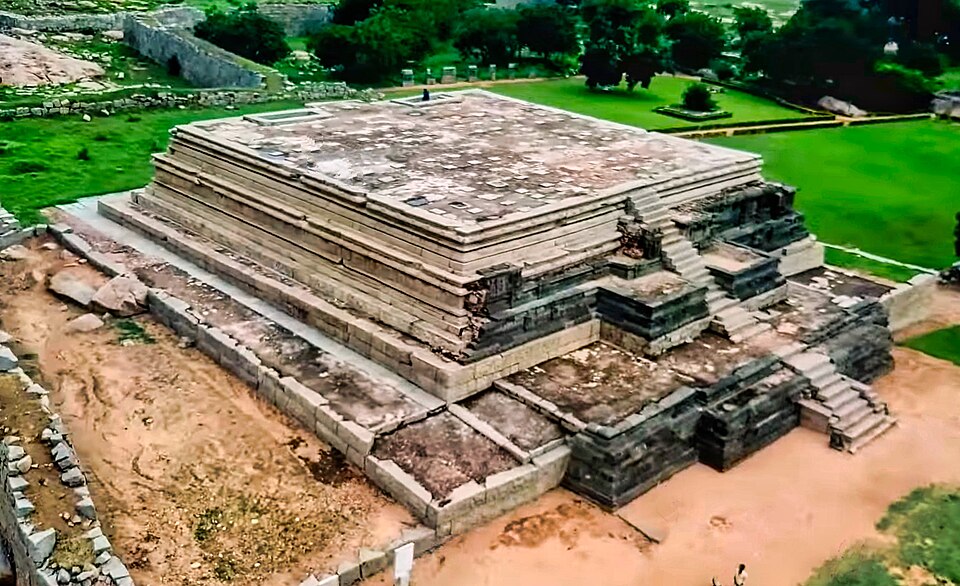
Towns and society. About eighty trade centres are known, and temple fairs under trade associations boosted commerce. Lower castes were divided into right-hand groups, mainly in farming and local trade, and left-hand groups, mainly mobile artisans and traders in non-farm goods. The capital itself combined markets, palaces, temples and mosques until it was destroyed in 1565.
Quick revision
- Deccan under Muhammad Tughluq: 23 iqlims; amiran-i sadah (military + revenue); Gulbarga rising 1327; Gujarat revolt 1345; summons to Broach.
- Bahmani 1347: Ismail Shah, then Hasan Gangu (Alauddin Hasan Bahman Shah); Gulbarga (1347-1422), Bidar (1422-1538).
- Afaqis (gharibud diyar: Iran, Iraq, Transoxiana) vs Dakhnis; Ahmad I: Khalaf Hasan Basri, malik-ut tujjar; Mahmud Gawan (Muhammad III), murdered by Dakhni plot.
- Gawan: 8 provinces, forts central, pay per 500 troopers, land measurement (forerunner of Todar Mal); Bahmani gunpowder.
- Successors by 1538: Bijapur, Ahmadnagar, Golconda, Bidar, Berar; Bijapur first (1537).
- Nikitin (1469-74): Bidar, Dabul; Sufis: Chishti, Qadiri, Shattari; Gesu Daraz at Gulbarga 1402-3; Feroz married a Vijayanagara princess.
- Vijayanagara 1336: Harihara and Bukka, Vidyaranya; dynasties Sangama, Saluva, Tuluva, Aravidu.
- Cockpit: Raichur/Tungabhadra doab, Krishna-Godavari delta, Konkan; Muslim archers (Deva Raya II); horses via west-coast ports.
- Krishnadeva Raya (1509-29): Raichur, Gajapati lands; friendly with Portuguese, fort at Bhatkal; Rama Raya under Sadasiva; Talikota 1565.
- Nayankara: amaranayakas, amaram; villages: amara (~3/4), bhandaravada (crown), manya (tax-free); ayagars: reddi/gauda, karnam, talaiyari.
- Revenue ~1/6; dasavanda / kattu-kodage; Brahman durga dannaiks, Telugu niyogis; temples: devadana, loans, irrigation; mahanavami.
- Trade: Muslim then Portuguese control; horses in; rice, sugar, iron, diamonds out; ~80 trade centres; right-hand and left-hand castes.